ECU BUICK REGAL 1996 Owner's Manual
[x] Cancel search | Manufacturer: BUICK, Model Year: 1996, Model line: REGAL, Model: BUICK REGAL 1996Pages: 356, PDF Size: 17.97 MB
Page 180 of 356
Do not load your vehicle any heavier than the
GVWR, or either the maximum front or rear
GAWR. If you do, parts on your vehicle can
break, or it can change the way your vehicle
handles. These could cause you to lose control.
Also, overloading can shorten the life of
your vehicle.
NOTICE:
Your warranty does not cover parts or
components that fail because of overloading.
If you put things inside your vehicle -- like suitcases,
tools, packages
or anything else -- they will go as fast as
the vehicle goes.
If you have to stop or turn quickly, or
if there is a crash, they’ll keep going.
Things you put inside your vehicle can strike
and injure people in
a sudden stop or turn, or
in
a crash.
Put things in the trunk of your vehicle. In a
trunk, put them as far forward as you can.
Try to spread the weight evenly.
0 Never stack heavier things, like suitcases,
inside the vehicle
so that some of them are
above the
tops of the seats.
Don’t leave an unsecured child restraint in
your vehicle.
When you carry something inside the
vehicle, secure it whenever you can.
4-28
ProCarManuals.com
Page 185 of 356
Driving with a Trailer Following Distance
Towing a trailer requires a certain amount of experience. Stay at least twice as far behind the vehicle ahead as you
Before setting out for the open road, you’ll want to get would when driving your vehicle without a trailer. This
to know your rig. Acquaint yourself with the feel
of can help you avoid situations that require heavy braking
handling and braking with the added weight of the and sudden turns.
trailer. And always keep
in mind that the vehicle you are
driving is now a good deal longer and not nearly as
Passing -
responsive as your vehicle is by itself.
You’ll need more passing distance up ahead when
Before you start, check the trailer hitch and platform you’re towing a trailer. And, because you’re a good deal
(and attachments), safety chains, electrical connector, longer, you’ll need to go much farther beyond the
lamps, tires and mirror adjustment. If the trailer has passed vehicle before you can return to your lane.
electric brakes, start your vehicle and trailer moving and
then apply the trailer brake controller by hand to be sure
Backing Up
the brakes are working. This lets you check your
electrical connection at the same time.
During your trip, check occasionally to be sure that the
load
is secure, and that the lamps and any trailer brakes
are still working. Hold the bottom
of the steering wheel with one hand.
Then, to move the trailer to the left, just move that hand
to the
left. To move the trailer to the right, move your
hand to the right. Always back up slowly and, if
possible, have someone guide you.
4-33
ProCarManuals.com
Page 195 of 356
Tawing Your Vehicle
Try to have a GM dealer or a professional towing
service tow your vehicle.
If your vehicle has been changed or modified since it
was factory-new by adding aftermarket items like fog
lamps, aero skirting, or special tires and wheels, these
instructions and illustrations may not be correct.
Before you do anything, turn on the hazard
warning flashers.
When you call, tell the towing service:
That your vehicle cannot be towed from the front or
rear with sling-type equipment.
That your vehicle has front-wheel drive.
0 The make, model and year of your vehicle.
Whether you can still move the shift lever.
0 If there was an accident, what was damaged. When
the towing service arrives, let the tow operator
know that this manual contains detailed towing
instructions and illustrations. The operator may want
to see
them.
To help avoid injury to you or others:
0 Never let passengers ride in a vehicle that is
Never tow faster than safe or posted speeds.
0 Never tow with damaged parts not fully
secured.
* Never get under your vehicle after it has
been lifted
by the tow truck.
Always secure the vehicle on each side with
separate safety chains when towing it.
Never use J-hooks. Use T-hooks instead.
being
towed.
ProCarManuals.com
Page 196 of 356
A V
A vehicle can fall from a car carrier if it isn’t
adequately secured. This can cause a collision,
serious personal injury and vehicle damage. The
vehicle should be tightly secured with chains or
steel cables before it is transported.
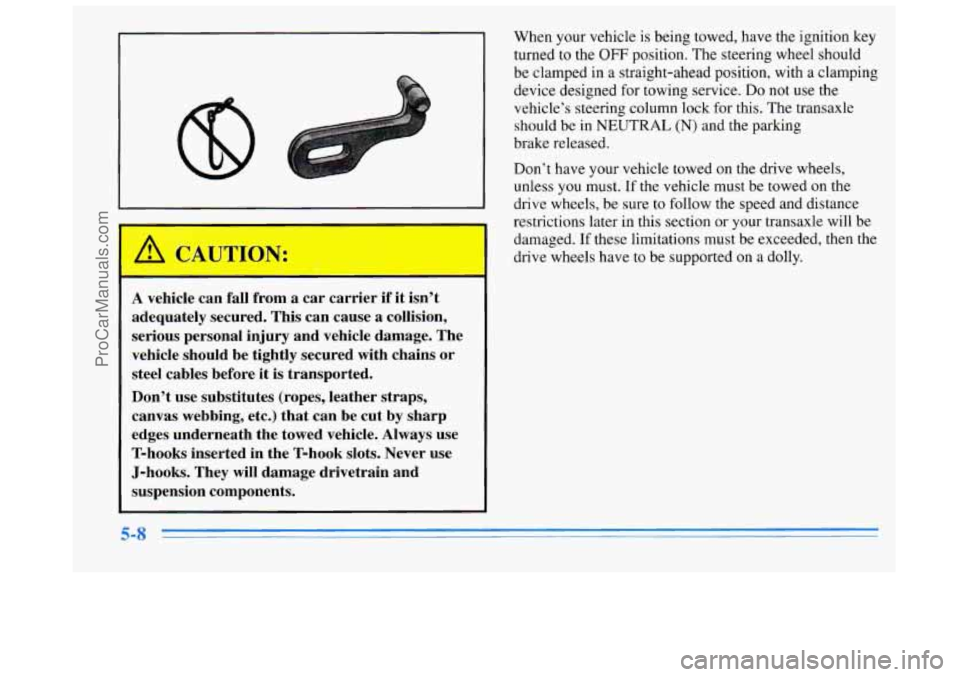
Don’t use substitutes (ropes, leather straps,
canvas webbing, etc.) that can be cut by sharp
edges underneath the towed vehicle. Always use
T-hooks inserted in the T-hook slots. Never use
J-hooks. They will damage drivetrain and
suspension components.
When your vehicle is being towed, have the ignition key
turned to the
OFF position. The steering wheel should
be clamped in a straight-ahead position, with a clamping
device designed for towing service.
Do not use the
vehicle’s steering column lock for this. The transaxle
should be in
NEUTRAL (N) and the parking
brake released.
Don’t have your vehicle towed on the drive wheels,
unless you must.
If the vehicle must be towed on the
drive wheels, be sure to follow the speed and distance
restrictions later in this section or your transaxle will be
damaged.
If these limitations must be exceeded, then the
drive wheels have
to be supported on a dolly.
3
ProCarManuals.com
Page 198 of 356
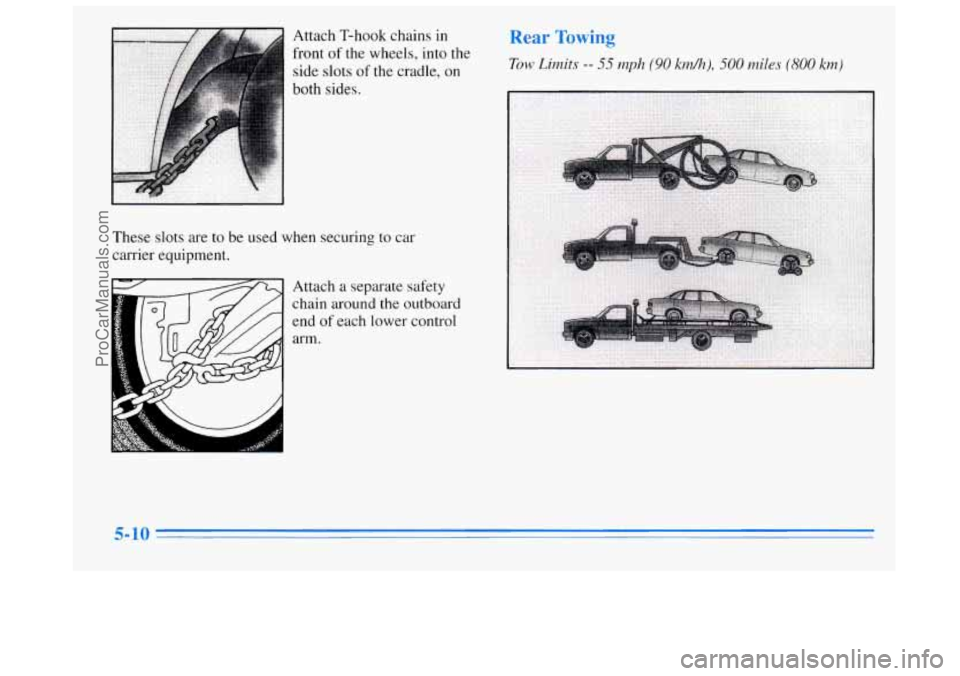
Attach T-hook chains in
front
of the wheels, into the
side slots
of the cradle, on
both sides.
These slots are to be used when securing to car
carrier equipment.
Attach
a separate safety
chain around the outboard
end
of each lower control
arm.
Rear rowmg
Tow Limits -- 55 mph (90 kh), 500 miles (800 km)
5-10
ProCarManuals.com
Page 199 of 356
NOTICE:
Do not tow with sling-type equipment or the rear
bumper valance will be damaged. Use wheel-lift
or car carrier equipment. Additional ramping
may be required for car carrier equipment. Use
safety chains and wheel straps.
Towing a vehicle over rough surfaces could
damage a vehicle. Damage can occur from vehicle
to ground
or vehicle to wheel-lift equipment. To
help avoid damage, install a towing dolly and raise
the vehicle until adequate clearance
is obtained
between the ground and/or wheel-lift equipment.
Do not attach winch cables or J-hooks to
suspension components when using car carrier
equipment. Always use T-hooks inserted in
T-hooks slots.
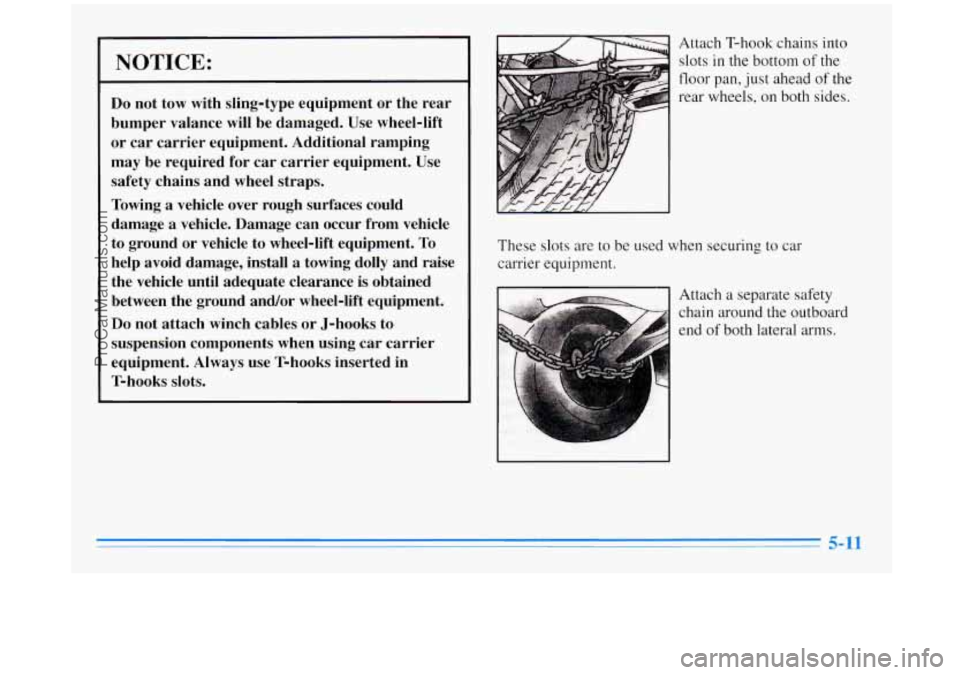
Attach T-hook chains into
slots
in the bottom of the
floor pan, just ahead
of the
rear wheels, on both sides.
These slots are to be used when securing to car
carrier equipment.
Attach
a separate safety
chain around the outboard
end
of both lateral arms.
ProCarManuals.com
Page 218 of 356
Storing the Flat Tire and Tools
~~
F< .&.ye ~ __
Storing a jack, a tire or other equipment in the
passenger compartment
of the vehicle could
cause injury. In a sudden stop or collision, loose
equipment could strike someone. Store all these
in the proper place.
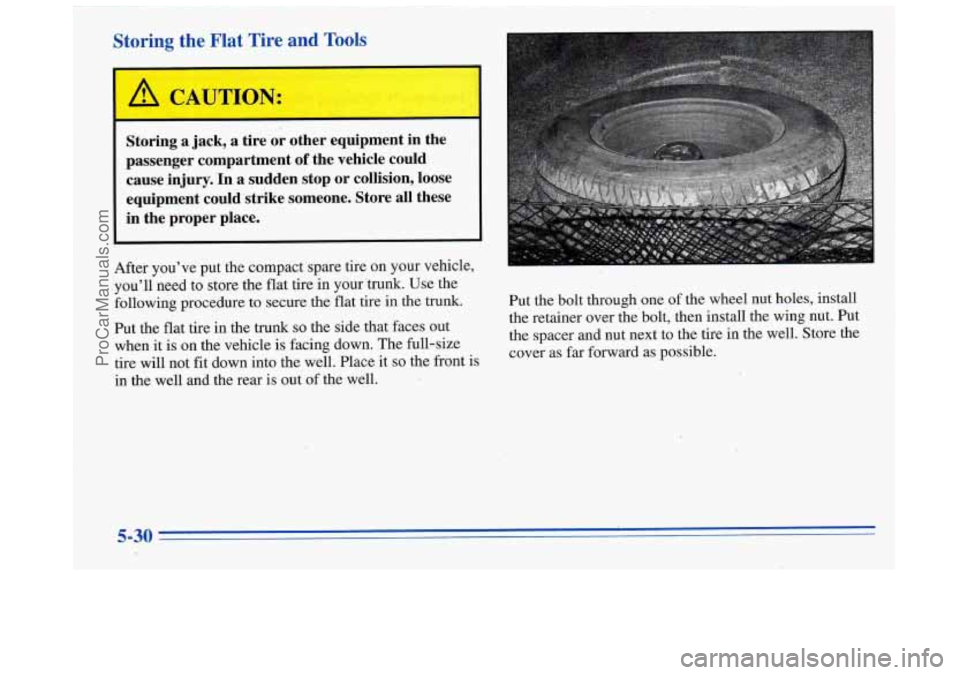
After you’ve put the compact spare tire on your vehicle,
you’ll need to store the flat tire in your trunk. Use the
following procedure
to secure the flat tire in the trunk.
Put the flat tire in the trunk
so the side that faces out
when it is on the vehicle is facing down. The full-size
tire will not fit down into the well. Place it
so the front is
in the well and the rear is out of the well. Put the bolt through
one of the wheel nut holes, install
the retainer over the’bolt, then install the wing nut. Put
the spacer and nut next to the tire in the well. Store the
cover as far forward as possible.
5-30
ProCarManuals.com
Page 256 of 356
Windshield Wiper Blade Replacement
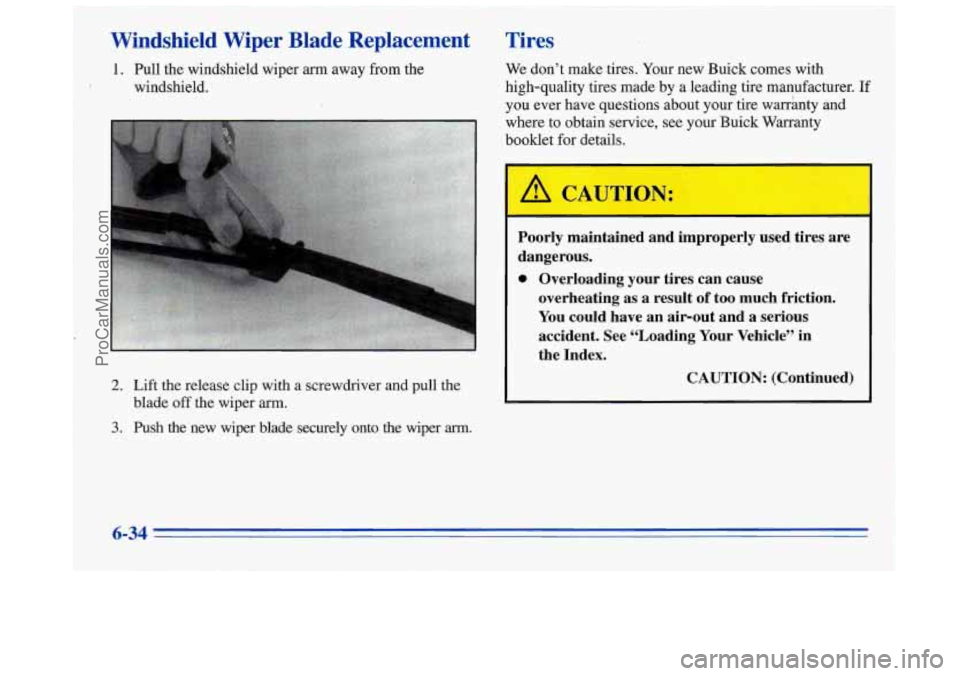
1. Pull the windshield wiper arm away from the
windshield.
Tires
We don’t make tires. Your new Buick comes with
high-quality tires made by a leading tire manufacturer. If
you ever have questions about your tire warranty and
where to obtain service, see your Buick Warranty
booklet
for details.
2. Lift the release clip with a screwdriver and pull the
3. Push the new wiper blade securely onto the wiper arm.
blade off the wiper arm.
Poorly maintained and improperly used tires are
dangerous.
0 Overloading your tires can cause
overheating
as a result of too much friction.
You could have an air-out and a serious
accident. See ‘(Loading Your Vehicle” in
the Index.
CAUTION: (Continued)
6-34
ProCarManuals.com
Page 264 of 356
NOTICE:
If your Buick has P225/60R16 size tires, don’t use
tire chains. They can damage your vehicle.
If you have other tires, use tire chains only where
legal and only when you must. Use only
SAE
Class “S” type chains that are the proper size for
your tires. Install them on the front tires and
tighten them as tightly as possible with the ends
securely fastened. Drive slowly and follow the
chain manufacturer’s instructions.
If you can
hear the chains contacting your vehicle, stop
and retighten them. If the contact continues,
slow down until it stops. Driving too fast or
spinning the wheels with chains on will
damage your vehicle.
11
Remember, cleaning products can be hazardous. Some
are toxic. Others can burst into flame if you strike
a
match or get them on a hot part of the vehicle. Some are
dangerous if you breathe their fumes in a closed space.
When you use anything from
a container to clean your
Buick, be sure to follow the manufacturer’s warnings
and instructions. And always open your doors or
windows when you’re cleaning the inside.
Never use these to clean your vehicle:
Gasoline
Benzene
Naphtha
Carbon Tetrachloride
Acetone
0 Paint Thinner
0 Turpentine
Lacquer Thinner
Nail Polish Removel-
They can all be hazardous
-- some more than
others
-- and they can all damage your vehicle, too.
ProCarManuals.com
Page 336 of 356
Roadside Assistance
A
nnl
Buick Motor Division is proud to offer Buick Premium
Roadside Assistance to customers for vehicles covered
under the
36 month/36,000 mile (60 000 km) new car
warranty (whichever occurs first). Our
commitment to Buick owners has always included
superior service through our network
of 3,000 Buick
dealers. Buick Premium Roadside Assistance provides
an extra measure of convenience and security.
Buick Premium Roadside Assistance:
- Provides owners with access to minor repairs or
towing for disabled vehicles.
- Takes the anxiety out of uncertain situations by
providing easy access to service professionals trained
to work with Buick owners, 24 hours a day,
365 days
a year, including weekends and holidays.
For details on Buick Premium Roadside Assistance,
please consult your Buick Premium Roadside Assistance
owner booklet included with your owner's manual. For
needed assistance, call the Buick Premium Roadside
Assistance toll-free hotline: 1-800-252- 11 12.
Canadian Roadside Assistance
Vehicles purchased in Canada have an extensive
Roadside Assistance program accessible from anywhere
in Canada or the United States. Please refer to
the
separate brochure provided by the dealer or call
1-800-268-6800 for emergency services.
8-4
ProCarManuals.com