ECU BUICK REGAL 1996 User Guide
[x] Cancel search | Manufacturer: BUICK, Model Year: 1996, Model line: REGAL, Model: BUICK REGAL 1996Pages: 356, PDF Size: 17.97 MB
Page 58 of 356
See the earlier part about the top strap if the child
restraint has one. 4. Run the vehicle's safety belt through or around the
restraint. The child restraint instructions will show
vou how.
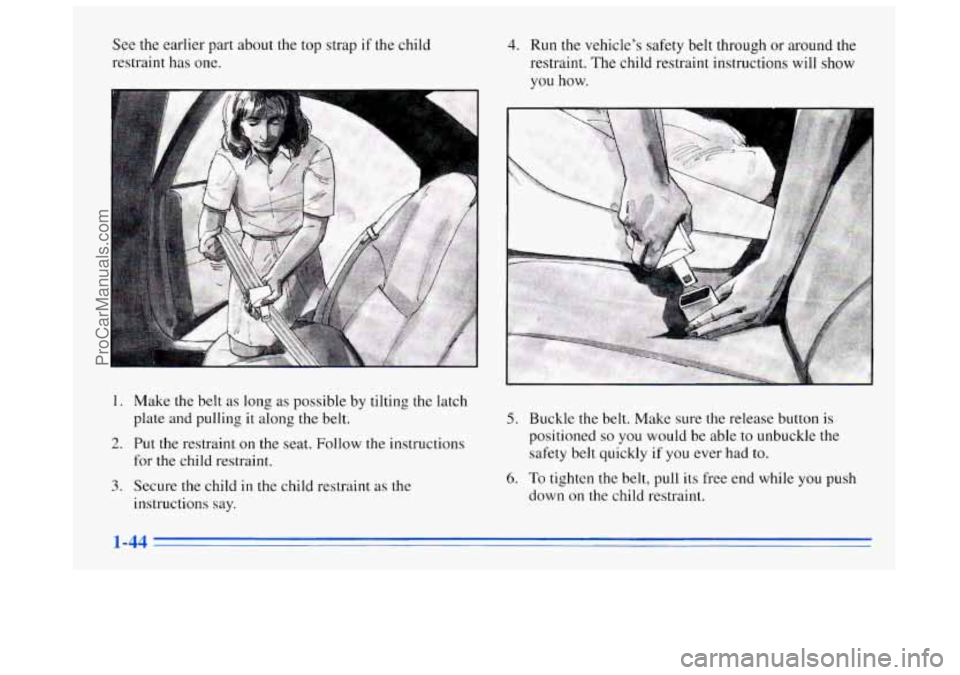
1. Make the belt as long as possible by tilting the latch
plate and pulling it along the belt.
for the child restraint.
2. Put the restraint on the seat. Follow the instructions
3. Secure the child in the child restraint as the
instructions say.
5. Buckle the belt. Make sure the release button is
positioned so you would be able to unbuckle the
safety belt quickly
if you ever had to.
6. To tighten the belt, pull its free end while you push
down on the child restraint.
ProCarManuals.com
Page 59 of 356
7. Push and pull the child restraint in different
directions to be sure it is secure. If it isn’t, secure
the
restraint in a different place in the vehicle and
contact the child restraint maker for their advice
about how to attach the child restraint properly.
To remove the child restraint, just unbuckle the vehicle’s
safety belt. It will be ready to work for an adult or larger
child passenger.
Securing a Child Restraint in the Right
Front Seat Position
U
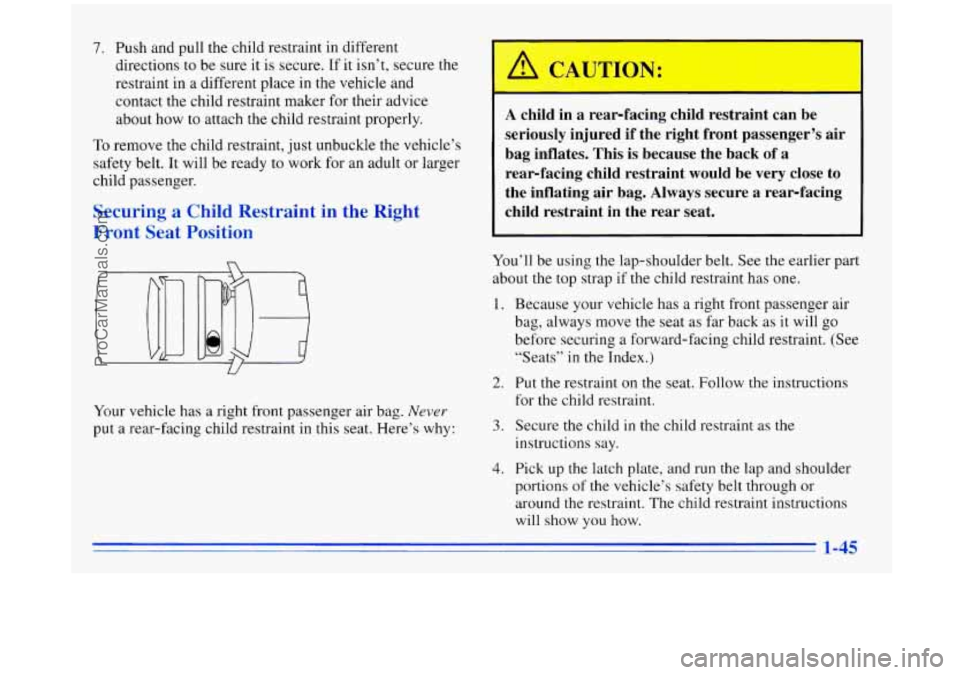
Your vehicle has a right front passenger air bag. Never
put a rear-facing child restraint in this seat. Here’s why:
A child in a rear-facing child restraint can be
seriously injured if the right front passenger’s air
bag inflates. This is because the back of a
rear-facing child restraint would be very close to
the inflating air bag. Always secure a rear-facing
child restraint in the rear seat.
You’ll be using the lap-shoulder belt. See the earlier part
about
the top strap if the child restraint has one.
1.
2.
3.
4.
Because your vehicle has a right front passenger air
bag, always move the seat as far back as it will go
before securing a forward-facing child restraint. (See
“Seats”
in the Index.)
Put the restraint
on the seat. Follow the instructions
for the child restraint.
Secure the child
in the child restraint as the
instructions
say.
Pick up the latch plate, and run the lap and shoulder
portions of the vehicle’s safety belt through or
around the restraint. The child restraint instructions
will show you how.
1-45
ProCarManuals.com
Page 61 of 356
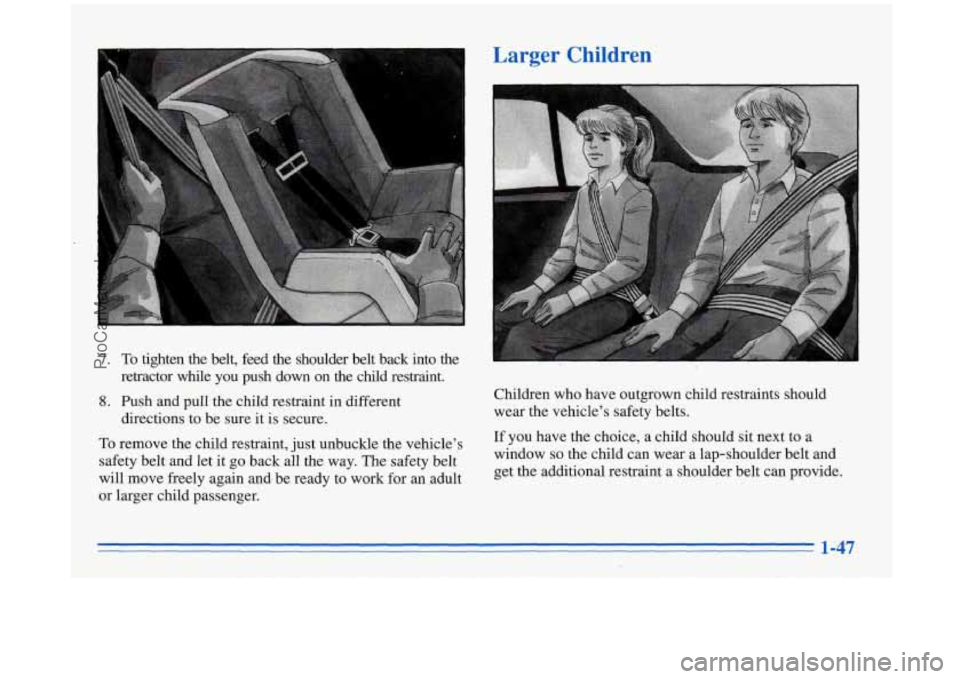
7. To tighten the belt, feed the shoulder belt back into the
retractor while you push down on the child restraint.
8. Push and pull the child restraint in different
directions to be sure it is secure.
To remove the child restraint, just unbuckle the vehicle’s
safety belt and let it go back all the way. The safety belt
will move freely again and. be ready to work for an ,adult
or larger child passenger.
Larger Children
Children who have outgrown child restraints should
wear the vehicle’s safety belts.
If you have the choice, a child should sit next to a
window
so the child can wear a lap-shoulder belt and
get the additional restraint a shoulder belt can provide.
1-47
ProCarManuals.com
Page 74 of 356
Parking Lots
If you park in a lot where someone will be watching
your vehicle, it’s best to lock it up and take your keys.
But what if you have to leave your ignition key? What if
you have to leave something valuable in your vehicle?
0 Put your valuables in a storage area, like your trunk
Lock the glove box.
Lock all the doors except the driver’s.
Then take the door key with you.
or glove
box.
Your vehicle
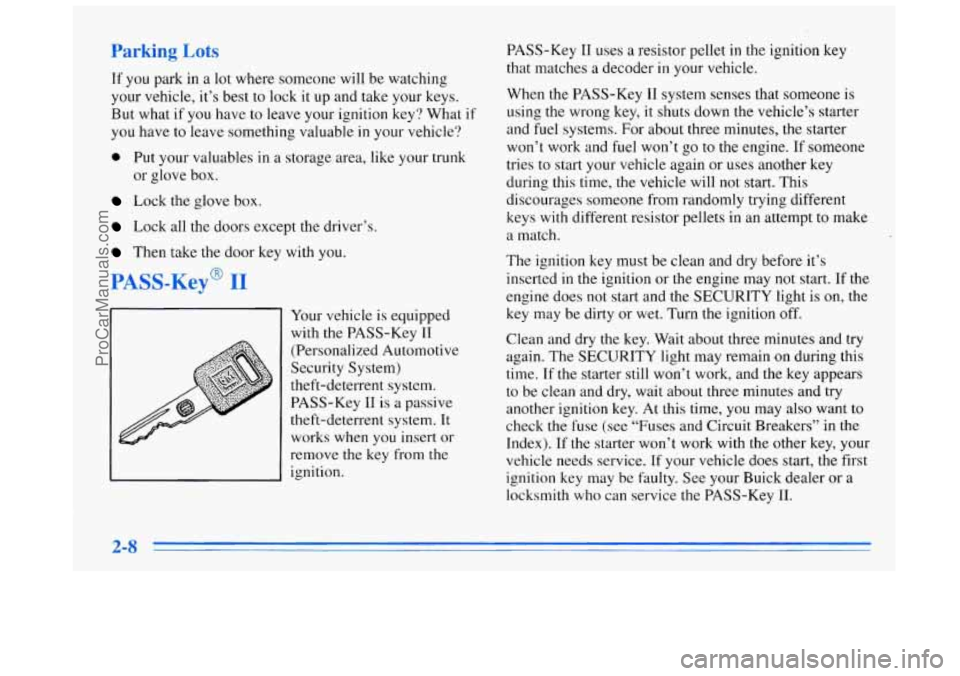
is equipped
with
the PASS-Key I1
(Personalized Automotive
Security System)
theft-deterrent system.
PASS-Key I1 is a passive
theft-deterrent system. It
works when you insert or
remove
the key from the
ignition. PASS-Key
I1 uses a resistor pellet
in the ignition key
that matches
a decoder in your vehicle.
When the PASS-Key I1 system senses that someone is
using the wrong key, it shuts down the vehicle’s starter
and fuel systems.
For about three minutes, the starter
won’t work and
fuel won’t go to the engine. If someone
tries to start your vehicle again or uses another key
during this time, the vehicle will not start. This
discourages someone from randomly trying different
keys
with different resistor pellets in an attempt to make
a match.
The ignition
key must be clean and dry before it’s
inserted in the ignition or the engine may not start.
If the
engine does not start and the SECURITY light is on, the
key may be dirty or wet. Turn
the ignition off.
Clean and dry the key. Wait about three minutes and try
again. The SECURITY light may remain on during this
time. If
the starter still won’t work, and the key appears
to be clean and dry, wait about three minutes and try
another ignition key. At this time, you may also want to
check the fuse (see
“Fuses and Circuit Breakers” in the
Index). If the starter won’t work with the other key, your
vehicle needs service.
If your vehicle does start, the first
ignition key may be faulty. See your Buick dealer or
a
locksmith who can service the PASS-Key 11.
2-8
ProCarManuals.com
Page 75 of 356
If you accidentally use a key that has a damaged or
missing resistor pellet, the starter won’t work, and the
SECURITY light will flash. But you don’t have to wait
three minutes before trying another ignition key.
See your Buick dealer
or a locksmith who can service
the PASS-Key
I1 to have a new key made.
If you’re ever driving and the SECURITY light comes
on, you will be able to restart your engine if you turn it
off. Your PASS-Key I1 system, howevcr, is not working
properly and must be serviced by your Buick dealer. Your
vehicle is not protected by the PASS-Key I1 system.
If you lose or damage a PASS-Key I1 ignition key, see
your Buick dealer or a locksmith who can service
PASS-Key I1 to have a new key made.
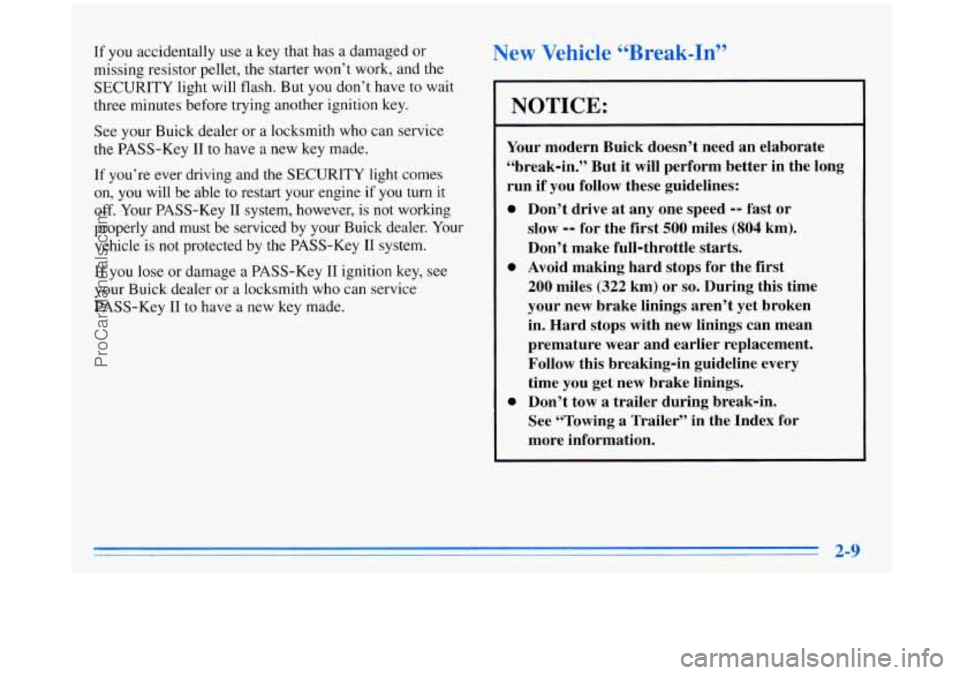
New Vehicle CCBreak-InSS
NOTICE:
Your modern Buick doesn’t need an elaborate
“break-in.” But it will perform better in the long
run if you follow these guidelines:
0 Don’t drive at any one speed -- fast or
slow -- for the first 500 miles (804 km).
Don’t make full-throttle starts.
200 miles (322 km) or so. During this time
your new brake linings aren’t yet broken
in. Hard stops with new linings can mean
premature wear and earlier replacement.
Follow this breaking-in guideline every
time you get new brake linings.
See “Towing
a Trailer’’ in the Index for
more information.
0 Avoid making hard stops for the first
0 Don’t tow a trailer during break-in.
ProCarManuals.com
Page 105 of 356
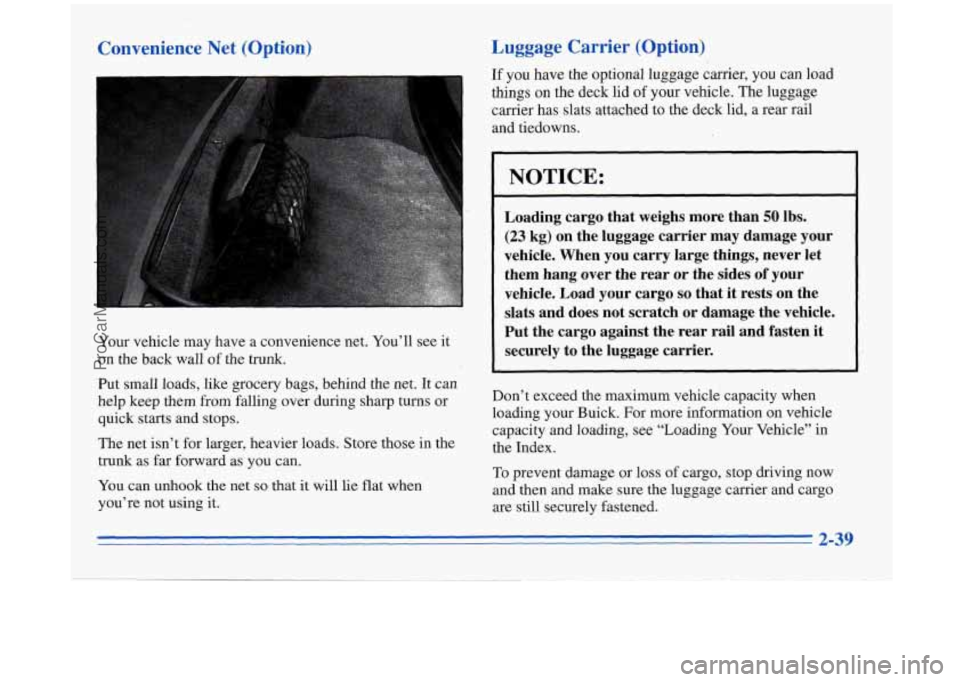
Convenience Net (Option)
I:x
Your vehicle may have a convenience net. You’ll see it
on the back wall of the
trunk.
Luggage Carrier (Option)
If you have the optional luggage carrier, you can load
things on the deck lid
of your vehicle. The luggage
carrier has slats attached to the deck lid, a rear rail
and tiedowns.
NOTICE:
~~
Loading cargo that weighs more than 50 lbs.
(23 kg) on the luggage carrier may damage your
vehicle. When you carry large things, never let
them hang over the rear or the sides of your
vehicle.
Load your cargo so that it rests on the
slats and does not scratch or damage the vehicle.
Put the cargo against the rear rail and fasten
it
securely to the luggage carrier.
Put small loads, like grocery bags, behind the net. It can
help keep them from falling over during sharp turns or
quick starts and stops.
The net isn’t for larger, heavier loads. Store those in the
trunk
as far forward as you can.
You can unhook the net
so that it will lie flat when
you’re not using it. Don’t exceed the maximum vehicle capacity when
loading your Buick. For more information on vehicle
capacity and loading, see “Loading Your Vehicle” in
the Index.
To prevent damage or loss of cargo, stop driving now
and then and make sure the luggage carrier and cargo are still securely fastened.
2-39
ProCarManuals.com
Page 122 of 356
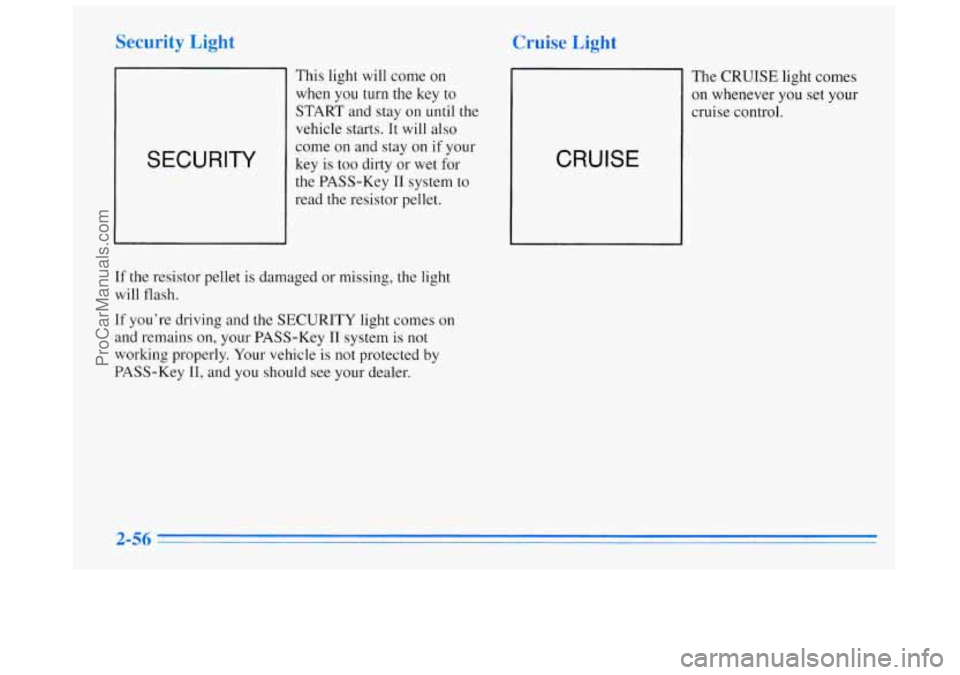
Security Light
SECURITY
This light will come on
when you turn the key to
START and stay on until the
vehicle starts. It will also
come on and stay on if your
key is too dirty or wet for
the PASS-Key
IT system to
read the resistor pellet.
If the resistor pellet is damaged or missing, the light
will flash.
If you’re driving and the SECURITY light comes on
and remains
on, your PASS-Key TI system is not
working properly. Your vehicle is not protected by
PASS-Key
11, and you should see your dealer.
Cruise Light
The CRUISE light comes
on whenever you set your
cruise control.
CRUISE
2-56
ProCarManuals.com
Page 145 of 356
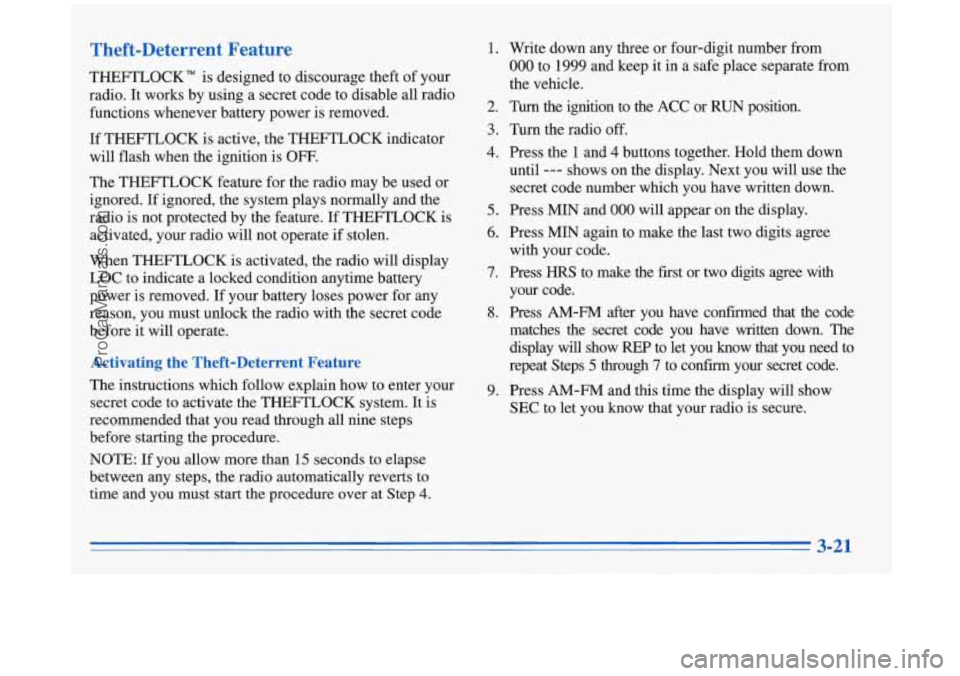
Theft-Deterrent Feature
THEFTLOCK" is designed to discourage theft of your
radio. It works by using
a secret code to disable all radio
functions whenever battery power is removed.
If THEFTLOCK is active, the THEFTLOCK indicator
will flash when the ignition is
OFF.
The THEFTLOCK feature for the radio may be used or
ignored.
If ignored, the system plays normally and the
radio is not protected by the feature. If THEFTLOCK is
activated, your radio will not operate if stolen.
When THEFTLOCK is activated, the radio will display
LOC to indicate a locked condition anytime battery
power is removed. If your battery loses power for any
reason, you must unlock the radio with the secret code
before it will operate.
Activating the Theft-Deterrent Feature
The instructions which follow explain how to enter your
secret code to activate the THEFTLOCK system. It
is
recommended that you read through all nine steps
before starting the procedure.
NOTE:
If you allow more than 15 seconds to elapse
between any steps, the radio automatically reverts to
time and you must start the procedure over at Step
4.
1. Write down any three or four-digit number from
000 to 1999 and keep it in a safe place separate from
the vehicle.
2. Turn the ignition to the ACC or RUN position.
3. Turn the radio off.
4. Press the 1 and 4 buttons together. Hold them down
until
--- shows on the display. Next you will use the
secret code number which you have written down.
5. Press MIN and 000 will appear on the display.
6. Press MIN again to make the last two digits agree
with your code.
7. Press HRS to make the first or two digits agree with
your code.
8. Press AM-FM after you have confirmed that the code
matches the secret code you have written down. The
display
will show REP to let you know that you need to
repeat Steps
5 through 7 to confirm your secret code.
9. Press AM-FM and this time the display will show
SEC to let you know that your radio is secure.
3-21
ProCarManuals.com
Page 146 of 356
Unlocking the Theft-Deterrent 1 ature After a
Power
Loss
Enter your secret code as follows; pause no more than
15 seconds between steps:
1.
2.
3.
4.
5.
LOC appears when the ignition is on.
Press MIN and
000 will appear on the display.
Press MIN again to make the last two digits agree
with your code.
Press
HRS to make the first or two digits agree with
your code.
Press AM-FM after
you have confirmed that the
code matches the secret code
you have written down.
The display will show SEC, indicating the radio is
now operable and secure.
If you enter
the wrong code eight times, INOP will
appear on the display.
You will have to wait an hour
with the ignition on before
you can try again. When you
try again, you will only have three chances to enter the
correct code before
INOP appears.
If you lose or forget your code, contact your dealer.
Disabling the Theft-Deterrent Feature
Enter your secret code as follows; pause no more than
15 seconds between steps:
1.
2.
3.
4.
5.
6.
7.
Turn the ignition to the ACC or RUN position.
Turn the radio
off.
Press the 1 and 4 buttons together. Hold them down
until
SEC shows on the display.
Press MIN and
000 will appear on the display.
Press
MTN again to make the last two digits agree
with your code.
Press HRS to make the first one or two digits agree
with your code.
Press AM-FM after you have confirmed that the
code matches the secret code you have written down.
The display will
show ---, indicating that the radio is
no longer secured.
If the code entered is incorrect, SEC will appear on the
display. The radio will remain secured
until the correct
code is entered.
When battery power
is given to a secured radio, the
radio
won’t turn on and LOC will appear on the display.
3-22
ProCarManuals.com
Page 175 of 356
Winter Driving
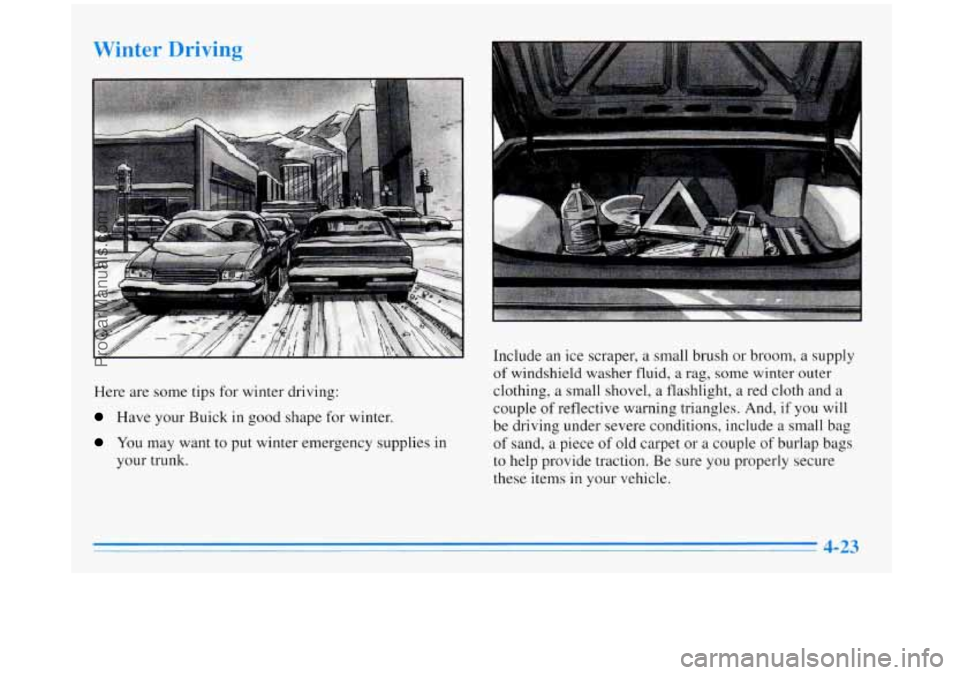
Here are some tips for winter driving:
Have your Buick in good shape for winter.
You may want to put winter emergency supplies in
your trunk. Include
an ice scraper, a small brush or broom, a supply
of windshield washer fluid, a rag, some winter outer
clothing, a small shovel, a flashlight, a red cloth and a
couple of reflective warning triangles. And, if
you will
be driving under severe conditions, include a small bag
of sand, a piece of old carpet or a couple of burlap bags
to help provide traction. Be sure you properly secure
these items
in your vehicle.
ProCarManuals.com