oil BUICK REGAL 1996 Owner's Manual
[x] Cancel search | Manufacturer: BUICK, Model Year: 1996, Model line: REGAL, Model: BUICK REGAL 1996Pages: 356, PDF Size: 17.97 MB
Page 239 of 356
L
Operating the engine with the air cleaner off
can cause you or others to be burned. The air
cleaner not only cleans the air, it stops flame if
the engine backfires.
If it isn’t there, and the
engine backfires, you could be burned. Don’t
drive with it
off, and be careful working on the
engine with the air cleaner
off.
NOTICE:
If the air cleaner is off, a backfire can cause a
damaging engine fire. And, dirt can easily get into your engine, which will damage it. Always
have the air cleaner in place when you’re driving.
Automatic Transaxle Fluid
When to Check and Change
A good time to check your automatic transaxle fluid
level is when the engine
oil is changed.
Change both the fluid and filter every
50,000 miles
(83 000 km) if the vehicle is mainly driven under one or
more of these conditions:
0 In heavy city traffic where the outside temperature
regularly reaches
90°F (32°C) or higher.
In hilly or mountainous ten-ain.
When doing frequent trailer towing.
Uses such as found in taxi, police or delivery service.
If you do not use your vehicle under any of these
conditions, the fluid and filter do not require changing.
See “Scheduled Maintenance Services”
in the Index.
6-17
ProCarManuals.com
Page 242 of 356
How to Add Fluid
Refer to the Maintenance Schedule to determine what
kind
of transaxle fluid to use. See “Recommended
Fluids and Lubricants’’
in the Index.
If the fluid level is low, add
only enough of the proper
fluid to bring the level into the cross-hatched area on
the dipstick.
1.
2.
0
0
Pull out the dipstick.
Using
a long-neck funnel, add enough fluid at the
dipstick hole to bring
it to the proper level. It doesn’t
take much fluid, generally less than a pint
(0.5 L).
Don t overfill. We recommend you use only fluid
labeled DEXRONO-111, because fluid with that label
is made especially for your automatic transaxle.
Damage caused by fluid other than DEXRON@-I11
is not covered by your new vehicle warranty.
After adding fluid, recheck the fluid level
as
described under “How to Check.”
When
the correct fluid level is obtained, push the
dipstick back in all the way.
Engine Coolant
The cooling system in your vehicle is filled with new
DEX-COOL
TM (orange-colored, silicate-free) engine
coolant. This coolant
is designed to remain in your
vehicle for
5 years or 100,000 miles (166 000 km),
whichever occurs first.
The following explains your cooling system and how to
add coolant when
it is low. If you have a problem with
engine overheating or
if you need to add coolant to your
radiator, see “Engine Overheating” in the Index.
A 50/50 mixture of water and the proper coolant for
your Buick will:
Give freezing protection down to
-34°F (-37°C).
Give boiling protection up
to’ 265 “F ( 129” C).
Protect against rust and corrosion.
Help keep the proper engine temperature.
Let the warning lights and gages work as
they should.
ProCarManuals.com
Page 243 of 356
NOTICE:
When adding coolant it is important that you use
DEX-COOL TM (orange-colored, silicate-free)
coolant meeting
GM Specification 6277M.
If silicated coolant is added to the system,
premature engine, heater core or radiator corrosion may result. In addition, the engine
coolant will require change sooner
-- at
30,000 miles (50 000 km) or 24 months whichever
occurs first
.
What to Use
Use a mixture
of one-half clean water (preferably
distilled) and one-half
DEX-COOL TM (orange-colored,
silicate-free) antifreeze that meets GM Specification
6277M, which won’t damage aluminum parts. Use
GM Engine Coolant Supplement (sealer) (GM Part
No. 3634621) with any complete coolant change. If you
use this mixture, you don’t need to add anything else.
CAUTION
-
Adding only plain water to your cooling system
can be dangerous. Plain water, or some other
liquid like alcohol, can boil before the proper
coolant mix will. Your vehicle’s coolant warning
system is set for the proper coolant mix. With
plain water or the wrong mix, your engine could
get too hot but you wouldn’t get the overheat
warning.
Your engine could catch fire and you or
others could be burned. Use a 50/50 mix of clean
water and
DEX-COOL TM (orange-colored,
silicate-free) antifreeze.
6-21
ProCarManuals.com
Page 250 of 356
What to Add
When you do need brake fluid, use only
DOT-3 brake
fluid
-- such as Delco Supreme 11 @ (GM Part
No. 1052535). Use new brake fluid from a sealed
container only, and always clean the brake fluid
reservoir cap before removing it.
-
With the wrong kind of fluid in your brake
system, your brakes may not work well, or they
may not even work at all. This could cause a
crash. Always use the proper brake fluid.
NOTICE:
0 Using the wrong fluid can badly damage
brake system parts. For example, just
a few
drops
of mineral-based oil, such as engine
oil, in your brake system can damage brake
system parts
so badly that they'll have to be
replaced. Don't let someone put in the
wrong kind
of fluid.
0 If you spill brake fluid on your vehicle's
painted surfaces, the paint finish can be damaged. Be careful not to spill brake fluid
on your vehicle. If you do, wash it
off
immediately. See "Appearance Care" in
the Index.
6-28
ProCarManuals.com
Page 266 of 356
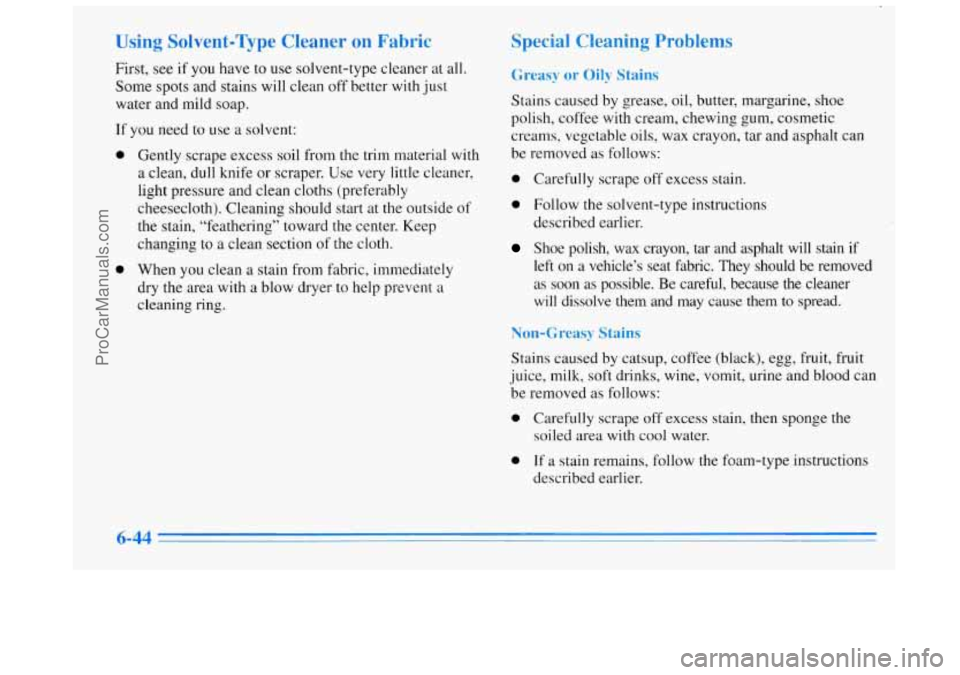
Using Solvent-Qpe Cleaner on Fabric
First, see if you have to use solvent-type cleaner at all.
Some spots and stains will clean off better with just
water and mild soap.
If you need to use
a solvent:
0 Gently scrape excess soil from the trim material with
a clean, dull knife or scraper. Use very little cleaner,
light pressure and clean cloths (preferably
cheesecloth). Cleaning should start at the outside of
the stain, “feathering” toward the center. Keep
changing to
a clean section of the cloth.
0 When you clean a stain from fabric, immediately
dry the area with
a blow dryer to help prevent a
cleaning ring.
Special Cleaning Problems
Greasy or Oily Stains
Stains caused by grease, oil, butter, margarine, shoe
polish, coffee with cream, chewing gum, cosmetic
creams, vegetable oils, wax crayon, tar and asphalt can
be removed
as follows:
0 Carefully scrape off excess stain.
0 Follow the solvent-type instructions
described earlier.
Shoe polish, wax crayon, tar and asphalt will stain if
left on
a vehicle’s seat fabric. They should be removed
as
soon as possible. Be careful, because the cleaner
will dissolve them and mdy cause them to spread.
Non-Greasy Stains
Stains caused by catsup, coffee (black), egg, fruit, fruit
juice, milk, soft drinks, wine, vomit, urine and blood can
be removed
as follows:
0 Carefully scrape off excess stain, then sponge the
soiled
area with cool water.
0 If a stain remains, follow the foam-type instructions
described earlier.
6-44
ProCarManuals.com
Page 267 of 356
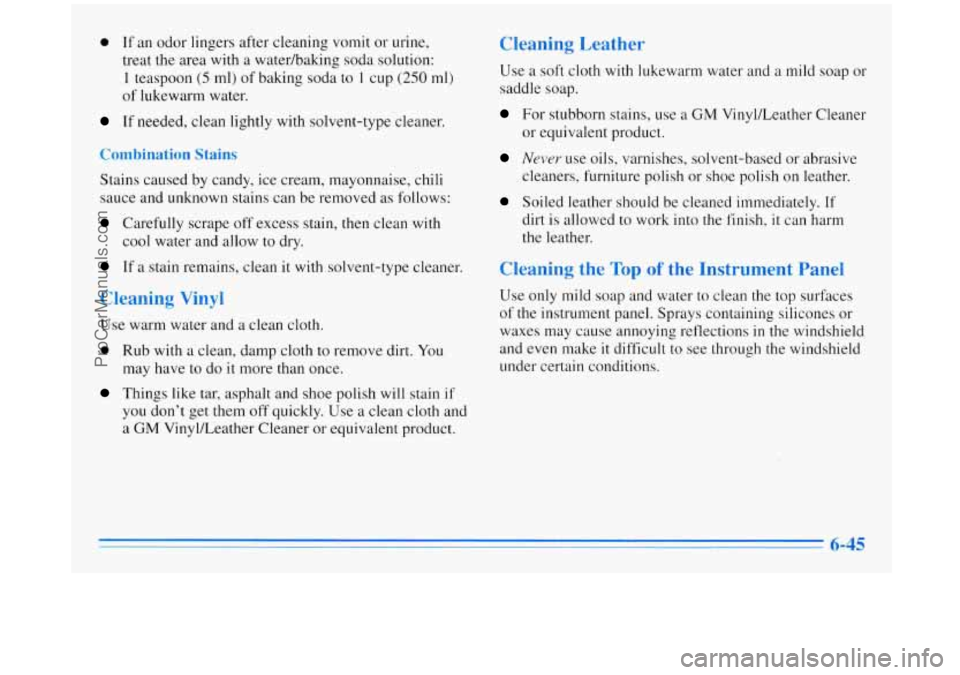
0 If an odor lingers after cleaning vomit or urine,
treat the area with
a watedbaking soda solution:
1 teaspoon
(5 ml) of baking soda to 1 cup (250 ml)
of lukewarm water.
If needed, clean lightly with solvent-type cleaner.
Combination Stains
Stains caused by candy, ice cream, mayonnaise, chili
sauce and unknown stains can be removed
as follows:
Carefully scrape off excess stain, then clean with
cool water and allow to dry.
If a stain remains, clean it with solvent-type cleaner.
Cleaning Vinyl
Use warm water and a clean cloth.
0 Rub with a clean, damp cloth to remove dirt. You
may have to do it more than once.
Things like tar, asphalt and shoe polish will stain if
you don’t get them off quickly. Use
a clean cloth and
a GM Vinyl/Leather Cleaner or equivalent product.
Cleaning Leather
Use a soft cloth with lukewarm water and a mild soap or
saddle soap.
For stubborn stains, use a GM Vinylkeather Cleaner
or equivalent product.
Never use oils, varnishes, solvent-based or abrasive
cleaners, furniture polish or shoe polish on leather.
Soiled leather should be cleaned immediately. If
dirt is allowed to work into the finish, it can harm
the leather.
Cleaning the Top of the Instrument Panel
Use only mild soap and water to clean the top surfaces
of the instrument panel. Sprays containing silicones or
waxes may cause annoying reflections in the windshield
and
even make it difficult to see through the windshield
under certain conditions.
ProCarManuals.com
Page 270 of 356
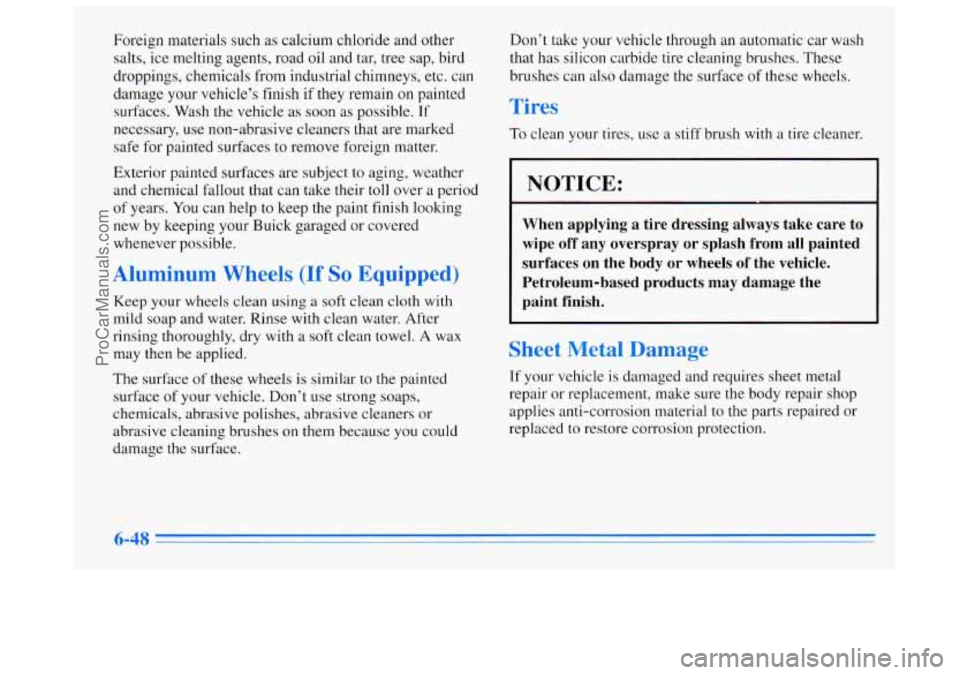
Foreign materials such as calcium chloride and other
salts, ice melting agents, road oil and tar, tree sap, bird
droppings, chemicals from industrial chimneys, etc. can
damage your vehicle’s finish if they remain on painted
surfaces. Wash the vehicle as soon
as possible. If
necessary, use non-abrasive cleaners that are marked
safe for painted surfaces to remove foreign matter.
Exterior painted surfaces are subject to aging, weather
and chemical fallout that can take their toll over
a period
of years. You can help to keep the paint finish looking
new by keeping your Buick garaged or covered
whenever possible.
Aluminum Wheels (If So Equipped)
Keep your wheels clean using a soft clean cloth with
mild soap and water. Rinse with clean water. After
rinsing thoroughly, dry with a soft clean towel. A wax
may then be applied.
The surface of these wheels is similar to the painted
surface
of your vehicle. Don’t use strong soaps,
chemicals, abrasive polishes, abrasive cleaners or
abrasive cleaning brushes on them because you could
damage the surface. Don’t
take your vehicle through
an autorrlatic car wash
that has silicon carbide tire cleaning brushes. These
brushes can
also damage the surface of these wheels.
Tires
To clean your tires, use a stiff brush with a tire cleaner.
I NOTICE:
When applying a tire dressing always take care to
wipe off any overspray
or splash from all painted
surfaces on the body or wheels of the vehicle.
Petroleum-based products may damage the
paint finish.
Sheet Metal Damage
If your vehicle is damaged and requires sheet metal
repair
or replacement, make sure the body repair shop
applies anti-corrosion material to the parts repaired or
replaced to restore corrosion protection.
6-48
ProCarManuals.com
Page 272 of 356
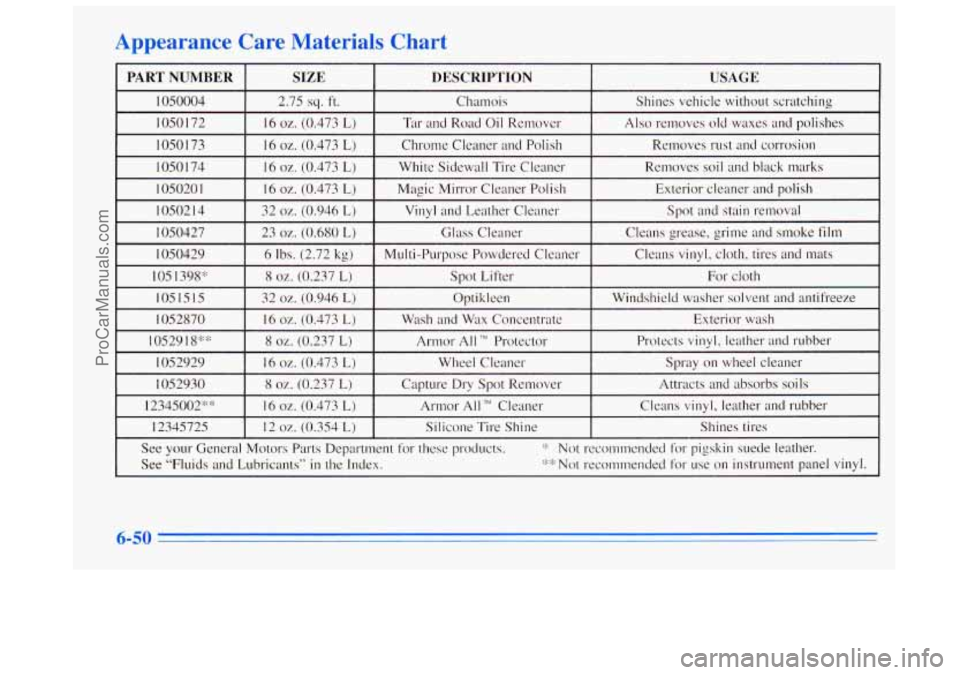
Appearance Care Materials Chart
PART NUMBER USAGE DESCRIPTION
SIZE
1050004
Also removes old waxes and polishes Tar and Road Oil
Remover
16 oz. (0.473 L) I 050 172 Shines
vehicle without scratching Chamois
2.75
sq. ft.
~~~
1050173 16 oz. (0.473 Lj Chrome Cleaner and Polish
Removes soil
and black marks
White Sidewall Tire Cleaner 16 oz. (0.473 L) 1050174 Removes
rust
and corrosion
~~~ ~ ~~~~~~~~~~~ ~~~ ~ ~ ~
105020 I
Windshield washer solvent and antifreeze
Optikleen
32 oz. (0.946 L) 1051515
For
cloth
Spot Lifter 8 oz. (0.237 L) 105 1398* Cleans
vinyl, cloth,
tires and mats
Multi-Purpose Powdered Cleaner 6 lbs. (2.72 kg)
1050429 Cleans grease, grime
and smoke film
Glass Cleaner 23
oz. (0.680 L) 1050427 Spot
and stain removal
Vinyl and Leather Cleaner
32 02. (0.946 L)
IO502 14 Exterior
cleaner and
polish Magic Mirror Cleaner Polish 16 OZ. (0.473 Lj
I 1 OS2870 I 16 oz. (0.473 L) I Wash and Wax Concentrate I Exterior wash
10529
18** Protects vinyl, leather and rubber
Armor All TM Protector 8 oz. (0.237 L)
1052929
Cleans
vinyl, leather and rubber
Armor All TM Cleaner 16 oz. (0.473 L) 12345002** Attracts and absorbs soils
Capture Dry Spot Remover
8 oz. (0.237 L) 1052930 Spray
on wheel
cleaner
Wheel Cleaner
16 oz. (0.473 L)
12345725 Shines tires
Silicone Tire Shine
12
oz. (0.354 L)
See your General Motors Parts Department for these products. :j: Not recommended for pigskin suede leather.
See "Fluids and Lubricants''
in the Index. :t::f: Not recommended for use on instrument panel vinyl.
6-50
ProCarManuals.com
Page 283 of 356
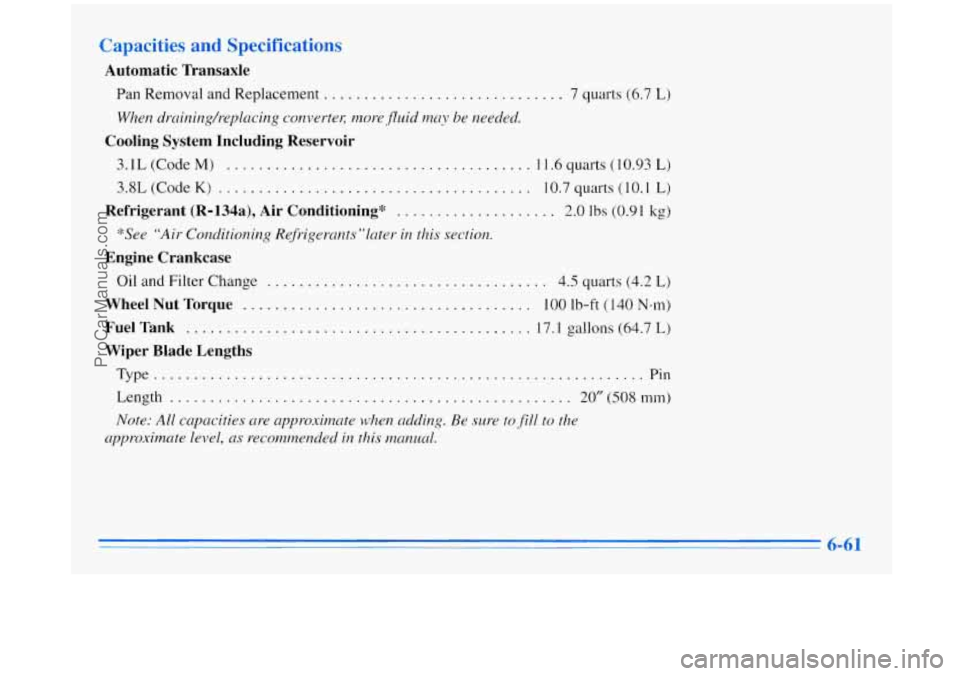
Capacities and Specifications
Automatic Transaxle
Pan Removal and Replacement .............................. 7 quarts (6.7 L)
When draiizilzg/replacil.Ig convertec more,fluid may be needed.
Cooling System Including Reservoir
3.1L(CodeM) ...................................... 11.6quarts(10.93L)
3.8L (Code
K) ....................................... 10.7 quarts (10.1 L)
Refrigerant (R-l34a), Air Conditioning* .................... 2.0 lbs (0.91 kg)
*See “Air Conditioning Refriger~-lnts”l~~tel- in th,is section.
Engine Crankcase
Oil and Filter Change ................................... 4.5 quarts (4.2 L)
Wheel Nut Torque .................................... 100 Ib-ft (140 N.m)
Fuel Tank ........................................... 17.1 gallons (64.7 L)
Wiper Blade Lengths
Type ............................................................. Pin
Length
.................................................. 20”(508mm)
Note: All capacities are approximate when adding. Be sure to Jill to the
approximate level, as recommended in this manual.
6-61
ProCarManuals.com
Page 285 of 356
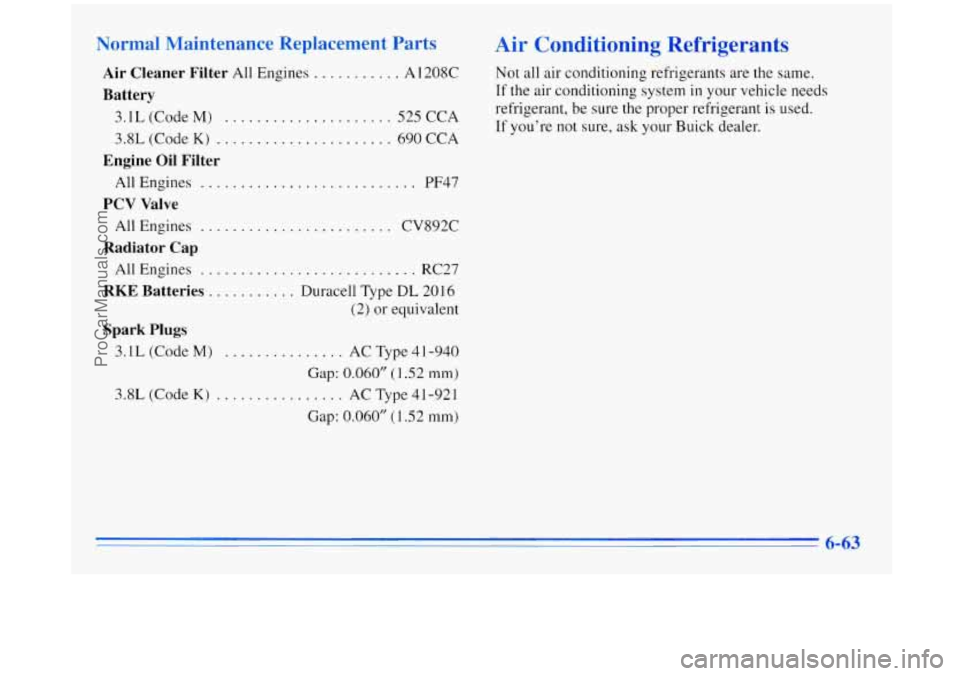
Normal Maintenance Replacement Parts
Air Cleaner Filter All Engines ........... A 1208C
Battery
3.1L (Code M) ..................... 525 CCA
3.8L (Code
K) ...................... 690 CCA
Engine Oil Filter
PCV Valve
All Engines ........................... PF47
All Engines
........................ CV892C
Radiator Cap
All Engines ........................... RC27
RKE Batteries ........... Duracell Type DL 2016
(2) or equivalent
Spark Plugs
3.1L (Code M) ............... AC Type 41 -940
Gap: 0.060” (1.52 mm)
3.8L (Code K) ................ AC Type 41-921
Gap:
0.060” (1.52 mm)
Air Conditioning Refrigerants
Not all air conditioning refrigerants are the same.
If the air conditioning system in your vehicle needs
refrigerant, be sure the proper refrigerant is used.
If you’re not sure, ask your Buick dealer.
6-63
ProCarManuals.com