service BUICK REGAL 1996 Owner's Guide
[x] Cancel search | Manufacturer: BUICK, Model Year: 1996, Model line: REGAL, Model: BUICK REGAL 1996Pages: 356, PDF Size: 17.97 MB
Page 225 of 356
Fuel
Use regular unleaded gasoline rated at 87 octane or higher.
At a minimum, it should meet specifications ASTM
D4814
in the United States and CGSB 3.5-M93 in Canada.
Improved gasoline specifications have been developed by
the American Automobile Manufacturers Association
(AAMA) for better vehicle performance and engine
protection. Gasolines meeting the
AAMA specification
could provide improved driveability and emission control
system protection compared to other gasolines.
Be sure
the posted octane is at least 87. If the octane is
less than
87, you may get a heavy knocking noise when
you drive. If it’s bad enough,
it can damage your engine.
If you’re using fuel rated at
87 octane or higher and you
still hear heavy knocking, your engine needs service.
But don’t worry
if you hear a little pinging noise when
you’re accelerating or driving up a hill. That’s normal,
and you don’t
have to buy a higher octane fuel to get rid
of pinging. It’s the heavy, constant knock that means
you have a problem. If
your vehicle is certified to meet California Emission
Standards (indicated
on the underhood tune-up label), it
is designed to operate on fuels that meet California specifications. If such fuels are not available in states
adopting California emissions standards, your vehicle will
operate satisfactorily on fuels meeting federal specifications, but emission control system pexformance
may be affected. The malfunction indicator lamp on your
instrument panel may turn on and/or your vehicle may
fail
a smog-check test. If this occurs, return to your authorized
Buick dealer for diagnosis to determine the cause of
failure. In the event
it is determined that the cause of the
condition is
the type of fuels used, repairs may not be
covered by your warranty.
In Canada, some gasolines contain an octane enhancing
additive called MMT. If you use such fuels, your
emission control system performance may deteriorate
and the malfunction indicator lamp on your instrument
panel may turn on.
If this happens, return to your
authorized Buick dealer for service.
6-3
ProCarManuals.com
Page 237 of 356
When to Change Engine Oil
See if any one of these is true for you:
0
0
0
0
0
Most trips are less than 5 to 10 miles (8 to 16 km).
This is particularly important when outside
temperatures are below freezing.
Most trips include extensive idling (such as frequent
driving in stop-and-go traffic).
Most trips are through dusty areas.
You frequently tow a trailer or use a carrier on top of
your vehicle.
The vehicle is used for delivery service, police, taxi
or other commercial application.
Driving under these conditions causes engine oil
to
break down sooner. If any one of these is true for
your vehicle, then
you need to change your oil and filter
every
3,000 miles (5 000 km) or 3 months -- whichever
occurs first.
If none
of them is true, change the oil and filter every
7,500 miles (12 500 km) or 12 months -- whichever
occurs first. Driving a vehicle with a fully warmed
engine under highway conditions causes engine oil to
break down slower.
What to Do with Used Oil
Did you know that used engine oil contains certain
elements that may be unhealthy for your skin and could
even cause cancer? Don’t let used oil stay
on your skin
for very long. Clean your skin and nails with soap and
water, or a good hand cleaner. Wash or properly throw
away clothing
or rags containing used engine oil. (See
the manufacturer’s warnings about the use and disposal
of oil products.)
Used oil can be a real threat
to the environment. If you
change your own oil, be sure to drain all free-flowing oil
from
the filter before disposal. Don’t ever dispose of oil
by putting it in the trash, pouring it on the ground, into
sewers, or into streams or bodies of water. Instead,
recycle it by taking
it to a place that collects used oil. If
you have a problem properly disposing of your used oil,
ask your dealer, a service station or a local recycling
center for help.
6-15
ProCarManuals.com
Page 238 of 356
1
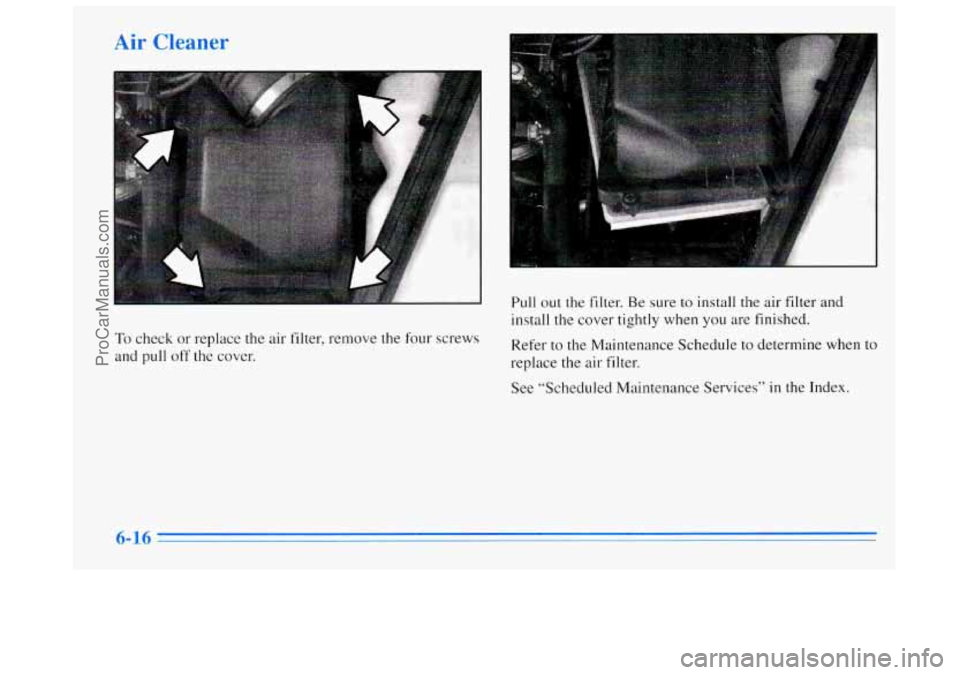
To check or replace the air filter, remove the four screws
and pull off
the cover.
Pull out the filter. Be sure to install the air filter and
install the cover tightly when you are finished.
Refer to the Maintenance Schedule to determine when to
replace the air filter.
See “Scheduled Maintenance Services” in the Index.
ProCarManuals.com
Page 239 of 356
L
Operating the engine with the air cleaner off
can cause you or others to be burned. The air
cleaner not only cleans the air, it stops flame if
the engine backfires.
If it isn’t there, and the
engine backfires, you could be burned. Don’t
drive with it
off, and be careful working on the
engine with the air cleaner
off.
NOTICE:
If the air cleaner is off, a backfire can cause a
damaging engine fire. And, dirt can easily get into your engine, which will damage it. Always
have the air cleaner in place when you’re driving.
Automatic Transaxle Fluid
When to Check and Change
A good time to check your automatic transaxle fluid
level is when the engine
oil is changed.
Change both the fluid and filter every
50,000 miles
(83 000 km) if the vehicle is mainly driven under one or
more of these conditions:
0 In heavy city traffic where the outside temperature
regularly reaches
90°F (32°C) or higher.
In hilly or mountainous ten-ain.
When doing frequent trailer towing.
Uses such as found in taxi, police or delivery service.
If you do not use your vehicle under any of these
conditions, the fluid and filter do not require changing.
See “Scheduled Maintenance Services”
in the Index.
6-17
ProCarManuals.com
Page 240 of 356
How to Check
Because this operation can be a little difficult, you may
choose to have this done
at your Buick dealer Service
Department.
If you do it yourself, be sure to follow all
the
instructions here, or you could get a false reading on
the dipstick.
NOTICE:
~ Too much or too little fluid can damage your
1 transaxle. Too much can mean that some of the
fluid could come out and fall
on hot engine parts
or exhaust system parts, starting a fire. Be sure
to
get an accurate reading if you check your
transaxle fluid.
Wait at least 30 minutes before checking the transaxle
fluid level
if you have been driving:
0 When outside temperatures are above 90°F (32°C).
0 At high speed for quite a while.
0 In heavy traffic -- especially in hot weather.
While pulling a trailer.
To get the right reading, the fluid should be at normal
~ operating temperature, which is 180°F to 200°F
1 I (82°C to 93°C).
Get the vehicle warmed
up by driving about 15 mues
(24 km) when outside temperatures are above 50°F
(10°C). If it's colder than 50°F (lO"C), you may
have to drive longer.
ProCarManuals.com
Page 251 of 356
Brake Wear
Your Buick has four-wheel disc brakes.
Disc brake pads have built-in wear indicators that make
a
high-pitched warning sound when the brake pads are
worn and new pads are needed. The sound may come and
go or be heard all the time your vehicle is moving (except
when you are pushing on the brake pedal firmly).
A CAUTION:
I
The brake wear warning so Id means that
sooner or later your brakes won’t work well.
That could lead to an accident. When you hear the brake wear warning sound, have your
vehicle serviced.
I NOTICE:
Continuing to drive with worn-out brake pads
could result in costly brake repair.
Some driving conditions or climates may cause a brake
squeal when the brakes are first applied or lightly
applied. This does not mean something is wrong with
your brakes.
Free movement of brake calipers and properly torqued
wheel nuts are necessary to help prevent brake
pulsation. When tires are rotated, inspect brake calipers
for movement, brake pads for wear,
and evenly torque
wheel nuts
in the proper sequence to GM specifications.
Brake linings should always be replaced
as complete
axle sets.
Brake Pedal Travel
See your dealer if the brake pedal does not return to
normal height, or
if there is a rapid increase in pedal
travel. This could be
a sign of brake trouble.
Brake Adjustment
Every time you apply the brakes, with or without the
vehicle moving, your brakes adjust for wear.
ProCarManuals.com
Page 256 of 356
Windshield Wiper Blade Replacement
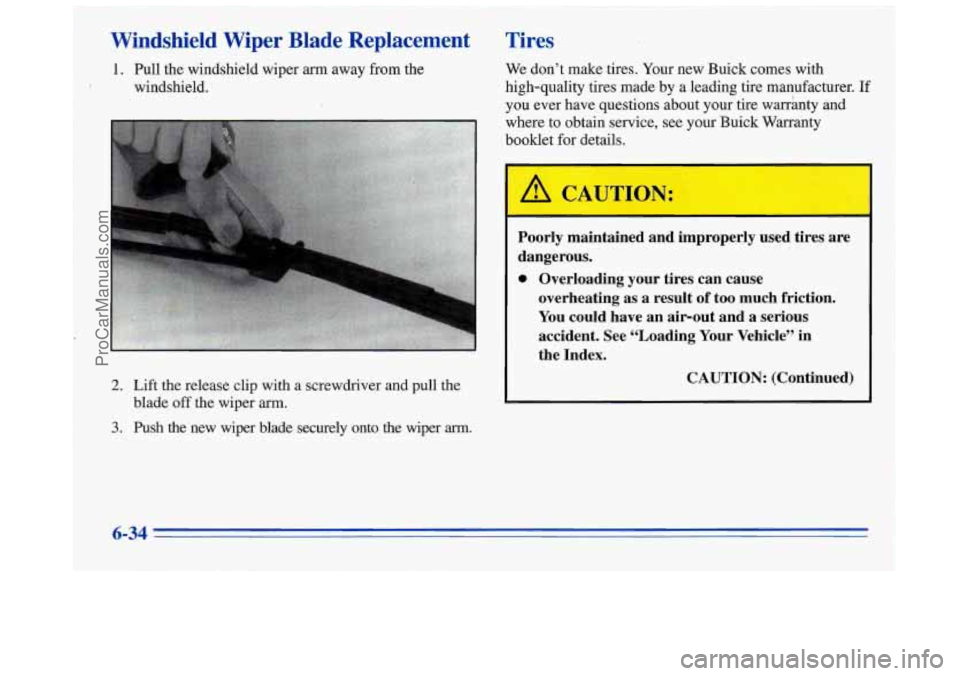
1. Pull the windshield wiper arm away from the
windshield.
Tires
We don’t make tires. Your new Buick comes with
high-quality tires made by a leading tire manufacturer. If
you ever have questions about your tire warranty and
where to obtain service, see your Buick Warranty
booklet
for details.
2. Lift the release clip with a screwdriver and pull the
3. Push the new wiper blade securely onto the wiper arm.
blade off the wiper arm.
Poorly maintained and improperly used tires are
dangerous.
0 Overloading your tires can cause
overheating
as a result of too much friction.
You could have an air-out and a serious
accident. See ‘(Loading Your Vehicle” in
the Index.
CAUTION: (Continued)
6-34
ProCarManuals.com
Page 258 of 356
NOTICE: (Continued)
If your tires have too much air (overinflation),
you can get the following:
Unusual wear
0 Bad handling
Rough ride
Needless damage from road hazards.
When
to Check
Check your tires once a month or more.
Don’t forget your compact spare tire.
It should be
at
60 psi (420 kPa).
How to Check
Use a good quality pocket-type gage to check tire
pressure. You can’t tell if
your tires are properly inflated
simply by looking at them. Radial tires may look
properly inflated even when they’re underinflated.
Be sure
to put the valve caps back on the valve stems.
They help prevent leaks
by keeping out dirt and moisture.
Tire Inspection and Rotation
Tires should be inspected every 6,000 to 8,000 miles
(10
000 to 13 000 km) for any signs of unusual wear.
If unusual wear is present, rotate your tires
as soon as
possible and check wheel alignment. Also check for
damaged tires or wheels. See “When It’s Time for New
Tires” and “Wheel Replacement” later in this section for
more information.
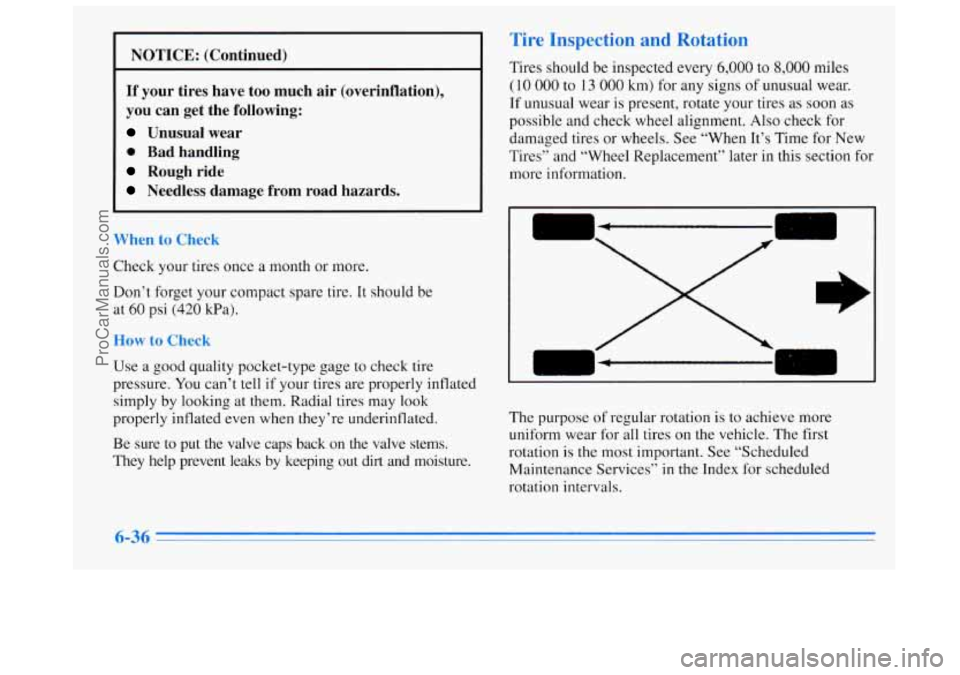
The purpose of regular rotation is to achieve more
uniform wear for all tires on the vehicle.
The first
rotation is the most important. See “Scheduled
Maintenance Services”
in the Index for scheduled
rotation intervals.
6-36
ProCarManuals.com
Page 260 of 356
The tire has a puncture, cut or other damage that
can’t be repaired well because of the size or location
of the damage.
Buying New Tires
To find out what kind and size of tires you need, look at
the Tire-Loading Information label.
The tires installed on your vehicle when it was new had
a Tire Performance Criteria Specification (TPC Spec)
number on each tire’s sidewall. When you get
new tires,
get ones with that same TPC Spec number. That way
your vehicle will continue to have tires that are designed
to give proper endurance, handling, speed rating,
traction, ride and other things during normal service on
your vehicle.
If your tires have an all-season tread
design,
the TPC number will be followed by an “MS”
(for mud and snow).
If you ever replace your tires with those not having a
TPC Spec number, make sure they are the same size,
load range, speed rating and construction type (bias,
bias-belted or radial) as your original tires.
Mixing tires coula cause you to lose control while
driving. If you mix tires
of different sizes or types
(radial and bias-belted tires), the vehicle may not
handle properly, and you could have a crash.
Using tires
of different sizes may also cause
damage to your vehicle. Be sure to use the same
size and type tires
on all four wheels.
It’s all right to drive with your compact spare,
though. It was developed
for use on your vehicle.
Uniform Tire Quality Grading
The following information relates to the system
developed by the United States National Highway
Traffic Safety Administration, which grades tires by
treadwear, traction and temperature performance. (This
applies only to vehicles sold in the United States.) The
grades are molded on the sidewalls of most passenger
car tires. The Uniform Tire Quality Grading system does
not apply to deep tread, winter-type snow tires,
space-saver or temporary use spare tires, tires with
6-38
ProCarManuals.com
Page 261 of 356
nominal rim diameters of 10 to 12 inches (25 to 30 cm),
or to some limited-production tires.
While the tires available on General Motors passenger
cars and light trucks may vary with respect to these
grades, they must
also conform to Federal safety
requirements and additional General Motors Tire
Performance Criteria (TPC) standards.
Treadwear
The treadwear grade is a comparative rating based on
the wear rate of the tire when tested under controlled
conditions on
a specified government test course. For
example,
a tire graded 150 would wear one and a half
(1 1/2) times as well on the government course as a tire
graded
100. The relative performance of tires depends
upon
the actual conditions of their use, however, and
may depart significantly from the norm due to variations
in driving habits, service practices and differences in
road characteristics and climate.
Traction - A, B, C
The traction grades, from highest to lowest, are A, B,
and C, and they represent the tire’s ability to stop on wet
pavement
as measured under controlled conditions on
specified government test surfaces of asphalt and
concrete.
A tire marked C may have poor traction
performance.
Warning: The traction grade assigned to this tire is based
on braking (straightahead) traction tests and does not
include cornering (turning) traction.
Temperature - A, B, C
The temperature grades are A (the highest), B, and C,
representing the tire’s resistance to the generation of
heat and its ability to dissipate heat when tested under
controlled conditions on a specified indoor laboratory
test wheel. Sustained high temperature can cause
the
material of the tire to degenerate and reduce tire life, and
excessive temperature can lead to sudden
tire failure.
The grade
C corresponds to a level of performance
which all passenger car tires must meet under the
Federal Motor Vehicle Safety Standard
No. 109. Grades
B and A represent higher levels of performance on the
laboratory test wheel than the minimum required by law.
6-39
ProCarManuals.com