wheel BUICK REGAL 1996 Service Manual
[x] Cancel search | Manufacturer: BUICK, Model Year: 1996, Model line: REGAL, Model: BUICK REGAL 1996Pages: 356, PDF Size: 17.97 MB
Page 261 of 356
nominal rim diameters of 10 to 12 inches (25 to 30 cm),
or to some limited-production tires.
While the tires available on General Motors passenger
cars and light trucks may vary with respect to these
grades, they must
also conform to Federal safety
requirements and additional General Motors Tire
Performance Criteria (TPC) standards.
Treadwear
The treadwear grade is a comparative rating based on
the wear rate of the tire when tested under controlled
conditions on
a specified government test course. For
example,
a tire graded 150 would wear one and a half
(1 1/2) times as well on the government course as a tire
graded
100. The relative performance of tires depends
upon
the actual conditions of their use, however, and
may depart significantly from the norm due to variations
in driving habits, service practices and differences in
road characteristics and climate.
Traction - A, B, C
The traction grades, from highest to lowest, are A, B,
and C, and they represent the tire’s ability to stop on wet
pavement
as measured under controlled conditions on
specified government test surfaces of asphalt and
concrete.
A tire marked C may have poor traction
performance.
Warning: The traction grade assigned to this tire is based
on braking (straightahead) traction tests and does not
include cornering (turning) traction.
Temperature - A, B, C
The temperature grades are A (the highest), B, and C,
representing the tire’s resistance to the generation of
heat and its ability to dissipate heat when tested under
controlled conditions on a specified indoor laboratory
test wheel. Sustained high temperature can cause
the
material of the tire to degenerate and reduce tire life, and
excessive temperature can lead to sudden
tire failure.
The grade
C corresponds to a level of performance
which all passenger car tires must meet under the
Federal Motor Vehicle Safety Standard
No. 109. Grades
B and A represent higher levels of performance on the
laboratory test wheel than the minimum required by law.
6-39
ProCarManuals.com
Page 262 of 356
Warning: The temperature grade for this tire is
established
for a tire that is properly inflated and not
overloaded. Excessive speed, underinflation, or
excessive loading, either separately or
in combination,
can cause heat buildup and possible tire failure.
Wheel Alignment and Tire Balance
The wheels on your vehicle were aligned and balanced
carefully at the factory
to give you the longest tire life
and best overall performance.
In most cases, you will not need to have your wheels
aligned again. However, if you notice unusual tire wear
or your vehicle pulling
one way or the other, the
alignment may need to be reset.
If you notice your
vehicle vibrating when driving on
a smooth road, your
wheels may need to be rebalanced.
Wheel Replacement
Replace any wheel that is bent, cracked, or badly rusted
or corroded. If wheel
nuts keep coming loose, the wheel,
wheel bolts and wheel
nuts should be replaced. If the
wheel leaks air, replace it (except some aluminum
wheels, which can sometimes be repaired). See your
Buick dealer if
any of these conditions exist.
I
Your dealer will know the kind of wheel you need.
Each new wheel should have the
same load-carrying
capacity, diameter, width, offset and be mounted the
same way
as the one it replaces.
If you need to replace any of your wheels, wheel bolts
or wheel nuts, replace them only with new
GM original
equipment parts. This way, you will be sure to have
the right wheel, wheel bolts and wheel nuts for your
Buick model.
Using the wrong replacement wheels, wheel bolts I
or wheel nuts on your vehicle can be dangerous.
It could affect the braking and handling
of your
vehicle, make your tires lose air and make you
lose control.
You could have a collision in which
you or others could be injured. Always use the
correct wheel, wheel bolts and wheel nuts for
replacement.
6-40
ProCarManuals.com
Page 263 of 356

NOTICE:
The wrong wheel can also cause problems with
bearing life, brake cooling, speedometer/odometer
calibration, headlamp aim, bumper height, vehicle
ground clearance and tire or tire chain clearance to
the body and chassis.
See “Changing
a Flat Tire” in the Index .for more
information. Used
Replacement Wheels
Putting
a used wheel on your vehicle is
dangerous. You can’t know how it’s been used
or
how many miles it’s been driven. It could fail
suddenly and cause an accident.
If you have to
replace a wheel, use a new
GM original
equipment wheel.
6-41
ProCarManuals.com
Page 264 of 356
NOTICE:
If your Buick has P225/60R16 size tires, don’t use
tire chains. They can damage your vehicle.
If you have other tires, use tire chains only where
legal and only when you must. Use only
SAE
Class “S” type chains that are the proper size for
your tires. Install them on the front tires and
tighten them as tightly as possible with the ends
securely fastened. Drive slowly and follow the
chain manufacturer’s instructions.
If you can
hear the chains contacting your vehicle, stop
and retighten them. If the contact continues,
slow down until it stops. Driving too fast or
spinning the wheels with chains on will
damage your vehicle.
11
Remember, cleaning products can be hazardous. Some
are toxic. Others can burst into flame if you strike
a
match or get them on a hot part of the vehicle. Some are
dangerous if you breathe their fumes in a closed space.
When you use anything from
a container to clean your
Buick, be sure to follow the manufacturer’s warnings
and instructions. And always open your doors or
windows when you’re cleaning the inside.
Never use these to clean your vehicle:
Gasoline
Benzene
Naphtha
Carbon Tetrachloride
Acetone
0 Paint Thinner
0 Turpentine
Lacquer Thinner
Nail Polish Removel-
They can all be hazardous
-- some more than
others
-- and they can all damage your vehicle, too.
ProCarManuals.com
Page 270 of 356
Foreign materials such as calcium chloride and other
salts, ice melting agents, road oil and tar, tree sap, bird
droppings, chemicals from industrial chimneys, etc. can
damage your vehicle’s finish if they remain on painted
surfaces. Wash the vehicle as soon
as possible. If
necessary, use non-abrasive cleaners that are marked
safe for painted surfaces to remove foreign matter.
Exterior painted surfaces are subject to aging, weather
and chemical fallout that can take their toll over
a period
of years. You can help to keep the paint finish looking
new by keeping your Buick garaged or covered
whenever possible.
Aluminum Wheels (If So Equipped)
Keep your wheels clean using a soft clean cloth with
mild soap and water. Rinse with clean water. After
rinsing thoroughly, dry with a soft clean towel. A wax
may then be applied.
The surface of these wheels is similar to the painted
surface
of your vehicle. Don’t use strong soaps,
chemicals, abrasive polishes, abrasive cleaners or
abrasive cleaning brushes on them because you could
damage the surface. Don’t
take your vehicle through
an autorrlatic car wash
that has silicon carbide tire cleaning brushes. These
brushes can
also damage the surface of these wheels.
Tires
To clean your tires, use a stiff brush with a tire cleaner.
I NOTICE:
When applying a tire dressing always take care to
wipe off any overspray
or splash from all painted
surfaces on the body or wheels of the vehicle.
Petroleum-based products may damage the
paint finish.
Sheet Metal Damage
If your vehicle is damaged and requires sheet metal
repair
or replacement, make sure the body repair shop
applies anti-corrosion material to the parts repaired or
replaced to restore corrosion protection.
6-48
ProCarManuals.com
Page 272 of 356
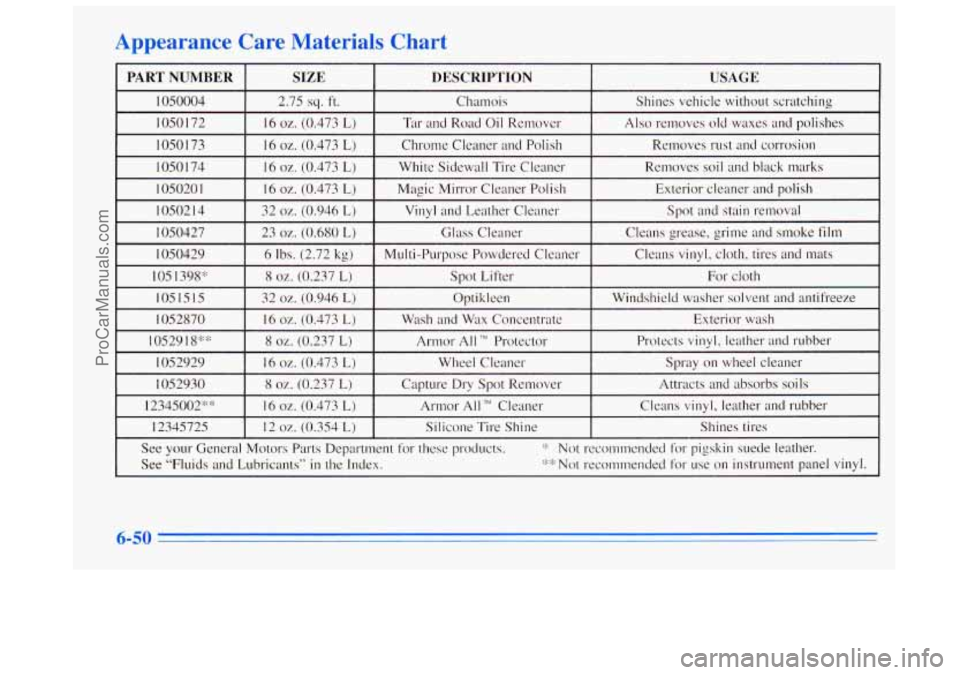
Appearance Care Materials Chart
PART NUMBER USAGE DESCRIPTION
SIZE
1050004
Also removes old waxes and polishes Tar and Road Oil
Remover
16 oz. (0.473 L) I 050 172 Shines
vehicle without scratching Chamois
2.75
sq. ft.
~~~
1050173 16 oz. (0.473 Lj Chrome Cleaner and Polish
Removes soil
and black marks
White Sidewall Tire Cleaner 16 oz. (0.473 L) 1050174 Removes
rust
and corrosion
~~~ ~ ~~~~~~~~~~~ ~~~ ~ ~ ~
105020 I
Windshield washer solvent and antifreeze
Optikleen
32 oz. (0.946 L) 1051515
For
cloth
Spot Lifter 8 oz. (0.237 L) 105 1398* Cleans
vinyl, cloth,
tires and mats
Multi-Purpose Powdered Cleaner 6 lbs. (2.72 kg)
1050429 Cleans grease, grime
and smoke film
Glass Cleaner 23
oz. (0.680 L) 1050427 Spot
and stain removal
Vinyl and Leather Cleaner
32 02. (0.946 L)
IO502 14 Exterior
cleaner and
polish Magic Mirror Cleaner Polish 16 OZ. (0.473 Lj
I 1 OS2870 I 16 oz. (0.473 L) I Wash and Wax Concentrate I Exterior wash
10529
18** Protects vinyl, leather and rubber
Armor All TM Protector 8 oz. (0.237 L)
1052929
Cleans
vinyl, leather and rubber
Armor All TM Cleaner 16 oz. (0.473 L) 12345002** Attracts and absorbs soils
Capture Dry Spot Remover
8 oz. (0.237 L) 1052930 Spray
on wheel
cleaner
Wheel Cleaner
16 oz. (0.473 L)
12345725 Shines tires
Silicone Tire Shine
12
oz. (0.354 L)
See your General Motors Parts Department for these products. :j: Not recommended for pigskin suede leather.
See "Fluids and Lubricants''
in the Index. :t::f: Not recommended for use on instrument panel vinyl.
6-50
ProCarManuals.com
Page 277 of 356
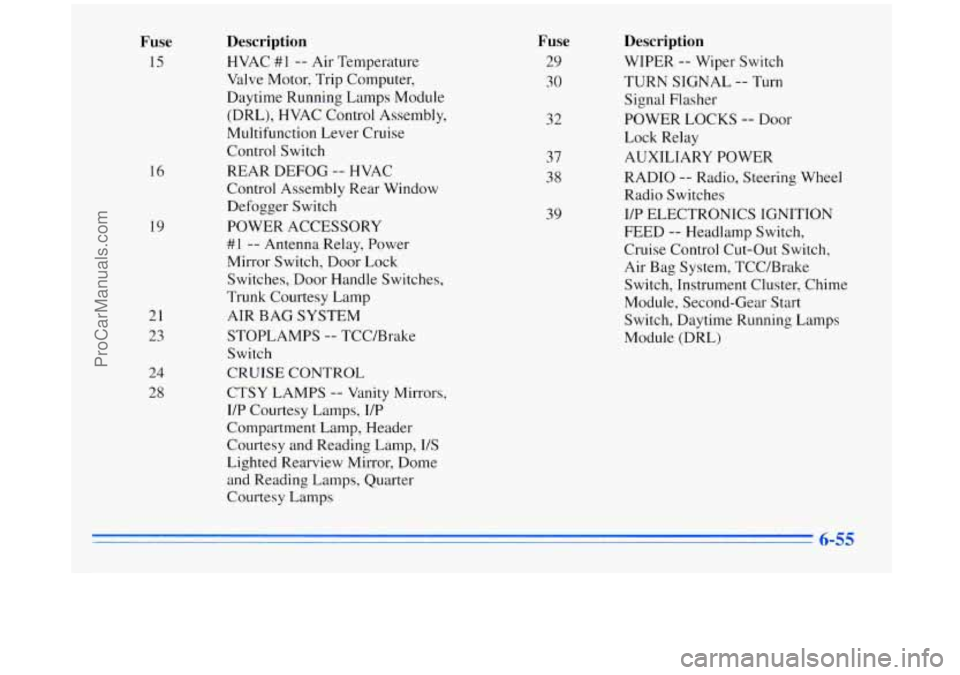
Fuse
15
16
19
21
23
24
28
Description
HVAC #1 -- Air Temperature
Valve Motor: Trip Computer,
Daytime Running Lamps Module
(DRL), HVAC Control Assembly,
Multifunction Lever Cruise
Control Switch
Control Assembly Rear Window
Defogger Switch
POWER ACCESSORY
#1 -- Antenna Relay, Power
Mirror Switch, Door Lock
Switches,
Door Handle Switches,
Trunk Courtesy Lamp
AIR BAG SYSTEM
STOPLAMPS
-- TCC/Brake
Switch
CRUISE CONTROL
CTSY LAMPS -- Vanity Mirrors,
T/P Courtesy Lamps, I/P
Compartment Lamp, Header
Courtesy and Reading Lamp,
I/S
Lighted Rearview Mirror, Dome
and Reading Lamps, Quarter
Courtesy Lamps
REAR
DEFOG
-- HVAC
Fuse
29
30
32
37
38
39
Description
WIPER -- Wiper Switch
TURN SIGNAL
-- Turn
Signal Flasher
POWER LOCKS
-- Door
Lock Relay
AUXILIARY POWER
RADIO
-- Radio, Steering Wheel
Radio Switches
I/P ELECTRONICS IGNITION
FEED
-- Headlamp Switch,
Cruise Control Cut-Out Switch,
Air Bag System, TCC/Brake
Switch, Instrument Cluster, Chime
Module, Second-Gear Start
Switch, Daytime Running Lamps
Module (DRL)
6-55
ProCarManuals.com
Page 283 of 356
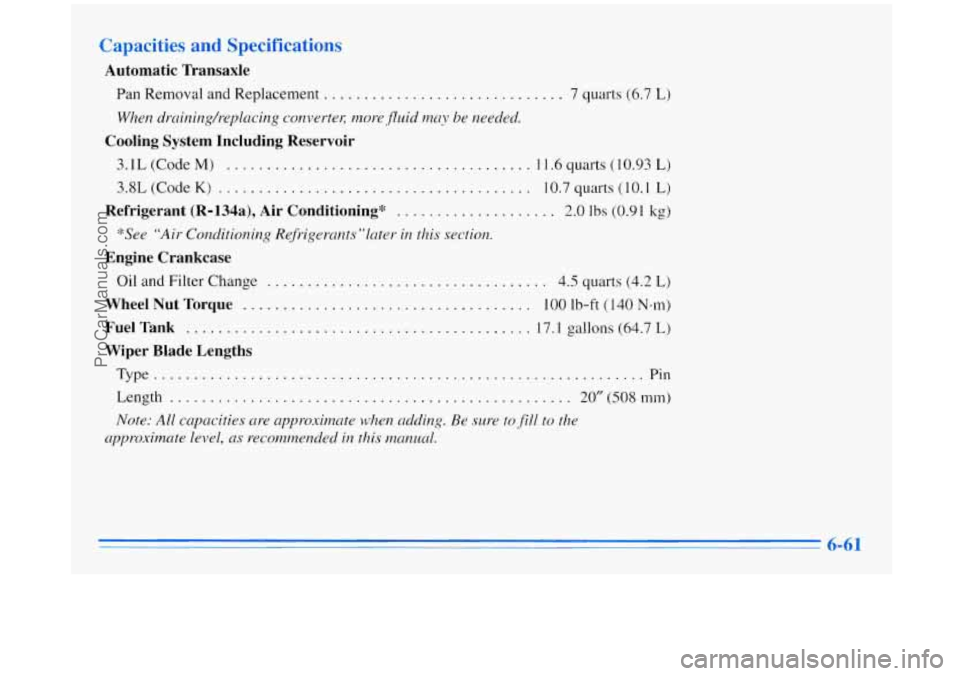
Capacities and Specifications
Automatic Transaxle
Pan Removal and Replacement .............................. 7 quarts (6.7 L)
When draiizilzg/replacil.Ig convertec more,fluid may be needed.
Cooling System Including Reservoir
3.1L(CodeM) ...................................... 11.6quarts(10.93L)
3.8L (Code
K) ....................................... 10.7 quarts (10.1 L)
Refrigerant (R-l34a), Air Conditioning* .................... 2.0 lbs (0.91 kg)
*See “Air Conditioning Refriger~-lnts”l~~tel- in th,is section.
Engine Crankcase
Oil and Filter Change ................................... 4.5 quarts (4.2 L)
Wheel Nut Torque .................................... 100 Ib-ft (140 N.m)
Fuel Tank ........................................... 17.1 gallons (64.7 L)
Wiper Blade Lengths
Type ............................................................. Pin
Length
.................................................. 20”(508mm)
Note: All capacities are approximate when adding. Be sure to Jill to the
approximate level, as recommended in this manual.
6-61
ProCarManuals.com
Page 284 of 356
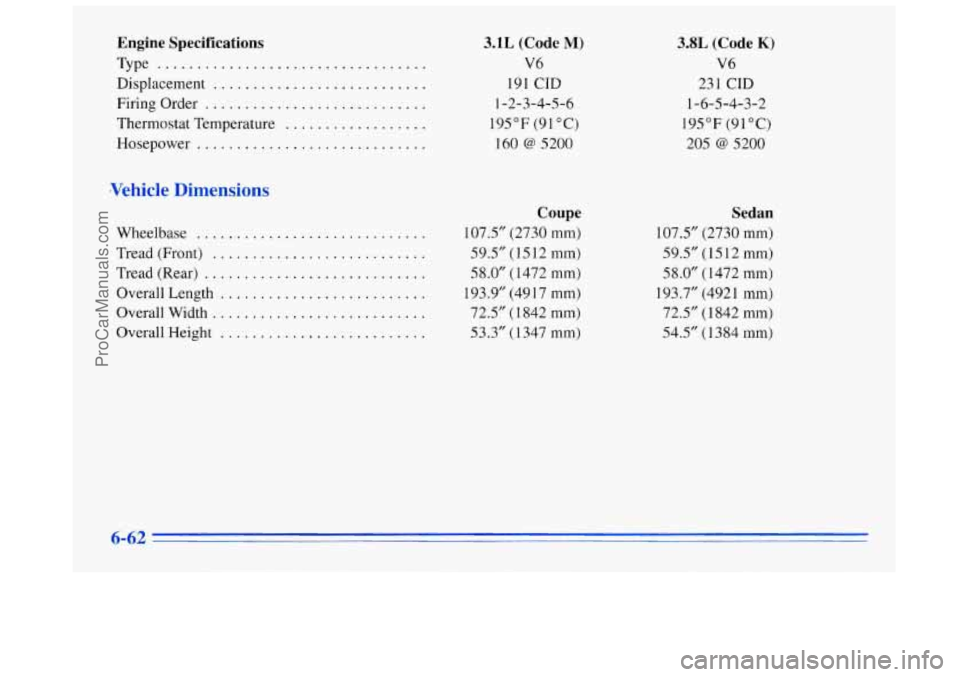
Engine Specifications
Type ..................................
Displacement ...........................
Thermostat Temperature ..................
Firing Order ............................
Hosepower .............................
-Vehicle Dimensions
Wheelbase .............................
Tread (Front) ...........................
Tread (Rear) ............................
Overall Length ..........................
Overall Width ...........................
Overall Height ..........................
3.1L (Code M)
V6
191 CID
1-2-3-4-5-6
195°F (91°C) 160
0 5200
Coupe
107.5” (2730 mm)
59.5”
(1 5 12 mm)
58.0” (1472
mm)
193.9” (49 17 mm)
72.5” (1 842 mm)
53.3” (1 347 mm)
3.8L (Code K)
V6
231
CID
1-6-5-4-3-2
195°F (91°C)
205 0 5200
Sedan
107.5” (2730 mm)
59.5” (15 12 mm)
58.0” (1472 mm)
193.7” (492
1 mm)
72.5”
(1 842 mm)
54.5”
(1 384 mm)
6-62
ProCarManuals.com
Page 325 of 356
Part C: Periodic Maintenance
Inspections
Listed below are inspections and services which should
be performed at least twice
a year (for instance, each
spring and fall). You should let your GM dealer’s
service department or other qualified service center
do these jobs. Make sure any necessary repairs are
completed at once.
Proper procedures to perform these services may be
found in a Buick service manual. See “Service and
Owner Publications’’ in the Index.
Steering, Suspension and Front- Wheel-Drive
Axle Boot and Seal Inspection
Inspect the front and rear suspension and steering
system for damaged, loose or missing parts, signs of
wear, or lack of lubrication. Inspect the power steering
lines and hoses for proper hookup, binding, leaks,
cracks, chafing, etc. Clean and then inspect
the drive
axle boot seals for damage, tears or leakage. Replace
seals if necessary.
Exhaust System Inspection
mspect the complete exhaust system. Inspect the body
near the exhaust system. Look for broken, damaged, missing
or out-of-position parts as well
as open seams,
holes,
loose connections, or other conditions which
could cause
a heat build-up in the floor pan or could let
exhaust fumes into the vehicle. See “Engine Exhaust”
in the Index.
Radiator and Heater Hose Inspection
Inspect the hoses and have them replaced if they are
cracked? swollen or deteriorated. Inspect
all pipes,
fittings and clamps; replace
as needed.
Throttle Linkage Inspection
Inspect the throttle linkage for interference or binding,
and for damage
or missing parts. Replace parts as
needed. Replace any cables that have high effort or
excessive wear.
Do not lubricate accelerator and cruise
control cables.
Brake System Inspection
Inspect the complete system. Inspect brake lines and
hoses for proper hookup, binding, leaks, cracks, chafing,
etc. Inspect disc brake pads for wear and rotors for
surface condition. Inspect other brake parts, including
calipers, parking brake, etc. Check parking brake
adjustment. You may need to have your brakes inspected
more often if your driving habits or conditions result in
frequent braking.
7-39
ProCarManuals.com