engine BUICK REGAL 1996 Manual Online
[x] Cancel search | Manufacturer: BUICK, Model Year: 1996, Model line: REGAL, Model: BUICK REGAL 1996Pages: 356, PDF Size: 17.97 MB
Page 249 of 356
Brakes
Bri lid
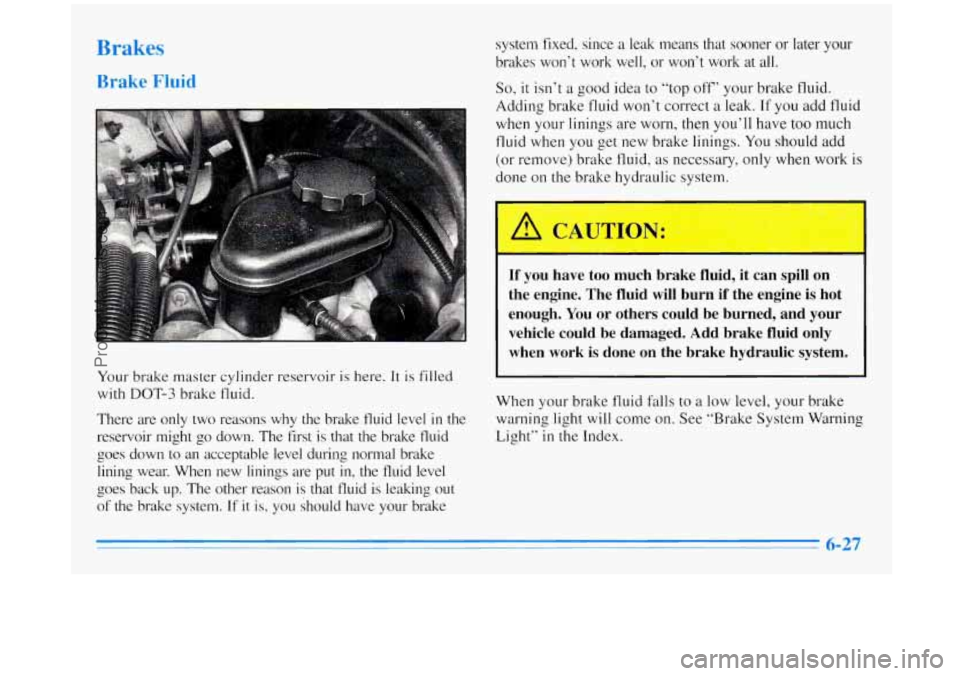
Your brake master cylinder reservoir is here. It is filled
with
DOT-3 brake fluid.
There are only two reasons why the brake fluid level
in the
reservoir might go down. The first is that the brake fluid
goes down to an acceptable level during normal brake lining wear. When new linings are put in, the fluid level
goes back up. The other reason is that fluid is leaking out
of the brake system. If it is, you should have your brake system fixed, since
a leak means that sooner or later your
brakes won’t work well, or won’t work at all.
So, it isn’t a good idea to “top off’ your brake fluid.
Adding brake fluid won’t correct
a leak. If you add fluid
when your linings are worn, then you’ll have too much
fluid when you get new brake linings.
You should add
(or remove) brake fluid,
as necessary, only when work is
done on the brake hydraulic system.
If you have too much brake fluid, it can spill on
the engine. The fluid
will burn if the engine is hot
enough. You or others could be burned, and your
vehicle could be damaged. Add brake fluid only
when work is done
on the brake hydraulic system
When your brake fluid falls to a low level, your brake
warning light will come on. See “Brake System Warning
Light”
in the Index.
6-27
ProCarManuals.com
Page 250 of 356
What to Add
When you do need brake fluid, use only
DOT-3 brake
fluid
-- such as Delco Supreme 11 @ (GM Part
No. 1052535). Use new brake fluid from a sealed
container only, and always clean the brake fluid
reservoir cap before removing it.
-
With the wrong kind of fluid in your brake
system, your brakes may not work well, or they
may not even work at all. This could cause a
crash. Always use the proper brake fluid.
NOTICE:
0 Using the wrong fluid can badly damage
brake system parts. For example, just
a few
drops
of mineral-based oil, such as engine
oil, in your brake system can damage brake
system parts
so badly that they'll have to be
replaced. Don't let someone put in the
wrong kind
of fluid.
0 If you spill brake fluid on your vehicle's
painted surfaces, the paint finish can be damaged. Be careful not to spill brake fluid
on your vehicle. If you do, wash it
off
immediately. See "Appearance Care" in
the Index.
6-28
ProCarManuals.com
Page 273 of 356
Vehicle Identification Number (VIN)
0- I
I I SAMPLE4UXTM072675 I Ud I
I,. .
ENGINE A6 $. ASSEMBLY
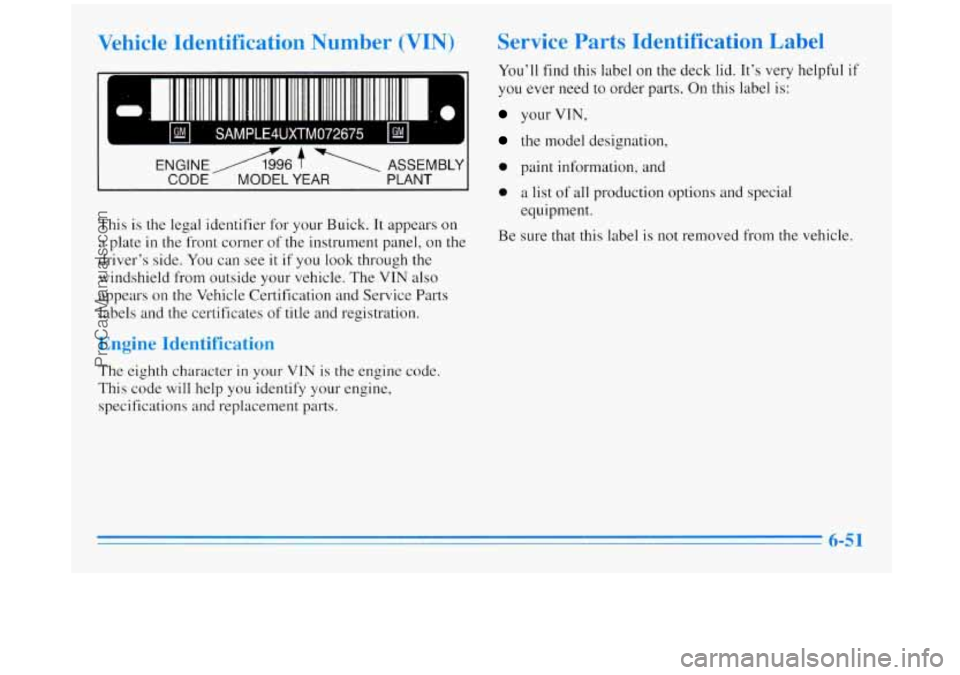
This is the legal identifier for your Buick. It appears on
a plate in the front corner of the instrument panel, on the
driver‘s side. You can see
it if you look through the
windshield from outside your vehicle. The VIN also
appears
on the Vehicle Certification and Service Parts
labels and the certificates
of title and registration.
Engine Identification
The eighth character in your VIN is the engine code.
This code
will help you identify your engine,
specifications and replacement parts.
Service Parts Identification Label
You’ll find this label on the deck lid. It’s very helpful if
you ever need to order parts. On this label is:
your VIN,
the model designation,
0 paint information, and
0 a list of all production options and special
equipment.
Be sure that this label is not removed from the vehicle.
6-51
ProCarManuals.com
Page 278 of 356

Underhood Electrical Center -- Passenger's Side
Some fuses are in the underhood electrical center on the
passenger's side
of the engine compartment.
ODD RICMPT REL ECM BAT
~~~ A!C CONT TCC
~~~ FllNJN ECM IGN ELEK IGN
--
I l4 II I -1 J
Fuse Description
R/CMPT REL Remote Trunk Release
ECM BAT Powertrain Control Module
(PCM),
Fuel Pump, Fuel Pump
Relay, Fan Cont
#1 Relay
A/C CONT
TCC
F/IN J N
A/C CMPR Relay (VIN M only)
Automatic Transaxle, Transaxle
Range
Switch
Fuel Injectors
6-56
ProCarManuals.com
Page 280 of 356

Und ’ hood Elect
Additional fuses are in the underhood electrical center
on the driver’s side
of the engine compartment.
DDD FOG LPS PARKLPS HORN
Fuse
PARK LPS
HORN
VAR P/S
ABS
Description
Headlamp Switch
Horn Relay, Underhood Lamp
EVO Steering
Anti-Lock Brake System
6-58
ProCarManuals.com
Page 283 of 356
Capacities and Specifications
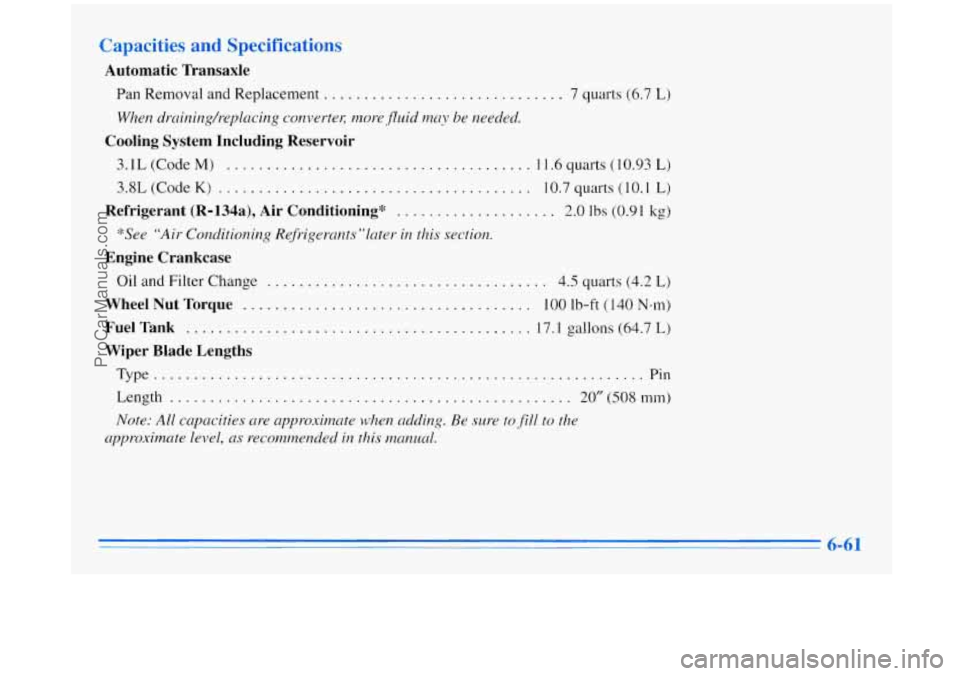
Automatic Transaxle
Pan Removal and Replacement .............................. 7 quarts (6.7 L)
When draiizilzg/replacil.Ig convertec more,fluid may be needed.
Cooling System Including Reservoir
3.1L(CodeM) ...................................... 11.6quarts(10.93L)
3.8L (Code
K) ....................................... 10.7 quarts (10.1 L)
Refrigerant (R-l34a), Air Conditioning* .................... 2.0 lbs (0.91 kg)
*See “Air Conditioning Refriger~-lnts”l~~tel- in th,is section.
Engine Crankcase
Oil and Filter Change ................................... 4.5 quarts (4.2 L)
Wheel Nut Torque .................................... 100 Ib-ft (140 N.m)
Fuel Tank ........................................... 17.1 gallons (64.7 L)
Wiper Blade Lengths
Type ............................................................. Pin
Length
.................................................. 20”(508mm)
Note: All capacities are approximate when adding. Be sure to Jill to the
approximate level, as recommended in this manual.
6-61
ProCarManuals.com
Page 284 of 356
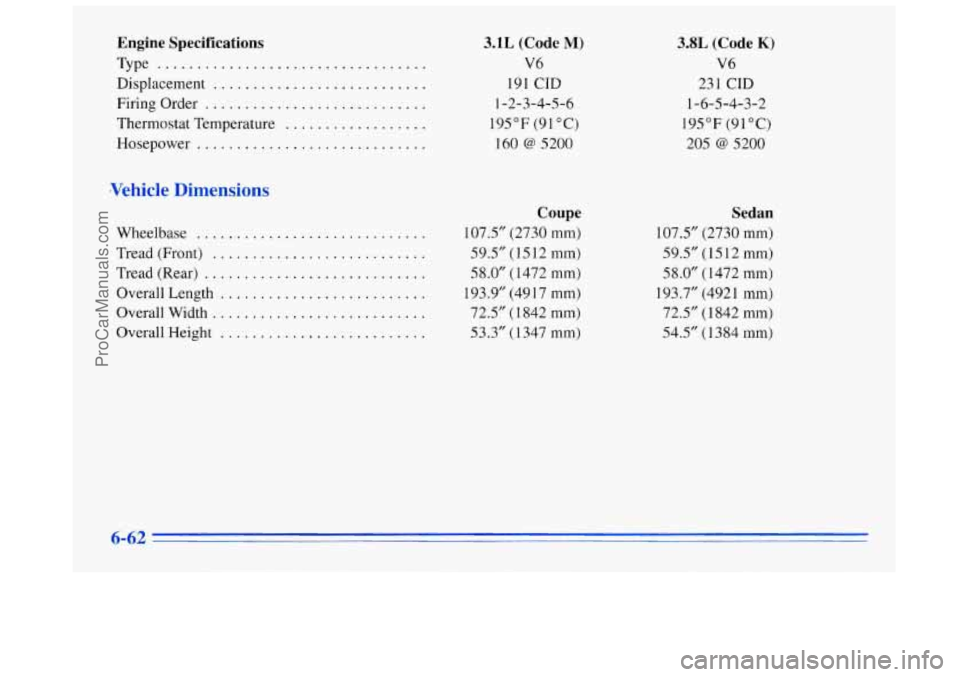
Engine Specifications
Type ..................................
Displacement ...........................
Thermostat Temperature ..................
Firing Order ............................
Hosepower .............................
-Vehicle Dimensions
Wheelbase .............................
Tread (Front) ...........................
Tread (Rear) ............................
Overall Length ..........................
Overall Width ...........................
Overall Height ..........................
3.1L (Code M)
V6
191 CID
1-2-3-4-5-6
195°F (91°C) 160
0 5200
Coupe
107.5” (2730 mm)
59.5”
(1 5 12 mm)
58.0” (1472
mm)
193.9” (49 17 mm)
72.5” (1 842 mm)
53.3” (1 347 mm)
3.8L (Code K)
V6
231
CID
1-6-5-4-3-2
195°F (91°C)
205 0 5200
Sedan
107.5” (2730 mm)
59.5” (15 12 mm)
58.0” (1472 mm)
193.7” (492
1 mm)
72.5”
(1 842 mm)
54.5”
(1 384 mm)
6-62
ProCarManuals.com
Page 285 of 356
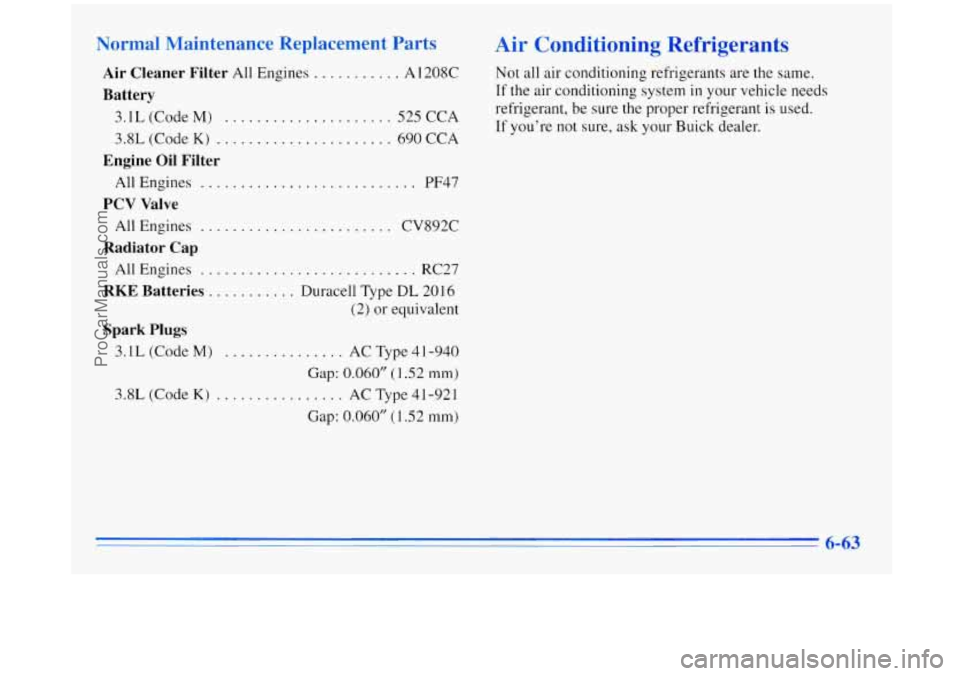
Normal Maintenance Replacement Parts
Air Cleaner Filter All Engines ........... A 1208C
Battery
3.1L (Code M) ..................... 525 CCA
3.8L (Code
K) ...................... 690 CCA
Engine Oil Filter
PCV Valve
All Engines ........................... PF47
All Engines
........................ CV892C
Radiator Cap
All Engines ........................... RC27
RKE Batteries ........... Duracell Type DL 2016
(2) or equivalent
Spark Plugs
3.1L (Code M) ............... AC Type 41 -940
Gap: 0.060” (1.52 mm)
3.8L (Code K) ................ AC Type 41-921
Gap:
0.060” (1.52 mm)
Air Conditioning Refrigerants
Not all air conditioning refrigerants are the same.
If the air conditioning system in your vehicle needs
refrigerant, be sure the proper refrigerant is used.
If you’re not sure, ask your Buick dealer.
6-63
ProCarManuals.com
Page 287 of 356
Section 7 Maintenance Schedule
I IMPORTANT:
KEEP ENGINE OIL
I ’ 1
.
Introduction
Your Vehicle and the Environment
Proper vehicle maintenance not only helps to keep your
vehicle in good working condition, but also helps the
environment.
All recommended maintenance procedures
are important. Improper vehicle maintenance can even
affect the quality
of the air we breathe. Improper fluid
levels or the wrong tire inflation can increase the level
of emissions from your vehicle. To help protect our
environment, and to keep your vehicle in
good
condition, please maintain your vehicle properly.
I
This section covers the maintenance required for your
Buick. Your vehicle needs these services to retain its
safety, dependability and emission control performance.
F
I I
Have you purchased the GM Protection Plan? The Plan
supplements
your IWPV vehicle warrunties. See your
Warranty and Owner Assistance booklet, or your Buick
dealer
for details.
7-1
ProCarManuals.com
Page 290 of 356
Maintenance Schedule
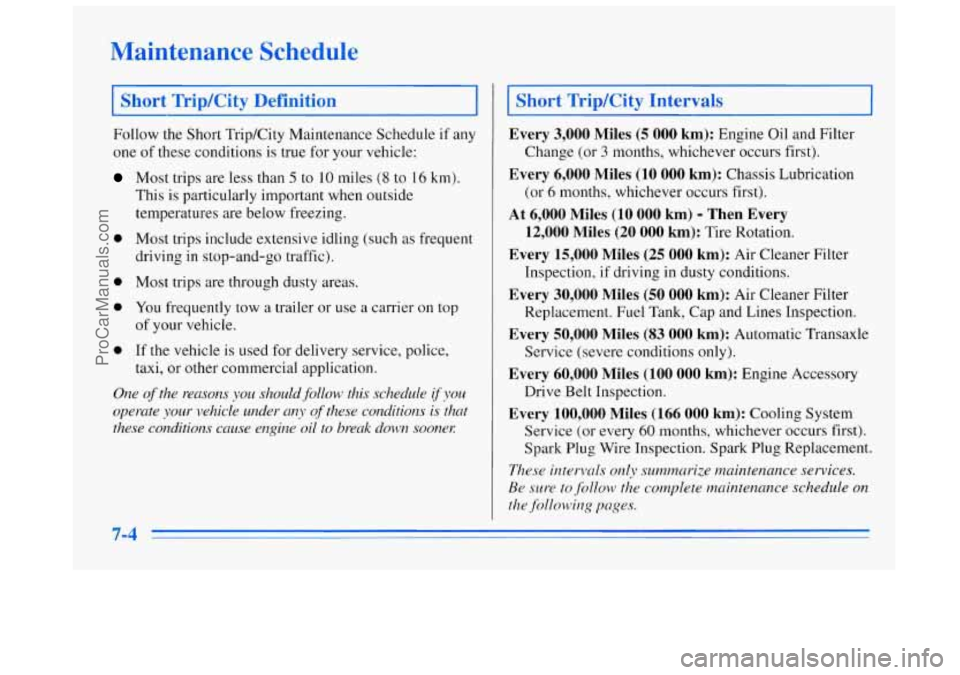
I Short Trip/City Defition I
Follow the Short Trip/City Maintenance Schedule if any
one
of these conditions is true for your vehicle:
Most trips are less than 5 to 10 miles (8 to 16 km).
This is particularly important when outside
temperatures
are below freezing.
0 Most trips include extensive idling (such as frequent
driving
in stop-and-go traffic).
0 Most trips are through dusty areas.
0 You frequently tow a trailer or use a carrier on top
of your vehicle.
0 If the vehicle is used for delivery service, police,
taxi, or other commercial application.
One of the reasons you should follow this schedule if you
operate your vehicle under any of these conditions is that
these conditions cause erzgirze oil to break down soonex
Short Trip/City Intervals
Every 3,000 Miles (5 000 km): Engine Oil and Filter
Change (or
3 months, whichever occurs first).
Every 6,000 Miles (10 000 km): Chassis Lubrication
(or
6 months, whichever occurs first).
At 6,000 Miles (10 000 km) - Then Every
12,000 Miles (20 000 km): Tire Rotation.
Every 15,000 Miles (25 000 km): Air Cleaner Filter
Inspection, if driving
in dusty conditions.
Every 30,000 Miles (50 000 km): Air Cleaner Filter
Replacement.
Fuel Tank, Cap and Lines Inspection.
Every 50,000 Miles (83 000 km): Automatic Transaxle
Service (severe conditions only).
Every 60,000 Miles (100 000 km): Engine Accessory
Drive Belt Inspection.
Every 100,000 Miles (166 000 km): Cooling System
Service (or every
60 months, whichever occurs first).
Spark Plug Wire Inspection. Spark Plug Replacement.
These ilztervnls on.ly summarize mainteuance services.
Be sure to follow th.e complete maintenance schedule on
the following pages.
7-4
ProCarManuals.com