seats BUICK REGAL 1996 Owners Manual
[x] Cancel search | Manufacturer: BUICK, Model Year: 1996, Model line: REGAL, Model: BUICK REGAL 1996Pages: 356, PDF Size: 17.97 MB
Page 3 of 356
The 1996 Buick Regal Owner’s Manual
7-
Seats and Restraint Systems ............................................................. 1-1
This section tells you how to use your seats and safety belts properly. It also explains “SRS” system.
This section explains how to start and operate your Buick.
This section tells you how to adjust the ventilation and comfort controls and how to operate your
audio system.
Here you’ll find helpful information and tips about the road and how to drive under different conditions.
This section tells you
what to do if you have a problem while driving, such as a flat tire or
overheated engine, etc.
Here the manual tells you how to keep
your Buick running properly and looking good.
This section tells
you when to perform vehicle maintenance and what fluids and lubricants to use.
This section tells you how to contact Buick for assistance and how to get service publications.
It also
gives you information on “Reporting Safety Defects” on page
8-7.
Index ........................................................................\
........ 9-1
Here’s an alphabetical listing of almost every subject in this manual. You can use it to quickly find something
you want to read.
Features and Controls .................................................................. 2-1
Comfort Controls and Audio Systems ..................................................... 3-1
YourDrivingandtheRoad .............................................................. 4-1
ProblemsontheRoad .................................................................. 5-1
Service and Appearance Care. ........................................................... 6-1
Maintenanceschedule .................................................................. 7-1
Customer Assistance Information ........................................................ 8-1
i
ProCarManuals.com
Page 15 of 356
Section 1 Seats and Restraint Systems
Here you’ll find information about the seats in your
Buick and how to use your safety belts properly. You
..
can also learn about some things you should not do with
air bags and safety belts.
Seats and Sest Controls
This section tells you how to adjust the seats and
explains the reclining seatbacks and head restraints.
Manual Front Seat
You can lose control of the vehicle if you try to
adjust a manual driver’s seat while the vehicle is
moving. The sudden movement could startle and
confuse you, or make you push a pedal when you
don’t want to. Adjust the driver’s seat only when
the vehicle
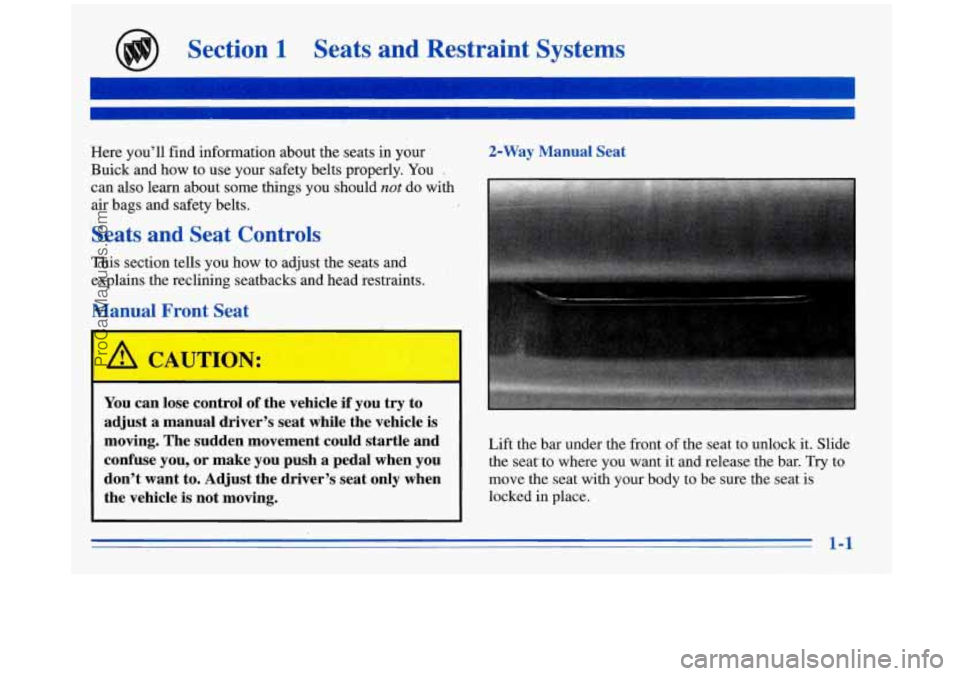
is not moving. 2-Way Manual Seat
Lift the bar under the front
of the seat to unlock it. Slide
the seat to where you want it and release the bar. Try to
move the seat with your body to be sure the seat is
locked in place.
1-1
ProCarManuals.com
Page 25 of 356
bw to Wear Safety Belts Properly
Adull
This part is only for people of adult size.
Be aware that there are special things to know about safety
belts and children. And there are different rules for smaller
children and babies. If
a child will be riding in your Buick,
see the part
of this manual called “Children.” Follow those
rules for everyone’s protection.
First, you’ll want to know which restraint systems your
vehicle has.
We’ll start with the driver position.
Driver Position
This part describes the driver’s restraint system.
Lap-Shoulder Belt
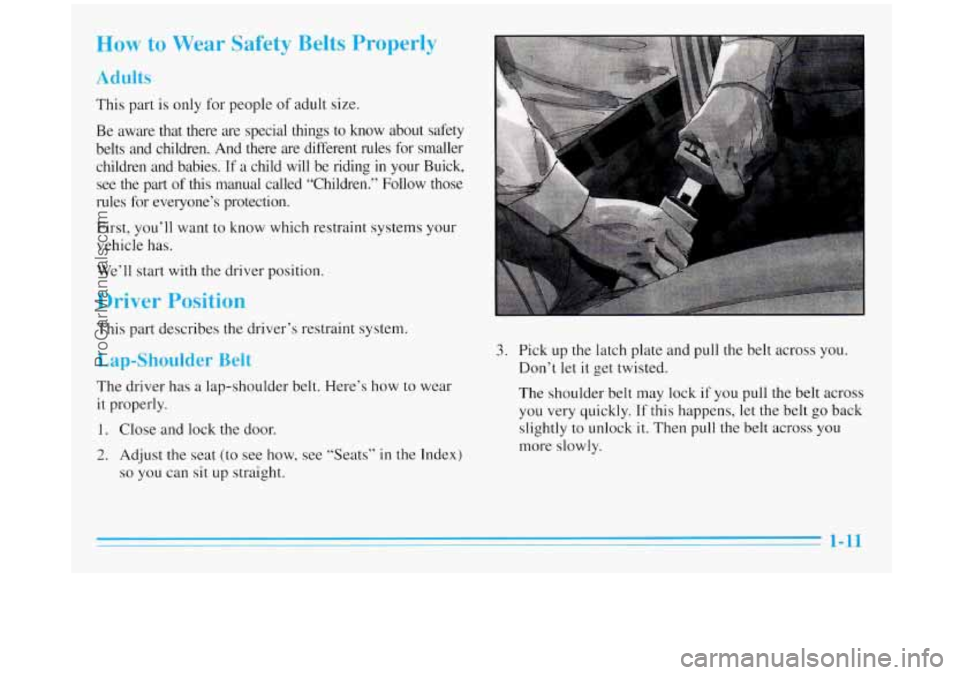
The driver has a lap-shoulder belt. Here’s how to wear
it properly.
1. Close and lock the door.
2. Adjust the seat (to see how, see “Seats’’ in the Index)
so you can sit up straight.
3. Pick up the latch plate and pull the belt across you.
Don’t let it get twisted.
The shoulder belt may lock if you
pull the belt across
you very quickly. If this happens, let the belt
go back
slightly
to unlock it. Then pull the belt across you
more slowly.
1-11
ProCarManuals.com
Page 59 of 356
7. Push and pull the child restraint in different
directions to be sure it is secure. If it isn’t, secure
the
restraint in a different place in the vehicle and
contact the child restraint maker for their advice
about how to attach the child restraint properly.
To remove the child restraint, just unbuckle the vehicle’s
safety belt. It will be ready to work for an adult or larger
child passenger.
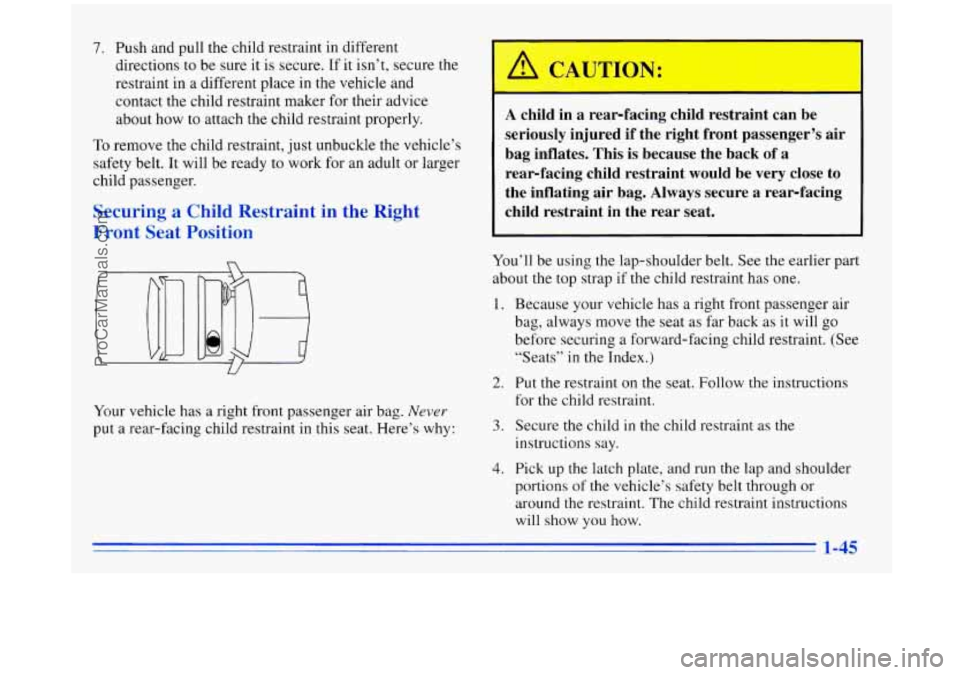
Securing a Child Restraint in the Right
Front Seat Position
U
Your vehicle has a right front passenger air bag. Never
put a rear-facing child restraint in this seat. Here’s why:
A child in a rear-facing child restraint can be
seriously injured if the right front passenger’s air
bag inflates. This is because the back of a
rear-facing child restraint would be very close to
the inflating air bag. Always secure a rear-facing
child restraint in the rear seat.
You’ll be using the lap-shoulder belt. See the earlier part
about
the top strap if the child restraint has one.
1.
2.
3.
4.
Because your vehicle has a right front passenger air
bag, always move the seat as far back as it will go
before securing a forward-facing child restraint. (See
“Seats”
in the Index.)
Put the restraint
on the seat. Follow the instructions
for the child restraint.
Secure the child
in the child restraint as the
instructions
say.
Pick up the latch plate, and run the lap and shoulder
portions of the vehicle’s safety belt through or
around the restraint. The child restraint instructions
will show you how.
1-45
ProCarManuals.com
Page 80 of 356
Automatic Transaxle Operation
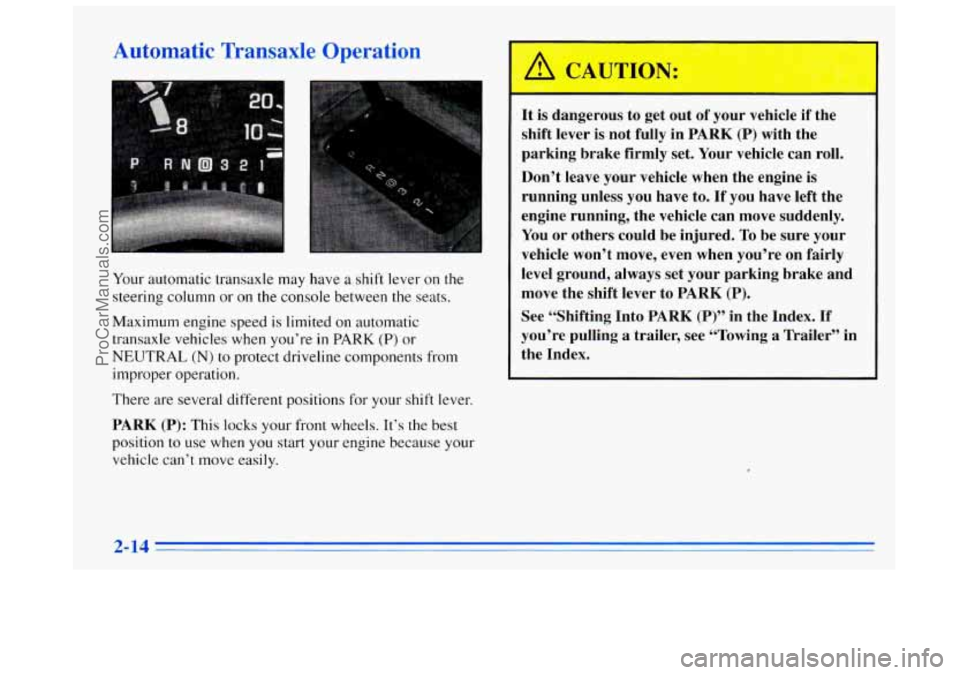
Your automatic transaxle may have a shift lever on the
steering column
or on the console between the seats.
Maximum engine speed is limited
on automatic
transaxle vehicles when you’re
in PARK (P) or
NEUTRAL (N) to protect driveline components from
improper operation.
There are several different positions for your shift lever.
PARK (P): This locks your front wheels. It’s the best
position to use
when you start your engine because your
vehicle can’t move easily.
It is dangerous to get out of your vehicle if the
shift lever is not fully in
PARK (P) with the
parking brake firmly set. Your vehicle can roll.
Don’t leave your vehicle when the engine is
running unless you have to.
If you have left the
engine running, the vehicle can move suddenly.
You or others could be injured.
To be sure your
vehicle won’t move, even when you’re on fairly
level ground, always
set your parking brake and
move the shift lever to
PARK (P).
See “Shifting Into PARK (P)” in the Index. If
you’re pulling a trailer, see “Towing a Trailer” in
the Index.
ProCarManuals.com
Page 129 of 356
Ventilation Tips
0
0
0
0
For mild outside temperatures when little heating or
cooling is needed, use VENT to direct outside air
through your vehicle.
Keep the hood and front air inlet free of ice, snow or
any other obstruction, such
as leaves. The heater and
defroster will work far better, reducing the chance of
fogging the inside of your windows.
When you enter
a vehicle in cold weather, adjust the
mode to HTR and the fan to the highest speed for a
few moments before driving off. This helps clear the
intake ducts
of snow and moisture and reduces the
chance
of fogging the inside of your windows.
Keep the air path under the front seats clear of
objects. This helps air to circulate throughout
your vehicle.
Defogging and Defrosting
Your system has two settings for clearing the front and
side windows.
To defrost the windows quickly, use
FRONT with the temperature lever all the way to
WARM.
To warm passengers while keeping the
windows clean, use BLEND.
For maximum defrost performance, both the driver’s
and passenger’s temperature controls should be
in the
full warm position. To do this, push the DUAL button so
that the light goes out. The driver can then control both
sides with the main temperature control. Slide the lever
all the way toward WARM.
ProCarManuals.com
Page 180 of 356
Do not load your vehicle any heavier than the
GVWR, or either the maximum front or rear
GAWR. If you do, parts on your vehicle can
break, or it can change the way your vehicle
handles. These could cause you to lose control.
Also, overloading can shorten the life of
your vehicle.
NOTICE:
Your warranty does not cover parts or
components that fail because of overloading.
If you put things inside your vehicle -- like suitcases,
tools, packages
or anything else -- they will go as fast as
the vehicle goes.
If you have to stop or turn quickly, or
if there is a crash, they’ll keep going.
Things you put inside your vehicle can strike
and injure people in
a sudden stop or turn, or
in
a crash.
Put things in the trunk of your vehicle. In a
trunk, put them as far forward as you can.
Try to spread the weight evenly.
0 Never stack heavier things, like suitcases,
inside the vehicle
so that some of them are
above the
tops of the seats.
Don’t leave an unsecured child restraint in
your vehicle.
When you carry something inside the
vehicle, secure it whenever you can.
4-28
ProCarManuals.com
Page 276 of 356
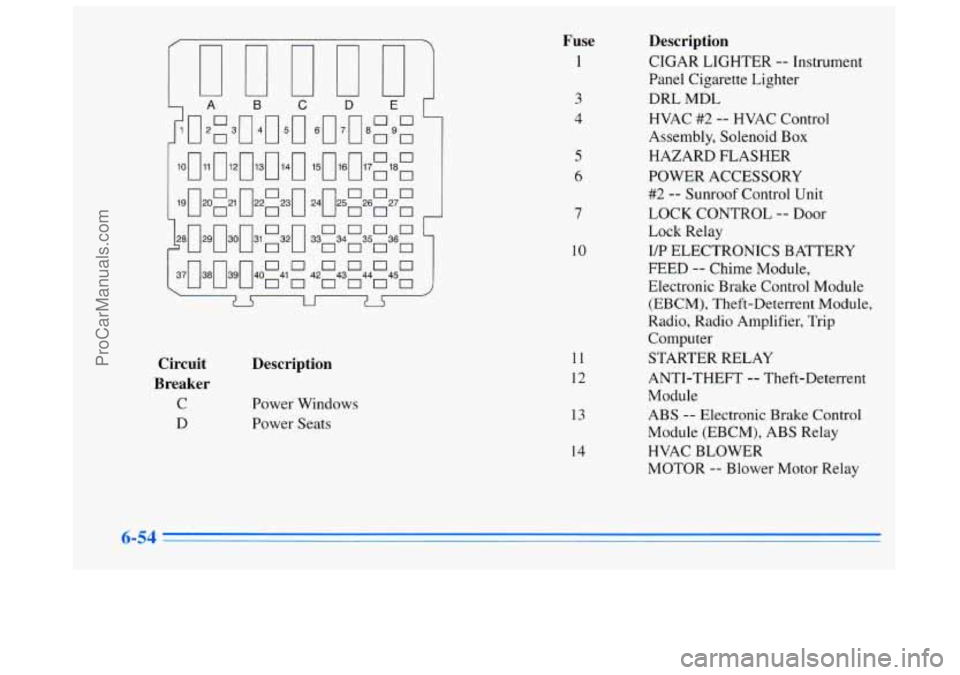
Circuit
Breaker
C
D
Description
Power Windows
Power Seats
Fuse
1
3
4
5
6
7
10
11
12
13
14
Description
CIGAR LIGHTER -- Instrument
Panel Cigarette Lighter
DRL MDL
HVAC
#2 -- HVAC Control
Assembly, Solenoid Box
HAZARD FLASHER
POWER ACCESSORY
#2 -- Sunroof Control Unit
LOCK CONTROL
-- Door
Lock Relay
I/P ELECTRONICS BATTERY
FEED
-- Chime Module,
Electronic Brake Control Module
(EBCM), Theft-Deterrent Module,
Radio, Radio Amplifier, Trip
Computer
STARTER RELAY
ANTI-THEFT
-- Theft-Deterrent
Module
ABS
-- Electronic Brake Control
Module (EBCM), ABS Relay
HVAC
BLOWER
MOTOR -- Blower Motor Relay
ProCarManuals.com
Page 352 of 356
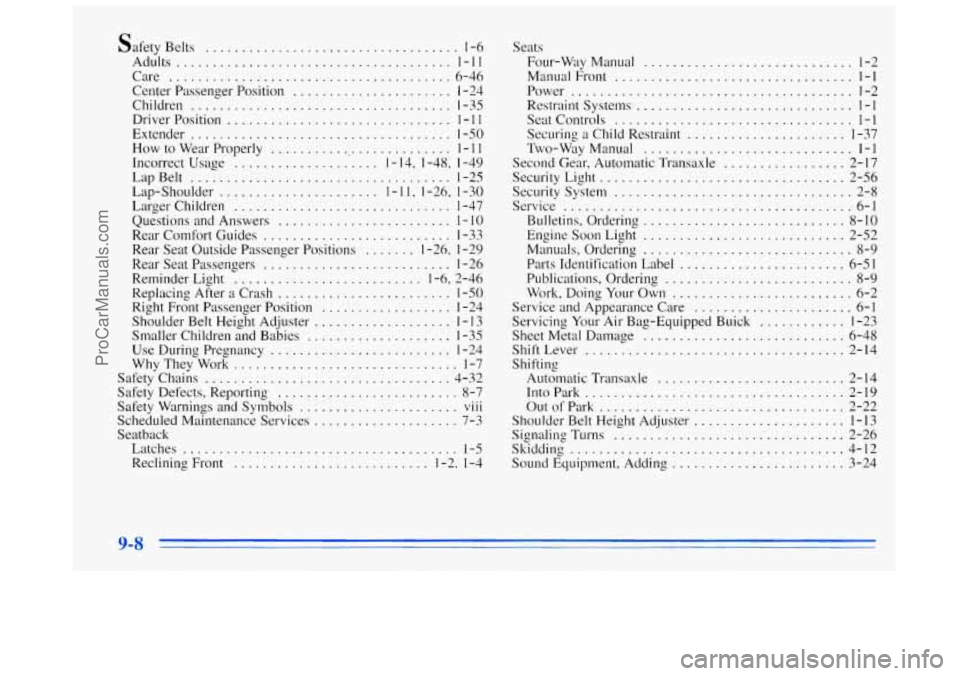
Safety Belts ................................... 1-6
Adults
...................................... 1-11
Care ....................................... 6-46
Children
.................................... 1-35
Driver Position ............................... I - 1 I
Extender .................................... 1-50
How to Wear Properly .......................... 1 - I 1
Incorrect Usage .................... 1 - 14, 1-48. 1-49
LapBelt
.................................... 1-25
Lap-Shoulder
...................... 1-1 1, 1-26. 1-30
Larger Children
.............................. 1-47
Questions and Answers
........................ 1 - IO
Rear Comfort Guides .......................... 1-33
Rear Seat Outside Passenger Positions
....... 1-26? 1-29
Rear Seat Passengers .......................... 1-26
Reminder Light
.......................... 1-6, 2-46
Replacing After a Crash
........................ 1-50
Right Front Passenger Position .................. 1-24
Shoulder Belt Height Adjuster
................... 1 - 13
Smaller Children and Babies
.................... 1-35
Use During Pregnancy ......................... 1-24
WhyTheyWork
............................... 1-7
Safety Chains
.................................. 4-32
Safety Defects, Reporting
......................... 8-7
Center
Passenger Position
...................... 1-24
... Safety Warnings and Symbols ...................... vl11
Scheduled Maintenance Services .................... 7-3
Seatback
Latches
...................................... 1-5
Reclining Front ........................... 1-2 . 1-4 Seats
Four-Way Manual
............................. 1-2
Manual Front ................................. 1-1
Power ....................................... 1-2
Restraint Systems
.............................. 1-1
Seat Controls ................................. 1-1
Securing a Child Restraint ...................... 1-37
Two-way Manual
............................. 1-1
Second Gear. Automatic Transaxle ................. 2-17
Security Light
.................................. 2-56
Security System
................................. 2-8
Bulletins. Ordering
............................ 8-10
Engine
Soon Light ............................ 2-52
Manuals. Ordermg
............................. 8-9
Parts Identification Label
....................... 6-51
Publications. Ordering .......................... 8-9
Work. Doing Your Own ......................... 6-2
Service and Appearance Care
...................... 6-1
Servicing Your Air Bag-Equipped Buick
............ 1-23
Sheet Metal Damage
............................ 6-48
ShiftLever
.................................... 2-14
Shifting Automatic Transaxle
.......................... 2-14
IntoPark
.................................... 2-19
Outofpark
.................................. 2-22
Shoulder Belt Height Adjuster
..................... 1-13
Signaling Turns
................................ 2-26
Sound Equipment. Adding
........................ 3-24
Service ........................................ 6-1
Skidding
...................................... 4-12
9-8
ProCarManuals.com