service BUICK REGAL 1997 User Guide
[x] Cancel search | Manufacturer: BUICK, Model Year: 1997, Model line: REGAL, Model: BUICK REGAL 1997Pages: 422, PDF Size: 21.34 MB
Page 101 of 422
AUTOMATIC OVERDRIVE (0): This position is
for normal driving. If you need more power for passing,
and you’re:
Going less than 35 mph (56 kmh), push your
Going about 35 mph (56 kmk) or more, push the
accelerator pedal about
halfway down.
accelerator pedal all the way down.
You’ll shift down to the
next gear and have
more power.
NOTICE:
I If your vehicle seems to start up rather slowly,
or
if it seems not to shift gears as you go faster,
something may be wrong with a transaxle system
sensor.
If you drive very far that way, your
vehicle can be damaged.
So, if this happens, have
your vehicle serviced right away. Until then, you
can use SECOND
(2) when you are driving less
than
35 mph (56 km/h) and AUTOMATIC
OVERDRIVE (0) for higher speeds.
THIRD (3): This position is also used for normal
driving, but it offers more power and lower fuel
economy than AUTOMATIC OVERDRIVE
(@).
Here are some times you might choose THIRD (3)
instead of AUTOMATIC OVERDRIVE (0):
When driving on hilly, winding roads.
When towing a trailer, so there is less shifting
When going down a steep hill.
When driving in non-highway scenarios (i.e. city
between
gears.
streets, etc.).
2-25
~
ProCarManuals.com
Page 129 of 422
NOTICE:
Adding some electrical equipment to your vehicle
can damage it
or keep other things from working
as they should. This wouldn’t be covered by your
warranty. Check with your dealer before adding
electrical equipment and never use anything that
exceeds the fuse rating.
Auxiliary Power Connection
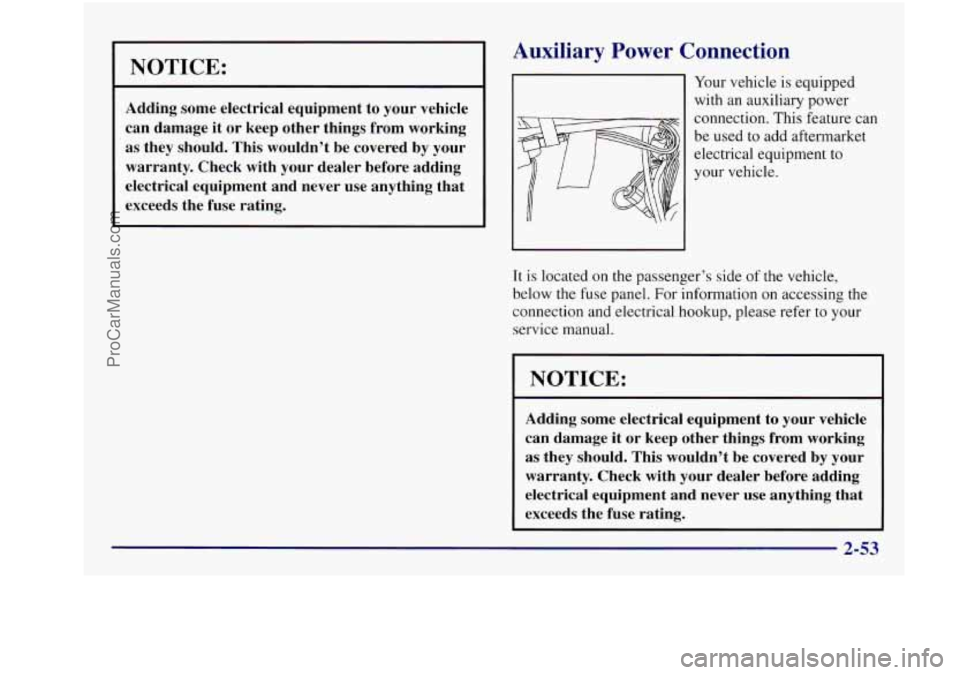
Your vehicle is equipped
with an auxiliary power
connection. This feature can
be used
to add aftermarket
electrical equipment to your vehicle.
It is located on the passenger’s side
of the vehicle,
below the fuse panel.
For information on accessing the
connection and electrical hookup, please refer to your
service manual.
I NOTICE:
Adding some electrical equipment to your vehicle
can damage it or keep other things from working
as they should. This wouldn’t be covered by your
warranty. Check with your dealer before adding
electrical equipment and never use anything that
exceeds the fuse rating.
2-53
ProCarManuals.com
Page 136 of 422

Air Bag Readiness Light
There is an air bag readiness light on the instrument
panel, which shows the air bag symbol.
The system
checks the air bag’s electrical system for malfunctions.
The light tells you if there is an electrical problem.
The system check includes the air bag modules, the
wiring and the crash sensing and diagnostic module. For
more information on the air bag system, see “Air Bag”
in the Index.
This light will come on
when you start your engine,
and
it will flash for a few
seconds. Then the light
should
go out. This means
the system is ready.
If the air bag readiness light stays on after you start the
engine or comes on when you are driving, your air bag
system may not work properly. Have your vehicle
serviced right away. The
air bag readiness light should flash for
a few
seconds when you turn the ignition key to
RUN. If the
light doesn’t come on then, have it fixed
so it will be
ready to warn you
if there is a problem.
Charging System Light
The charging system light
will come
on briefly when
you turn on the ignition,
as
a check to show you it’s
working. Then it should
1+1 go out.
##
If it stavgdn, or comes on while you are driving, you
may b&e
a problem with the charging system. It could
inqk6ate that you have
a loose drive belt or another
dectrical problem. Have it checked right away.
Driving while this light is on could drain your battery.
If you must drive a short distance with the light on, be
certain to turn off all your accessories, such
as the radio
and air conditioner.
2-60
ProCarManuals.com
Page 137 of 422
Brake System Warning Light
Your Buick’s hydraulic brake system is divided into two
parts. If one part isn’t working, the other part can still
work and stop you. For good braking, though, you need
both parts working well.
If the warning light comes on, there could be a brake
problem. Have your brake system inspected right away.
This light should come on briefly when you turn
the ignition key
to RUN.
If it doesn’t come on then,
have it fixed
so it will
be ready to warn you if
there’s a problem.
BRAKE
If the light comes on while you are driving, pull off the
road and stop carefully. You may notice that
the pedal is
harder to push.
Or, the pedal may go closer to the floor.
It may take longer to stop. If the light is still on, or
if the anti-lock brake system warning light
is flashing, have
the vehicle towed for service. (See “Anti-Lock Brake
System Warning Light” and “Towing Your Vehicle” in
the Index.)
Your brake system may not be working properly
if the brake system warning light is on. Driving
with the brake system warning light on can lead
to an accident. If the light is still on or if the
anti-lock brake system warning light is flashing
after you’ve pulled off the road and stopped
carefully, have the vehicle towed for service.
When the ignition is on, the brake system warning light will also come on when you’ set your parking brake. The
light will stay on if your parking brake doesn’t release
fully. If
it stays on after your parking brake is fully
released, it means you have a brake problem.
2-61
ProCarManuals.com
Page 138 of 422
Anti-Lock Brake System Warning Light
ANTI -
LOCK
With the anti-lock brake
system, this light will
come
on when you start
your engine and it will
stay on for three seconds.
That’s normal.
If the light flashes when you’re driving, you don’t have
anti-lock brakes and there could be a problem with your
regular brakes. Pull off the road and stop carefully.
You
may notice that the pedal is harder to push. Or, the pedal
may go closer to the floor.
It may take longer to stop.
Have the vehicle towed for service. (See “Towing Your
Vehicle” in the Index.)
Your regular brake system may not be working
properly if the anti-lock brake system warning
light is flashing. Driving with the anti-lock
brake system warning light flashing can lead
to an accident. After you’ve pulled off the road
and stopped carefully, have the vehicle towed
for service.
I
If the anti-lock brake system warning light stays on
longer than normal after you’ve started your engine, turn
the ignition off. Or, if the light comes on and stays on
when you’re driving, stop as soon as possible and turn
the ignition off. Then start the engine again to reset the
system. If the light still stays on, or comes on again
while you’re driving, your Buick needs service. If the
light
is on but not flashing and the regular brake system
warning light isn’t on, you still have brakes, but you
don’t have anti-lock brakes.
The anti-lock brake system warning light should come
on briefly when
you turn the ignition key to RUN. If the
light doesn’t come
on then, have it fixed so it will be
ready to warn
you if there is a problem.
2-62
ProCarManuals.com
Page 140 of 422
0 If the Enhanced Traction System warning light
comes on and stays on for an extended period of
time when the system is turned on your vehicle
needs service. Adjust your driving accordingly.
If the traction control system is affected by an
engine-related problem, the system will turn off and
the warning light will come on. When this warning
light
is on, the system will not limit wheel spin.
Adjust your driving accordingly.
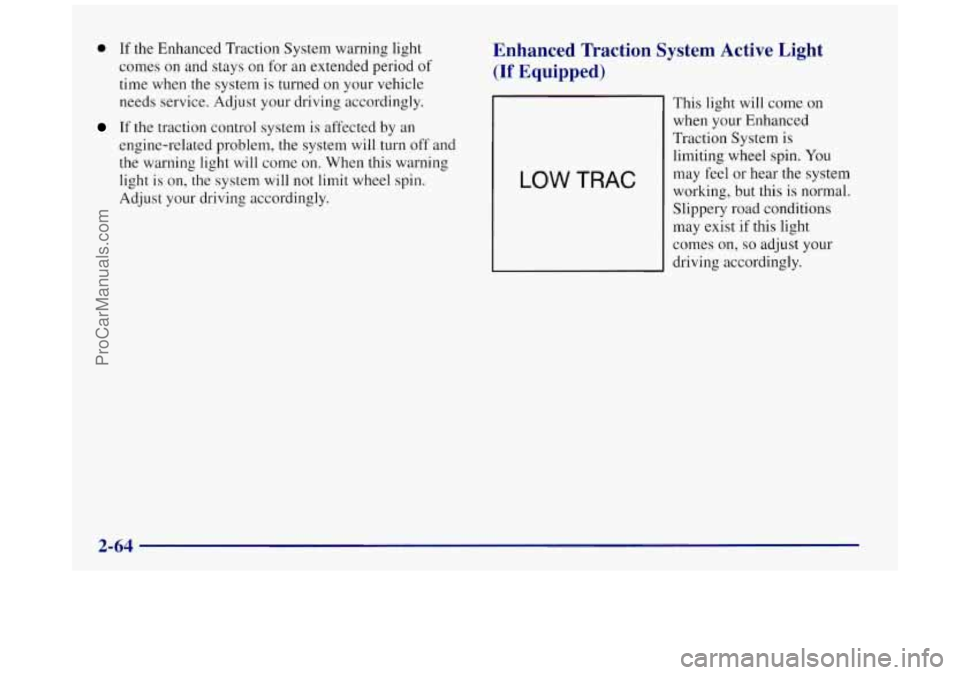
Enhanced Traction System Active Light
(If Equipped)
LOW TRAC
This light will come on
when your Enhanced
Traction System is
limiting wheel spin. You
may feel
or hear the system
working, but this is normal.
Slippery road conditions
may exist if this light
comes on,
so adjust your
driving accordingly.
2-64
ProCarManuals.com
Page 145 of 422
Low Coolant Warning Light
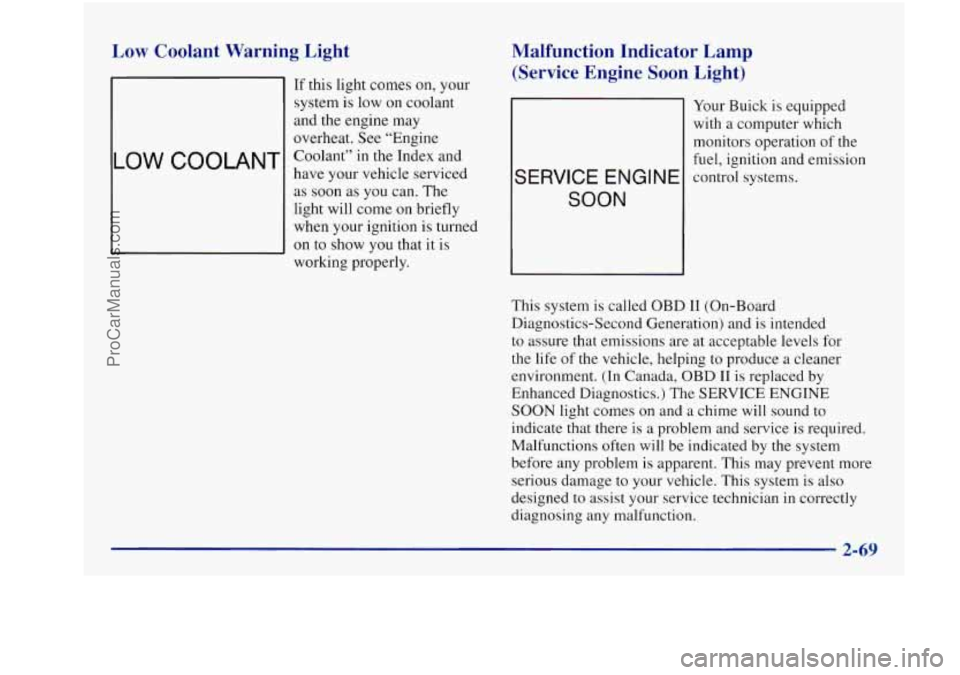
I OW COOLANT
If this light comes on, your
system is low on coolant
and the engine may
overheat. See “Engine
Coolant” in the Index and
have your vehicle serviced as soon as you can.
The
light will come on briefly
when your ignition is turned
on to show you that it is
working properly.
Malfunction Indicator Lamp (Service Engine Soon Eight)
SERVICE ENGINE
SOON
Your Buick is equipped
with a computer which
monitors operation
of the
fuel, ignition and emission
control systems.
This system is called OBD
I1 (On-Board
Diagnostics-Second Generation) and
is intended
to assure that emissions are at acceptable levels for
the life of the vehicle, helping to produce a cleaner
environment. (In Canada,
OBD I1 is replaced by
Enhanced Diagnostics.) The
SERVICE ENGINE
SOON light comes on and a chime will sound to
indicate that there is a problem and service is required.
Malfunctions often will be indicated by the system
before any problem is apparent. This may prevent more
serious damage to your vehicle. This system is also
designed to assist your service technician
in correctly
diagnosing any malfunction.
2-69
-.
ProCarManuals.com
Page 146 of 422

NOTICE:
If you keep driving your vehicle with this light
on, after a while, your emission controls may not
work as well, your fuel economy may not be as
good and your engine may not run as smoothly.
This could lead
to costly repairs that may not be
covered by your warranty.
This light should come on, as a check to show you it is
working, when the ignition is on and the engine is not
running.
If the light doesn’t come on, have it repaired.
This light will also come on during a malfunction in one
of two ways:
0
0
Light Flashing -- A misfire condition has been
detected.
A misfire increases vehicle emissions and
may damage the emission control system on your
vehicle. Dealer or qualified service center diagnosis
and service is required.
Light On Steady -- An emission control system
malfunction has been detected on your vehicle.
Dealer or qualified service center diagnosis and
service may be required.
If the Light Is Flashing
The following may prevent more serious damage to
your vehicle:
Reducing vehicle speed.
0 Avoiding hard accelerations.
0 Avoiding steep uphill grades.
0 If you are towing a trailer, reduce the amount of
cargo being hauled as soon as it is possible.
If the light stops flashing and remains on steady, see “If
the Light Is On Steady” following.
If the light continues to flash, when
it is safe to do so,
stop the vehicle. Find a safe place to park your vehicle.
Turn the key off, wait at least 10 seconds and restart the
engine. If the light remains on steady, see “If the Light
Is On Steady” following. If the light is still flashing,
follow the previous steps, and drive the vehicle to your
dealer or qualified service center for service.
2-70
ProCarManuals.com
Page 147 of 422
If the Light Is On Steady
You may be able to correct the emission system
malfunction by considering the following:
Did you recently
put fuel into your vehicle?
If
so, reinstall the fuel cap, making sure to fully install
the cap. The diagnostic system can determine
if the fuel
cap has been left
off or improperly installed. A loose or
missing fuel cap will allow fuel to evaporate into the
atmosphere.
A few driving trips with the cap properly
installed should turn
the light off.
Did you just drive through a deep puddle of water?
If
so, your electrical system may be wet. The condition
will usually be corrected when the electrical system
dries out.
A few driving trips should turn the light off.
Have you recently changed brands of fuel?
If
so, be sure to fuel your vehicle with quality fuel (see
“Fuel” in the Index). Poor fuel quality will cause your
engine not to run as efficiently as designed. You may
notice this as stalling after start-up, stalling when you
put the vehicle into gear, misfiring, hesitation on
acceleration or stumbling on acceleration. (These
conditions may go away once the engine is warmed up.)
This will be detected by the system and cause the light
to
turn on. If you
experience one or more of these conditions,
change the
fuel brand you use. It will require at least one
full tank of the proper fuel to turn the light off.
If none of the above steps have made the light turn off,
have your dealer or qualified service center check the vehicle. Your dealer has the proper test equipment and
diagnostic tools
to fix any mechanical or electrical
problems that may have developed.
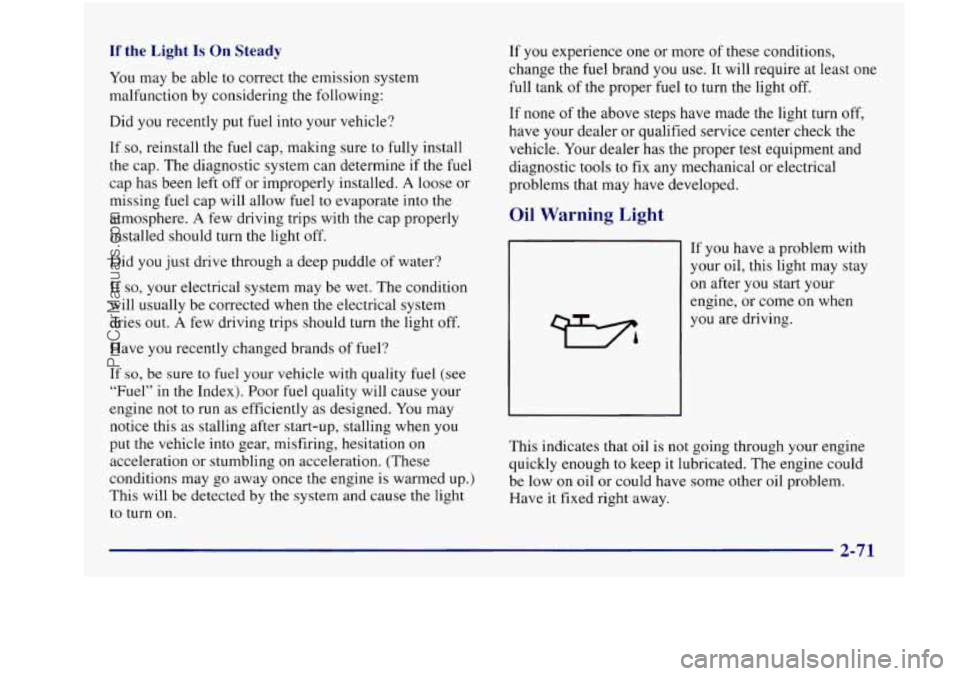
Oil Warning Light
If you have a problem with
your oil, this light may stay
on after you start your
engine,
or come on when
you are driving.
This indicates that oil is not going through your engine
quickly enough to keep it lubricated. The engine could
be low on oil or could have some other oil problem.
Have it fixed right away.
2-71
ProCarManuals.com
Page 148 of 422
The oil light could also come on in the following situations:
The light will come on briefly when you turn on the
ignition to show you that it is working properly.
(If it
doesn’t come on with the ignition on, you may have
a
problem with the fuse or bulb. Have it fixed right away.)
0 Sometimes when the engine is idling at a stop, the
light may blink on and
off. This is normal.
Don’t keep driving if the oil pressure is low. If
you do, your engine can become so hot that it
catches fire. You
or others could be burned.
Check your oil as soon as possible and have
your vehicle serviced.
NOTICE:
Damage to your engine from neglected oil problems can be costly and is not covered by
your warranty.
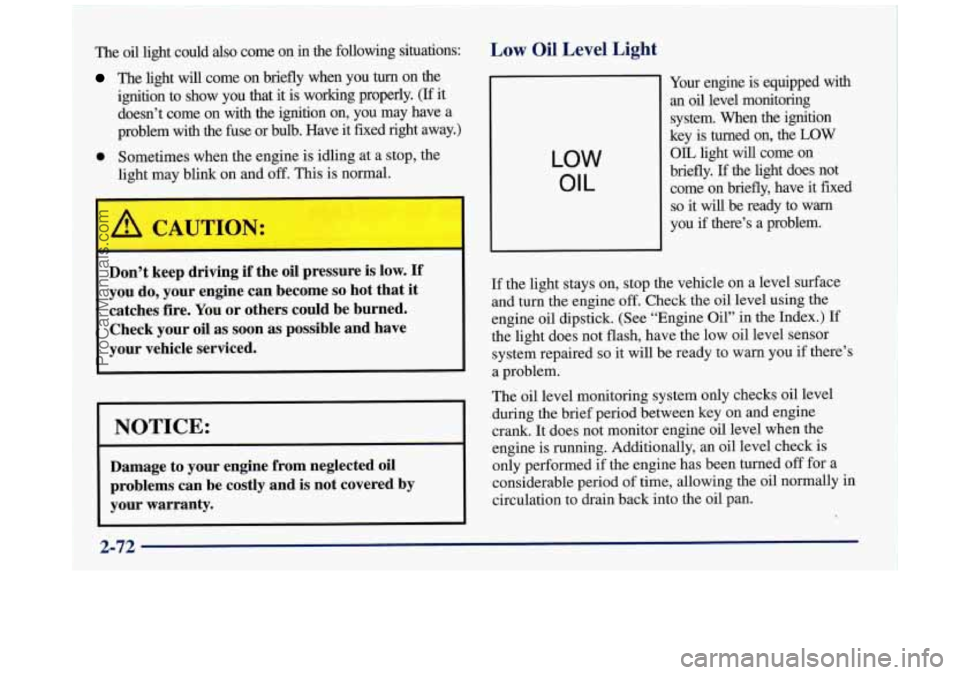
Low Oil Level Light
LOW
OIL
Your engine is equipped with
an oil level monitoring
system. When
the ignition
key is turned on, the
LOW
OIL light will come on
briefly.
If the light does not
come on briefly, have it fixed
so it will be ready to warn
you if there’s a problem.
If the light stays on, stop the vehicle on a level surface
and turn the engine
off. Check the oil level using the
engine oil dipstick. (See “Engine Oil” in the Index.)
If
the light does not flash, have the low oil level sensor
system repaired
so it will be ready to warn you if there’s
a problem.
The oil level monitoring system only checks oil level
during the brief period between key
on and engine
crank. It does not monitor engine oil level when the
engine is running. Additionally, an oil level check is
only performed if
the engine has been turned off for a
considerable period of time, allowing the oil normally in
circulation to drain back into the oil pan.
2-72
ProCarManuals.com