trunk BUICK REGAL 1997 User Guide
[x] Cancel search | Manufacturer: BUICK, Model Year: 1997, Model line: REGAL, Model: BUICK REGAL 1997Pages: 422, PDF Size: 21.34 MB
Page 227 of 422
Run your engine only as long as you must. This saves
fuel. When you run the engine, make it go a little faster
than just idle. That is, push the accelerator slightly. This
uses less fuel for the heat that you get and it keeps the
battery charged. You will need a well-charged battery to
restart the vehicle, and possibly for signaling later on
with your headlamps. Let the heater run for a while.
Then, shut the engine off and close the window almost
all the way to preserve the heat. Start the engine again
and repeat this only when
you feel really uncomfortable
from the cold. But do
it as little as possible. Preserve the
fuel as long as you can.
To help keep warm, you can get
out of the vehicle and do some fairly vigorous exercises
every half hour or
so until help comes.
Loading Your Vehicle
OCCUPANTS VEHICLE CAP. WT.
TIRE-LOADING INFORMATION
FRT. CTR. RR. TOTAL LBS. KG
MAX. LOADING & GVWR SAME AS VEHICLE
CAPACITY WEIGHT XXX COLD TIRE
TIRE SIZE SPEED PRESSURE
RTG PSIlKPa
FRT.
RR.
SPA.
IF TIRES ARE HOT,
ADD 4PSIi28KPa
SEE OWNER’S MANUAL
FOR ADDITIONAL
, INFORMATION
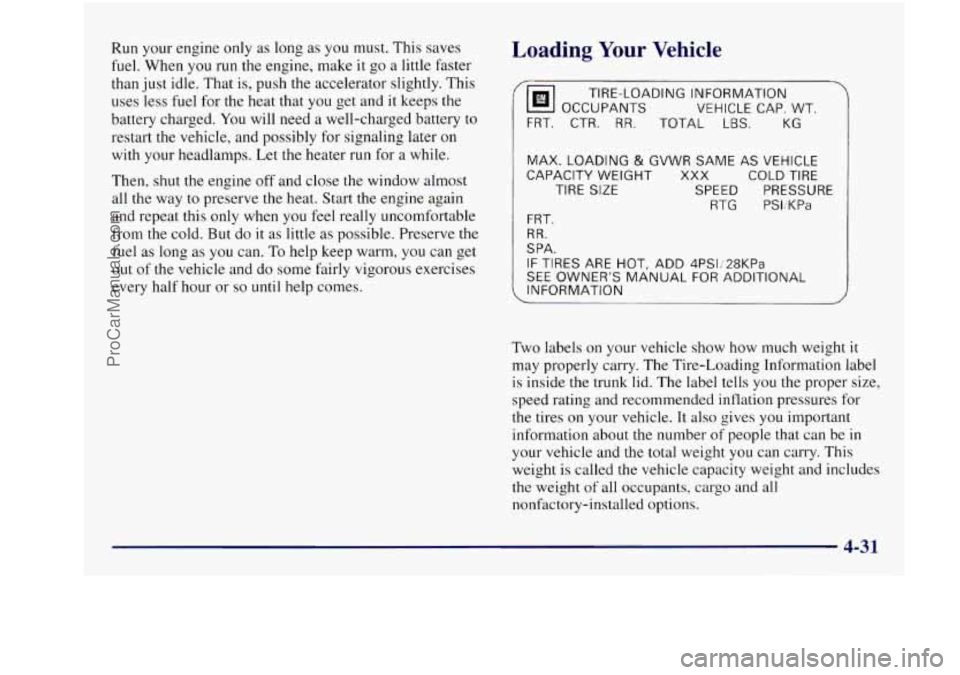
Two labels on your vehicle show how much weight it
may properly carry. The Tire-Loading Information label
is inside the trunk lid. The label tells you the proper size,
speed rating and recommended inflation pressures for
the tires on your vehicle. It also gives you important
information about the number
of people that can be in
your vehicle and the total weight you can carry. This
weight is called the vehicle capacity weight and includes
the weight of all occupants, cargo and all
nonfactory-installed options.
4-31
ProCarManuals.com
Page 228 of 422
MFD BY GENERAL MOTORS CORP
DATE
GVWR GAWR FRT GAWR RR
THIS VEHICLE CONFORMS TO ALL APPLI-
CABLE
U.S. FEDERAL MOTOR VEHICLE
SAFETY, BUMPER, AND THEFT PREVENTION
STANDARDS IN EFFECT ON THE DATE
OF
MANUFACTURE SHOWN ABOVE.
I
Do not load your vehicle any heavier than the
GVWR, or either the maximum front or rear
GAWR. If you do, parts on your vehicle can
break, or it can change the
way your vehicle
handles. These could cause
you to lose control.
Also, overloading can shorten the life
of
your vehicle.
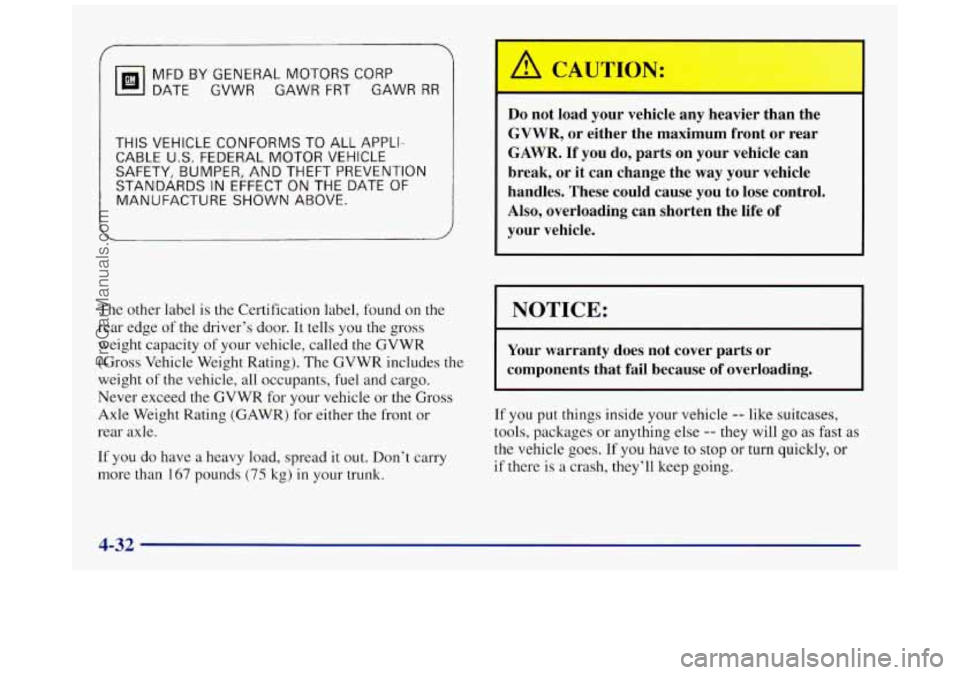
The other label is the Certification label, found on the
rear edge of the driver’s door. It tells you the gross NOTICE:
weight of the vehicle, all occupants, fuel and cargo.
(Gross
Vehicle Weight Rating). The GVWR includes the
Your warranty does not cover parts or weight capacity of your vehicle, called the GVWR
rear axle. tools, packages or anything else
-- they will go as fast as
Axle Weight Rating (GAWR) for either the front or If you put things inside your vehicle -- like suitcases,
Never exceed the GVWR for your vehicle or the Gross
components that fail because of overloading.
If you do have a heavy load, spread it out. Don’t carry
more than
167 pounds (75 kg) in your trunk. the vehicle
goes. If you have
to stop or turn quickly, or
if there is
a crash, they’ll keep going.
4-32
ProCarManuals.com
Page 229 of 422
Things you put inside your vehicle can strike
and injure people in
a sudden stop or turn, or in
a crash.
Put things in the trunk of your vehicle. In a
trunk, put them as far forward as you can.
Try to spread the weight evenly.
inside the vehicle
so that some of them are
above the tops of the seats.
0 Don’t leave an unsecured child restraint in
your vehicle.
When you carry something inside the
vehicle, secure it whenever you can.
0 Don’t leave a seat folded down unless you
need to.
Never stack heavier things, like suitcases,
Towing a Trailer
If you don’t use the correct equipment and drive
properly, you can lose control when you pull
a
trailer. For example, if the trailer is too heavy, the
brakes may not work well
-- or even at all. You
and your passengers could be seriously injured.
Pull a trailer only if you have followed all the
steps in this section. Ask your Buick dealer for
advice and information about towing
a trailer
with your vehicle.
NOTICE:
Pulling a trailer improperly can damage your
vehicle and result in costly repairs not covered by
your warranty. To pull a trailer correctly, follow
the advice in this part, and see your Buick dealer
for important information about towing a trailer
with your vehicle.
4-33
-. -
ProCarManuals.com
Page 232 of 422
A B
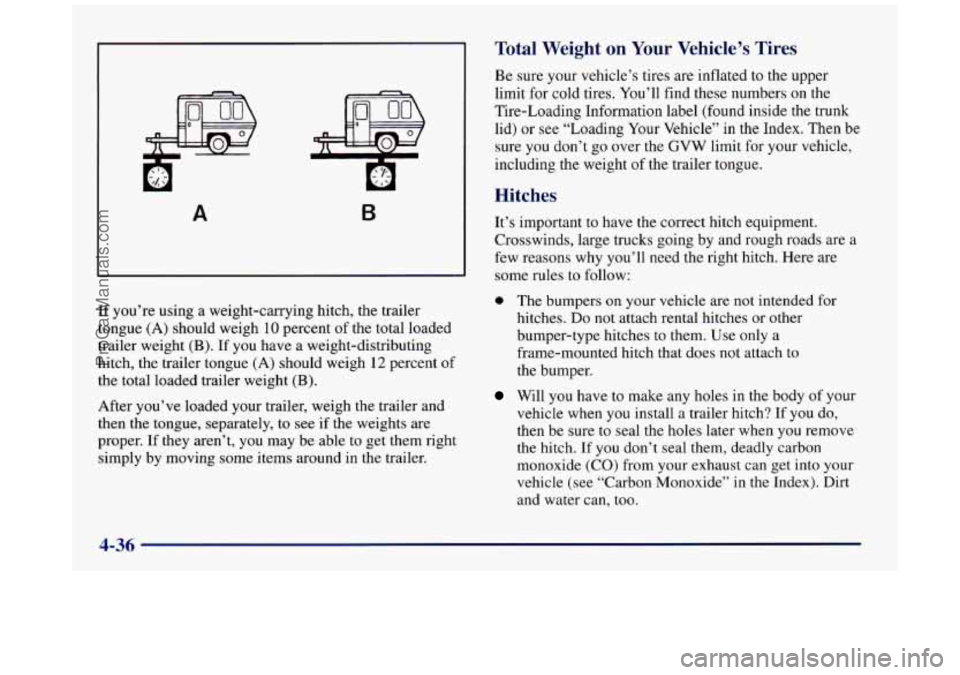
If you’re using a weight-carrying hitch, the trailer
tongue (A) should weigh
10 percent of the total loaded
trailer weight
(B). If you have a weight-distributing
hitch, the trailer tongue
(A) should weigh 12 percent of
the total loaded trailer weight
(B).
After you’ve loaded your trailer, weigh the trailer and
then the tongue, separately, to see if the weights are
proper. If they aren’t, you may be able to get them right
simply by moving some items around in the trailer.
Total Weight on Your Vehicle’s Tires
Be sure your vehicle’s tires are inflated to the upper
limit for cold tires. You’ll find these numbers on the
Tire-Loading Information label (found inside the trunk
lid) or see “Loading Your Vehicle” in the Index. Then be
sure
you don’t go over the GVW limit for your vehicle,
including the weight of the trailer tongue.
Hitches
It’s important to have the correct hitch equipment.
Crosswinds, large trucks going by and rough roads are
a
few reasons why you’ll need the right hitch. Here are
some rules to follow:
0 The bumpers on your vehicle are not intended for
hitches.
Do not attach rental hitches or other
bumper-type hitches to them. Use only
a
frame-mounted hitch that does not attach to
the bumper.
Will you have to make any holes in the body of your
vehicle when you install a trailer hitch? If you do,
then be sure to seal the holes later when you remove
the hitch. If you don’t seal them, deadly carbon
monoxide (CO) from your exhaust
can get into your
vehicle (see “Carbon Monoxide’’ in the Index). Dirt
and water can, too.
4-36
ProCarManuals.com
Page 262 of 422

I
........................................................................\
....... ........................................................................\
........ ........................................................................\
....... ............................................. .............................................. ............................................ m .......................................... .................
........................................... .................- ....................
The following steps will tell you how to use the jack and
change a tire.
Removing the Spare Tire and Tools
1* . . 3 The eauiDment vou’ll need 1L
is in the trunk. Pull the
carpeted mat up from the
floor
of the trunk.
(See “Compact Spare Tire” later
in this section for more
information about the compact spare.)
1. Turn the center nut on the compact spare cover to the
left to remove
it. Then lift and remove the cover.
5-26
ProCarManuals.com
Page 270 of 422
-
Incorrect wheel nuts or improperly tightened
wheel nuts can cause the wheel to become loose
and even come
off. This could lead to an accident.
Be sure to use the correct wheel nuts.
If you have
to replace them, be sure to get new GM original
equipment wheel nuts.
Stop somewhere
as soon as you can and have the
nuts tightened with
a torque wrench to 100 lb-ft
(140 Nom).
5-34
I NOTICE:
Improperly tightened wheel nuts can lead to
brake pulsation and rotor damage. To avoid
expensive brake repairs, evenly tighten the wheel
nuts in the proper sequence and to the proper
torque specification.
Don’t try to put the wheel cover on your compact spare
tire. It won’t fit. Store the wheel cover
in the trunk until
you have the flat tire repaired or replaced.
NOTICE:
Wheel covers won’t fit on your compact spare. If
you try to put a wheel cover on your compact
spare, you could damage the cover or the spare.
ProCarManuals.com
Page 271 of 422
Storing the Flat Tire and Tools
Stc ng a jack, a tire or other equipment in the
passenger compartment
of the vehicle could
cause injury. In a sudden stop or collision, loose
equipment could strike someone. Store all these
in the proper place.
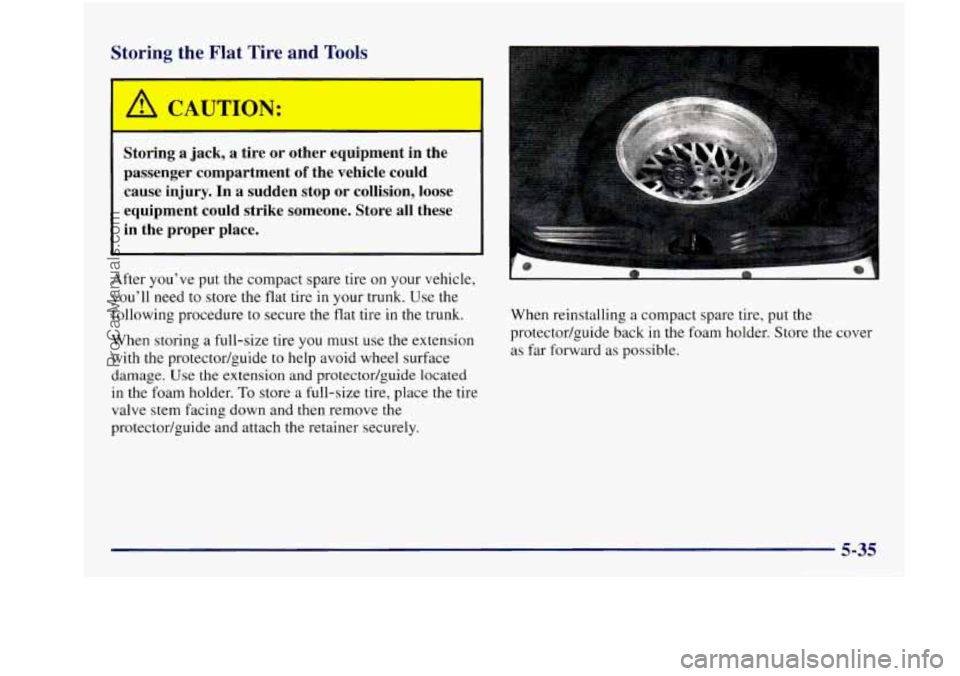
After you’ve put the compact spare tire on your vehicle,
you’ll need to store the flat tire
in your trunk. Use the
following procedure to secure the flat tire in the trunk.
When storing a full-size tire
you must use the extension
with the protector/guide to help avoid wheel surface
damage. Use
the extension and protector/guide located
in the foam holder.
To store a full-size tire, place the tire
valve stem facing down and then remove the
protector/guide and attach the retainer securely. When reinstalling
a compact spare tire, put the
protector/guide back in the foam holder. Store the cover
as far forward as possible.
5-35
ProCarManuals.com
Page 310 of 422
Center High-Mounted Stoplamp
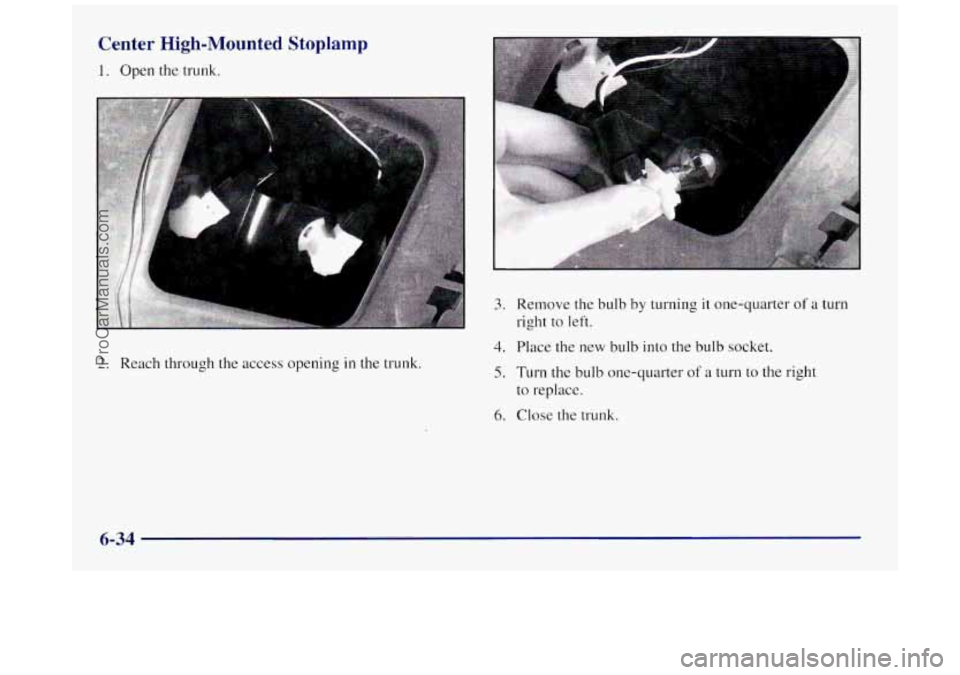
1. Open the trunk.
2. Reach through the access opening in the trunk.
3.
4.
5.
6.
Remove the bulb by turning it one-quarter of a turn
right
to left.
Place the new bulb into the bulb socket.
Turn the bulb one-quarter
of a turn to the right
to replace.
Close the
trunk.
6-34
ProCarManuals.com
Page 312 of 422
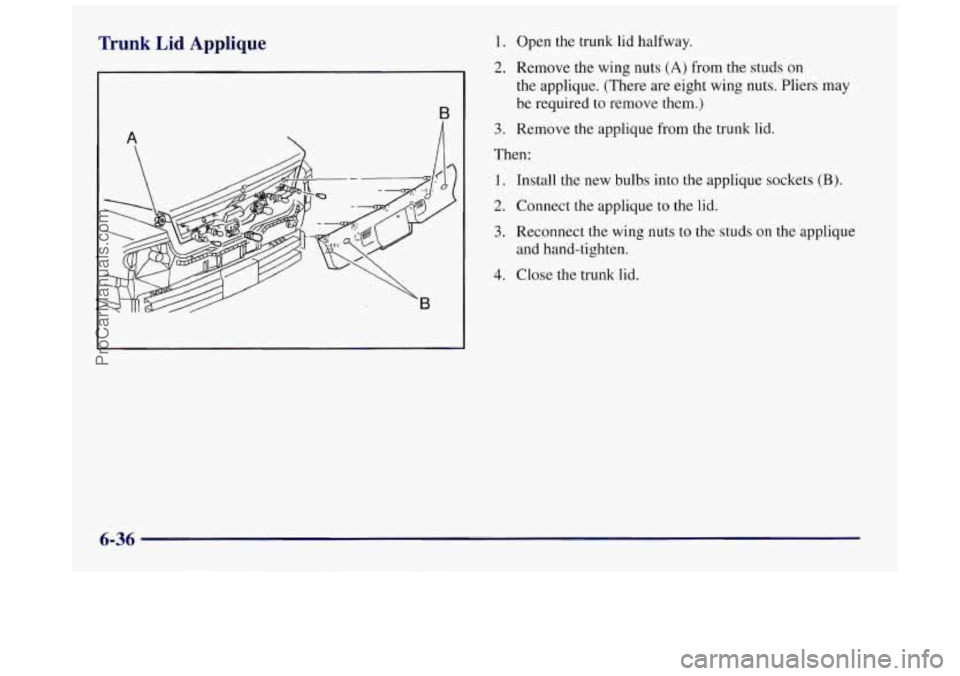
Trunk Lid Applique 1.
2.
A
B
3.
Open the trunk lid halfway.
Remove the wing nuts
(A) from the studs on
the applique. (There are eight wing nuts. Pliers may
be required to remove them.)
Remove
the applique from the trunk lid.
Then:
1.
2.
3.
4.
Install the new bulbs into the applique sockets (B).
Connect the applique to the lid.
Reconnect the wing nuts to the studs on
the applique
and hand-tighten.
Close the trunk lid.
6-36
ProCarManuals.com
Page 313 of 422
Back-up Lamp
The back-up lamps are located in the trunk lid applique.
(Refer
to the trunk lid applique removal procedure earlier
in this section for graphic and further instructions.)
1. Remove the trunk lid applique.
2. Twist and pull the back-up lamp socket from the
3. Twist and pull the bulb from the back-up
trunk
lid applique.
lamp socket.
Dome Lamp
To install the new bulb:
1. Twist and push the bulb into the back-up
lamp socket.
2. Twist and push the back-up lamp socket into
the trunk lid applique.
3. Reinstall the trunk lid applique.
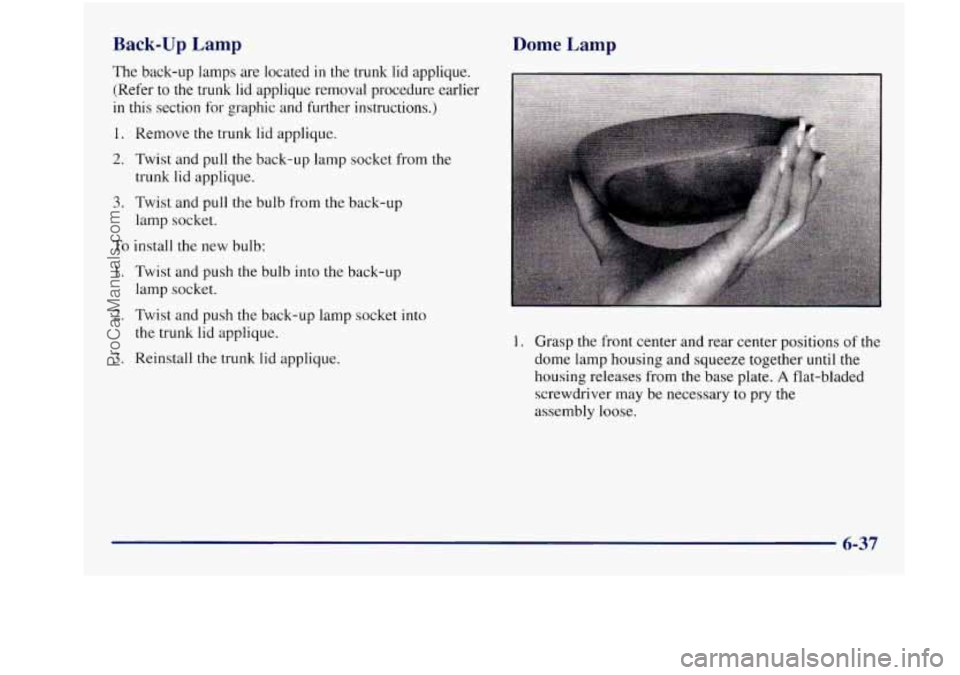
1. Grasp the front center and rear center positions of the
dome lamp housing and squeeze together until the
housing releases from
the base plate. A flat-bladed
screwdriver may be necessary to pry the
assembly loose.
I
6-37
ProCarManuals.com