child restraint BUICK REGAL 1997 Owner's Manual
[x] Cancel search | Manufacturer: BUICK, Model Year: 1997, Model line: REGAL, Model: BUICK REGAL 1997Pages: 422, PDF Size: 21.34 MB
Page 70 of 422
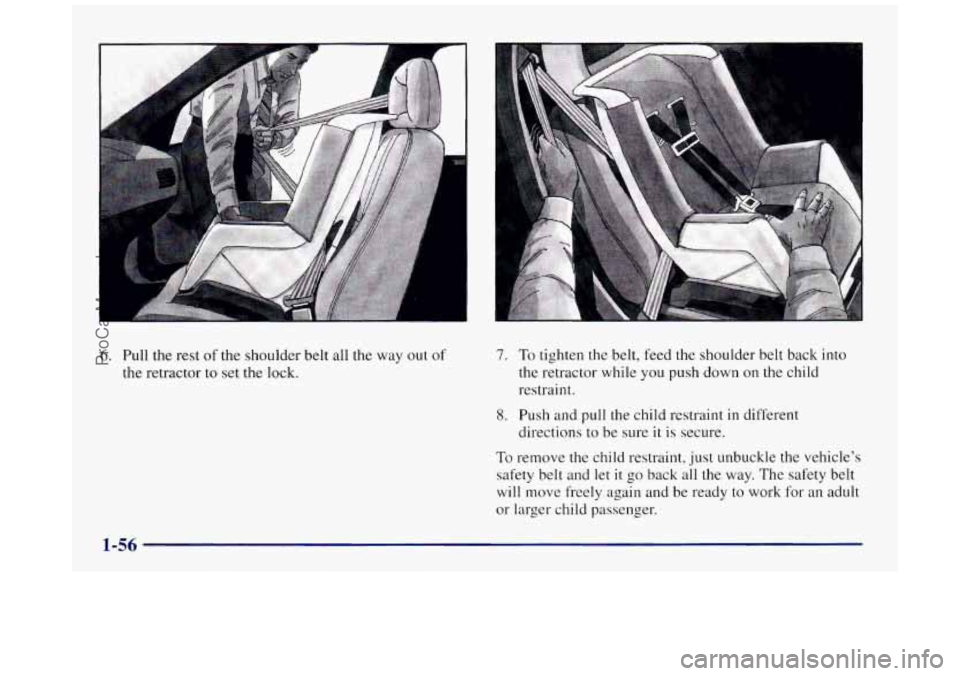
6. Pull the rest of the shoulder belt all the way out of
the retractor to set the lock. 7. To tighten the belt, feed the shoulder belt back into
the retractor while you
push down on the child
restraint.
8. Push and pull the child restraint in different
directions to be sure
it is secure.
To remove the child restraint, just unbuckle the vehicle’s
safety belt and let it
go back all the way. The safety belt
will move freely again and be ready to work for an adult
or larger child passenger.
1-56
ProCarManuals.com
Page 71 of 422
Larger Children
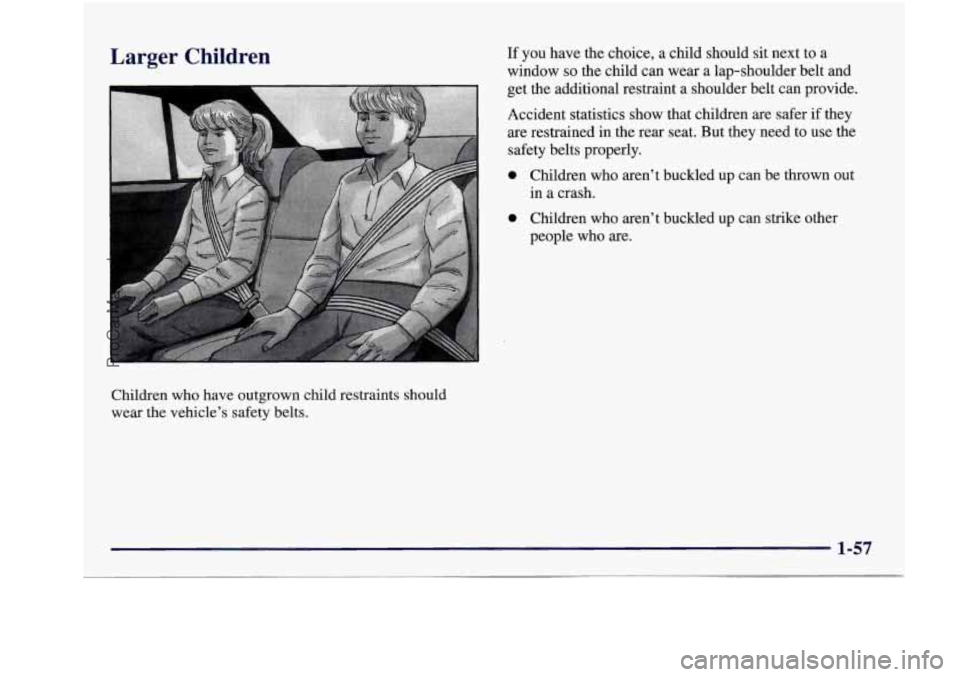
Children who have outgrown child restraints should
wear the vehicle’s safety belts.
If you have the choice, a child should sit next to a
window
so the child can wear a lap-shoulder belt and
get the additional restraint a shoulder belt can provide.
Accident statistics show that children are safer if they
are restrained in the rear seat. But they need to use the
safety belts properly.
0 Children who aren’t buckled up can be thrown out
0 Children who aren’t buckled up can strike other in a crash.
people who
are.
1-57
ProCarManuals.com
Page 72 of 422
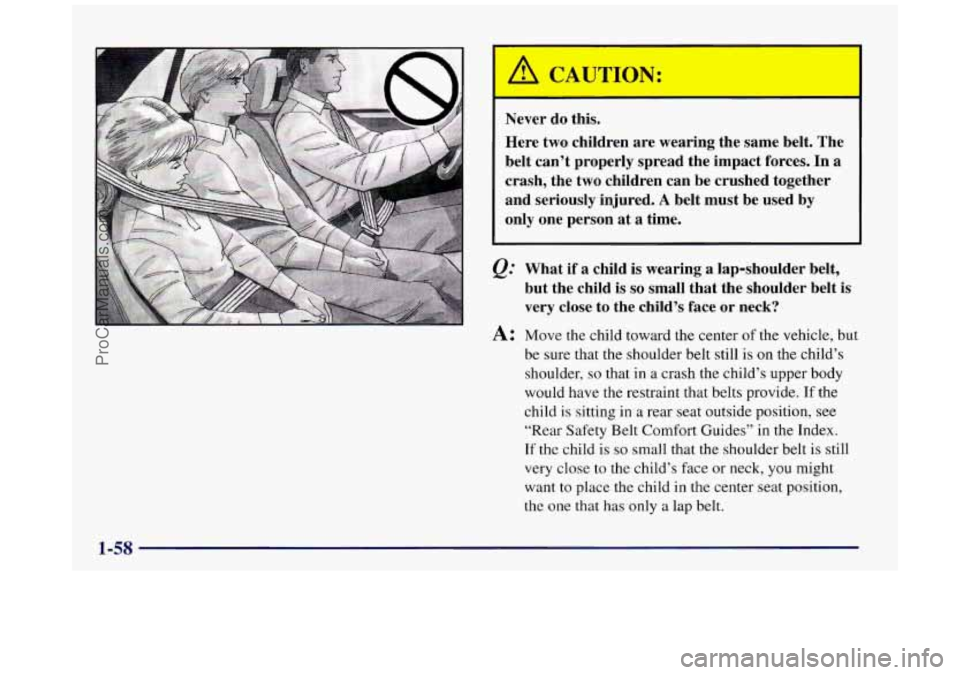
Never do this.
Here two children are wearing the same belt. The
belt can’t properly spread the impact forces. In a
crash, the two children can be crushed together
and seriously injured.
A belt must be used by
only one person at a time.
e.’ What if a child is wearing a lap-shoulder belt,
but the child is
so small that the shoulder belt is
very close to the child’s face or neck?
A: Move the child toward the center of the vehicle, but
be sure that the shoulder belt still is on the child’s
shoulder,
so that in a crash the child’s upper body
would have the restraint that belts provide.
If the
child
is sitting in a rear seat outside position, see
“Rear Safety Belt Comfort Guides’’ in the Index.
If the child is so small that the shoulder belt is still
very close to the child’s face or neck, you might
want to place the child in the center seat position,
the one that has only
a lap belt.
1-58
ProCarManuals.com
Page 74 of 422
Safety Belt Extender
If the vehicle’s safety belt will fasten around you, you
should use
it.
But if a safety belt isn’t long enough to fasten, your
dealer will order you an extender. It’s free. When you go
in to order it, take the heaviest coat you will wear, so the
extender will be long enough for you. The extender will
be just for you, and just for the seat in your vehicle that
you choose. Don’t
let someone else use it, and use it
only for the seat it is made to fit. To wear it, just attach
it to the regular safety belt.
Checking Your Restraint Systems
Now and then, make sure the safety belt reminder light
and all your belts, buckles, latch plates, retractors and
anchorages are working properly. If your vehicle has a
built-in child restraint, also periodically make sure the
harness straps, latch plates, buckle, clip, retractors and
anchorages are working properly.
Look for any other
loose or damaged safety belt and built-in child restraint
system parts. If you see anything that might keep a
safety belt or built-in child restraint system from doing
its job, have
it repaired.
Torn or frayed safety belts may not protect you in
a
crash. They can rip apart under impact forces. If a belt
is torn or frayed, get a new one right away.
If your vehicle has the built-in child restraint, torn or
frayed harness straps can rip apart under impact forces
just like torn or frayed safety belts can. They may not
protect a child in a crash. If a harness strap is torn or
frayed, get a new harness right away.
Also look for any opened or broken air bag covers, and
have them repaired or replaced. (The air bag system
does not need regular maintenance.)
1-60
ProCarManuals.com
Page 75 of 422
Replacing Restraint System Parts
After a Crash
If you’ve had a crash, do you need new safety belts or
built-in child restraint parts?
After a very minor collision, nothing may be necessary.
But
if the safety belts or built-in child restraint harness
straps were stretched, as they would be if worn during
a
more severe crash, then you need new safety belts or
harness straps. If
safety belts or built-in child restraint harness straps
are cut or damaged, replace them. Collision damage also
may mean you will need to have safety belt, built-in
child restraint or seat parts repaired or replaced. New
parts and repairs may be necessary even if the safety
belt
or built-in child restraint wasn’t being used at the
time
of the collision.
If an air bag inflates, you’ll need to replace air bag
system parts. See the part on the air bag system earlier
in this section.
ProCarManuals.com
Page 229 of 422
Things you put inside your vehicle can strike
and injure people in
a sudden stop or turn, or in
a crash.
Put things in the trunk of your vehicle. In a
trunk, put them as far forward as you can.
Try to spread the weight evenly.
inside the vehicle
so that some of them are
above the tops of the seats.
0 Don’t leave an unsecured child restraint in
your vehicle.
When you carry something inside the
vehicle, secure it whenever you can.
0 Don’t leave a seat folded down unless you
need to.
Never stack heavier things, like suitcases,
Towing a Trailer
If you don’t use the correct equipment and drive
properly, you can lose control when you pull
a
trailer. For example, if the trailer is too heavy, the
brakes may not work well
-- or even at all. You
and your passengers could be seriously injured.
Pull a trailer only if you have followed all the
steps in this section. Ask your Buick dealer for
advice and information about towing
a trailer
with your vehicle.
NOTICE:
Pulling a trailer improperly can damage your
vehicle and result in costly repairs not covered by
your warranty. To pull a trailer correctly, follow
the advice in this part, and see your Buick dealer
for important information about towing a trailer
with your vehicle.
4-33
-. -
ProCarManuals.com
Page 277 of 422
Section 6 Service and Appearance Care
Here you will find information about the care of your Buick. This section begins with service and fuel information,
and then it shows how
to check important fluid and lubricant levels. There is also technical information about your
6-2
6-3
6-5
6-5
6-7
6-11
6-1
1
6-16
6-19
6-22
6-26
6-27
6-28
6-3
1
6-32 6-39
6-47
6-48
6-5
1
6-5 1
vehicle, and a part devoted to its appearance care.
Service
Fuel
Fuels in Foreign Countries
Filling Your Tank
Checking Things Under the Hood
3800 Supercharged (Code 1) Engine
Engine Oil
Air Cleaner
Automatic Transaxle Fluid
Engine Coolant
Power Steering Fluid
Windshield Washer Fluid
Brakes
Battery
Bulb Replacement
Tires
Appearance Care
Cleaning the Inside
of Your Buick
Cleaning the Built-in Child Restraint
Care
of Safety Belts and Built-in Child
Restraint Harness 6-5
1
6-52
6-52
6-52
6-53
6-54 6-54
6-54
6-55
6-55
6-5 6
6-57
6-57
6-58
6-63
6-63
6-64
6-65
6-65 Cleaning Glass Surfaces
Cleaning
the Outside of the Windshield and
Wiper Blades
Weatherstrips Cleaning the Outside of Your Buick
Cleaning Aluminum or Chrome Wheels
Cleaning Tires
Sheet Metal Damage
Finish Damage
Underbody Maintenance
Chemical Paint Spotting
Appearance Care Materials Chart
Vehicle Identification Number
(VIN)
Service Parts Identification Label
Electrical System Replacement Bulbs
Capacities and Specifications
Vehicle Dimensions
Normal Maintenance Replacement Parts
Air Conditioning Refrigerants
6-1
ProCarManuals.com
Page 327 of 422
Cleaning the Built-in Child Restraint
Your built-in child restraint may be cleaned with mild
soap and lukewarm water. Don’t use household cleaners.
They may weaken the harness
or damage plastic parts.
The built-in child restraint pad is attached to the child
restraint cushion and seatback with fastener strips. You
can remove the pad, machine wash it in cold water on a
gentle cycle and tumble dry it on a low heat setting.
Never bleach or iron the pad, and don’t dry clean it.
Care of Safety Belts and Built-in
Child Restraint Harness
Keep the safety belts and the built-in child restraint
harness clean and dry.
Do not bleach or dye safety belts or the built-in
child restraint harness. If you do, they may be
severely weakened. In a crash, they might not be
able to provide adequate protection. Clean the
safety belts and the child restraint harness only with mild soap and lukewarm water.
Cleaning Glass Surfaces
Glass should be cleaned often. GM Glass Cleaner (GM
Part No. 1050427) or a liquid household glass cleaner
will remove normal tobacco smoke and dust films on
interior glass.
Don’t
use abrasive cleaners on glass, because they may
cause scratches. Avoid placing decals on the inside rear
window, since they may have
to be scraped off later.
If abrasive cleaners
are used on the inside of the rear
window, an electric defogger element may be damaged.
Any temporary license should not be attached across the
defogger grid.
6-51
ProCarManuals.com
Page 382 of 422
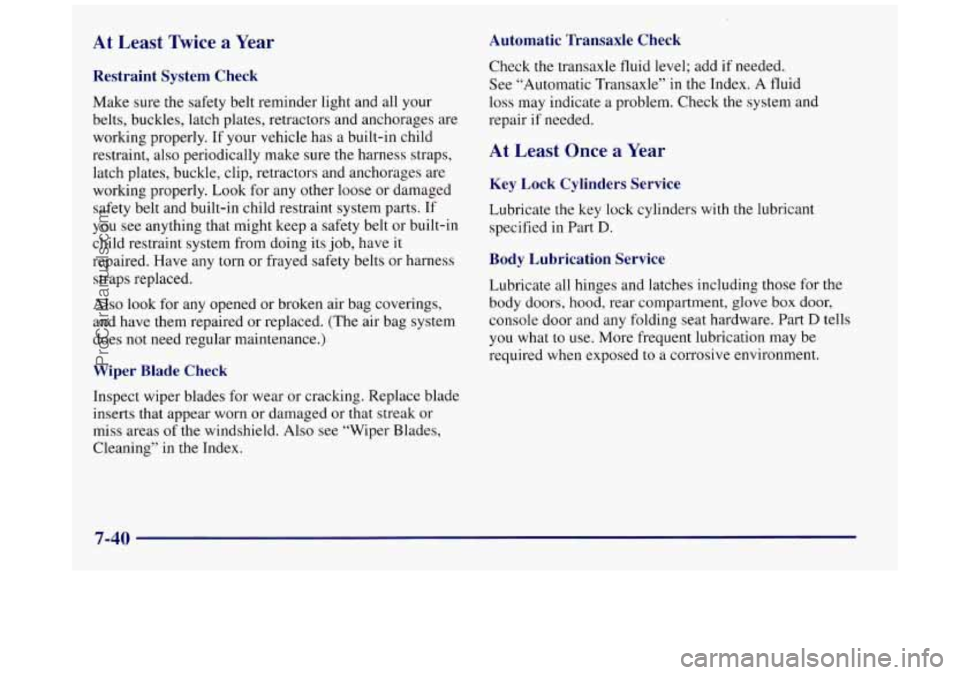
At Least Twice a Year Automatic Transaxle Check
Restraint System Check
Make sure the safety belt reminder light and all your
belts, buckles, latch plates, retractors and anchorages are
working properly. If your vehicle has a built-in child
restraint, also periodically make sure the harness straps,
latch plates, buckle, clip, retractors and anchorages are
working properly. Look for any other loose or damaged
safety belt and built-in child restraint system parts. If
you see anything that might keep a safety belt or built-in
child restraint system from doing its
job, have it
repaired. Have any torn or frayed safety belts or harness
straps replaced.
Also look for any opened or broken air bag coverings,
and have them repaired
or replaced. (The air bag system
does not need regular maintenance.)
Wiper Blade Check
Inspect wiper blades for wear or cracking. Replace blade
inserts that appear worn or damaged or that streak or
miss areas of the windshield. Also see “Wiper Blades,
Cleaning” in
the Index. Check the transaxle fluid
level; add if needed.
See “Automatic Transaxle” in the Index.
A fluid
loss may indicate a problem. Check the system and
repair if needed.
At Least Once a Year
Key Lock Cylinders Service
Lubricate the key lock cylinders with the lubricant
specified
in Part D.
Body Lubrication Service
Lubricate all hinges and latches including those for the
body doors, hood, rear compartment, glove box door,
console door and any folding seat hardware. Part
D tells
you what to use. More frequent lubrication may be
required when exposed to a corrosive environment.
7-40
ProCarManuals.com
Page 409 of 422
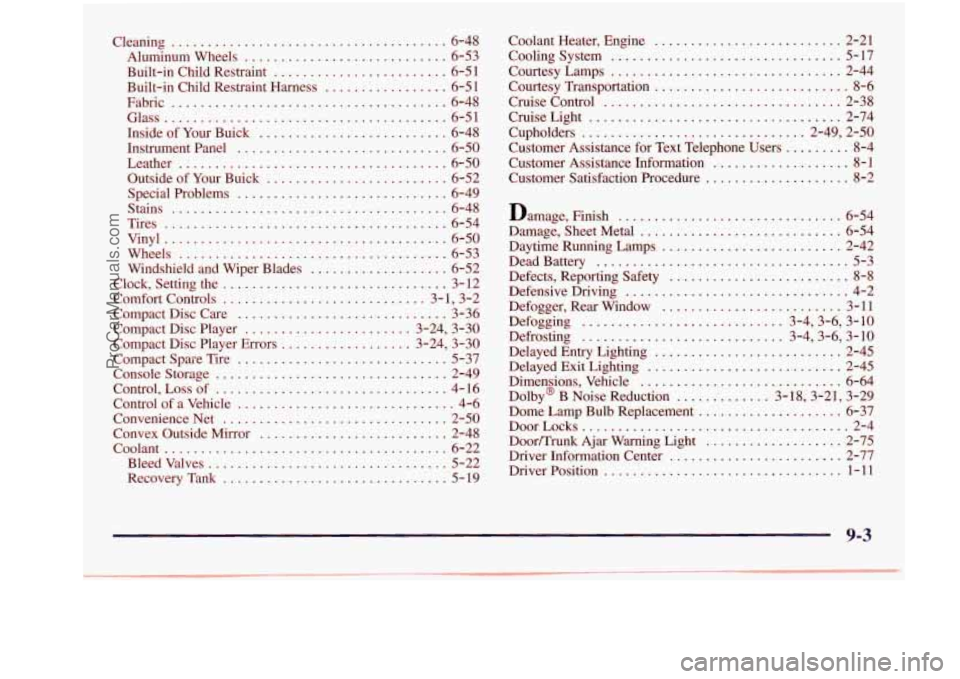
Cleaning ...................................... 6-48
Aluminum Wheels
............................ 6-53
Built-in Child Restraint
........................ 6-5 1
Built-in Child Restraint Harness
................. 6-5 1
Glass
....................................... 6-51
Inside of
Your Buick .......................... 6-48
Fabric
...................................... 6-48
Instrumentpanel
............................. 6-50
Leather
..................................... 6-50
Outside of Your Buick
......................... 6-52
Special Problems
............................. 6-49
Stains
...................................... 6-48
Vinyl
....................................... 6-50
Windshield and Wiper Blades
................... 6-52
Clock, Setting the
............................... 3-12
Comfort Controls
............................ 3-1, 3-2
Compact Disc Care
............................. 3-36
Compact Disc Player
....................... 3-24, 3-30
Compact Disc Player
Errors .................. 3-24, 3-30
Compact Spare Tire
............................. 5-37
Console Storage
................................ 2-49
Control, Loss of
................................ 4-16
Control of a Vehicle
.............................. 4-6
Convenience Net
............................... 2-50
Convex Outside
Mirror .......................... 2-48
Coolant
....................................... 6-22
Bleedvalves
................................. 5-22
RecoveryTank
............................... 5-19
Tires
....................................... 6-54
Wheels
..................................... 6-53 Coolant Heater. Engine
.......................... 2-21
Cooling System
................................ 5-17
Courtesy Transportation
........................... 8-6
Cruise Control
................................. 2-38
Cupholders
............................... 2-49, 2-50
Customer Assistance for Text Telephone Users
......... 8-4
Customer Assistance Information
................... 8-1
Customer Satisfaction Procedure
.................... 8-2
CourtesyLamps
................................ 2-44
CruiseLight
................................... 2-74
Damage. Finish
............................... 6-54
Damage. Sheet Metal
............................ 6-54
Daytime Running
Lamps ......................... 2-42
DeadBattery
................................... 5-3
Defects, Reporting Safety
......................... 8-8
Defensive Driving
............................... 4-2
Defogger, Rear Window
......................... 3-11
Defogging ............................ 3-4,3-6, 3-10
Defrosting
............................ 3-4,3-6, 3-10
Delayed Entry Lighting
.......................... 2-45
Delayed
Exit Lighting ........................... 2-45
Dimensions, Vehicle
............................ 6-64
Dolby@ B Noise Reduction
............. 3-18,3-21, 3-29
Dome Lamp Bulb Replacement
.................... 6-37
Door/Trunk Ajar Warning Light
................... 2-75
Driver Information Center
........................ 2-77
Driver Position
................................. 1-11
DoorLocks
..................................... 2-4
9-3
ProCarManuals.com