tires BUICK REGAL 1997 Owner's Guide
[x] Cancel search | Manufacturer: BUICK, Model Year: 1997, Model line: REGAL, Model: BUICK REGAL 1997Pages: 422, PDF Size: 21.34 MB
Page 321 of 422
Temperature -- A, B, C
The temperature grades are A (the highest), B, and C,
representing the tire’s resistance to the generation of
heat and its ability to dissipate heat when tested under
controlled conditions on a specified indoor laboratory
test wheel. Sustained high temperature can cause the
material
of the tire to degenerate and reduce tire life, and
excessive temperature can lead to sudden tire failure.
The grade
C corresponds to a level of performance
which all passenger car tires must meet under the
Federal Motor Vehicle Safety Standard
No. 109. Grades
B and
A represent higher levels of performance on the
laboratory test wheel than the minimum required by law.
Warning: The temperature grade for this tire is
established for a tire that is properly inflated and not
overloaded. Excessive speed, underinflation, or
excessive loading, either separately or in combination,
can cause heat buildup and possible tire failure.
Wheel Alignment and Tire Balance
The wheels on your vehicle were aligned and balanced
carefully at the factory to give
you the longest tire life
and best overall performance. Scheduled
wheel alignment and wheel balancing are
not needed. However,
if you notice unusual tire wear
or your vehicle pulling one way or the other, the
alignment
may need to be reset. If you notice your
vehicle vibrating when driving on
a smooth road, your
wheels may need to be rebalanced.
Wheel Replacement
Replace any wheel that is bent, cracked, or badly rusted
or corroded.
If wheel nuts keep coming loose, the wheel,
wheel bolts and wheel nuts should be replaced.
If the
wheel leaks air, replace it (except some aluminum
wheels, which can sometimes be repaired). See your
Buick dealer
if any of these conditions exist.
Your dealer will know the kind of wheel you need.
Each new wheel should have the same load-carrying
capacity, diameter, width, offset and be mounted the
same way as the one it replaces.
If you need to replace any of your wheels, wheel
bolts or wheel nuts, replace them only with new GM
original equipment parts. This way, you will be sure to
have the right wheel, wheel bolts and wheel nuts for
your Buick model.
6-45
ProCarManuals.com
Page 322 of 422
1 Used Replacement Wheels
Using the wrong replacement wheels, wheel
bolts or wheel nuts on your vehicle can be
dangerous. It could affect the braking and
handling
of your vehicle, make your tires lose
air and make you lose control. You could have
a
collision in which you or others could be injured.
Always use the correct wheel, wheel bolts and
wheel nuts for replacement.
NOTICE:
The wrong wheel can also cause problems with
bearing life, brake cooling, speedometer or
odometer calibration, headlamp aim, bumper height, vehicle ground clearance and tire or tire
chain clearance
to the body and chassis.
See “Changing a Flat Tire”
in the Index for more
information. Putting
a used wheel
on your vehicle is
dangerous. You can’t know how it’s been used or
how far it’s been driven. It could fail suddenly
and cause an accident.
If you have to replace a
wheel, use a new
GM original equipment wheel.
Tire Chains
NOTICE:
If your Buick has P225/60R16 size tires, don’t use
tire chains. They can damage your vehicle
because there’s not enough clearance.
NOTICE: (Continued)
6-46
ProCarManuals.com
Page 323 of 422
NOTICE: (Continued)
Use another type of traction device only if its
manufacturer recommends it for use on your
vehicle and tire size combination and road
conditions. Follow that manufacturer’s
instructions.
To help avoid damage to your
vehicle, drive slowly, readjust or remove the
device if it’s contacting your vehicle, and don’t
spin your wheels.
If you do find traction devices that will fit, install
them on the front tires.
If you have other tires, use tire chains only where
legal and only when you must. Use only
SAE Class
“S” type chains that are the proper size for your
tires. Install them on the front tires and tighten
them
as tightly as possible with the ends securely
fastened. Drive slowly and follow the chain
manufacturer’s instructions.
If you can hear the
chains contacting your vehicle, stop and retighten
them.
If the contact continues, slow down until it
stops. Driving too fast or spinning the wheels with
chains on
will damage your vehicle.
Appearance Care
Remember, cleaning products can be hazardous. Some
are toxic. Others can
burst into flame if you strike a
match or get them on a hot part of the vehicle. Some are
dangerous
if you breathe their fumes in a closed space.
When you use anything from
a container to clean your
Buick, be sure to follow the manufacturer’s warnings
and instructions. And always open your doors or
windows
when you’re cleaning the inside.
Never use these to clean your vehicle:
Gasoline
Benzene
Naphtha
Carbon Tetrachloride
Acetone
0 Paint Thinner
Turpentine
Lacquer Thinner
Nail Polish Remover
They can all be hazardous
-- some more than others --
and they can all damage your vehicle, too.
6-47
ProCarManuals.com
Page 330 of 422
Cleaning Tires Sheet Metal Damage
To clean your tires, use a stiff brush with a tire cleaner. If your vehicle is damaged and requires sheet metal
repair or replacement, make sure the body repair shop
applies anti-corrosion material
to the parts repaired or
NOTICE: replaced to restore corrosion protection.
When applying a tire dressing always take care
to wipe off any overspray or splash from all
painted surfaces on the body or wheels of the vehicle. Petroleum-based products may damage
the paint finish.
Finish Damage
Any stone chips, fractures or deep scratches in the finish
should be repaired right away. Bare metal will corrode
quickly and may develop into a major repair expense.
Minor chips and scratches can
be repaired with touch-up
materials available from your dealer or other service
outlets. Larger areas
of finish damage can be corrected
in your dealer’s body and paint shop.
6-54
ProCarManuals.com
Page 350 of 422
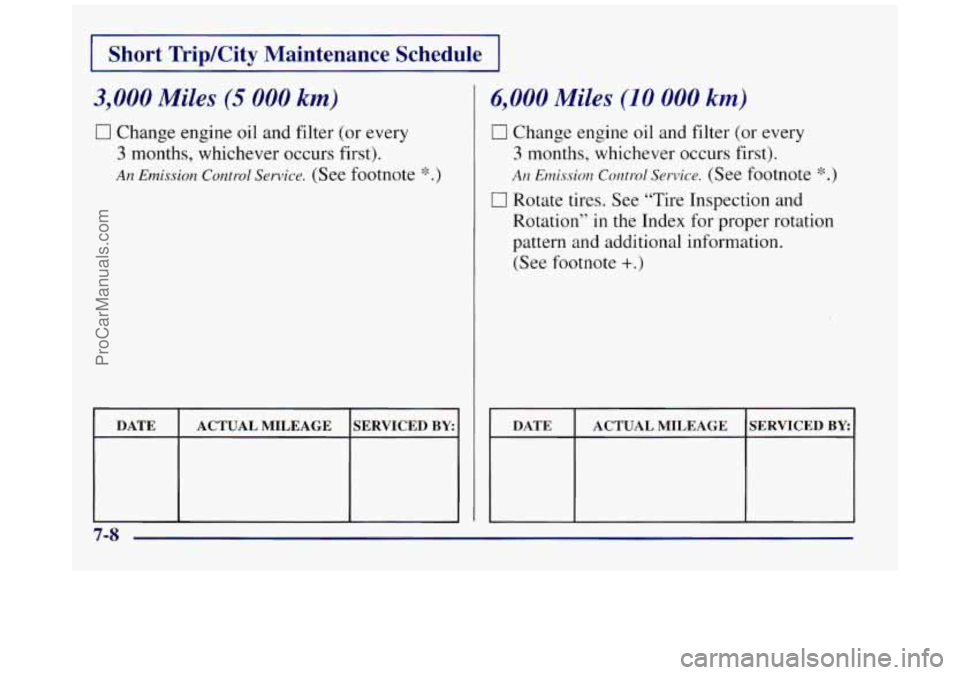
I Short Trip/City Maintenance Schedule I
3,000 Miles (5 000 km)
0 Change engine oil and filter (or every
3 months, whichever occurs first).
An Emission. Control Service. (See footnote *.)
DATE ACTUAL MILEAGE
nn 7
SERVICED BY
6,000 Miles (1 0 000 km)
0 Change engine oil and filter (or every
3 months, whichever occurs first).
AH Enzissiou Cot2trol Service. (See footnote * .)
0 Rotate tires. See “Tire Inspection and
Rotation”
in the Index for proper rotation
pattern
and additional information.
(See footnote
+.)
DATE SERVICED BY ACTUAL MILEAGE
1-25
ProCarManuals.com
Page 351 of 422
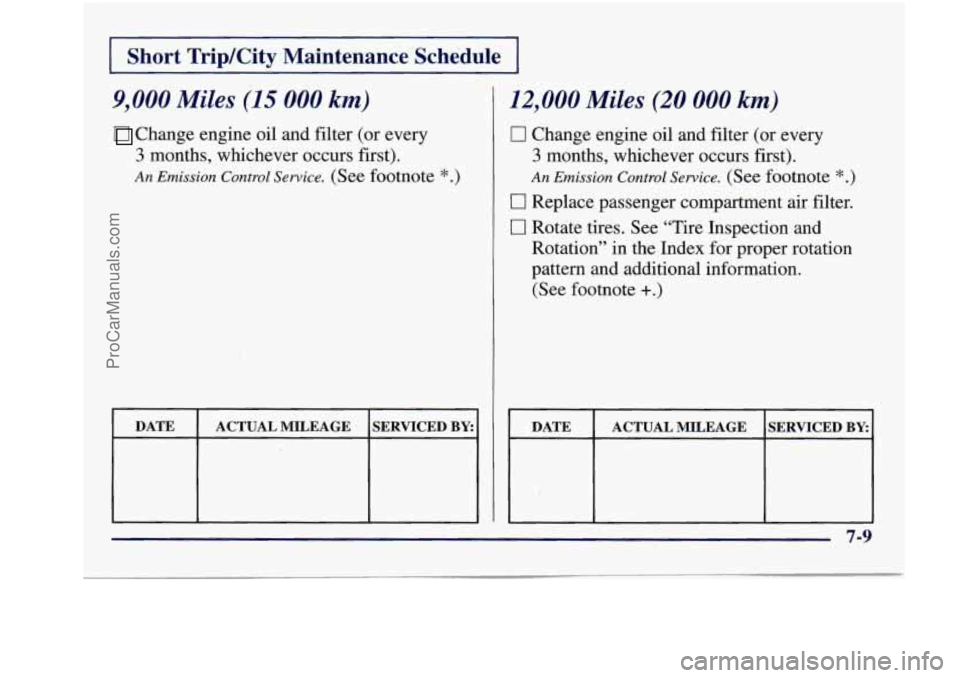
I Short Trip/City Maintenance Schedule I
9,000 Miles (15 000 km)
Change engine oil and filter (or every
3 months, whichever occurs first).
An Emission Control Service. (See footnote * .)
DATE
SERVICED BY: ACTUAL MILEAGE
12,000 Miles (20 000 km)
0 Change engine oil and filter (or every
3 months, whichever occurs first).
An Emission Control Service. (See footnote *.)
0 Replace passenger compartment air filter.
0 Rotate tires. See “Tire Inspection and
Rotation” in the Index for proper rotation
pattern and additional information.
(See footnote
+.)
DATE SERVICED BY: ACTUAL MILEAGE
7-9
ProCarManuals.com
Page 352 of 422
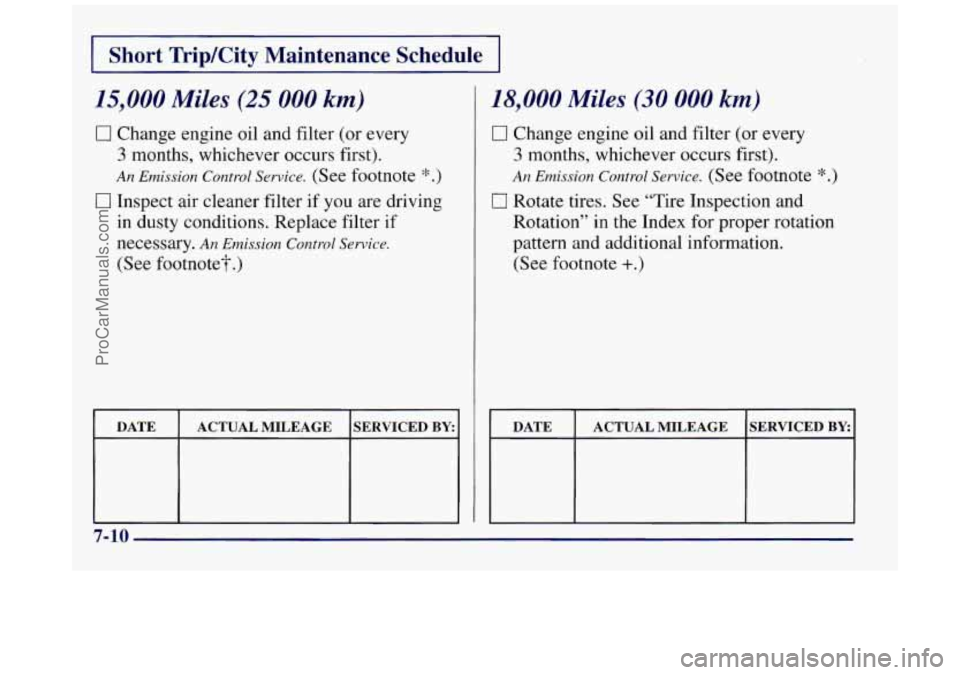
I Short TripKity Maintenance Schedule I
15,000 Miles (25 000 km)
0 Change engine oil and filter (or every
3 months, whichever occurs first).
An Emission Control Service. (See footnote *.)
0 Inspect air cleaner filter if you are driving
in dusty conditions. Replace filter
if
necessary. An Emission Control Service.
(See footnote?.)
DATE
SERVICED BY ACTUAL MILEAGE
18,000 Miles (30 000 km)
c7 Change engine oil and filter (or everj
3 months, whichever occurs first).
An Emission Control Service. (See footnote * .)
0 Rotate tires. See “Tire Inspection and
Rotation” in the Index for
proper rotation
pattern and additional information.
(See footnote
+.)
I I I 1
DATE SERVICED BY: ACTUAL MILEAGE
7-10
ProCarManuals.com
Page 353 of 422
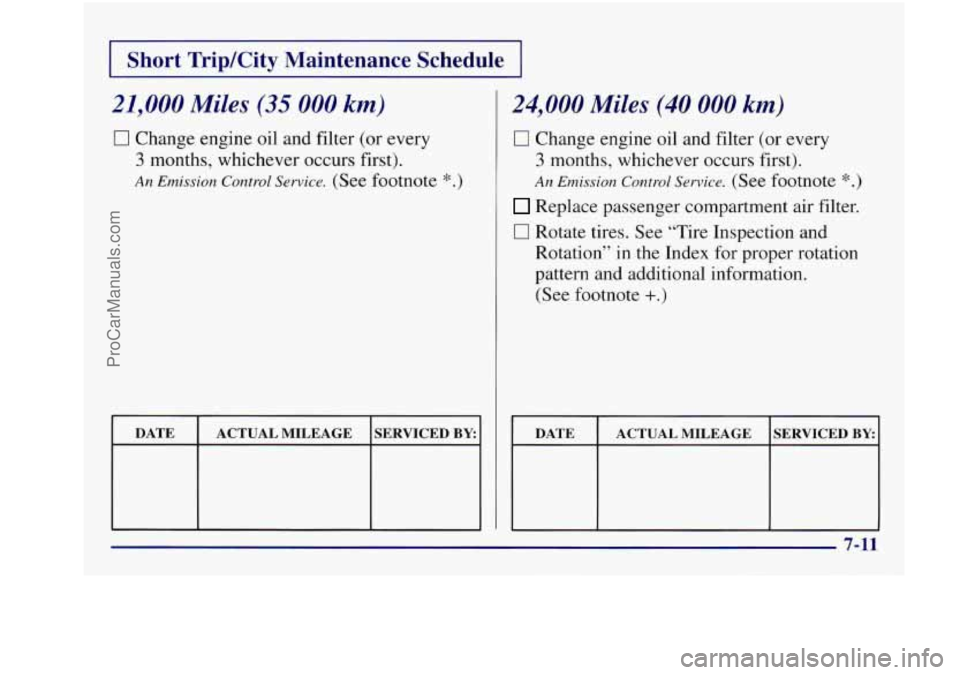
I Short TripKity Maintenance Schedule I
21,000 Miles (35 000 km)
0 Change engine oil and filter (or every
3 months, whichever occurs first).
An Emission Control Service. (See footnote *.)
I DATE
c
ACTUAL MILEAGE
3
SERVICED BY
24,000 Miles (40 000 km)
0 Change engine oil and filter (or every
3 months, whichever occurs first).
An Emission Control Service. (See footnote *.)
Replace passenger compartment air filter.
0 Rotate tires. See “Tire Inspection and
Rotation” in the Index for proper rotation
pattern and additional information.
(See footnote
+.)
I I I
DATE SERVICED BY: ACTUAL MILEAGE
ProCarManuals.com
Page 355 of 422
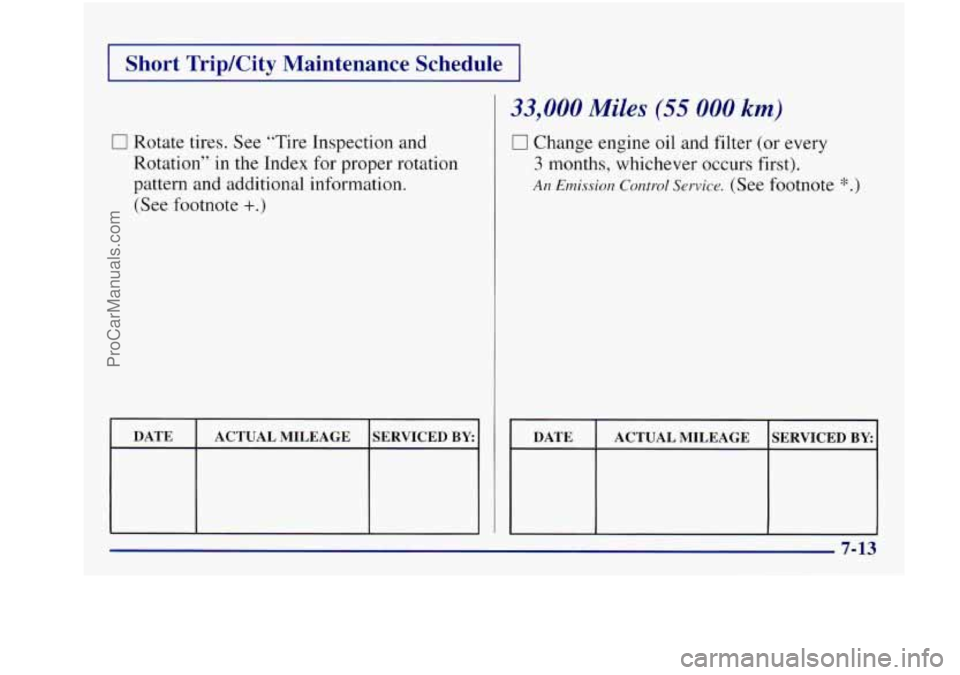
I Short TripKity Maintenance Schedu
0 Rotate tires. See “Tire Inspection and
Rotation” in the Index for proper rotation
pattern and additional information.
(See footnote
+.)
DATE ACTUAL MILEAGE SERVICED BY
33,000 Miles (55 000 km)
0 Change engine oil and filter (or every
3 months, whichever occurs first).
AI? Emission Control Service. (See footnote ?)
I DATE ACTUAL MILEAGE SERVICED BY
ProCarManuals.com
Page 356 of 422
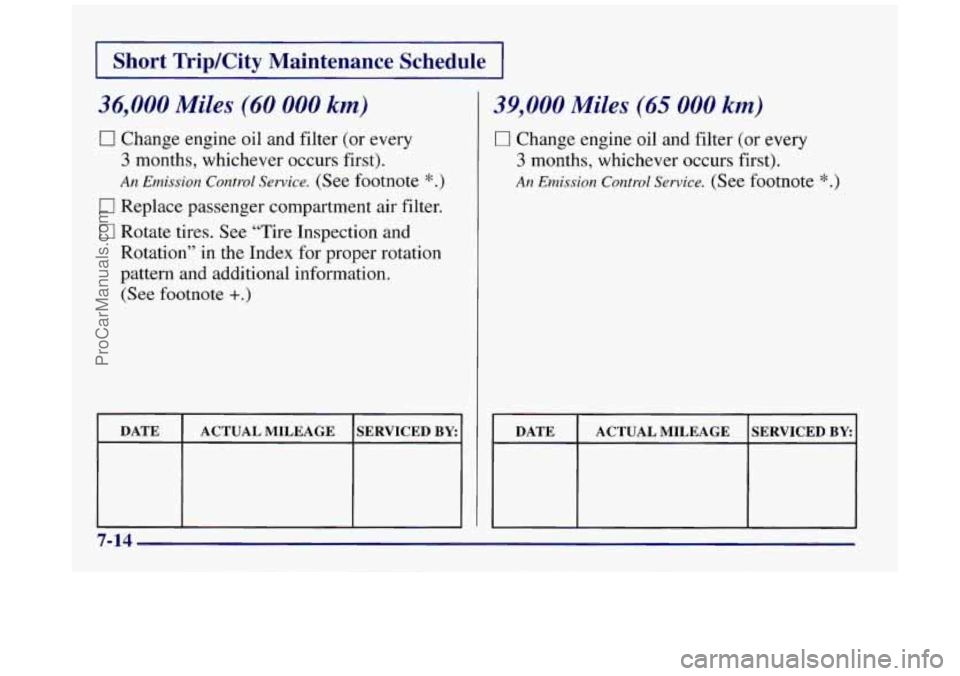
I Short Trip/City Maintenance Schedule I
36,000 Miles (60 000 km)
0 Change engine oil and filter (or every
3 months, whichever occurs first).
An Emission Control Service. (See footnote *.)
0 Replace passenger compartment air filter.
0 Rotate tires. See “Tire Inspection and
Rotation” in the Index for proper rotation
pattern and additional information.
(See footnote +.)
I I
DATE ACTUAL MILEAGE
3
SERVICED BY
I 39,000 Miles (65 000 km)
1 0 Change engine oil and filter (or every
3 months, whichever occurs first).
An. Emission Control Service. (See footnote *.)
DATE
SERVICED BY ACTUAL MILEAGE
I I I
7-14
ProCarManuals.com