heater BUICK REGAL 1997 Owners Manual
[x] Cancel search | Manufacturer: BUICK, Model Year: 1997, Model line: REGAL, Model: BUICK REGAL 1997Pages: 422, PDF Size: 21.34 MB
Page 77 of 422
Section 2 Features and Controls
Here you can learn about the many standard and optional features on your Buick, and information on starting, shifting
and braking. Also explained are the instrument panel and the warning systems that tell you
if everything is working
properly
-- and what to do if you have a problem.
2-2
2-4
2-9
2-15
2-16
2- 17
2-18
2-18
2-20
2-2 1
2-22
2-28
2-29
2-3
1
2-3 1
2-32
2-3 2
2-33 Keys
Door
Locks
Remote Keyless
Entry
Trunk
Theft
PASS-Key@
I1
New Vehicle “Break-In”
Ignition Positions
Starting Your Engine
Engine Coolant Heater Automatic Transaxle Operation
Parking Brake Shifting Into PARK
(P)
Shifting Out of PARK (P)
Parking Over Things That Burn
Engine Exhaust
Running Your Engine While You’re Parked
Windows 2-34
2-34
2-35
2-4
1
2-44
2-47
2-49
2-5 1
2-52
2-52 2-5 3
2-54
2-54
2-55
2-56 2-59
2-77 Horn
Tilt Steering Wheel
Turn Signal/Multifunction Lever
Exterior Lamps
Interior Lamps
Mirrors
Storage Compartments
Ashtrays and Lighter
Sun Visors
Accessory Outlet
Auxiliary Power Connection
Sunroof
Cellular Phone Provisions
Instrument Panel
-- Your Information System
lnstrument Panel Cluster
Warning Lights, Gages and Indicators
Driver Information Center
ProCarManuals.com
Page 97 of 422
NOTICE:
Your engine is designed to work with the
electronics in your vehicle.
If you add electrical
parts or accessories, you could change the way
the engine operates. Before adding electrical
equipment, check with your dealer.
If you don’t,
your engine might not perform properly.
If you ever have to have your vehicle towed, see
the part
of this manual that tells how to do it
without damaging your vehicle. See “Towing
Your Vehicle” in the Index.
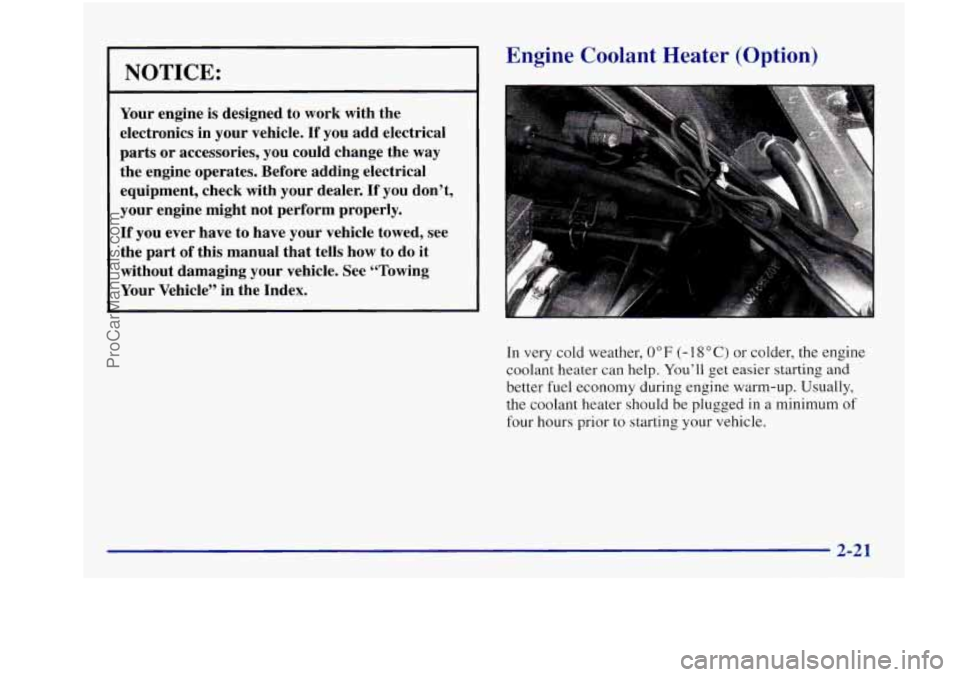
Engine Coolant Heater (Option)
In very cold weather, 0°F (- 1 SOC) or colder, the engine
coolant heater can help. You’ll get easier starting and
better fuel economy during engine warm-up.
Usually,
the coolant heater should be plugged in a minimum of
four hours prior to starting your vehicle.
2-21
ProCarManuals.com
Page 98 of 422
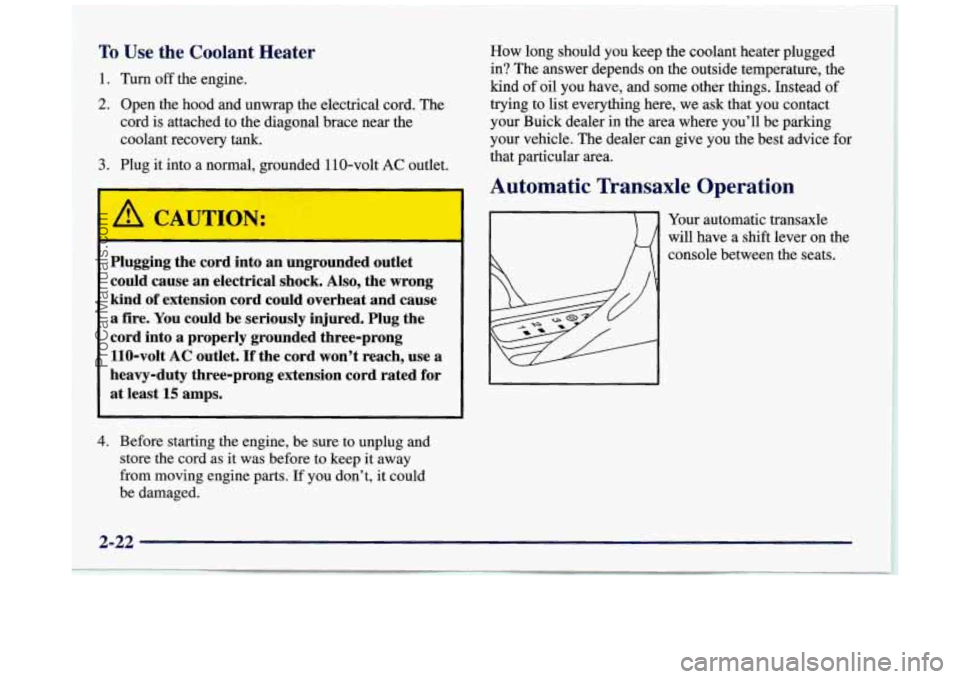
To Use the Coolant Heater
1. Turn off the engine.
2. Open the hood and unwrap the electrical cord. The
cord is attached to the diagonal brace near the
coolant recovery tank.
3. Plug it into a normal, grounded 110-volt AC outlet.
Plugging the cord into an ungrounded outlet
could cause an electrical shock. Also, the wrong
kind
of extension cord could overheat and cause
a fire. You could be seriously injured. Plug the
cord into
a properly grounded three-prong
110-volt AC outlet.
If the cord won’t reach, use a
heavy-duty three-prong extension cord rated for
at least
15 amps.
4. Before starting the engine, be sure to unplug and
store the cord
as it was before to keep it away
from moving engine parts. If you don’t, it could
be damaged. How long should you keep the coolant heater plugged
in? The answer depends on the outside temperature, the
kind
of oil you have, and some other things. Instead of
wing to list everything here, we ask that you contact
your Buick dealer in the area where you’ll be parking
your vehicle. The dealer can give you the best advice for
that particular area.
AI natic Transaxle Operation . ~
Your automatic transaxle
will have a shift lever on the
2-22
ProCarManuals.com
Page 121 of 422
Illuminated Entry includes a feature called theater
dimming. With theater dimming, the lamps don’t just
turn
off at the end of the delay time. Instead, they slowly
dim after the delay time until they go out. The delay
time is canceled
if you turn the- ignition key to RUN or
START, so the lamps will dim right away.
When the ignition is on, Illuminated Entry is inactive,
which means the courtesy lamps won’t come on unless
a door is opened.
Delayed Entry Lighting
Delayed Entry Lighting illuminates your vehicle’s interior for a period of time after
all the doors have been closed.
The ignition must be
off for Delayed Entry Lighting
to work. Just after
all the doors have been closed,
the Delayed Entry Lighting feature will continue to
work until:
The ignition is turned to the RUN position.
0 The doors are locked.
0 An illumination period of 25 seconds has elapsed. If
during the illumination period a door is opened, the
timed illumination period will be canceled and the
interior lamps will remain on since a door is open.
Delayed Exit Lighting
This feature illuminates your vehicle’s interior for a
period
of time after the ignition key is removed from
the ignition.
The vehicle’s ignition must be
off for Delayed Exit
Lighting to work. When the ignition key is removed,
interior illumination will activate and remain on until:
The ignition is turned to the RUN position.
The power door locks are activated.
0 An illumination period of 25 seconds has elapsed.
If during the illumination period a door is opened, the
timed illumination period will be canceled and the interior lamps will remain on since a door is open.
ProCarManuals.com
Page 160 of 422
Heating
On cold days, use HTR with the temperature knob all
the way in the red area. The system will bring in outside
air, heat
it and send it to the floor ducts.
If your vehicle has an engine coolant heater, you can use
it to help your system provide warm air faster when it’s
cold outside
(0°F (- 18 O C) or lower). An engine coolant
heater warms the coolant your engine and heating
system use to provide heat. See “Engine Coolant
Heater” in the Index.
Ventilation
For mild outside temperatures when little heating or
cooling is needed, use VENT to direct outside air
through your vehicle. Your vehicle also has the
flow-through ventilation system described later in
this section.
Defogging and Defrosting
Your system has two settings for clearing the front and
side windows.
To defrost the windows quickly, use
FRONT with the temperature knob all the way in the red
area.
To warm passengers while keeping the windows
clear, use
BLEND.
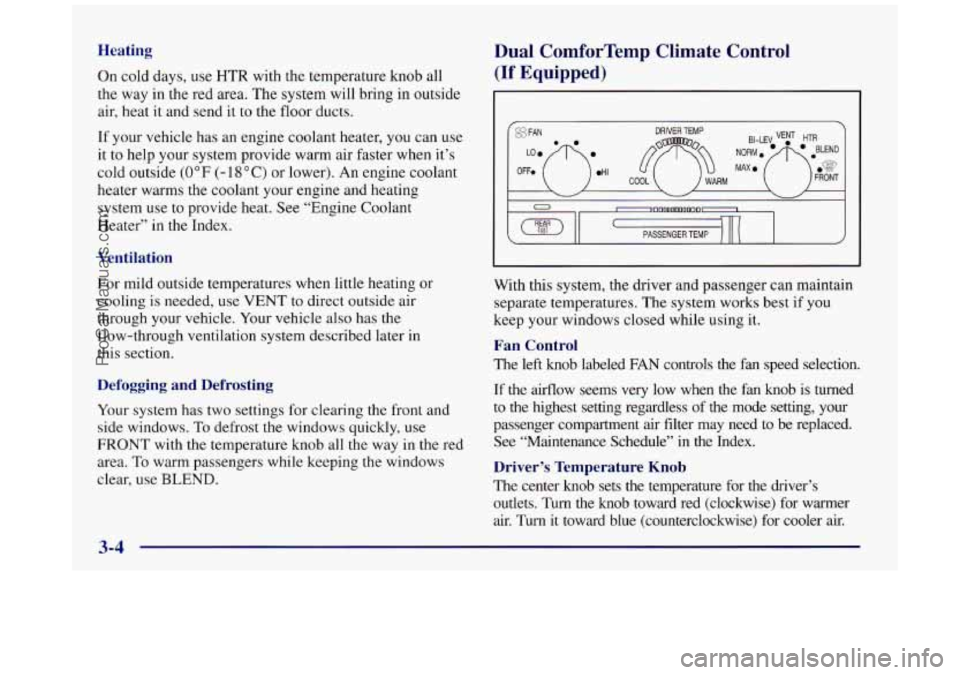
Dual ComforTemp Climate Control
(If Equipped)
I_ .
With this system, the driver and passenger can maintain
separate temperatures. The system works best if you
keep your windows closed while using it.
Fan Control
The left knob labeled FAN controls the fan speed selection.
If the airflow seems very low when the fan knob is turned
to the highest setting regardless
of the mode setting, your
passenger compartment air filter may need to be replaced. See “Maintenance Schedule’’ in the Index.
Driver’s Temperature Knob
The center knob sets the temperature for the driver’s
outlets.
Turn the knob toward red (clockwise) for warmer
air. Turn it toward blue (counterclockwise) for cooler air.
3-4
ProCarManuals.com
Page 162 of 422
Air Conditioning
On very hot days, open the windows long enough to let
hot, inside air escape. This reduces the time for the
vehicle to cool down.
For a quick cool-down on very hot days, use MAX with
the temperature knobs all the way
in the blue area. If
this setting is used for long periods of time, the air in
your vehicle may become too dry.
For normal cooling on hot days, use
NORM with the
temperature knobs in the blue area. The system will
bring
in outside air and cool it.
On cool, but sunny days, the
sun may warm your upper
body,
but your lower body may not be warm enough.
You can use BI-LEV and set the temperature knob to a
comfortable setting. The system will bring in outside air
and direct it to your upper body, while sending slightly
warmed air to your lower body. You may notice this
temperature difference more at some times than others.
Heating
On cold days, use HTR with the temperature knobs all
the way in the red area. The system will bring
in outside
air, heat it and send it to
the floor ducts.
If your vehicle has an engine coolant heater, you can use
it to help your system provide warm air faster when it’s
cold outside
(0°F (-18°C) or lower). An engine coolant
heater warms the coolant your engine and heating
system use to provide heat. See “Engine Coolant
Heater” in
the Index.
Ventilation
For mild outside temperatures when little heating or
cooling is needed, use VENT to direct outside air through
your vehicle. Your vehicle also has the flow-through
ventilation system described later
in this section.
Defogging and Defrosting
Your system has two settings for clearing the front and side
windows.
To defrost the windows quickly, use FRONT.
For maximum defroster performance, set both
driver and passenger temperature controls to the
warmest setting.
To warm passengers while keeping the windows clear,
use
BLEND.
3-6
ProCarManuals.com
Page 166 of 422
Heating
On cold days, use HTR with the temperature knob all
the way in the red area. The system will bring in outside
air, heat it and send it to the floor ducts.
Ventilation System
If your vehicle has an engine coolant heater, you can use
it to help your system provide warm air faster when it’s
cold outside
(0°F (-18°C) or lower). An engine coolant
heater warms the coolant your engine and heating
system use to provide heat. See “Engine Coolant
Heater” in
the Index.
Defogging and Defrosting
Your system has two settings for clearing the front and
side windows.
To defrost the windows quickly, use
FRONT and full hot
(90°F (32°C)). Driver sets
temperature and selects high fan speed.
To warm
passengers while keeping the windows clear, push the
AIR FLOW button until WINDSHTELDFLOOR
appears
in the display. Select fan speed for comfort and
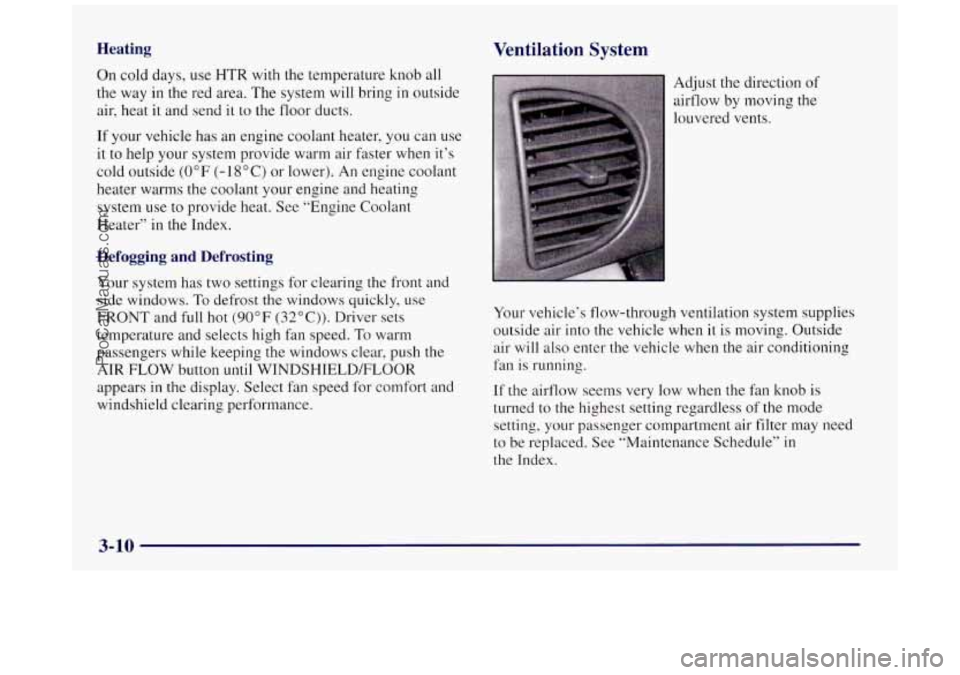
windshield clearing performance. Adjust the direction
of
airflow by moving the
louvered vents.
Your vehicle’s flow-through ventilation system supplies
outside air into the vehicle when
it is moving. Outside
air will also enter the vehicle when the
air conditioning
fan is running.
If the airflow seems very low when the fan knob is
turned to the highest setting regardless of
the mode
setting, your passenger compartment air filter may need
to be replaced. See “Maintenance Schedule” in
the Index.
3-10
ProCarManuals.com
Page 167 of 422
Ventilation Tips
0 Keep the hood and front air inlet free of ice, snow or
any other obstruction, such as leaves. The heater and
defroster will work far better, reducing the chance
of
fogging the inside of your windows.
0 When you enter a vehicle in cold weather, adjust the
mode knob or button to
FLOOR and the fan to the
highest speed for a few seconds before driving off.
This helps clear the intake ducts of snow and
moisture and reduces the chance
of fogging the
inside of your windows.
Keep the air path under the front seats clear of
objects. This helps air to circulate throughout
your vehicle.
Rear Window Defogger
C
J
I
I REAR I
I--1
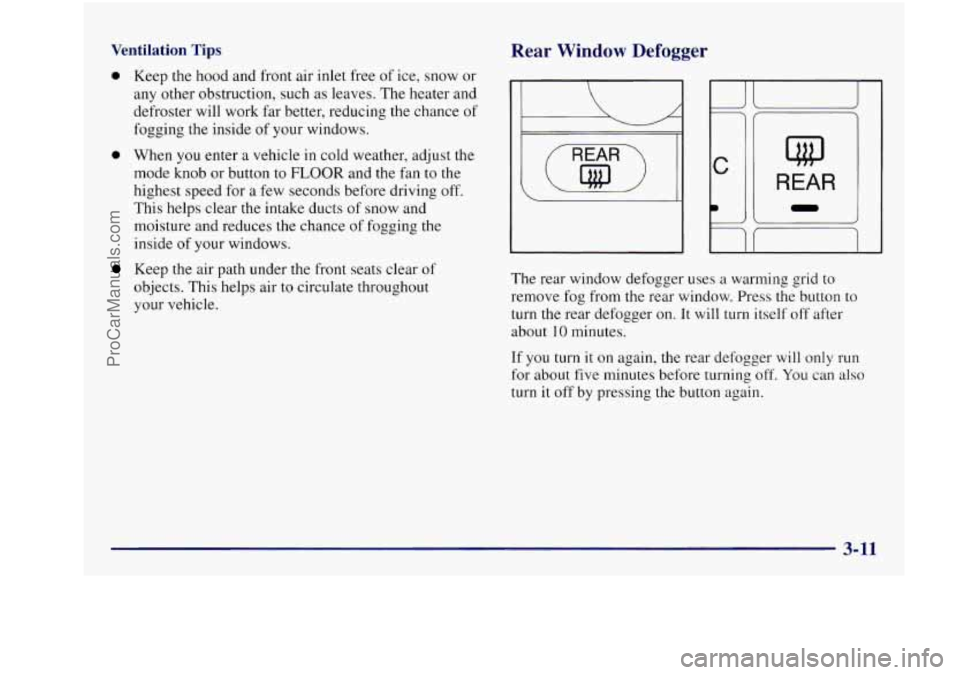
The rear window defogger uses a warming grid to
remove fog from the rear window. Press the button to
turn the rear defogger on. It will turn itself off after
about
10 minutes.
If you turn it on again, the rear defogger will only run
for about five minutes before turning
off. You can also
turn it off by pressing the button again.
ProCarManuals.com
Page 227 of 422
Run your engine only as long as you must. This saves
fuel. When you run the engine, make it go a little faster
than just idle. That is, push the accelerator slightly. This
uses less fuel for the heat that you get and it keeps the
battery charged. You will need a well-charged battery to
restart the vehicle, and possibly for signaling later on
with your headlamps. Let the heater run for a while.
Then, shut the engine off and close the window almost
all the way to preserve the heat. Start the engine again
and repeat this only when
you feel really uncomfortable
from the cold. But do
it as little as possible. Preserve the
fuel as long as you can.
To help keep warm, you can get
out of the vehicle and do some fairly vigorous exercises
every half hour or
so until help comes.
Loading Your Vehicle
OCCUPANTS VEHICLE CAP. WT.
TIRE-LOADING INFORMATION
FRT. CTR. RR. TOTAL LBS. KG
MAX. LOADING & GVWR SAME AS VEHICLE
CAPACITY WEIGHT XXX COLD TIRE
TIRE SIZE SPEED PRESSURE
RTG PSIlKPa
FRT.
RR.
SPA.
IF TIRES ARE HOT,
ADD 4PSIi28KPa
SEE OWNER’S MANUAL
FOR ADDITIONAL
, INFORMATION
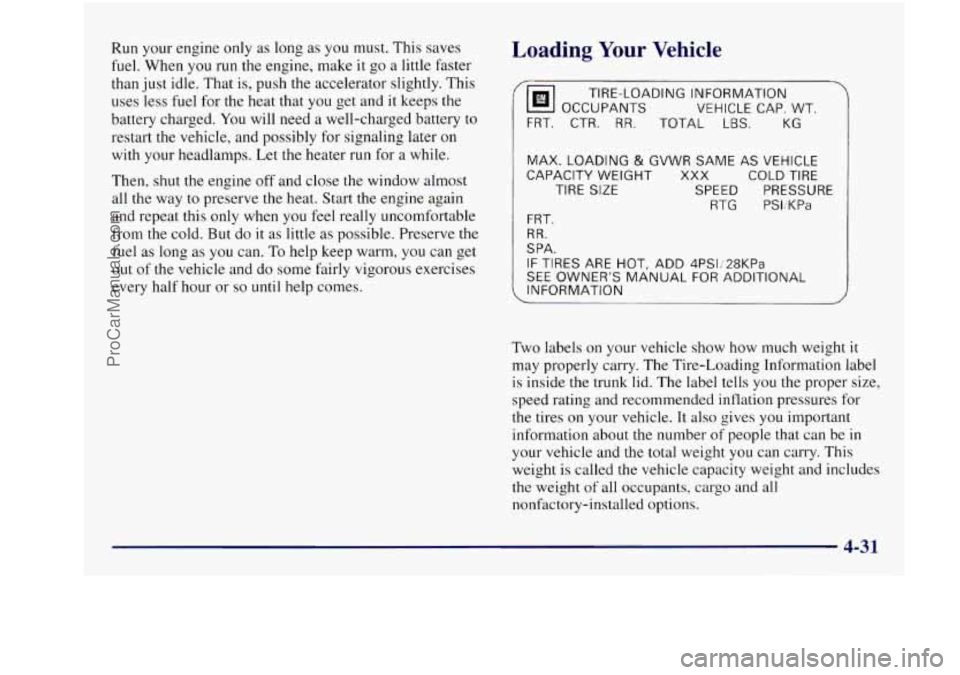
Two labels on your vehicle show how much weight it
may properly carry. The Tire-Loading Information label
is inside the trunk lid. The label tells you the proper size,
speed rating and recommended inflation pressures for
the tires on your vehicle. It also gives you important
information about the number
of people that can be in
your vehicle and the total weight you can carry. This
weight is called the vehicle capacity weight and includes
the weight of all occupants, cargo and all
nonfactory-installed options.
4-31
ProCarManuals.com
Page 252 of 422
1 NOTICE:
I I
If your engine catches fire because you keep
driving with no coolant, your vehicle can
be
badly damaged. The costly repairs would not be
covered by your warranty.
If No Steam Is Coming From Your Engine
If you get the overheat warning but see or hear no
steam, the problem may not be too serious. Sometimes
the engine can get a little too hot when you:
0 Climb a long hill on a hot day.
0 Stop after high-speed driving.
0 Idle for long periods in traffic.
0 Tow a trailer. If you
get the overheat warning with no sign of steam,
try this for
a minute or so:
1. Turn off your air conditioner.
2. Turn on your heater to full hot at the highest fan
speed and open the window as necessary.
3. If you’re in a traffic jam, shift to NEUTRAL (N);
otherwise, shift to the highest gear while
driving
-- AUTOMATIC OVERDRIVE (@).
If you no longer have the overheat warning, you can
drive. Just to be safe, drive slower
for about 10 minutes.
If the warning doesn’t come back
on, you can
drive normally.
If the warning continues, pull over, stop, and park your
vehicle right away.
If there’s still no sign of steam, you can idle the engine
for two or three minutes while you’re parked, to see if
the warning stops. But then, if you still have the
warning, turn ofthe engine
and get everyone out of the
vehicle until it cools down.
You may decide not to lift the hood but to get service
help right away.
5-16
ProCarManuals.com