ECU BUICK REGAL 1998 User Guide
[x] Cancel search | Manufacturer: BUICK, Model Year: 1998, Model line: REGAL, Model: BUICK REGAL 1998Pages: 388, PDF Size: 20.19 MB
Page 63 of 388
When choosing a child restraint, be sure the child
restraint is designed to be used in a vehicle. If
it is, it
will have a label saying that it meets Federal Motor
Vehicle Safety Standards.
Then follow the instructions for the restraint.
You may
find these instructions on the restraint itself or in a
booklet, or both. These restraints use the belt system in
your vehicle, but the child also has to be secured within
the restraint to help reduce the chance of personal injury.
The instructions that come with the infant or child
restraint will show you how to do that. Both the owner’s
manual and the child restraint instructions are important,
so if either one of these is not available, obtain a
replacement copy from the manufacturer.
Where to Put the Restraint
Accident statistics show that children are safer if they
are restrained in the rear rather than the front seat. We at
General Motors therefore recommend that
you put your
child restraint in the rear seat. Never put a rear-facing
child restraint in the front passenger seat. Here’s why:
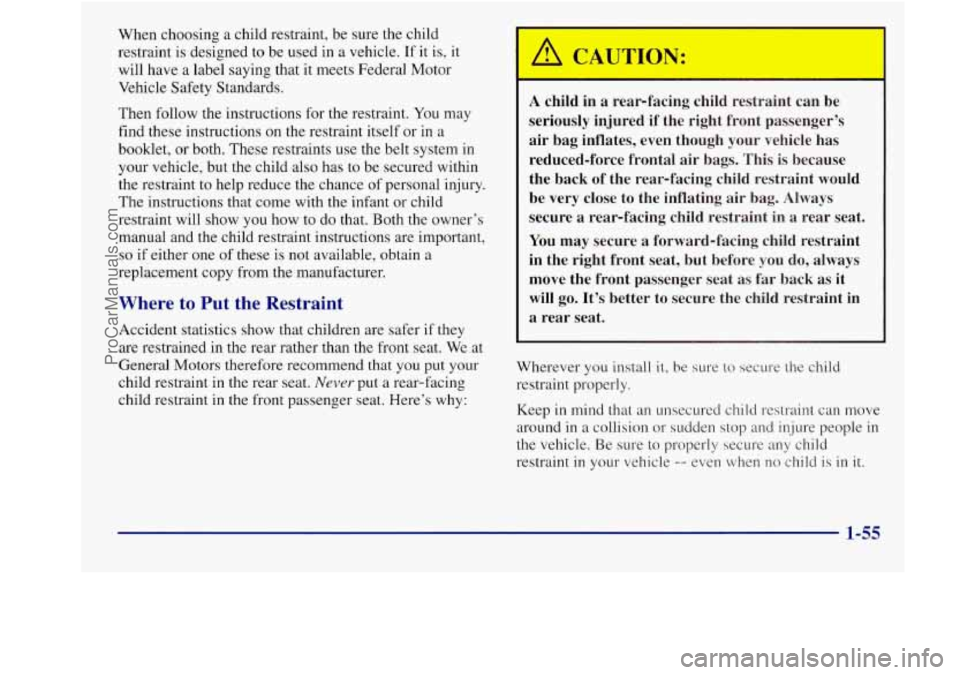
A child in a rear-facing child restraint can be
seriously injured if the right front passenger’s
air bag inflates, even though your vehicle has
reduced-force frontal air bags. This is because
the back of the rear-facing child restraint would
be very close to the inflating air bag. Always
secure a rear-facing child restraint
in a rear seat.
You may secure a forward-facing child restraint
in the right front seat, but before you do, always
move the front passenger seat as far back as it will go. It’s better to secure the child restraint in
a rear seat.
Wherever
you install it, be sure to secure the child
restraint properly.
Keep in mind that an unsecured child restraint can
move
around in a collision or sudden stop and injure people in
the vehicle. Be sure
to properly secure any child
restraint
in your vehicle -- even when no child is in it.
1-55
ProCarManuals.com
Page 64 of 388
Top Strap
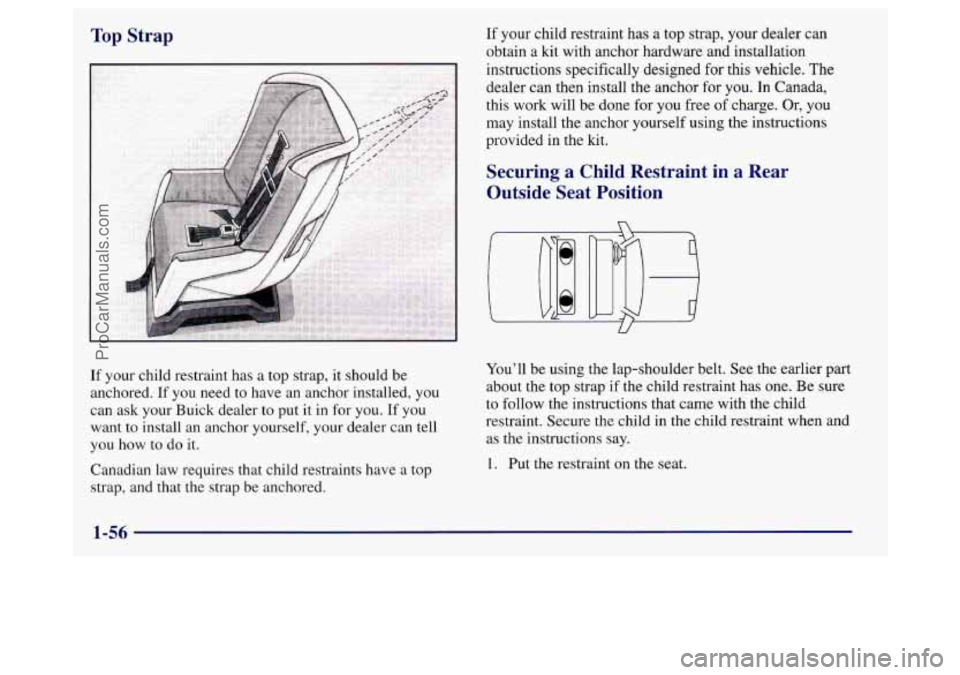
If your child restraint has a top strap, it should be
anchored. If you need to have an anchor installed, you
can ask your Buick dealer to put it in for you.
If you
want
to install an anchor yourself, your dealer can tell
you how to do
it.
Canadian law requires that child restraints have a top
strap, and that the strap be anchored. If
your child restraint has a top strap, your dealer can
obtain a kit with anchor hardware and installation
instructions specifically designed for this vehicle. The
dealer can then install the anchor
for you. In Canada,
this work will be done for you free of charge. Or, you
may install the anchor yourself using the instructions
provided in the
kit.
Securing a Child Restraint in a Rear
Outside Seat Position
U
You’ll be using the lap-shoulder belt. See the earlier part
about the top strap if the child restraint has one. Be sure
to follow the instructions that came with the child
restraint. Secure the child in the child restraint when and
as the instructions say.
1. Put the restraint on the seat.
1-56
ProCarManuals.com
Page 66 of 388
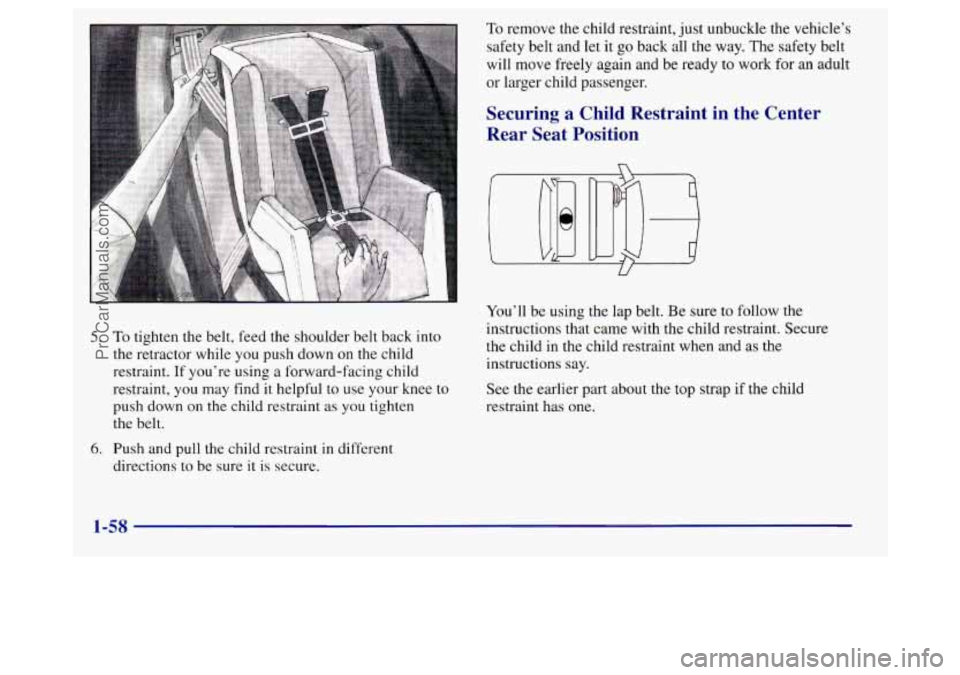
5. To tighten the belt, feed the shoulder belt back into
the retractor while you push down on the child
restraint. If you’re using a forward-facing child
restraint, you may find it helpful to use your knee to
push down on the child restraint as you tighten
the belt.
6. Push and pull the child restraint in different
directions to be sure
it is secure.
To remove the child restraint, just unbuckle the vehicle’s
safety belt and let it go back all the way. The safety belt
will move freely again and be ready to work for an adult
or larger child passenger.
Securing a Child Restraint in the Center
Rear Seat Position
You’ll be using the lap belt. Be sure to follow the
instructions that came with the child restraint. Secure
the child in the child restraint when and
as the
instructions say.
See the earlier part about the top strap if the child
restraint has one.
1-58
ProCarManuals.com
Page 68 of 388

6. Push and pull the child restraint in different
directions to be sure it
is secure.
To remove the child restraint, just unbuckle the vehicle’s
safety belt. It will be ready
to work for an adult or larger
child passenger.
Securing a Child Restraint in the Right
Front Seat Position
Your vehicle has a right front passenger air bag. Never
put a rear-facing child restraint in this seat. Here’s why:
A CAUTICY:
A child in a rear-facing child rest int can be
seriously injured or killed if the right front
passenger’s air bag inflates, even though your
vehicle has reduced-force frontal air bags. This
is because the back of the rear-facing child
restraint would be very close to the inflating
air bag. Always secure
a rear-facing child
1 restraint in the rear seat.
U
1-60
ProCarManuals.com
Page 69 of 388

You’ll be using the lap-shoulder belt. See the earlier part
about the
top strap if the child restraint has one. Be sure
to follow the instructions that came with the child
restraint. Secure the child
in the child restraint when and
as the instructions say.
1. Because your vehicle has a right front passenger air
bag, always move the seat as far back as it will go
before securing a forward-facing child restraint. (See
“Seats’’
in the Index.)
2. Put the restraint on the seat.
3. Pick up the latch plate, and run the lap and shoulder
portions of the vehicle’s safety belt through or
around the restraint. The child restraint instructions
will show you how.
If the shoulder belt goes in front of the child’s face or
neck, put it behind the child restraint.
4. Buckle the belt. Make sure the release button is
positioned
so you would be able to unbuckle the
safety belt quickly if you ever had to.
1-61
ProCarManuals.com
Page 70 of 388
D
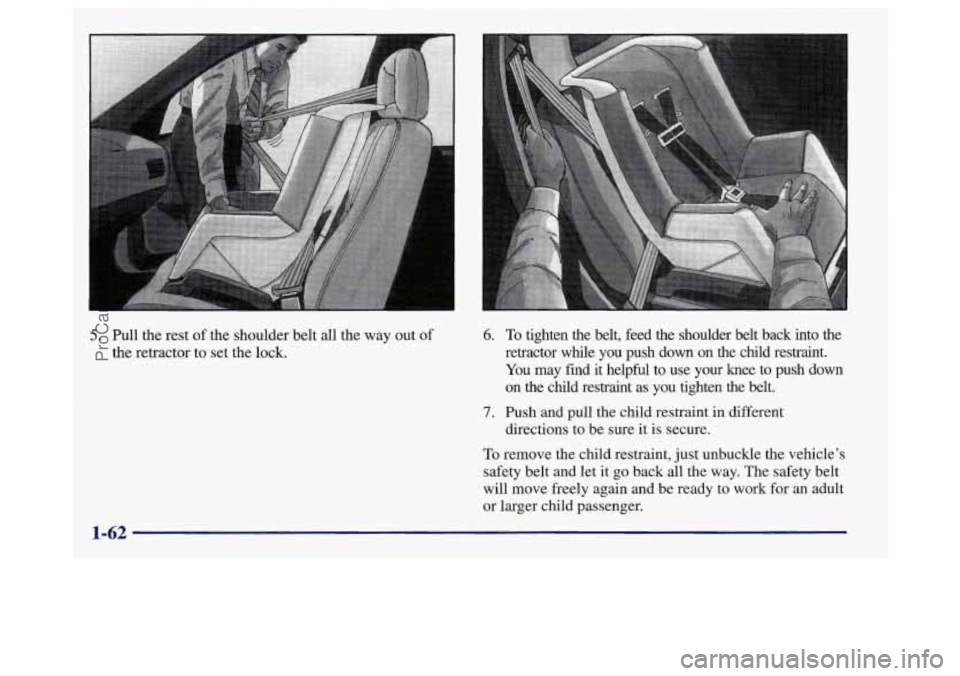
5. Pull the rest of the shoulder belt all the way out of
the retractor to set the lock. 6. To tighten the belt, feed the shoulder belt back into the
retractor while you push down on the child restraint.
You may fmd it helpful to use your knee to push down
on the child restraint as you tighten the belt.
7. Push and pull the child restraint in different
directions to be sure it is secure.
To remove the child restraint, just unbuckle the vehicle’s
safety belt and let it go back all the way. The safety belt
will move freely again and be ready to work for an adult
or larger child passenger.
1-62
ProCarManuals.com
Page 80 of 388
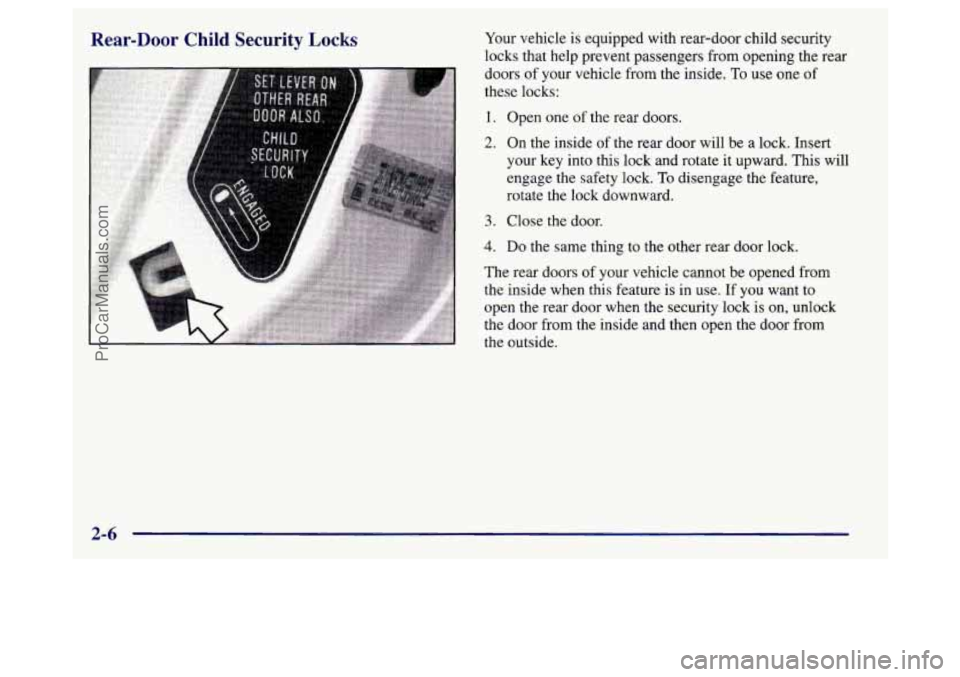
Rear-Door Child Security Locks Your vehicle is equipped with rear-door child security
locks that help prevent passengers from opening the rear
doors of your vehicle from the inside.
To use one of
these locks:
1. Open one of the rear doors.
2. On the inside of the rear door will be a lock. Insert
your key into this lock and rotate it upward. This will
engage the safety lock.
To disengage the feature,
rotate the lock downward.
3. Close the door.
4. Do the same thing to the other rear door lock.
The rear doors of your vehicle cannot be opened from
the inside when this feature is in
use. If you want to
open the rear door when the security lock is on, unlock
the door from the inside and then open the door from
the outside.
2-6
ProCarManuals.com
Page 81 of 388
Programmable Automatic Power
Door Locks
Programmable Automatic Power Door Locks is a
standard feature that
is intended to provide enhanced
security and convenience by automatically locking and
unlocking doors. This feature provides four operating
modes. For your vehicle, you may select and program
one of the following four operating modes:
Mode 1: No automatic door lock or unlock.
Mode 2: Automatic all-door lock when the transaxle is
shifted out of PARK (P); no automatic door unlock.
Automatic door relock when any door is unlocked,
opened and then all doors are again closed while
the
vehicle is not in PARK (P) or NEUTRAL (N) and the
driver’s foot is on the brake pedal.
Mode 3: Automatic all-door lock when the transaxle is
shifted out
of PARK (P).
Automatic all-door unlock when the transaxle is shifted
into PARK (P).
Automatic door relock when any door is unlocked,
opened and then all doors are again closed while the
vehicle is not in PARK (P) or NEUTRAL
(N) and the
driver’s foot is
on the brake pedal.
Mode 4: Automatic all-door lock when the transaxle is
shifted out
of PARK (P).
Automatic driver’s door only unlock when the transaxle
is shifted into PARK
(P).
Automatic door relock when any door is unlocked,
opened and then all doors are again closed while the
vehicle is not in PARK (P) or NEUTRAL
(N) and the
driver’s foot is on the brake pedal.
The operating mode of the Programmable Automatic
Power Door Locks will be changed when the driver
performs the following sequence with the engine not
running, the doors closed and the ignition key in RUN:
1. Apply your regular brakes.
2. Press and hold the power door lock switch. While
holding the door lock switch, cycle the transaxle out
of and back into PARK (P).
After an initial transaxle cycle, each additional cycle
will advance the operating mode by one, starting from
the current operating mode. During this procedure, the
automatic door lock and unlock functions will operate
as defined
by each mode above, providing the driver
with feedback of the current operating mode. If cycled
beyond Mode
4, the vehicle will enter operating
Mode
1. When the door lock switch is released, the
vehicle will remain in the most recent operating mode.
2-7
ProCarManuals.com
Page 85 of 388
Security Feedback
Security Feedback provides audible and/or visible
feedback that a remote keyless entry lock or unlock
command has been received and executed. Your
vehicle’s ignition must be off for this feature to work.
You may select one of four operating modes for
reception of a lock command. You may also select one
of four operating modes for reception of an unlock
command. The selection and programming of the lock
and unlock operating modes are independent of each
other. The following modes are available for either lock
or unlock verification:
Mode 1: No Verification
Mode 2: Horn Chirp only
Mode 3: Headlamp Flash only
Mode &Horn Chirp and Headlamp Flash The operating
mode of the Security Feedback lock
feature will be changed when you perform the following
sequence with your vehicle’s doors closed and the
ignition key in
RUN:
1.
2.
Press and hold the power door lock switch. While
holding the door lock switch, press and release the
remote keyless entry
(RKE) transmitter lock button.
This will initialize the customization mode. While in
the customization mode, the feature will sound the
number of chimes corresponding to the current
Security Feedback lock mode.
Each additional press of the
RKE transmitter lock button
will cause your vehicle
to advance the lock mode by
one, starting from the current lock mode. If cycled
beyond lock Mode
4, the vehicle will enter lock Mode 1.
During this procedure, the feature will sound the number
of chimes corresponding to the current lock mode,
providing you with feedback. When the door lock
switch is released, the vehicle will remain in the most
recent lock mode.
2-11
ProCarManuals.com
Page 86 of 388
The operating mode of the Security Feedback unlock
feature will be changed when you perform
the following
sequence with your vehicle’s doors closed and the
ignition key
in RUN:
1.
2.
Press and hold the power door unlock switch. While
holding the door unlock switch, press and release the
RKE transmitter unlock button. This will initialize
the customization mode.
While in the customization mode, the feature will
sound the number of chimes corresponding
to the
current unlock mode.
Each additional press of the
RKE transmitter unlock
button will cause your vehicle to advance the unlock
mode by
one, starting from the current unlock mode. If
cycled beyond unlock Mode
4, the vehicle will enter
unlock Mode 1. During this procedure, the feature will
sound the number of chimes corresponding to the
current unlock mode, providing you with feedback.
When the door unlock switch is released,
the vehicle
will remain in
the most recent unlock mode.
Disconnecting the vehicle’s battery for up to a year will
not change the programmed mode of the lock and
unlock Security Feedback features.
Illumination on Remote Activation
This feature provides interior illumination when a
remote keyless entry door unlock command is received
and executed by your vehicle.
Your vehicle’s ignition
must be off for the Illumination
on Remote Activation
feature to work. The interior lamps will illuminate until
your vehicle’s ignition
is turned to RUN or until an
illumination period of
40 seconds has elapsed. If a door
is opened during the illumination period, the timed
illumination will be canceled, and the interior lamps will
remain on since a door is open.
Instant Alarm
This feature allows you to activate an alarm by pressing
a button on the remote keyless entry transmitter. Your
vehicle’s ignition must be off for the Instant Alarm to
work. When you press the special horn button on the
remote keyless entry transmitter, your vehicle’s
headlamps will flash, the horn will honk repeatedly, and
your interior lamps will illuminate, attracting attention if
you need it. The alarm will continue until:
1. You press the alarm button on the RKE transmitter a
second time.
2. The vehicle’s ignition is in RUN.
3. An alarm period of about two minutes has elapsed.
2-12
ProCarManuals.com