fuel BUICK REGAL 1998 User Guide
[x] Cancel search | Manufacturer: BUICK, Model Year: 1998, Model line: REGAL, Model: BUICK REGAL 1998Pages: 388, PDF Size: 20.19 MB
Page 152 of 388
Modes
AVG ECON: Shows your average fuel economy since
you last reset this mode. Average fuel economy is
viewed as a long term approximation of your overall
driving and driving conditions. To learn the average fuel
economy from a new starting point, press the RESET
button while
the average fuel economy is displayed in
the
DIC.
INSTANTANEOUS FUEL ECONOMY Shows your
current fuel economy. Instantaneous fuel economy
varies with your driving conditions, such as
acceleration, braking and the grade of the road being
traveled. The instantaneous fuel economy display cannot
be reset, therefore the reset button has no effect while in
this mode.
OIL LIFE MONITOR: Shows an estimate of the oil’s
remaining useful life. When
the oil life index is less than
lo%, the CHANGE OIL SOON light will come on.
When you have the oil changed according to the
maintenance schedule (see “Maintenance Schedule” in
the Index), you will have to reset the oil life monitor.
To
do this, press and hold the RESET button for more than
five seconds while the oil life monitor is being displayed
on the DIC. The oil life will change
to 100%.
RANGE: Shows the approximate distance you can
drive without refueling. This
is based on the amount of
fuel in the tank and on the fuel economy of the most
recent
25 miles (40 km). Pressing RESET while in this
mode will have no effect.
BOOST GAGE: If you have the supercharged engine,
this gage will show
the amount of boost your engine is
receiving. Pressing RESET while in this mode will have
no effect.
2-78
ProCarManuals.com
Page 208 of 388
The exit speed is usually posted.
Reduce your speed according to your speedometer, not
to your sense of motion. After driving for any distance
at higher speeds, you may tend to think you are going
slower than you actually
are.
Before Leaving on a Long Trip
Make sure you’re ready. Try to be well rested. If you
must start when you’re not fresh -- such as after a day’s
work
-- don’t plan to make too many miles that first part
of the journey. Wear comfortable clothing and shoes you
can easily drive in.
Is your vehicle ready for a long trip? If you keep it
serviced and maintained, it’s ready
to go. If it needs
service, have it done before starting
out. Of course,
you’ll find experienced and able service experts in
Buick dealerships all across North America. They’ll be
ready and willing to help
if you need it. Here
are some things you can check before
a trip:
0
0
0
0
0
0
0
Windshield Washer Fluid: Is the reservoir full? Are
all windows clean inside and outside?
Wiper Blades: Are they in good shape?
Fuel, Engine Oil, Other Fluids: Have you checked
all levels?
Lamps: Are they all working? Are the lenses clean?
Tires: They are vitally important to a safe,
trouble-free trip.
Is the tread good enough for
long-distance driving? Are the tires all inflated to the
recommended pressure?
Weather Forecasts: What’s the weather outlook
along your route? Should you delay your trip a short
time to avoid a major storm system?
Maps: Do you have up-to-date maps?
4-24
ProCarManuals.com
Page 215 of 388

Run your engine only as long as you must. This saves
fuel. When you run the engine, make it go a little faster
than just idle. That is, push the accelerator slightly. This
uses less fuel for the heat that you get and it keeps the
battery charged. You will need a well-charged battery to
restart the vehicle, and possibly for signaling later
on
with your headlamps. Let the heater run for a while.
Then,
shut the engine off and close the window almost
all the way to preserve the heat. Start the engine again
and repeat this only when
you feel really uncomfortable
from the cold. But do it as little as possible. Preserve the
fuel as long as you can.
To help keep warm, you can get
out of the vehicle and
do some fairly vigorous exercises
every half hour or
so until help comes.
Loading Your Vehicle
Two labels on your vehicle show how much weight it
may properly calry. The Tire-Loading Information label
is inside the trunk lid. The label tells you the proper size,
speed rating and recommended inflation pressures for
the tires
on your vehicle. It also gives you important
information about the number of people that can be in
your vehicle and the total weight you can carry. This
weight is called the vehicle capacity weight and includes
the weight of all occupants, cargo and all
nonfactory-installed options.
4-31
ProCarManuals.com
Page 216 of 388

/
MFD BY GENERAL MOTORS CORP
The other label is the Certification label, found on the
rear edge
of the driver’s door. It tells you the gross
weight capacity of your vehicle, called the Gross
Vehicle Weight Rating (GVWR). The GVWR includes
the weight
of the vehicle, all occupants, fuel and cargo.
Never exceed the GVWR for your vehicle or the Gross
Axle Weight Rating (GAWR) for either the front or
rear axle.
If you do have a heavy load, spread it out. Don’t carry
more than
167 pounds (75 kg) in your trunk.
u 11
Do not load your vehicle any heavier than the
GVWR, or either the maximum front or rear
GAWR. If you do, parts on your vehicle can
break, or
it can change the way your vehicle
handles. These could cause you to lose control.
Also, overloading can shorten the life of
your vehicle.
NOTICE:
Your warranty does not cover parts or
components that fail because of overloading.
~~
If you put things inside your vehicle -- like suitcases,
tools, packages or anything else
-- they will go as fast as
the vehicle goes. If you have
to stop or turn quickly, or
if there is a crash, they’ll keep going.
4-32
ProCarManuals.com
Page 218 of 388

Your vehicle can tow a trailer if it is equipped with the
proper trailer towing equipment. To identify what the
vehicle trailering capacity is for your vehicle, you
should read the information in “Weight of the Trailer”
that appears later in this section. But trailering is
different than just driving your vehicle by itself.
Trailering means changes in handling, durability and
fuel economy. Successful, safe trailering takes correct
equipment, and it has to be used properly.
That’s the reason for this part. In it are many
time-tested, important trailering tips and safety rules.
Many of these are important for your safety and that of
your passengers.
So please read this section carefully
before you pull a trailer.
Load-pulling components such as the engine, transaxle,
wheel assemblies and tires are forced to work harder
against the drag
of the added weight. The engine is
required to operate at relatively higher speeds and under
greater loads, generating extra heat. What’s more, the
trailer adds considerably to wind resistance, increasing
the pulling requirements.
If You Do Decide To Pull A Trailer
If you do, here are some important points:
0
0
0
0
0
There are many different laws, including speed limit
restrictions, having to do with trailering. Make sure
your rig will be legal, not only where you live but
also where you’ll be driving.
A good source for this
information can be state or provincial police.
Consider using a sway control. You can ask a hitch
dealer about sway controls.
Don’t tow a trailer at all during
the first 1,000 miles
(1 600 km) your new vehicle is driven. Your engine,
axle or other parts could be damaged.
Then, during the first
500 miles (800 km) that you
tow a trailer, don’t drive over 50 mph (80 kdh) and
don’t make starts at full throttle. This helps your
engine and other parts of your vehicle wear
in at the
heavier loads.
Obey speed limit restrictions when towing a trailer.
Don’t drive faster than the maximum posted speed
for trailers (or no more than
55 mph (90 kmh)) to
save wear on your vehicle’s parts.
4-34
ProCarManuals.com
Page 265 of 388

Section 6 Service and Appearance Care
Here you will find information about the care of your vehicle. This section begins with service and fuel information,
and then it shows how to check important fluid and lubricant levels. There is also technical information about your
vehicle, and a part devoted to its appearance care.
6-2
6-3
6-5 6-5
6-8
6- 12
6-
12
6- 17
6-20
6-23
6-27
6-28 6-30
6-33 6-34
6-39
6-49
6-49 Service
Fuel
Fuels in Foreign Countries
Filling Your Tank
Checking Things Under the Hood
3800 Supercharged (Code 1) Engine
Engine Oil Air Cleaner
Automatic Transaxle Fluid
Engine Coolant
Power Steering Fluid
Windshield Washer Fluid
Brakes
Battery
Bulb Replacement
Tires
Appearance Care Cleaning the Inside
of Your Vehicle 6-5
1
6-52
6-52
6-52
6-53
6-54
6-55
6-57 6-58
6-58
6-59
6-65
6-65
6-66
6-67 6-67 Cleaning the Built-in
Child Restraint
Care of Safety Belts and Built-in Child
Restraint Harness
Cleaning Glass Surfaces
Cleaning the Outside of the Windshield and
Wiper Blades
Cleaning the Outside of Your Vehicle
Cleaning Aluminum or Chrome Wheels
Cleaning Tires
Appearance Care Materials Chart
Vehicle Identification Number (VIN)
Service Parts Identification Label
Electrical System
Replacement Bulbs
Capacities and Specifications
Vehicle Dimensions
Normal Maintenance Replacement Parts
Air Conditioning Refrigerants
6- 1
ProCarManuals.com
Page 267 of 388
I
You can be injured and your vehicle could be
damaged if you try to do service work on a
vehicle without knowing enough about it.
e
e
Be sure you have sufficient knowledge,
experience, the proper replacement parts
and tools before you attempt any vehicle
maintenance task.
Be sure to use the proper nuts, bolts and
other fasteners. “English” and “metric”
fasteners can be easily confused.
If you use
the wrong fasteners, parts can later break
or fall off. You could be hurt.
Adding Equipment to the Outside of
Your Vehicle
Things you might add to the outside of your vehicle can
affect the airflow around it. This may cause wind noise
and affect windshield washer performance. Check with
your dealer before adding equipment to the outside of
your vehicle.
Fuel
The 8th digit of your vehicle identification number
(VIN) shows the code letter for your engine.
You will
find the VIN at the top left of your instrument panel.
(See “Vehicle Identification Number”
in the Index.)
If you have the 3800 engine (VIN Code K), use regular
unleaded gasoline rated at
87 octane or higher. If you’re
using fuel rated at the recommended octane or higher
and you hear heavy knocking, your engine needs
service. But don’t worry
if you hear a little pinging
noise when you‘re accelerating or driving up
a hill.
That’s normal, and you don’t have to
buy a higher
octane fuel to get rid
of pinging. It’s the heavy, constant
knock that means
you have a problem.
If you have the 3800 Supercharged engine (VIN Code
l), use premium unleaded gasoline rated at 91 octane or
higher. With the 3800 Supercharged engine, in
an
emergency, you may be able to use a lower octane -- as
low as 87 -- if heavy knocking does not occur. If you
are using 9
1 or higher octane unleaded gasoline and you
hear heavy knocking, your engine needs service.
6-3
ProCarManuals.com
Page 268 of 388
At a minimum, the gasoline you use should meet
specifications ASTM
D4814 in the United States and
CGSB 3.5-M93 in Canada. Improved gasoline
specifications have been developed by the American
Automobile Manufacturers Association (AAMA) for
better vehicle performance and engine protection.
Gasolines meeting the AAMA specification could
provide improved driveability and emission control
system protection compared
to other gasolines.
Be sure the posted octane for premium is at least 91 (at
least 89 for middle grade and
87 for regular). If the
octane is less than
87, you may get a heavy knocking
noise when you drive.
If it’s bad enough, it can damage
your engine.
If your vehicle is certified to meet California Emission
Standards (indicated on the underhood emission control
label), it is designed
to operate on fuels that meet
California specifications. If such
fuels are not available
in states adopting California emissions standards, your
vehicle will operate satisfactorily
on fuels meeting
federal specifications, but emission control system performance
may be affected. The malfunction indicator
lamp on your instrument panel may turn on and/or your
vehicle may fail a smog-check test. If this occurs, return
to your authorized Buick dealer for diagnosis to
determine the cause of failure. In the event it is
determined that the cause of the condition is the type
of
fuels used, repairs may not be covered by your warranty.
Some gasolines that are not reformulated for low
emissions contain an octane-enhancing additive called
methylcyclopentadienyl manganese tricarbonyl (MMT);
ask your service station operator whether or not his fuel
contains MMT. General Motors does
not recommend the
use of such gasolines.
If fuels containing MMT are used,
spark plug life may be reduced and your emission
control system performance may be affected. The
malfunction indicator lamp on your instrument panel
may turn on. If this occurs, return to your authorized
Buick dealer for service.
6-4
ProCarManuals.com
Page 269 of 388
To provide cleaner air, all gasolines in the United States
are now required to contain additives that will help
prevent deposits from forming in your engine and fuel
system, allowing your emission control system to
function properly. Therefore, you should not have to add
anything to the fuel. In addition, gasolines containing
oxygenates, such as ethers and ethanol, and
reformulated gasolines may be available in your area to
help clean the air. General Motors recommends that you
use these gasolines if they comply with the
specifications described earlier.
1 NOTICE:
Your vehicle was not designed for fuel that
contains methanol. Don’t use
it. It can corrode
metal parts in your fuel system and also damage
plastic and rubber parts. That damage wouldn’t be covered under your warranty.
Fuels in Foreign Countries
If you plan on driving in another country outside the
United States or Canada, the proper fuel may be hard to
find. Never use leaded gasoline or any other fuel not
recommended in the previous text on fuel. Costly repairs
caused by use of improper fuel wouldn’t be covered by
your warranty.
To check on fuel availability, ask an auto club, or
contact a major oil company that does business in the
country where you’ll be driving.
You can also write us at the following address for
advice. Just tell us where you’re going and give your
Vehicle Identification Number (VIN).
General Motors Overseas Distribution Corporation
1908 Colonel Sam Drive
Oshawa, Ontario L1H
8P7
6-5
ProCarManuals.com
Page 270 of 388
Filling Your Tank
Gasoline vapor is highly flammable. It burns
violently, and that can cause very bad injuries.
Don’t smoke if you’re near gasoline or refueling
your vehicle. Keep sparks, flames and smoking materials away from gasoline.
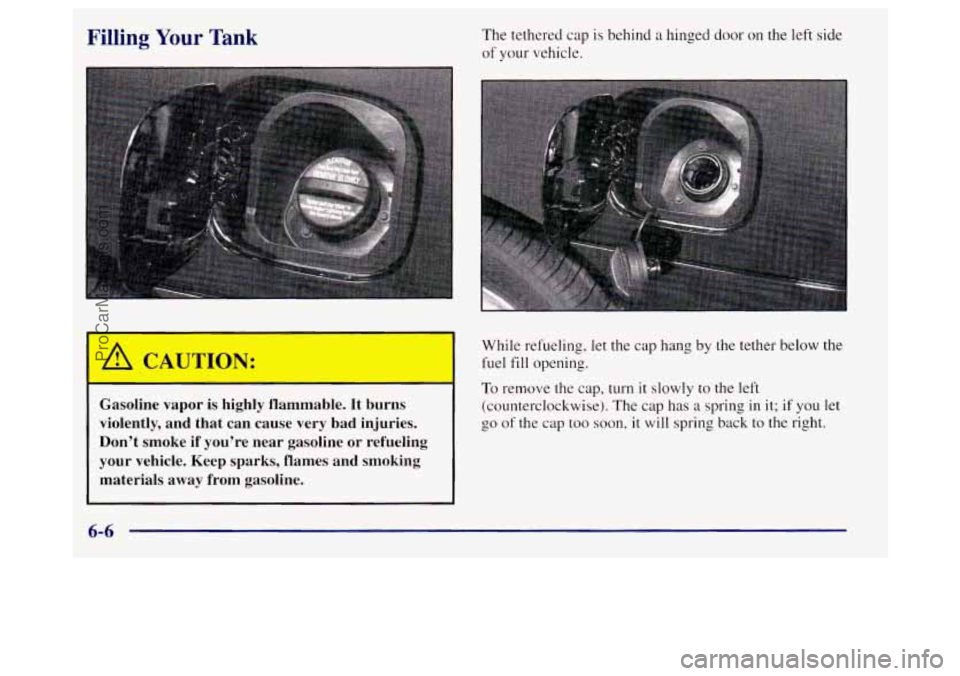
The tethered cap is behind a hinged door on the left side
of your vehicle.
While refueling, let the cap hang
by the tether below the
fuel fill opening.
To remove the cap, turn it slowly to the left
(counterclockwise). The cap has a spring in it;
if you let
go of the cap too soon, it will spring back to the right.
6-6
ProCarManuals.com