steering BUICK REGAL 1998 User Guide
[x] Cancel search | Manufacturer: BUICK, Model Year: 1998, Model line: REGAL, Model: BUICK REGAL 1998Pages: 388, PDF Size: 20.19 MB
Page 108 of 388
TILT-WHEEL TM Adjustable
Steering Column
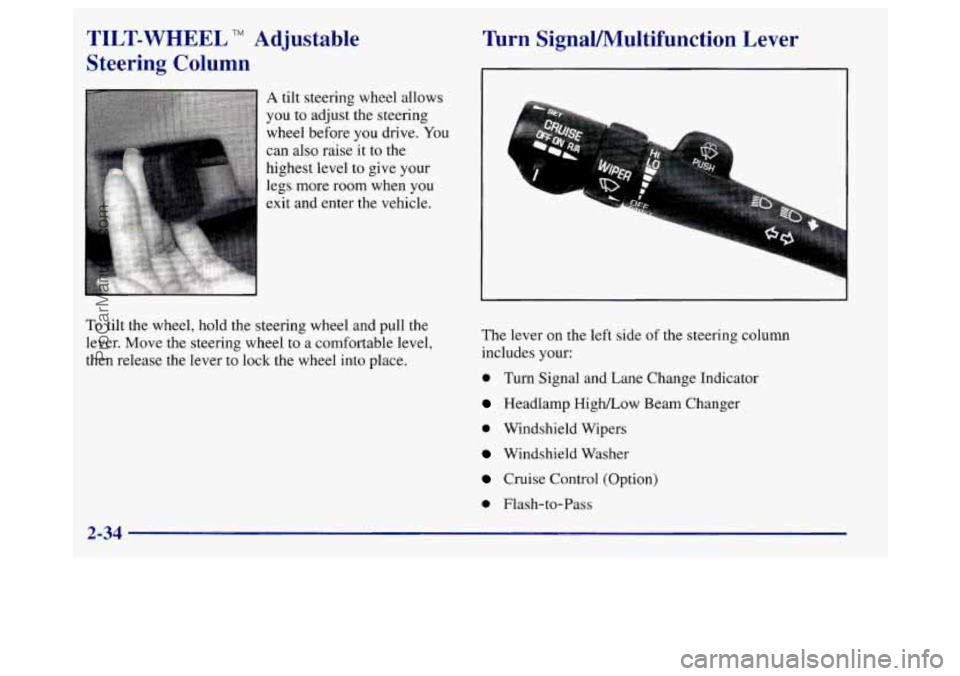
A tilt steering wheel allows
you to adjust the steering
wheel before
you drive. You
can also raise it to the
highest level to give your
legs more room when you
exit and enter the vehicle.
To tilt the wheel, hold the steering wheel and pull the
lever. Move the steering wheel to a comfortable level,
then release the lever to lock the wheel into place.
Turn SignaYMultifunction Lever
The lever on the left side of the steering column
includes your:
0 Turn Signal and Lane Change Indicator
Headlamp High/Low Beam Changer
0 Windshield Wipers
Windshield Washer
Cruise Control (Option)
0 Flash-to-Pass
2-34
ProCarManuals.com
Page 118 of 388
Fog Lamps Interior Lamps
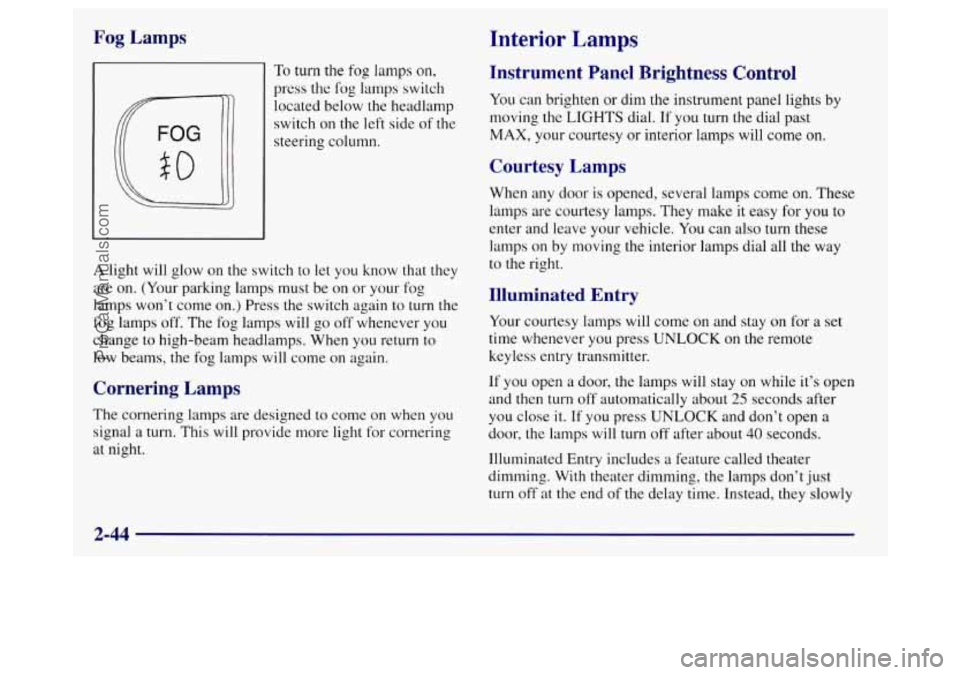
To turn the fog lamps on,
press the
log lamps switch
located below the headlamp
switch on
the left side of the
steering column.
A light will glow on the switch to let you know that they
are on. (Your parking lamps must be on or your fog
lamps won’t come on.) Press the switch again to turn the
fog lamps off. The fog lamps will go off whenever you
change to high-beam headlamps. When you return to
low beams, the fog lamps will come
on again.
Cornering Lamps
The cornering lamps are designed to come on when you
signal a turn. This will provide more light for cornering
at night.
Instrument Panel Brightness Control
You can brighten or dim the instrument panel lights by
moving
the LIGHTS dial. If you turn the dial past
MAX, your courtesy or interior lamps will come on.
Courtesy Lamps
When any door is opened, several lamps come on. These
lamps are courtesy lamps. They make it easy for you to
enter and leave your vehicle. You can also turn these
lamps
on by moving the interior lamps dial all the way
to the right.
Illuminated Entry
Your courtesy lamps will come on and stay on for a set
time whenever you press
UNLOCK on the remote
keyless entry transmitter.
If you open a door, the lamps will stay on while it’s open
and
then turn off automatically about 25 seconds after
you close it. If you press UNLOCK and don’t open a
door, the lamps
will turn off after about 40 seconds.
Illuminated Entry includes a feature called theater
dimming. With theater dimming, the lamps don’t just
turn off
at the end of the delay time. Instead, they slowly
2-44
ProCarManuals.com
Page 151 of 388
Control Buttons
I
RESET
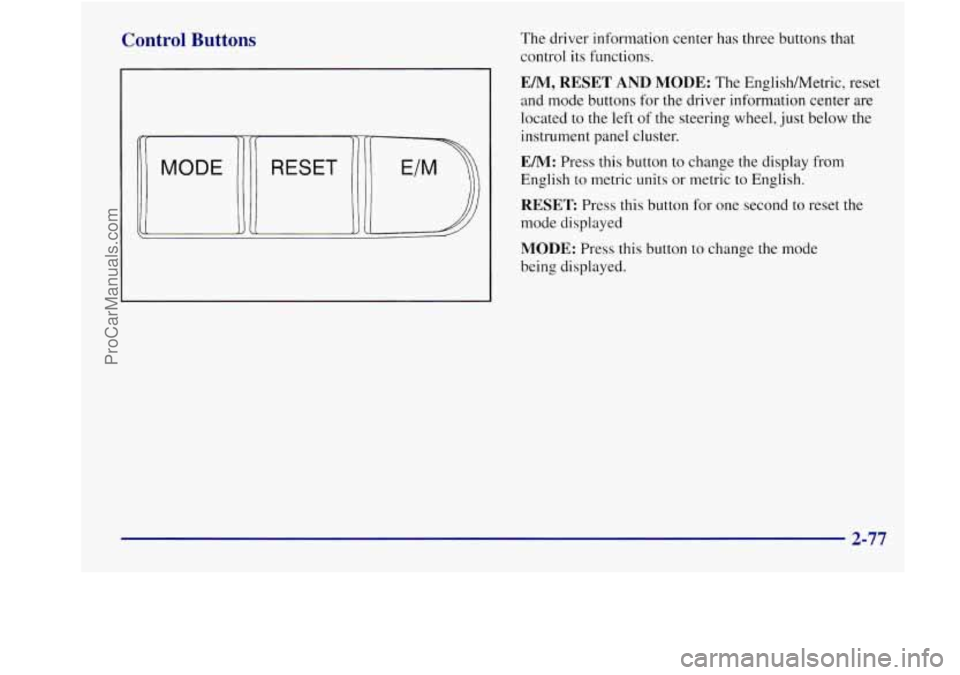
The driver information center has three buttons that
control its functions.
EM, RESET AND MODE: The EnglishMetric, reset
and mode buttons
for the driver information center are
located
to the left of the steering wheel, just below the
instrument panel cluster.
EM: Press this button to change the display from
English to metric units
or metric to English.
RESET Press this button for one second to reset the
mode displayed
MODE: Press this button to change the mode
being displayed.
2-77
ProCarManuals.com
Page 153 of 388
Section 3 Comfort Controls and Audio Systems
In
this section, you’ll find out how to operate the comfort control and audio systems offered with your vehicle. Be
sure to read about the particular systems supplied with your vehicle.
3-2
3-2
3-4 3-7
3-10
3-11
3- 12 3- 12
3-13 3-16 Comfort Controls
Manual
Single Zone Climate Control
Dual ComforTemp Climate Control
(If Equipped)
Dual Automatic ComforTemp Climate Control (If Equipped)
Ventilation System
Rear Window Defogger
Audio Systems Setting the Clock
AM-FM Stereo with Cassette Tape Player
AM-FM Stereo with Cassette Tape Player and
Automatic Tone Control (If Equipped)
3-20
3-25
3-28
3-29
3-29
3-30
3-3 1
3-3 1
3-3 1
3-3 1 AM-FM Stereo
with Cassette Tape and
Compact Disc Player with Automatic Tone
Control (If Equipped)
Theft-Deterrent Feature (If Equipped)
Audio Steering Wheel Controls
(If Equipped)
Understanding Radio Reception
Tips About Your Audio System
Care
of Your Cassette Tape Player
Care of Your Compact Discs
Care
of Your Compact Disc Player
Fixed Mast Antenna
Backglass Antenna
(If Equipped)
3-1
ProCarManuals.com
Page 180 of 388
To unlock a secured radio see “Unlocking the
Theft-Deterrent Feature After a Power
Loss” earlier in
this section.
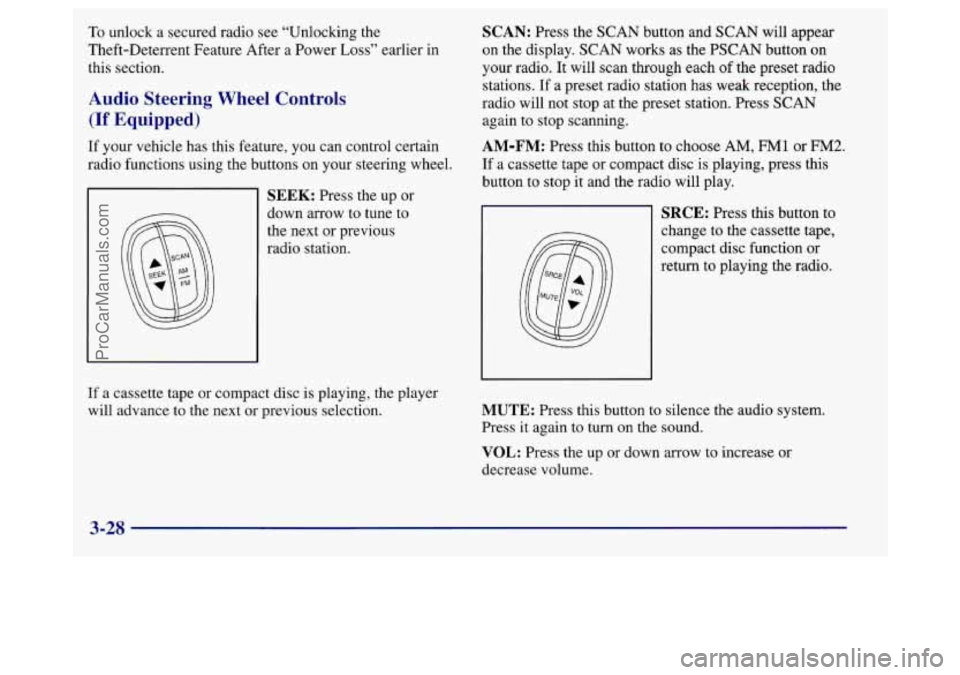
Audio Steering Wheel Controls
(If Equipped)
If your vehicle has this feature, you can control certain
radio functions using the buttons on your steering wheel.
SEEK: Press the up or
down arrow to tune to
the next or previous
radio station.
SCAN: Press the SCAN button and SCAN will appear
on the display. SCAN works as the PSCAN button on
your radio.
It will scan through each of the preset radio
stations. If a preset radio station has weak reception, the
radio will not stop at the preset station. Press SCAN
again to stop scanning.
AM-FM: Press this button to choose AM, FM1 or FM2.
If a cassette tape or compact disc is playing, press this
button to stop it and the radio will play.
SRCE: Press this button to
change to the cassette tape,
compact disc function or
return to playing the radio.
If a cassette tape or compact disc is playing, the player
will advance to the next
or previous selection. MUTE: Press this button to silence the audio system.
Press it again to turn on the sound.
VOL: Press the up or down arrow to increase or
decrease volume.
3-28
ProCarManuals.com
Page 185 of 388
Section 4 Your Driving and the Road
Here you’ll find information about driving on different kinds of roads and in varying weather conditions. We’ve also
included many other useful tips on driving.
4-2
4-3
4-6 4-6 4- 12
4-
14
4- 15
4- 16
4-17 Defensive
Driving
Drunken Driving
Control of a Vehicle
Braking
Steering
Off-Road Recovery
Passing Loss of Control
Driving at Night 4-
19
4-22
4-23
4-24
4-25
4-25
4-27
4-3
1
4-33 Driving
in Rain and on Wet
Roads
City Driving
Freeway Driving
Before Leaving on
a Long Trip
Highway Hypnosis
Hill and Mountain Roads
Winter Driving
Loading Your Vehicle
Towing a Trailer
4-1
ProCarManuals.com
Page 190 of 388
Control of a Vehicle
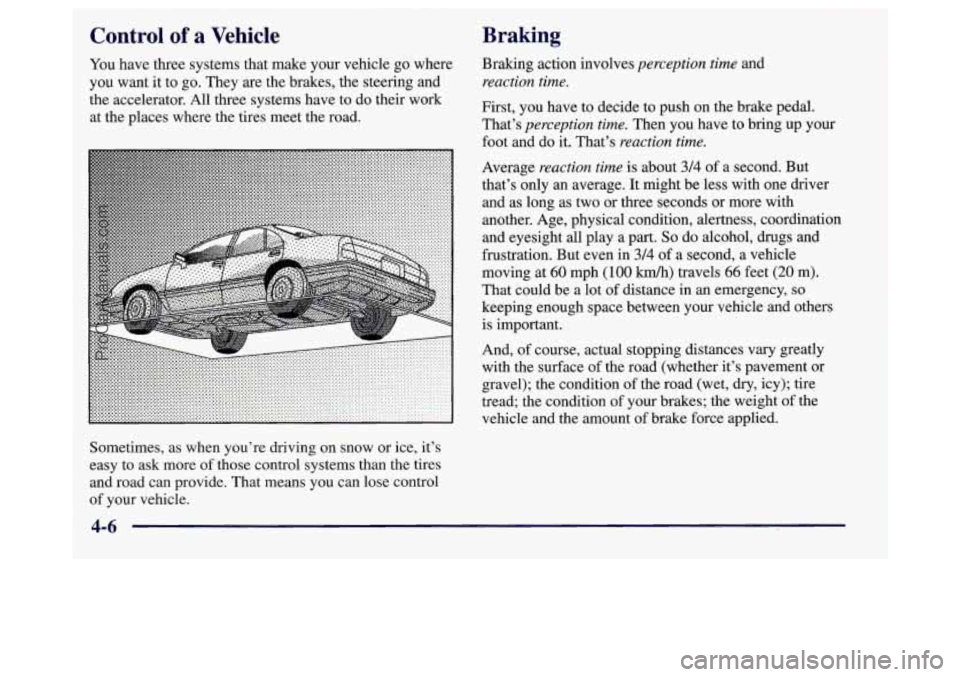
You have three systems that make your vehicle go where
you want it to go. They are the brakes, the steering and
the accelerator. All three systems have to do their work
at the places where the tires meet the road.
Sometimes, as when you’re driving on snow or ice, it’s
easy to ask more of those control systems than the tires
and road can provide. That means you can lose control
of your vehicle.
Braking
Braking action involves perception time and
reaction time.
First, you have to decide to push on the brake pedal.
That’s
perception time. Then you have to bring up your
foot and do
it. That’s reaction time.
Average reaction time is about 3/4 of a second. But
that’s only an average. It might be less with one driver
and as long as two or three seconds or more with
another. Age, physical condition, alertness, coordination
and eyesight all play a part.
So do alcohol, drugs and
frustration. But even in
3/4 of a second, a vehicle
moving at
60 mph (100 km/h) travels 66 feet (20 m).
That could be a lot
of distance in an emergency, so
keeping enough space between your vehicle and others is important.
And, of course, actual stopping distances vary greatly
with the surface of the road (whether it’s pavement
or
gravel); the condition of the road (wet, dry, icy); tire
tread; the condition of your brakes; the weight
of the
vehicle and the amount
of brake force applied.
4-6
ProCarManuals.com
Page 196 of 388
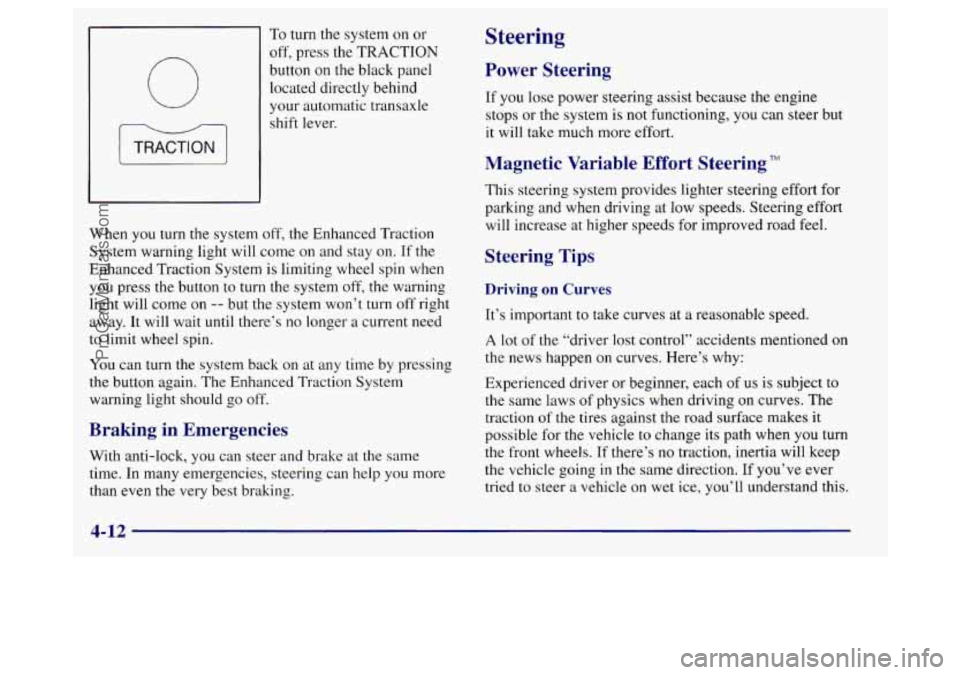
To turn the system on or
off, press the TRACTION
button on the black panel located directly behind
your automatic transaxle
shift lever.
When
you turn the system off, the Enhanced Traction
System warning light will come on and stay on. If the
Enhanced Traction System is limiting wheel spin when
you press the button to turn the system off, the warning
light will come on
-- but the system won’t turn off right
away. It will wait until there’s no longer a current need
to limit wheel spin.
You can turn the system back on at any time by pressing
the button again. The Enhanced Traction System
warning light should go off.
Braking in Emergencies
With anti-lock, you can steer and brake at the same
time. In many emergencies, steering can help you more
than even
the very best braking.
Steering
Power Steering
If you lose power steering assist because the engine
stops or the system
is not functioning, you can steer but
it will take much more effort.
Magnetic Variable Effort Steering TM
This steering system provides lighter steering effort for
parking and when driving at low speeds. Steering effort
will increase at higher speeds for improved road feel.
Steering Tips
Driving on Curves
It’s important to take curves at a reasonable speed.
A lot of the “driver lost control’’ accidents mentioned on
the news happen on curves. Here’s why:
Experienced driver or beginner, each
of us is subject to
the same laws of physics when driving on curves. The
traction
of the tires against the road surface makes it
possible for the vehicle
to change its path when you turn
the front wheels.
If there’s no traction, inertia will keep
the vehicle going
in the same direction. If you’ve ever
tried to steer a vehicle on wet ice, you’ll understand this.
4-12
ProCarManuals.com
Page 197 of 388
The traction you can get in a curve depends on the
condition of your tires and the road surface, the angle at
which the curve is banked, and your speed.
While you’re
in a curve, speed is the one factor you can control.
Suppose you’re steering through a sharp curve. Then you
suddenly accelerate. Both control systems
-- steering and
acceleration
-- have to do their work where the tires meet
the road. Adding the sudden acceleration can demand too
much of those places. You can
lose control.
What should
you do if this ever happens? Ease up on the
accelerator pedal, steer the vehicle the way you want it
to go, and slow down.
Speed limit signs near curves warn that you should
adjust your speed. Of course, the posted speeds are
based on good weather and road conditions. Under less
favorable conditions you’ll want
to go slower.
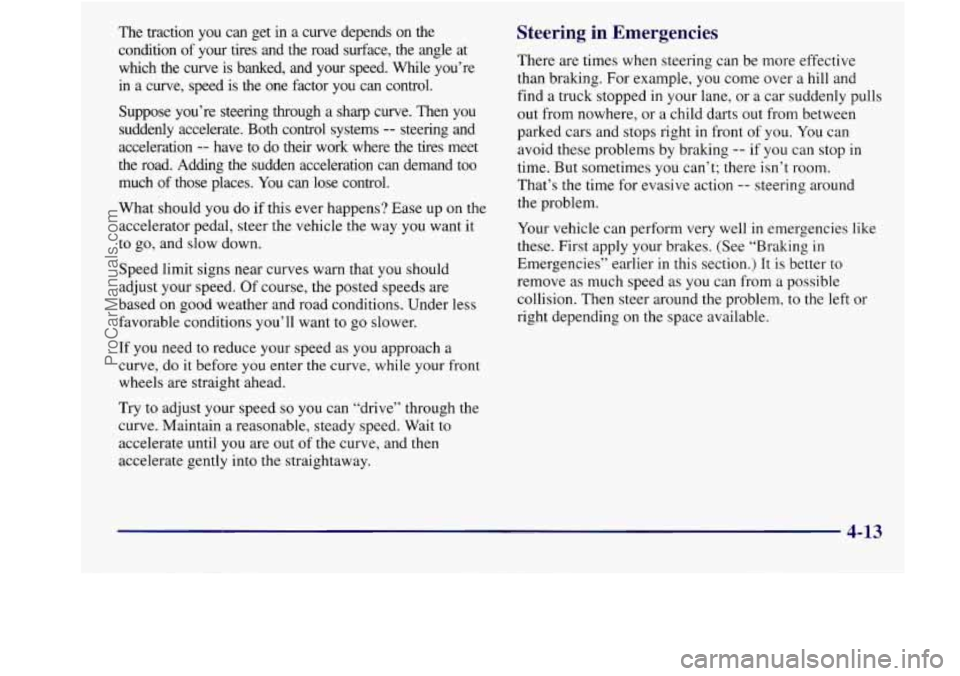
Steering in Emergencies
There are times when steering can be more effective
than braking. For example, you come over a hill and
find a truck stopped
in your lane, or a car suddenly pulls
out from nowhere, or a child darts out from between
parked cars and stops right in front of you. You can
avoid these problems by braking
-- if you can stop in
time. But sometimes you can’t; there isn’t room.
That’s the time for evasive action
-- steering around
the problem.
Your vehicle can perform very well in emergencies like
these. First apply your brakes. (See “Braking
in
Emergencies” earlier in this section.) It is better to
remove as much speed as you can from a possible
collision. Then steer around the problem, to the left
or
right depending on the space available.
If you need to reduce your speed as you approach a
curve, do it before you enter the curve, while your front
wheels are straight ahead.
Try to adjust your speed so you can “drive” through the
curve. Maintain a reasonable, steady speed. Wait to
accelerate until you are out of the curve, and then
accelerate gently into the straightaway.
4-13
ProCarManuals.com
Page 198 of 388
An emergency like this requires close attention and a
quick decision. If you are holding the steering wheel at
the recommended
9 and 3 o’clock positions, you can
turn it a
full 180 degrees very quickly without removing
either hand. But you have to act fast, steer quickly, and
just as quickly straighten the wheel once you have
avoided the object.
The fact that such emergency situations are always
possible is
a good reason to practice defensive driving at
all times and wear safety belts properly.
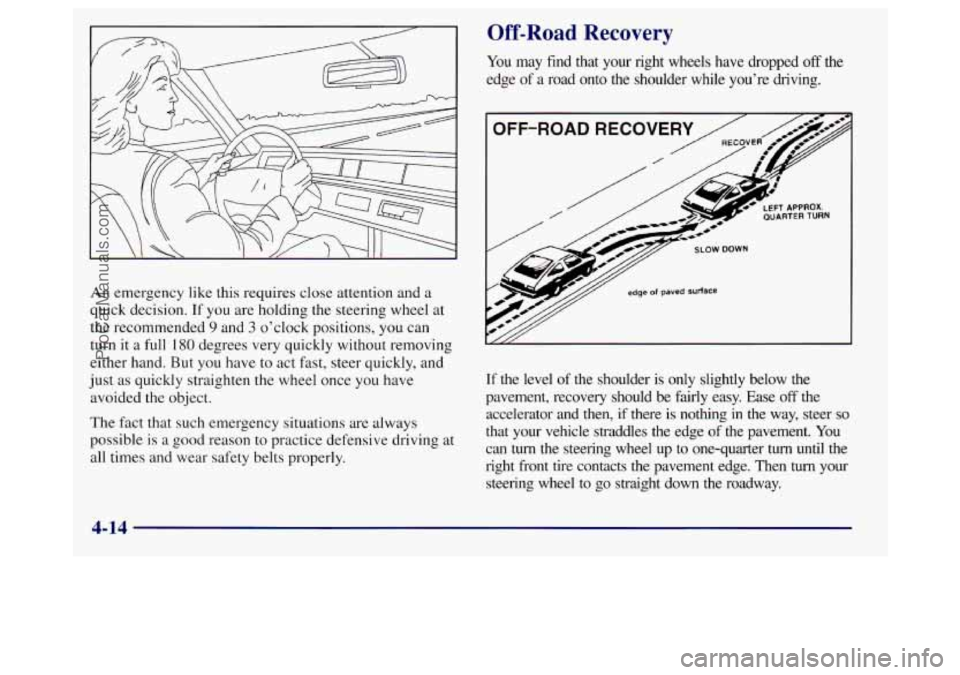
Off-Road Recovery
You may find that your right wheels have dropped off the
edge
of a road onto the shoulder while you’re driving.
If the level
of the shoulder is only slightly below the
pavement, recovery should be fairly easy. Ease
off the
accelerator and
then, if there is nothing in the way, steer so
that your vehicle straddles the edge of the pavement. You
can turn the steering wheel up to one-quarter turn until the
right front tire contacts the pavement edge. Then
turn your
steering wheel to
go straight down the roadway.
4-14
ProCarManuals.com