trunk BUICK REGAL 1998 User Guide
[x] Cancel search | Manufacturer: BUICK, Model Year: 1998, Model line: REGAL, Model: BUICK REGAL 1998Pages: 388, PDF Size: 20.19 MB
Page 216 of 388

/
MFD BY GENERAL MOTORS CORP
The other label is the Certification label, found on the
rear edge
of the driver’s door. It tells you the gross
weight capacity of your vehicle, called the Gross
Vehicle Weight Rating (GVWR). The GVWR includes
the weight
of the vehicle, all occupants, fuel and cargo.
Never exceed the GVWR for your vehicle or the Gross
Axle Weight Rating (GAWR) for either the front or
rear axle.
If you do have a heavy load, spread it out. Don’t carry
more than
167 pounds (75 kg) in your trunk.
u 11
Do not load your vehicle any heavier than the
GVWR, or either the maximum front or rear
GAWR. If you do, parts on your vehicle can
break, or
it can change the way your vehicle
handles. These could cause you to lose control.
Also, overloading can shorten the life of
your vehicle.
NOTICE:
Your warranty does not cover parts or
components that fail because of overloading.
~~
If you put things inside your vehicle -- like suitcases,
tools, packages or anything else
-- they will go as fast as
the vehicle goes. If you have
to stop or turn quickly, or
if there is a crash, they’ll keep going.
4-32
ProCarManuals.com
Page 217 of 388
Things you put inside your vehicle can strike
and injure people in a sudden stop or turn, or in
a crash.
Put things in the trunk of your vehicle. In a
trunk, put them as far forward as you can.
Try to spread the weight evenly.
Never stack heavier things, like suitcases,
inside the vehicle
so that some of them are
above the tops of the seats.
Don’t leave an unsecured child restraint in
your vehicle.
When you carry something inside the
vehicle, secure it whenever you can.
Don’t leave a seat folded down unless you
need to.
Towing a Trailer
I
If you don’t use the correct equipment and drive
properly, you can lose control when you pull
a
trailer. For example, if the trailer is too heavy, the
brakes may not work well
-- or even at all. You
and your passengers could be seriously injured.
You may also damage your vehicle; the resulting
repairs would not be covered by your warranty.
Pull a trailer only if you have followed all the
steps in this section. Ask your dealer for advice
and information about towing a trailer with
your vehicle.
Do not tow a trailer if your vehicle is equipped with the
3800 L67 Supercharged engine.
4-33
ProCarManuals.com
Page 220 of 388

Weight of the Trailer Tongue
The tongue load (A) of any trailer is an important
weight to measure because it affects the total or gross
weight of your vehicle. The Gross Vehicle Weight
(GVW) includes the curb weight
of the vehicle, any
cargo you may carry in it, and the people who will be
riding in the vehicle. And if you tow a trailer, you must
add the tongue load
to the GVW because your vehicle
will be carrying that weight, too. See “Loading Your
Vehicle” in the Index for more information about your
vehicle’s maximum load capacity.
A B
If you’re using a weight-carrying hitch, the trailer
tongue
(A) should weigh 10 percent of the total loaded
trailer weight
(B). If you have a weight-distributing
hitch, the trailer tongue
(A) should weigh 12 percent of
the total loaded trailer weight
(B).
After you’ve loaded your trailer, weigh the trailer and
then the tongue, separately, to see if the weights are
proper. If they aren’t, you may be able to get them right
simply by moving some items around in the trailer.
Total Weight on Your Vehicle’s Tires
Be sure your vehicle’s tires are inflated to the upper
limit for cold tires. You’ll find these numbers
on the
Tire-Loading Information label (found inside the trunk
lid) or see “Loading Your Vehicle” in the Index. Then be
sure you don’t go over the GVW limit for your vehicle,
including the weight of the trailer tongue.
4-36
ProCarManuals.com
Page 253 of 388
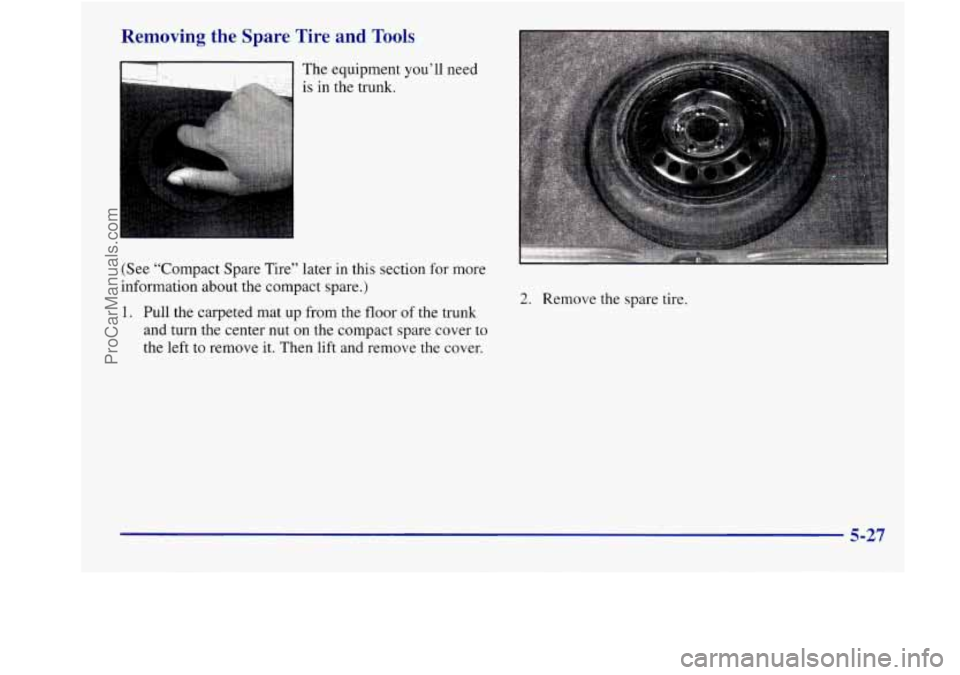
Removing the Spare Tire and Tools
(See “Compact Spare Tire” later in this section for more
information about the compact spare.)
1. Pull the carpeted mat up from the floor of the trunk
and turn the center nut
on the compact spare cover to
the left to remove it. Then lift and remove the cover.
2. Remove the spare tire.
5-27
ProCarManuals.com
Page 260 of 388
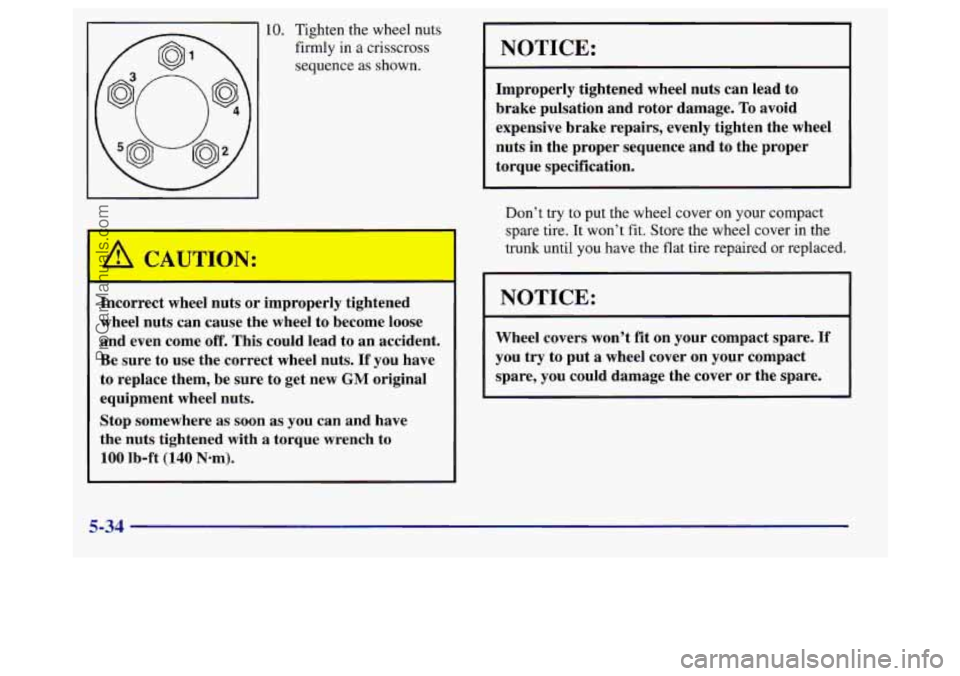
10. Tighten the wheel nuts
firmly in a crisscross
sequence as shown.
/!1 CA’, TION:
Incorrect wheel nuts or improperly tightened
wheel nuts can cause the wheel to become loose
and even come
off. This could lead to an accident.
Be sure to use the correct wheel nuts.
If you have
to replace them, be sure to get new
GM original
equipment wheel nuts.
Stop somewhere as soon as you can and have
the nuts tightened with
a torque wrench to
100 Ib-ft (140 Nom).
NOTICE:
Improperly tightened wheel nuts can lead to
brake pulsation and rotor damage. To avoid
expensive brake repairs, evenly tighten the wheel
nuts in the proper sequence and to the proper
torque specification.
Don’t try to put the wheel cover
on your compact
spare tire. It won’t fit. Store the wheel cover in the
trunk until you have the flat tire repaired
or replaced.
NOTICE:
Wheel covers won’t fit on your compact spare. If
you try to put a wheel cover on your compact
spare, you could damage the cover or the spare.
5-34
ProCarManuals.com
Page 261 of 388
Storing the Flat Tire and Tools
Storing a jack, a tire or other equipment in the
passenger compartment
of the vehicle could
cause injury.
In a sudden stop or collision, loose
equipment could strike someone. Store
all these
in the proper place.
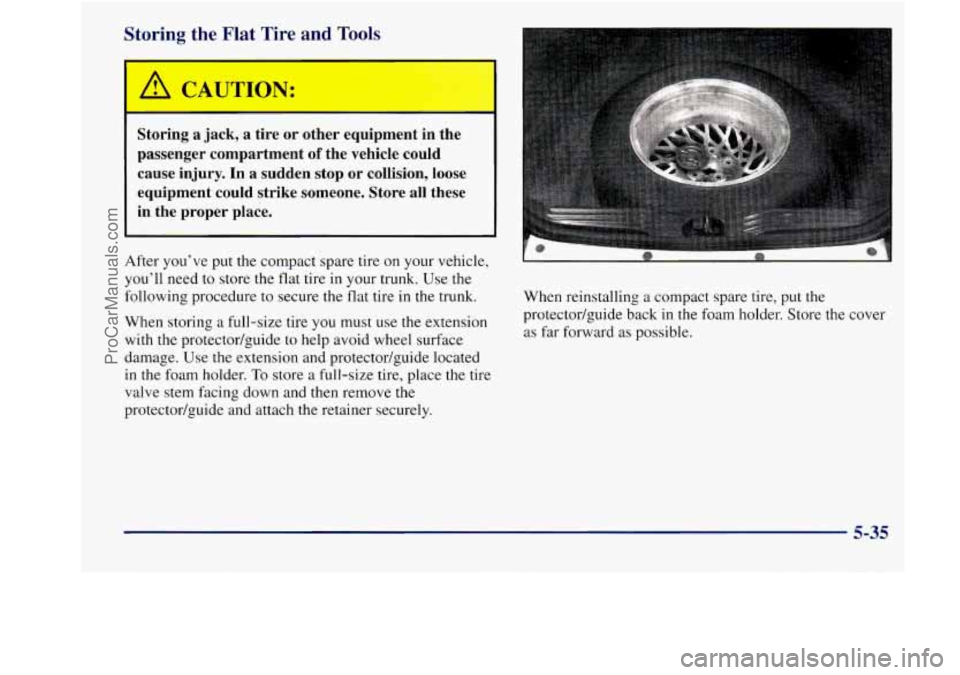
After you’ve put the compact spare tire on your vehicle,
you’ll need to store the flat tire in your trunk. Use the
following procedure to secure the flat tire
in the trunk.
When storing a full-size tire you must use the extension
with the protector/guide to help avoid wheel surface
damage. Use the extension and protector/guide located
in the foam holder.
To store a full-size tire, place the tire
valve stem facing down and then remove
the
protector/guide and attach the retainer securely. When reinstalling
a compact spare tire, put the
protector/guide back in the foam holder. Store the cover
as far forward as possible.
5-35
...
ProCarManuals.com
Page 262 of 388
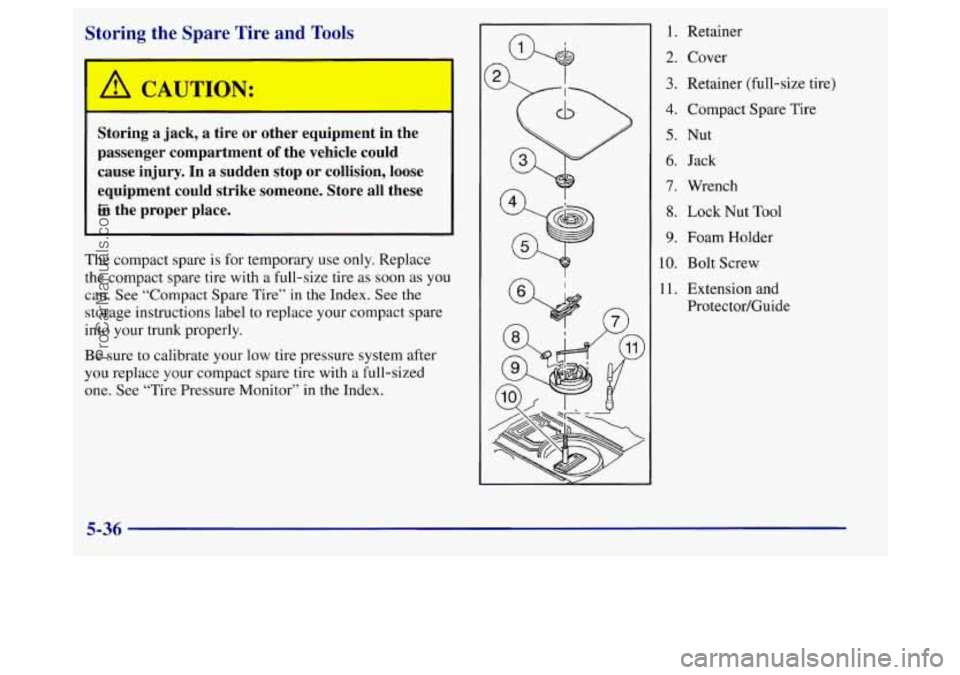
Storing the Spare Tire and Tools
Storing a jack, a tire or other equipment in the
passenger compartment
of the vehicle could
cause injury. In a sudden stop or collision, loose
equipment could strike someone. Store all these
in the proper place.
The compact spare is for temporary use only. Replace
the compact spare tire with a full-size tire
as soon as you
can. See “Compact Spare Tire” in the Index. See the
storage instructions label to replace your compact spare
into your trunk properly.
Be sure
to calibrate your low tire pressure system after
you replace your compact spare tire with a full-sized
one. See “Tire Pressure Monitor”
in the Index.
1. Retainer
2. Cover
3. Retainer (full-size tire)
4. Compact Spare Tire
5. Nut
6. Jack
7. Wrench
8. Lock Nut Tool
9. Foam Holder
10. Bolt Screw
11. Extension and
Protector/Guide
5-36
ProCarManuals.com
Page 272 of 388
Filling a Portable Fuel Container Checking Things
Under the Hood
Never fill a portable fuel container while it is in
your vehicle. Static electricity discharge from the
container can ignite the gasoline vapor. You can
be badly burned and your vehicle damaged
if this
occurs. To help avoid injury to you and others:
0 Dispense gasoline only into approved
containers.
0 Do not fill a container while it is inside a
vehicle, in a vehicle's trunk, pickup bed or
on any surface other than the ground.
inside of the fill opening before operating
the nozzle. Contact should be maintained
until the filling is complete.
0 Bring the fill nozzle in contact with the
Don't smoke while pumping gasoline. An
electric fan under the hood can start up and
injure you even when the engine
is not running.
Keep hands, clothing and tools away from any
underhood electric fan.
1
Things that burn can get on hot engine parts and
start a fire. These include liquids like gasoline,
oil, coolant, brake fluid, windshield washer and
other fluids, and plastic or rubber. You or others
could be burned. Be careful not to drop or spill
things that will burn onto a hot engine.
6-8
ProCarManuals.com
Page 302 of 388
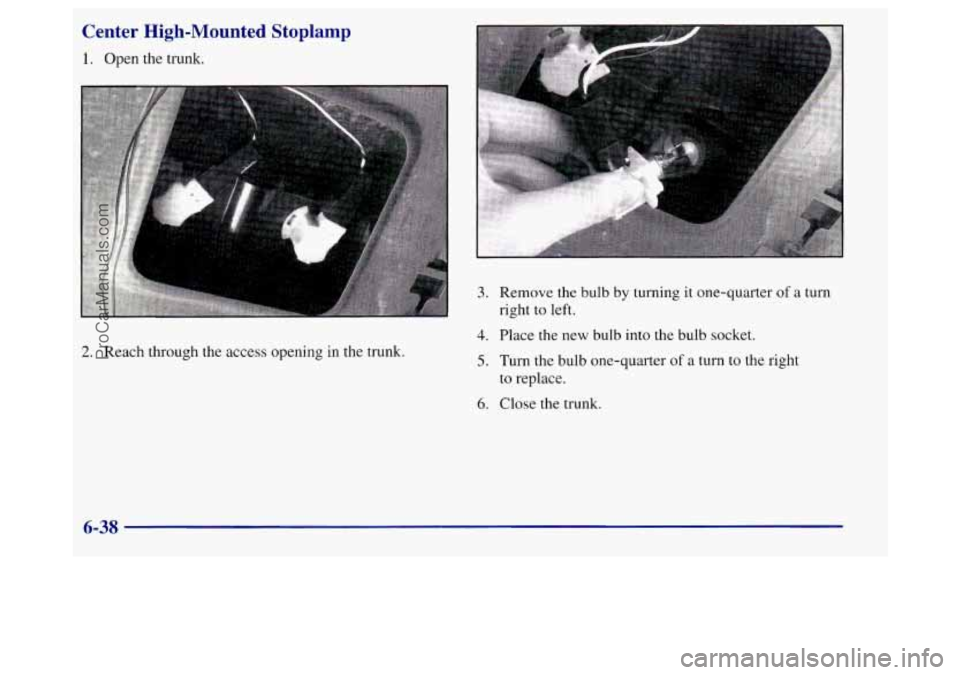
Center High-Mounted Stoplamp
1. Open the trunk.
2. Reach through the access opening in the trunk.
3. Remove the bulb by turning it one-quarter of a turn
right to left.
4. Place the new bulb into the bulb socket.
5. Turn the bulb one-quarter of a turn to the right
to replace.
6. Close the trunk.
6-38
ProCarManuals.com
Page 304 of 388
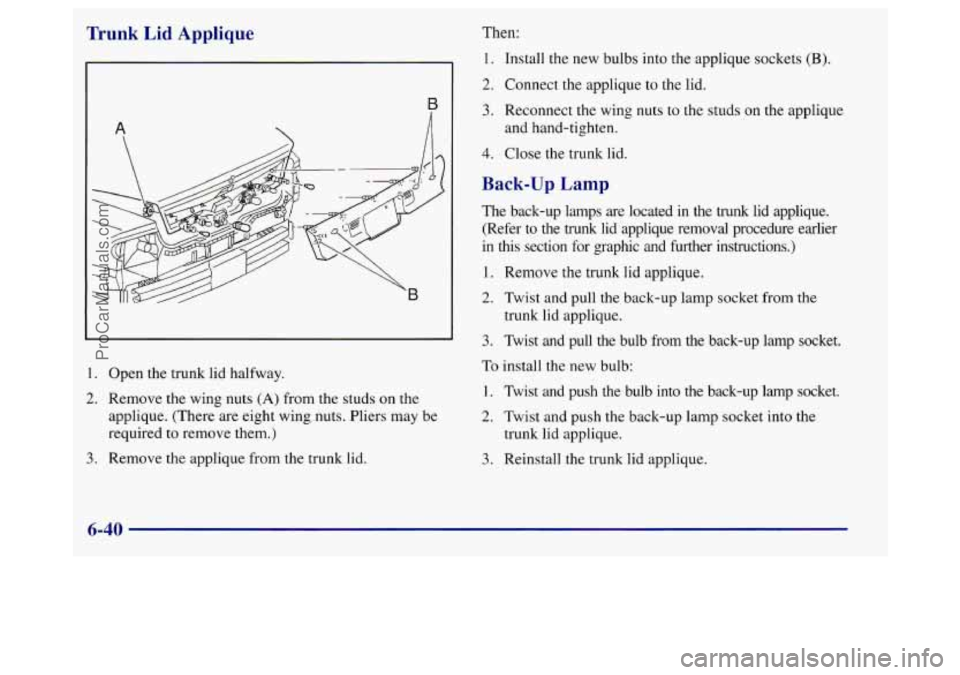
Trunk Lid Applique Then:
1. Install the new bulbs into the applique sockets (B).
A
1. Open the trunk lid halfway.
2. Remove the wing nuts (A) from the studs on the
applique. (There are eight wing nuts. Pliers may be
required to remove them.)
3. Remove the applique from the trunk lid.
2. Connect the applique to the lid.
3. Reconnect the wing nuts to the studs on the applique
and hand-tighten.
4. Close the trunk lid.
Back-up Lamp
The back-up lamps are located in the trunk lid applique.
(Refer to the trunk
lid applique removal procedure earlier
in this section for graphic and further instructions.)
1. Remove the trunk lid applique.
2. Twist and pull the back-up lamp socket from the
trunk lid applique.
3. Twist and pull the bulb from the back-up lamp socket.
To install the new bulb:
1. Twist and push the bulb into the back-up lamp socket.
2. Twist and push the back-up lamp socket into the
trunk lid applique.
3. Reinstall the trunk lid applique.
6-40
ProCarManuals.com