battery BUICK REGAL 1998 Owner's Manual
[x] Cancel search | Manufacturer: BUICK, Model Year: 1998, Model line: REGAL, Model: BUICK REGAL 1998Pages: 388, PDF Size: 20.19 MB
Page 233 of 388
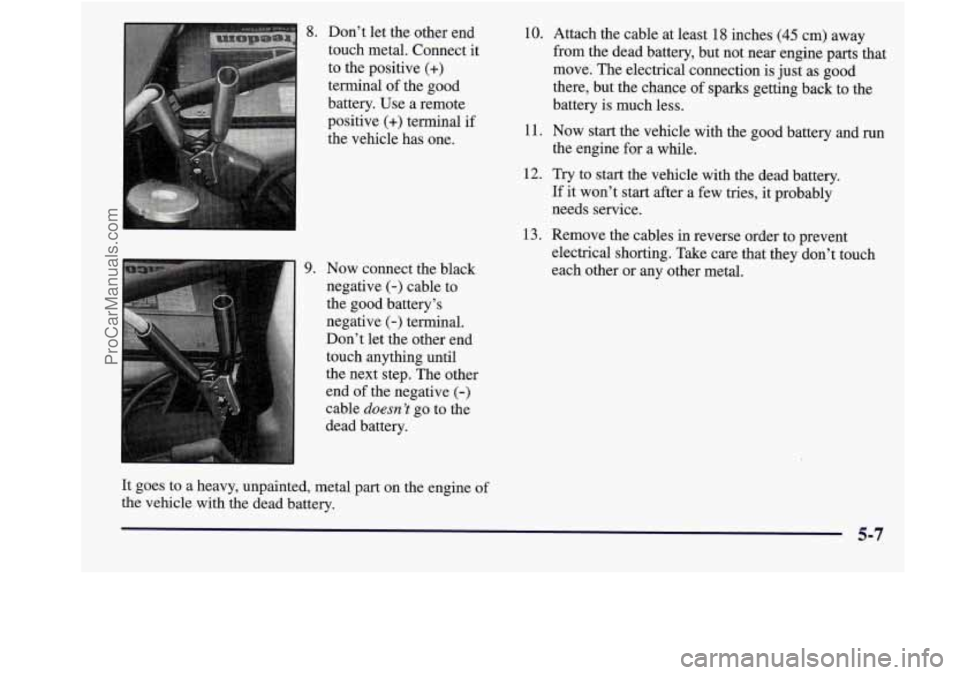
8. Don’t let the other end
touch metal. Connect
it
to the positive (+)
terminal of the good
battery. Use a remote
positive
(+) terminal if
the vehicle has one.
10. Attach the cable at least 18 inches (45 cm) away
from the dead battery, but not near engine parts that
move. The electrical connection
is just as good
there, but the chance of sparks getting back to the
battery is much less.
11. Now start the vehicle with the good battery and run
the engine for a while.
9. Now connect the black
negative
(-) cable to
negative
(-) terminal.
Don’t let the other end
touch anything until
the next step. The other
end of the negative
(-)
cable doesn t go to the
dead battery. the
good battery’s
12. Try to start the vehicle with the dead battery.
If it won’t start after a few tries, it probably
needs service.
13. Remove the cables in reverse order to prevent
electrical shorting. Take care that they don’t touch
each other or any other metal.
It goes to a heavy, unpainted, metal part
on the engine of
the vehicle with the dead battery.
ProCarManuals.com
Page 234 of 388
14. Reinstall the red protective remote jump start cover
on the vehicle that was jump started.
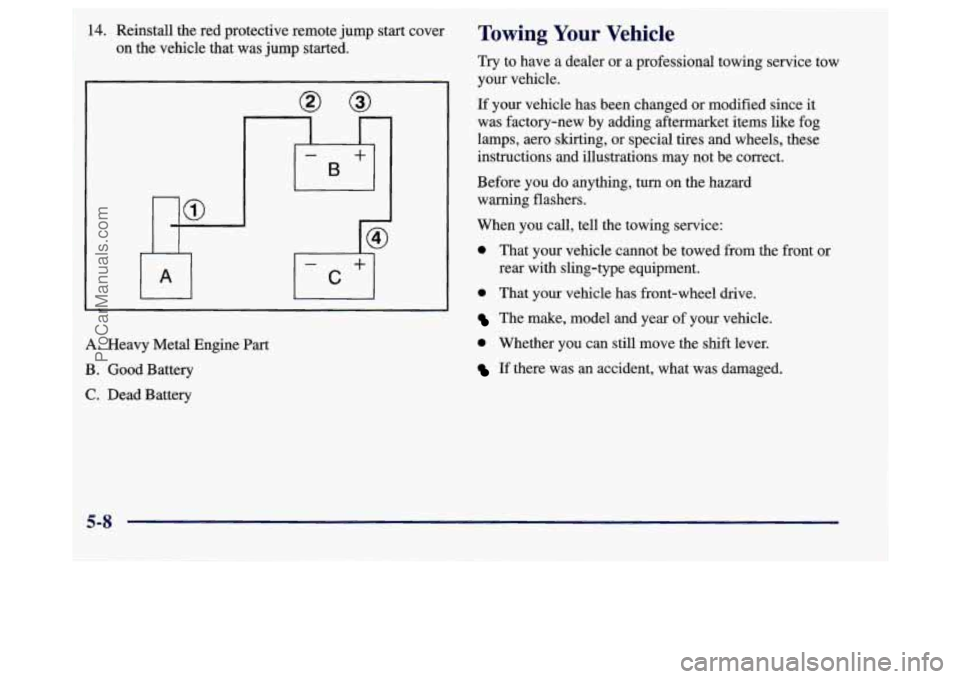
A. Heavy Metal Engine Part
B. Good Battery
C. Dead Battery
Towing Your Vehicle
Try to have a dealer or a professional towing service tow
your vehicle.
If your vehicle has been changed or modified since it
was factory-new by adding aftermarket items like fog
lamps, aero skirting, or special tires and wheels, these
instructions and illustrations may not be correct.
Before you do anything, turn on the hazard
warning flashers.
When you call, tell the towing service:
0 That your vehicle cannot be towed from the front or
rear with sling-type equipment.
0 That your vehicle has front-wheel drive.
The make, model and year of your vehicle.
0 Whether you can still move the shift lever.
If there was an accident, what was damaged.
5-8
ProCarManuals.com
Page 265 of 388

Section 6 Service and Appearance Care
Here you will find information about the care of your vehicle. This section begins with service and fuel information,
and then it shows how to check important fluid and lubricant levels. There is also technical information about your
vehicle, and a part devoted to its appearance care.
6-2
6-3
6-5 6-5
6-8
6- 12
6-
12
6- 17
6-20
6-23
6-27
6-28 6-30
6-33 6-34
6-39
6-49
6-49 Service
Fuel
Fuels in Foreign Countries
Filling Your Tank
Checking Things Under the Hood
3800 Supercharged (Code 1) Engine
Engine Oil Air Cleaner
Automatic Transaxle Fluid
Engine Coolant
Power Steering Fluid
Windshield Washer Fluid
Brakes
Battery
Bulb Replacement
Tires
Appearance Care Cleaning the Inside
of Your Vehicle 6-5
1
6-52
6-52
6-52
6-53
6-54
6-55
6-57 6-58
6-58
6-59
6-65
6-65
6-66
6-67 6-67 Cleaning the Built-in
Child Restraint
Care of Safety Belts and Built-in Child
Restraint Harness
Cleaning Glass Surfaces
Cleaning the Outside of the Windshield and
Wiper Blades
Cleaning the Outside of Your Vehicle
Cleaning Aluminum or Chrome Wheels
Cleaning Tires
Appearance Care Materials Chart
Vehicle Identification Number (VIN)
Service Parts Identification Label
Electrical System
Replacement Bulbs
Capacities and Specifications
Vehicle Dimensions
Normal Maintenance Replacement Parts
Air Conditioning Refrigerants
6- 1
ProCarManuals.com
Page 274 of 388
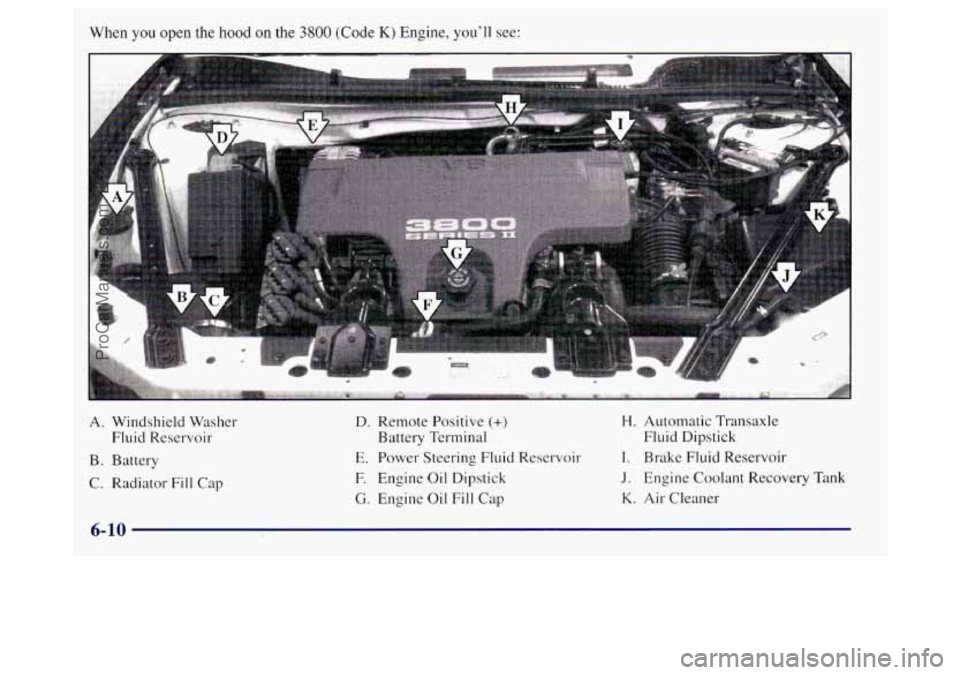
When you open the hood on the 3800 (Code K) Engine, you’ll see:
A. Windshield Washer
Fluid Reservoir
B. Battery
C. Radiator Fill Cap
D. Remote Positive (+)
Battery Terminal
E. Power Steering Fluid Reservoir
F. Engine Oil Dipstick
G. Engine Oil Fill Cap
H. Automatic Transaxle
I. Brake Fluid Reservoir
J. Engine Coolant Recovery Tank
K. Air Cleaner
Fluid
Dipstick
ProCarManuals.com
Page 275 of 388
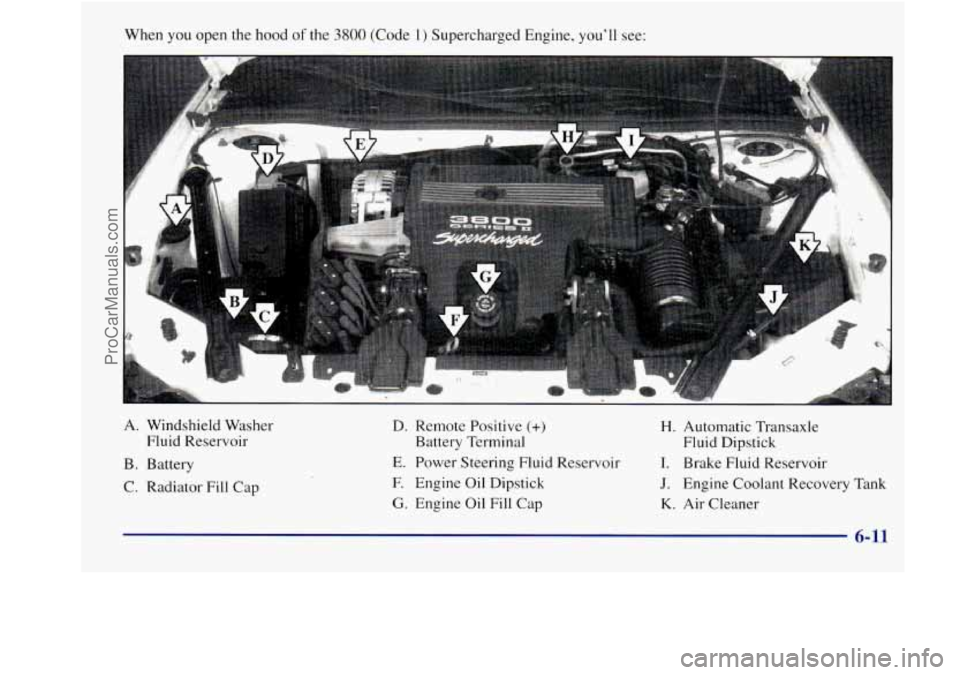
When you open the hood of the 3800 (Code 1) Supercharged Engine, you’ll see:
H
A. Windshield Washer
Fluid Reservoir
B. Battery
C. Radiator Fill Cap
D. Remote Positive (+) H. Automatic Transaxle
E. Power Steering Fluid Reservoir I. Brake Fluid Reservoir
E Engine Oil Dipstick J. Engine Coolant Recovery Tank
G. Engine Oil Fill Cap K. Air Cleaner
Battery Terminal
Fluid Dipstick
6-11
ProCarManuals.com
Page 297 of 388
Replacing Brake System Parts
The braking system on a modern vehicle is complex.
Its many parts have to be
of top quality and work well
together if the vehicle is to have really good braking.
Your vehicle was designed and tested with top-quality
GM brake parts. When you replace parts of your braking
system
-- for example, when your brake linings wear
down and you have to have new ones put in
-- be sure
you get new approved GM replacement parts. If you
don’t, your brakes may no longer work properly. For
example,
if someone puts in brake linings that are wrong
for your vehicle, the balance between your front and
rear brakes can change
-- for the worse. The braking
performance you’ve come to expect can change in many
other ways if someone puts
in the wrong replacement
brake parts.
Battery
Every new Buick has an ACDelco Freedom@ battery.
You never have to add water to one of these. When it’s
time for a new battery, we recommend an ACDelco
Freedom battery. Get one that has the replacement
number shown on the original battery’s label.
Vehicle Storage
If you’re not going to drive your vehicle for 25 days
or more, remove
the black, negative (-) cable from
the battery. This will help keep your battery from
running down.
Batteries have acid that can burn you and gas
that can explode. You can be badly hurt if you
aren’t careful. See “Jump Starting” in the Index
for tips on working around a battery without
getting hurt.
Contact your dealer to learn how to prepare your vehicle
for longer storage periods.
Also, for your audio system, see “Theft-Deterrent
Feature”
in the Index.
6-33
ProCarManuals.com
Page 308 of 388
Tire Pressure Monitor System (If Equipped)
The tire pressure monitor system can alert you to a large
change in the pressure
of one tire. The system “learns”
the pressure at each tire throughout the operating speed
range of your vehicle. The system normally takes
between
45 and 90 minutes of driving to learn the tire
pressures. This time may be longer depending on your
individual driving habits. Learning need not be
accumulated during
a single trip. Once learned, the
system will remember the tire pressures until the system
is recalibrated.
After the system has learned tire pressures with properly
inflated tires, the LOW TIRE light will come on if the
pressure in
one tire becomes 12 psi (83 kPa) lower than
the other three tires. The tire pressure monitor system
won’t alert you if the pressure
in more than one tire is
low, if the system is not properly calibrated, or if the
vehicle
is moving faster than 70 mph (1 10 kdh).
The tire pressure monitor system detects differences
in tire rotation speeds that are caused by changes
in
tire pressure. The system can alert you about a low
tire
-- but it doesn’t replace normal tire maintenance.
See “Tires” in the Index. When the LOW
TIRE light comes
on, you should stop
as soon as you can and check all your tires for damage.
(If a tire is flat, see “If
a Tire Goes Flat” in the Index.)
Also check
the tire pressure in all four tires as soon as
you can. See “Inflation
- Tire Pressure” in the Index.
The light will come on and stay on
until you turn off the
ignition or press the
RESET button.
Don’t reset the tire pressure monitor system without first
correcting the cause of the problem and checking and
adjusting the pressure in all four tires. If you reset the
system when the tire pressures are incorrect, the tire
pressure monitor system will not work properly and may
not alert you when
a tire is low.
Any time
you adjust a tire’s pressure, rotate your tires,
or have one or more tires repaired or replaced, you’ll
need to reset (calibrate) the tire pressure monitor system.
You’ll also need to reset the system whenever you buy
new tires and whenever the vehicle’s battery has been
disconnected.
To reset (calibrate) the system,
turn the ignition switch
to
RUN. Then press and hold the RESET button for
about five seconds.
6-44
ProCarManuals.com
Page 333 of 388
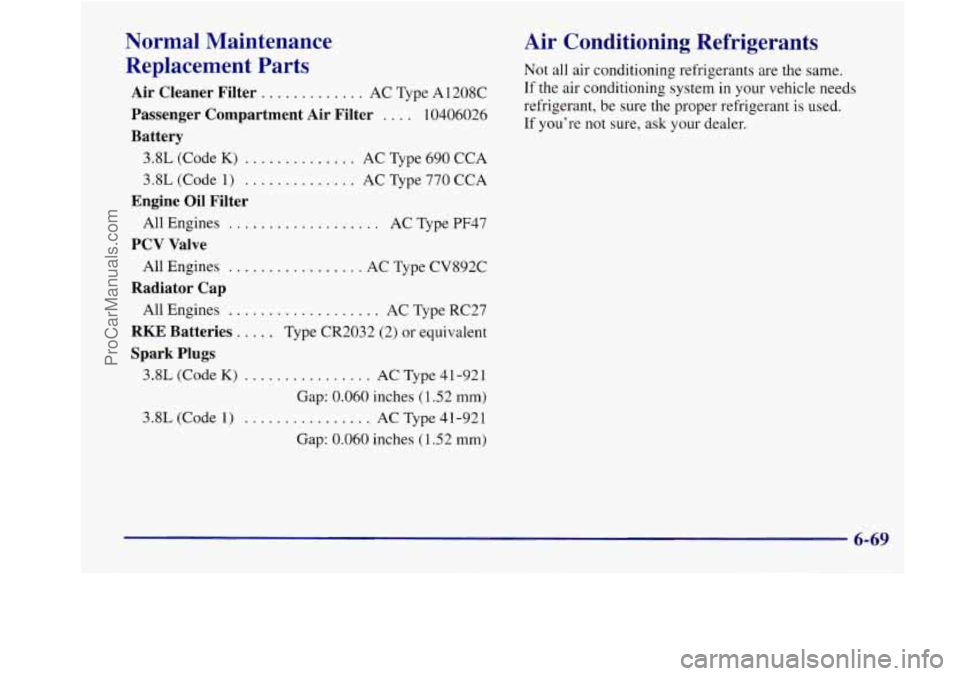
Normal Maintenance
Replacement Parts
Air Cleaner Filter ............. AC Type A 1208C
Passenger Compartment Air Filter .... 10406026
Battery
3.8L (Code K) .............. AC Type 690 CCA
3.8L (Code
1) .............. AC Type 770 CCA
All Engines
................... AC Type PF47
All Engines
................. AC Type CV892C
All Engines ................... AC Type RC27
RKE Batteries ..... Type CR2032 (2) or equivalent
Spark Plugs Engine Oil Filter
PCV Valve
Radiator Cap
3.8L (Code K) ................ AC Type 4 1-92 1
Gap:
0.060 inches (1.52 mm)
3.8L (Code 1) ................ AC Type 41-921
Gap: 0.060 inches (1.52 mm)
Air Conditioning Refrigerants
Not all air conditioning refrigerants are the same.
If the air conditioning system in your vehicle needs
refrigerant, be sure the proper refrigerant
is used.
If you’re not sure, ask your dealer.
6-69
ProCarManuals.com
Page 375 of 388
Cigarette Lighter ............................... 2-50
Circuit Breakers and Fuses
....................... 6-60
Cleaner. Air
................................... 6-17
Cleaning Aluminum or Chrome Wheels
................... 6-57
Built-in Child Restraint
........................ 6-54
Built-in Child Restraint Harness
................. 6-54
Fabric
...................................... 6-50
Glass Surfaces
............................... 6-54
Inside of Your Vehicle
......................... 6-52
Instrumentpanel
............................. 6-54
Interior Plastic Components
..................... 6-54
Leather
..................................... 6-53
Outside of Your Vehicle
........................ 6-55
Special Problems
............................. 6-53
Stains
...................................... 6-50
Tires
....................................... 6-57
Vinyl
....................................... 6-53
Wheels
..................................... 6-54
Windshield and Wiper Blades
................... 6-55
Cleaning Exterior LampsLenses
................... 6-56
Clock. Setting the
............................... 3-12
Comfort Controls
................................ 3-2
Compact Disc Care
............................. 3-3 1
Compact Disc Player
............................ 3-25
Compact Disc Player Care
........................ 3-3 1
Compact Disc Player Errors
....................... 3-24
Compact Spare Tire
............................. 5-37
Console Storage
................................ 2-49
Control. Loss
of ................................ 4- 16
Control
of a Vehicle .............................. 4-6 Convex
Outside Mirror
.......................... 2-48
Coolant Bleedvalve
................................. 5-23
RecoveryTank
............................... 5-19
Coolant Heater. Engine
.......................... 2-20
Cooling System
................................ 5-17
Courtesy Lamps
................................ 2-44
Courtesy Transportation
........................... 8-6
Cruise Control
................................. 2-38
CruiseLight
................................... 2-74
Cupholders
............................... 2-49. 2-50
Customer Assistance for
Text Telephone Users ......... 8-4
Customer Assistance Information
................... 8-1
Customer Satisfaction Procedure
.................... 8-2
Damage. Finish
............................... 6-55
Damage. Sheet Metal
............................ 6-55
Daytime Running Lamps
......................... 2-42
Dead Battery
................................... 5-3
Defects. Reporting Safety
......................... 8-8
Defensive Driving
............................... 4-2
Defogger. Rear Window
......................... 3-11
Defogging
............................ 3.4.3-6. 3-10
Defrosting
............................ 3.4.3.6. 3.10
Delayed Entry Lighting .......................... 2-45
Delayed Exit Lighting
........................... 2-45
Dimensions. Vehicle
............................ 6-66
Dolby@
B Noise Reduction ............. 3.16.3.19. 3.23
Dome Lamp Bulb Replacement
.................... 6-41
DoorLocks
..................................... 2-4
9-3
ProCarManuals.com
Page 386 of 388

Service Station Checkpoints
WINDSHIELD
WASHER
FLUID
P6-28
ENGINE OIL
DIPSTICK REMOTE POSITIVE
BATTERY TERMINAL
P5-5 / TI RES
P6-13
SECONDARY
HOOD RELEASE
P6-9
I1 I I
P \
ENGINE COOLANT
RECOVERY TANK P5-19 AND P6-26 HOOD
RELEASE
P6-9 FUEL DOOR
P6-6
For
detailed information, refer to the page number listed, or see the Index in the back of the owner’s manual.
9-14
ProCarManuals.com