reset BUICK REGAL 1998 Owner's Manual
[x] Cancel search | Manufacturer: BUICK, Model Year: 1998, Model line: REGAL, Model: BUICK REGAL 1998Pages: 388, PDF Size: 20.19 MB
Page 291 of 388
Radiator Pressure Cap NOTICE:
Your radiator cap is a 15 psi (105 kPa)
pressure-type cap and must be tightly installed to
prevent coolant loss and possible engine damage
from overheating. Be sure the arrows on the cap line up with the overflow tube on the radiator
filler neck.
When you replace your radiator pressure cap, an AC@
cap is recommended.
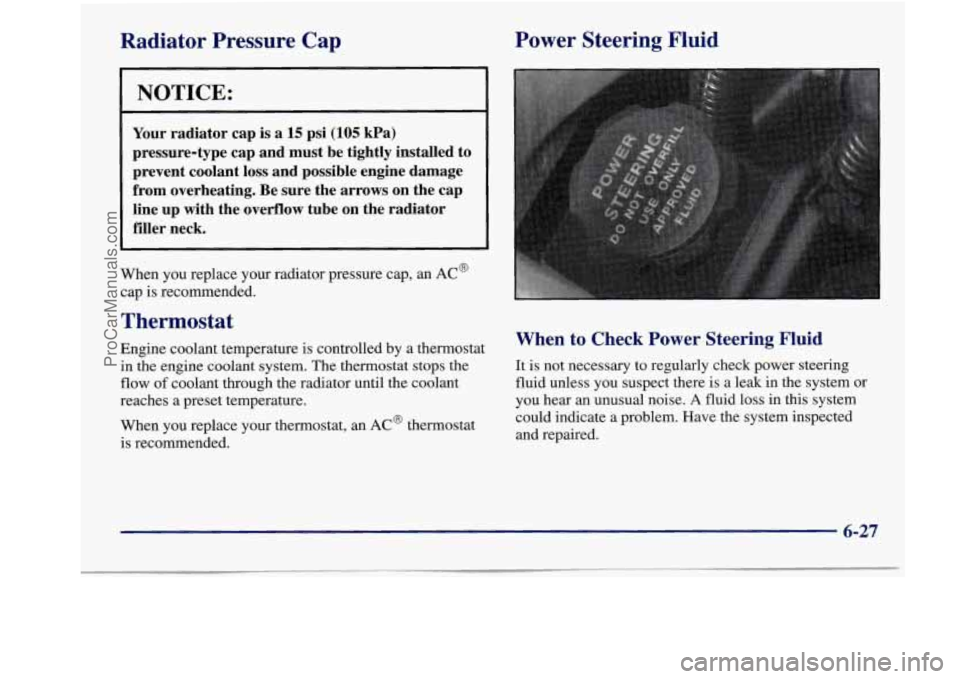
Power Steering Fluid
Thermostat
Engine coolant temperature is controlled by a thermostat
in the engine coolant system. The thermostat stops the
flow
of coolant through the radiator until the coolant
reaches a preset temperature.
When you replace your thermostat, an
AC@ thermostat
is recommended.
When to Check Power Steering Fluid
It is not necessary to regularly check power steering
fluid unless you suspect there is a leak in the system or
you hear an unusual noise.
A fluid loss in this system
could indicate a problem. Have the system inspected
and repaired.
6-27
ProCarManuals.com
Page 308 of 388
Tire Pressure Monitor System (If Equipped)
The tire pressure monitor system can alert you to a large
change in the pressure
of one tire. The system “learns”
the pressure at each tire throughout the operating speed
range of your vehicle. The system normally takes
between
45 and 90 minutes of driving to learn the tire
pressures. This time may be longer depending on your
individual driving habits. Learning need not be
accumulated during
a single trip. Once learned, the
system will remember the tire pressures until the system
is recalibrated.
After the system has learned tire pressures with properly
inflated tires, the LOW TIRE light will come on if the
pressure in
one tire becomes 12 psi (83 kPa) lower than
the other three tires. The tire pressure monitor system
won’t alert you if the pressure
in more than one tire is
low, if the system is not properly calibrated, or if the
vehicle
is moving faster than 70 mph (1 10 kdh).
The tire pressure monitor system detects differences
in tire rotation speeds that are caused by changes
in
tire pressure. The system can alert you about a low
tire
-- but it doesn’t replace normal tire maintenance.
See “Tires” in the Index. When the LOW
TIRE light comes
on, you should stop
as soon as you can and check all your tires for damage.
(If a tire is flat, see “If
a Tire Goes Flat” in the Index.)
Also check
the tire pressure in all four tires as soon as
you can. See “Inflation
- Tire Pressure” in the Index.
The light will come on and stay on
until you turn off the
ignition or press the
RESET button.
Don’t reset the tire pressure monitor system without first
correcting the cause of the problem and checking and
adjusting the pressure in all four tires. If you reset the
system when the tire pressures are incorrect, the tire
pressure monitor system will not work properly and may
not alert you when
a tire is low.
Any time
you adjust a tire’s pressure, rotate your tires,
or have one or more tires repaired or replaced, you’ll
need to reset (calibrate) the tire pressure monitor system.
You’ll also need to reset the system whenever you buy
new tires and whenever the vehicle’s battery has been
disconnected.
To reset (calibrate) the system,
turn the ignition switch
to
RUN. Then press and hold the RESET button for
about five seconds.
6-44
ProCarManuals.com
Page 309 of 388
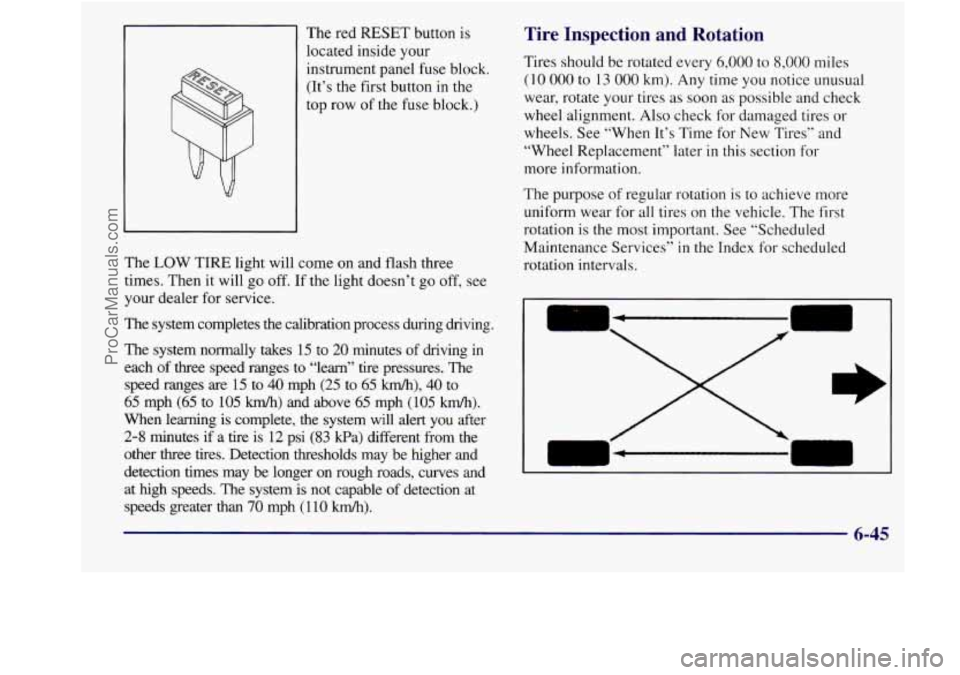
The red RESET button is
located inside your
instrument panel fuse block.
(It’s the first button in the
top row of the fuse block.)
The LOW TIRE light will come
on and flash three
times. Then it will go off. If the light doesn’t go off, see
your dealer for service.
The system completes the calibration process during driving.
The system normally takes
15 to 20 minutes of driving in
each of three speed ranges to “learn” tire pressures. The
speed ranges are 15 to 40 mph (25 to 65 km/h), 40 to
65 mph (65 to 105 km/h) and above 65 mph (105 km/h).
When learning is complete, the system will alert you after
2-8 minutes if a tire is 12 psi (83 kPa) different from the
other
three tires. Detection thresholds may be higher and
detection times may be longer on rough roads, curves and
at high speeds. The system
is not capable of detection at
speeds greater
than 70 mph (1 10 km/h).
Tire Inspection and Rotation
Tires should be rotated every 6,000 to 8,000 miles
(10 000 to 13 000 km). Any time you notice unusual
wear, rotate your tires
as soon as possible and check
wheel alignment. Also check for damaged tires or
wheels. See “When It’s Time for New Tires”
and
“Wheel Replacement” later in this section for
more information.
The purpose
of regular rotation is to achieve more
uniform wear for
all tires on the vehicle. The first
rotation is the most important. See “Scheduled
Maintenance Services”
in the Index for scheduled
rotation intervals.
6-45
ProCarManuals.com
Page 313 of 388
Temperature -- A, B, C
The temperature grades are A (the highest), B, and C,
representing the tire’s resistance to the generation of
heat and its ability
to dissipate heat when tested under
controlled conditions on a specified indoor laboratory
test wheel. Sustained high temperature can cause the
material
of the tire to degenerate and reduce tire life, and
excessive temperature can lead to sudden tire failure.
The grade
C corresponds to a level of performance
which all passenger car tires must meet under the
Federal Motor Vehicle Safety Standard
No. 109. Grades
B and A represent higher levels of performance on the
laboratory test wheel than the minimum required by law.
Warning:
The temperature grade for this tire is
established for a tire that is properly inflated and not
overloaded. Excessive speed, underinflation, or
excessive loading, either separately or
in combination,
can cause heat buildup and possible tire failure.
Wheel Alignment and Tire Balance
The wheels on your vehicle were aligned and balanced
carefully at the factory to give you the longest tire life
and best overall performance. Scheduled
wheel alignment and wheel balancing are not
needed. However, if you notice unusual tire wear or
your vehicle pulling one way or the other, the alignment
may need to be reset. If you notice your vehicle
vibrating when driving on a smooth road, your wheels
may need to be rebalanced.
Wheel Replacement
Replace any wheel that is bent, cracked, or badly rusted
or corroded. If wheel nuts keep coming loose, the wheel,
wheel bolts and wheel nuts should be replaced. If the
wheel leaks air, replace it (except some aluminum
wheels, which can sometimes be repaired). See your
dealer if any of these conditions exist.
Your dealer will know the kind of wheel you need.
Each new wheel should have
the same load-carrying
capacity, diameter, width, offset and be mounted the
same way as the one it replaces.
If you need to replace any of your wheels, wheel bolts
or wheel nuts, replace them only with new
GM original
equipment parts. This way, you will be sure to have the
right wheel, wheel bolts and wheel nuts for your
B uick model.
6-49
ProCarManuals.com
Page 326 of 388
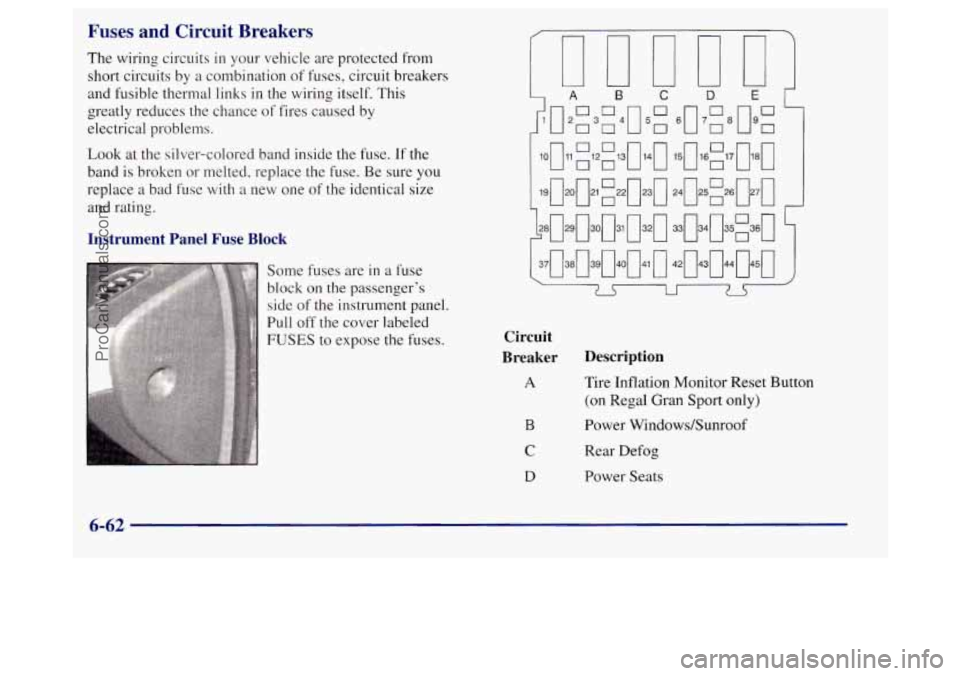
Fuses and Circuit Breakers
The wiring circuits in your vehicle are protected from
short circuits by a combination of fuses, circuit breakers
and fusible thermal links in the wiring itself. This
greatly reduces the chance of fires caused by
electrical problems.
Look at the silver-colored band inside the fuse. If the
band is broken or melted, replace the fuse. Be sure you
replace a bad fuse
with a new one of the identical size
and rating.
Instrument Panel Fuse Block
Some fuses are in a fuse
block on the passenger’s side of the instrument panel.
Pull off the cover labeled
FUSES to expose the fuses. Circuit
Breaker Description
A Tire Inflation Monitor Reset Button
(on Regal Grin Sport only)
B
C
D
Power Windows/Sunroof
Rear Defog
Power Seats
6-62
ProCarManuals.com
Page 339 of 388
I Maintenance Schedule I
The services shown in this schedule up to 100,000 miles
(166
000 km) should be performed after 100,000 miles
(166
000 km) at the same intervals. The services shown
at 150,000 miles
(240 000 km) should be performed at
the same interval after
150,000 miles (240 000 km).
See “Owner Checks and Services” and “Periodic
Maintenance Inspections” following.
Footnotes
The U.S. Environmental Protection Agency or the
California Air Resources Board has determined that the
failure
to perform this maintenance item will not nullify
the emission warranty or limit recall liability prior to the
completion of the vehicle’s useful life. We, however,
urge that all recommended maintenance services be
performed at the indicated intervals and the maintenance
be recorded.
* Your vehicle has an Engine Oil Life Monitor. This
monitor will show you when to change the engine oil
and filter
-- usually between 3,000 miles (5 000 km)
and 7,500 miles (12 500 km) since your last oil change.
Under severe conditions, the indicator may come on
before
3,000 miles (5 000 km). Never drive your vehicle
more than
7,500 miles (12 500 km) or 12 months
without an oil and filter change.
The system won’t detect dust in the oil.
So if you drive
in a dusty area, be sure to change your oil and filter
every
3,000 miles (5 000 km) or sooner if the CHANGE
OIL SOON light comes
on. Remember to reset the Oil
Life Monitor when the oil has been changed. For more
information,
see “Change Oil Soon Light” in the Index.
+ A good time to check your brakes is during tire
rotation. See “Brake System Inspection” under “Periodic
Maintenance Inspections” in Part C of this schedule.
7-5
ProCarManuals.com
Page 340 of 388
I Maintenance Schedule I
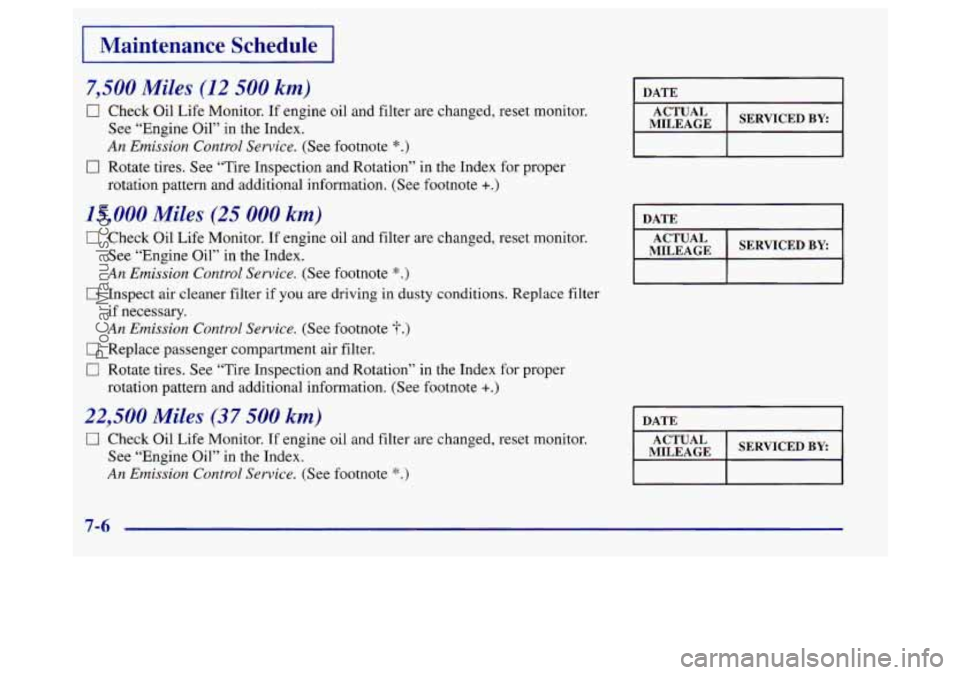
7,500 Miles (12 500 knt)
0 Check Oil Life Monitor. If engine oil and filter are changed, reset monitor.
See “Engine Oil”
in the Index.
An Emission Control Sewice. (See footnote *.)
rotation pattern and additional information. (See footnote +.)
0 Rotate tires. See “Tire Inspection and Rotation” in the Index for proper
15,000 Miles (25 000 km)
0 Check Oil Life Monitor. If engine oil and filter are changed, reset monitor.
See “Engine Oil” in the Index.
An Emission Control Sewice. (See footnote *.)
0 Inspect air cleaner filter if you are driving in dusty conditions. Replace filter
if necessary.
An Emission Control Service. (See footnote t.)
0 Replace passenger compartment air filter.
0 Rotate tires. See “Tire Inspection and Rotation” in the Index for proper
rotation pattern and additional information. (See footnote
+.)
22,500 Miles (37 500 km)
0 Check Oil Life Monitor. If engine oil and filter are changed, reset monitor.
See “Engine Oil” in the Index.
An Emission Control Service. (See footnote *.)
DATE
MILEAGE
ACTUAL I SERVICEDBY: I
DATE I
MILEAGE
ACTUAL SERVICED BY:
DATE
ProCarManuals.com
Page 341 of 388
Maintenance Schedule
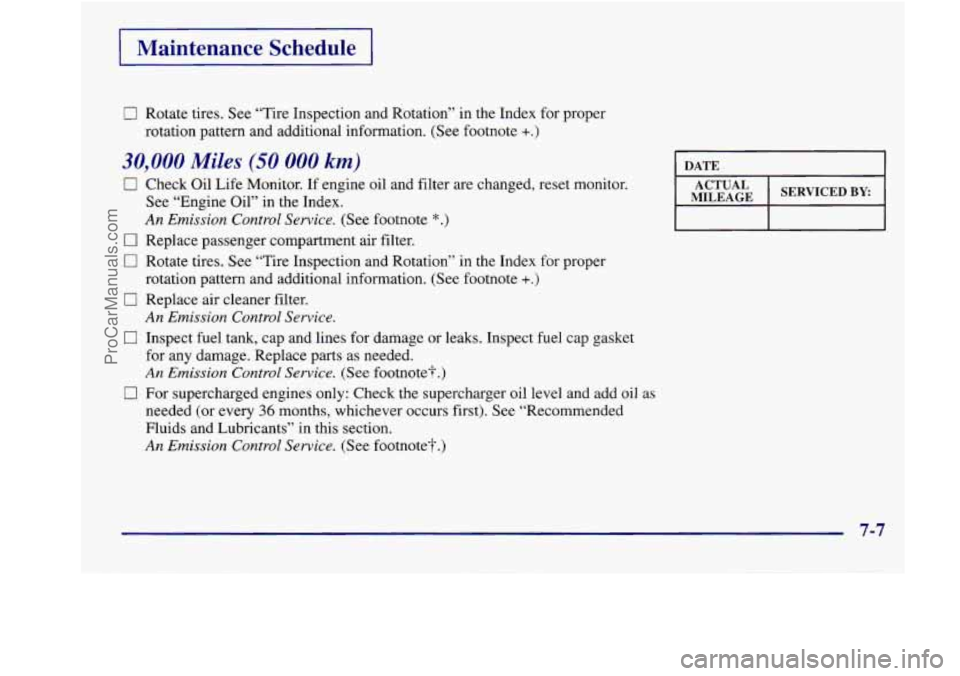
0 Rotate tires. See “Tire Inspection and Rotation” in the Index for proper
rotation pattern and additional information. (See footnote
+.)
30,000 Miles (50 000 km)
17 Check Oil Life Monitor. If engine oil and filter are changed, reset monitor.
See “Engine Oil” in the Index.
An Emission Control Service. (See footnote *,)
0 Replace passenger compartment air filter.
0 Rotate tires. See “Tire Inspection and Rotation” in the Index for proper
0 Replace air cleaner filter.
0 Inspect fuel tank, cap and lines for damage or leaks. Inspect fuel cap gasket
rotation
pattern and additional information. (See footnote
+.)
An Emission Control Service.
for any damage. Replace parts as needed.
An Emission Control Service. (See footnote?.)
0 For supercharged engines only: Check the supercharger oil level and add oil as
needed (or every
36 months, whichever occurs first). See “Recommended
Fluids and Lubricants” in this section.
An Emission Control Service. (See footnote?.)
DATE
7-7
ProCarManuals.com
Page 342 of 388
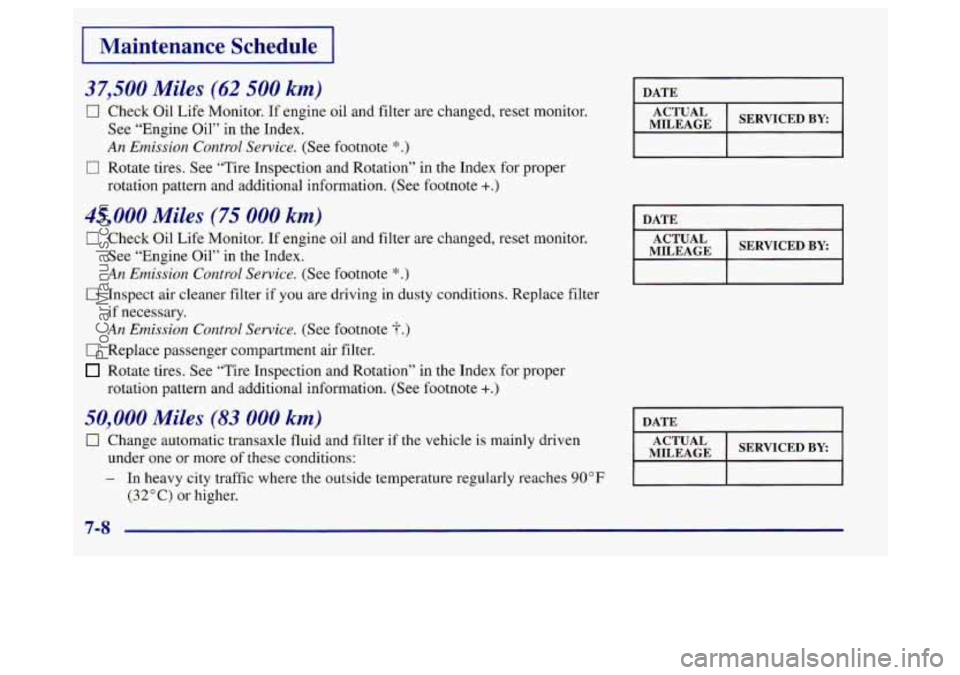
I Maintenance Schedule I
37,500 Miles (62 500 km)
0 Check Oil Life Monitor. If engine oil and filter are changed, reset monitor.
See “Engine Oil” in the Index.
An Emission Control Service. (See footnote *.)
rotation pattern and additional information. (See footnote +.)
0 Rotate tires. See “Tire Inspection and Rotation” in the Index for proper
45,000 Miles (75 000 km)
0 Check Oil Life Monitor. If engine oil and filter are changed, reset monitor.
See “Engine Oil” in the Index.
An Emission Control Service. (See footnote *.)
0 Inspect air cleaner filter if you are driving in dusty conditions. Replace filter
if necessary.
An Emission Control Service. (See footnote “f)
0 Replace passenger compartment air filter.
Rotate tires. See “Tire Inspection and Rotation” in the Index for proper
rotation pattern and additional information. (See footnote
+.)
DATE
DATE
MILEAGE
50,000 Miles (83 000 km)
0 Change automatic transaxle fluid and filter if the vehicle is mainly driven
MILEAGE under one or more of these conditions:
- In heavy city traffic where the outside temperature regularly reaches 90°F
(32°C) or higher.
7-8
ProCarManuals.com
Page 343 of 388
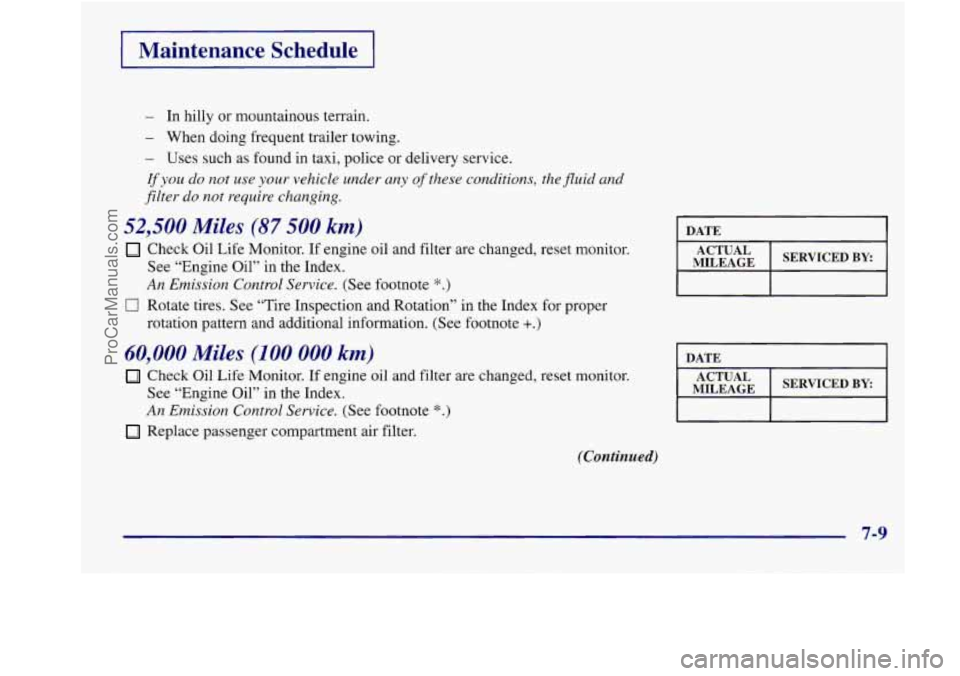
I Maintenance Schedule I
- In hilly or mountainous terrain.
- When doing frequent trailer towing.
- Uses such as found in taxi, police or delivery service.
If you do not use your vehicle under any of these conditions, the fluid and
filter do not require changing.
52,500 Miles (87 500 km)
Check Oil Life Monitor. If engine oil and filter are changed, reset monitor.
See “Engine Oil” in the Index.
An Emission Control Service. (See footnote *.)
rotation pattern and additional information. (See footnote +.)
0 Rotate tires. See “Tire Inspection and Rotation” in the Index for proper
60,000 Miles (100 000 km)
Check Oil Life Monitor. If engine oil and filter are changed, reset monitor.
See “Engine Oil” in the Index.
An Emission Control Service. (See footnote *.)
Replace passenger compartment air filter.
(Continued)
DATE I
ACTUAL
7-9
ProCarManuals.com