tow BUICK REGAL 1998 Service Manual
[x] Cancel search | Manufacturer: BUICK, Model Year: 1998, Model line: REGAL, Model: BUICK REGAL 1998Pages: 388, PDF Size: 20.19 MB
Page 259 of 388
I A CAUTION:
Never use oil or grease on studs or nuts. If you
do, the nuts might come loose. Your wheel could
fall off, causing
a serious accident.
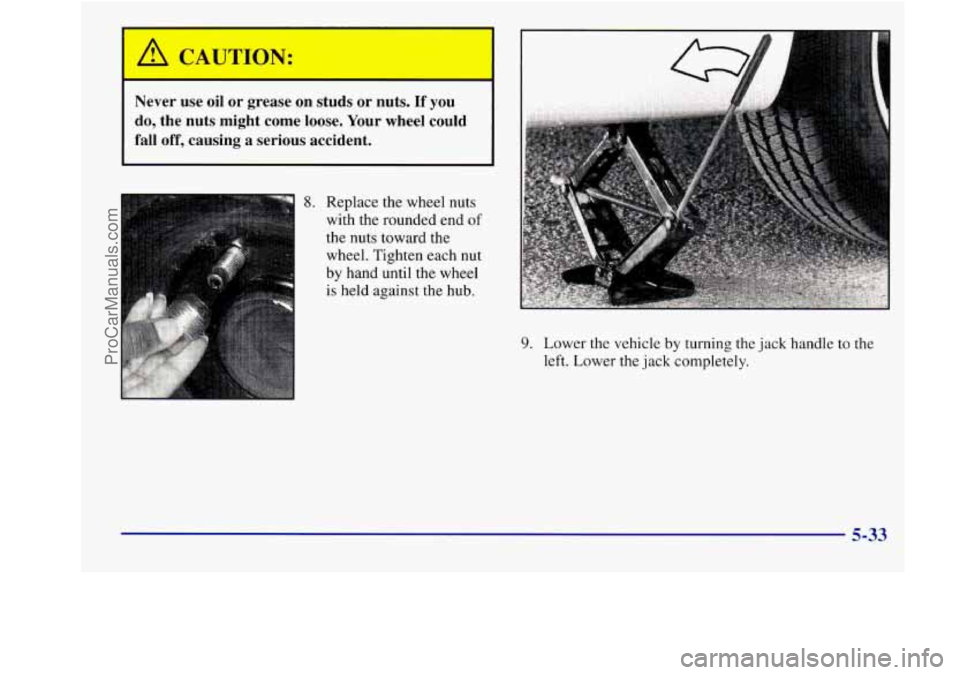
Replace the wheel nuts
with the rounded end
of
the nuts toward the
wheel. Tighten each nut
by hand until the wheel
is held against the hub.
9. Lower the vehicle by turning the jack handle to the
left. Lower the jack completely.
5-33
ProCarManuals.com
Page 277 of 388
Checking Engine Oil
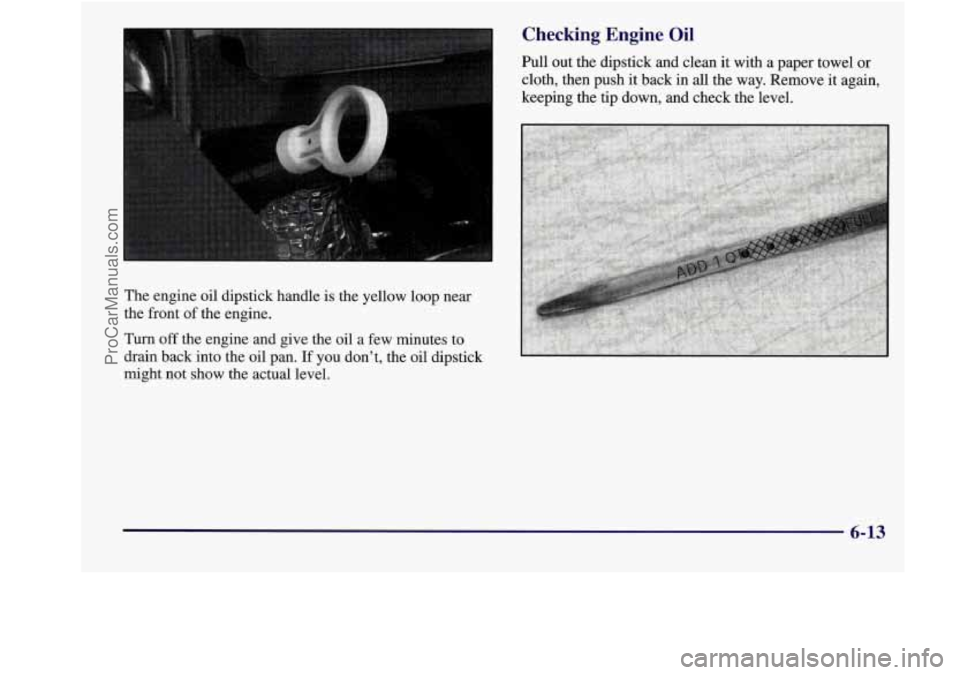
Pull out the dipstick and clean it with a paper towel or
cloth, then push it back in all the way. Remove it again,
keeping the tip down, and check the level.
The engine oil dipstick handle is the yellow loop near
the front
of the engine.
Turn
off the engine and give the oil a few minutes to
drain back into the oil pan.
If you don't, the oil dipstick
might not show the actual level.
6-13
ProCarManuals.com
Page 278 of 388
When to Add Engine Oil
If the oil is at or below the ADD mark, then you’ll need
to add at least one quart of oil. But you must use the
right kind. This part explains what kind
of oil to use. For
crankcase capacity, see “Capacities and Specifications’’
in the Index.
NOTICE:
Don’t add too much oil. If your engine has so
much oil that the oil level gets above the
cross-hatched area that shows the proper
operating range, your engine could be damaged.
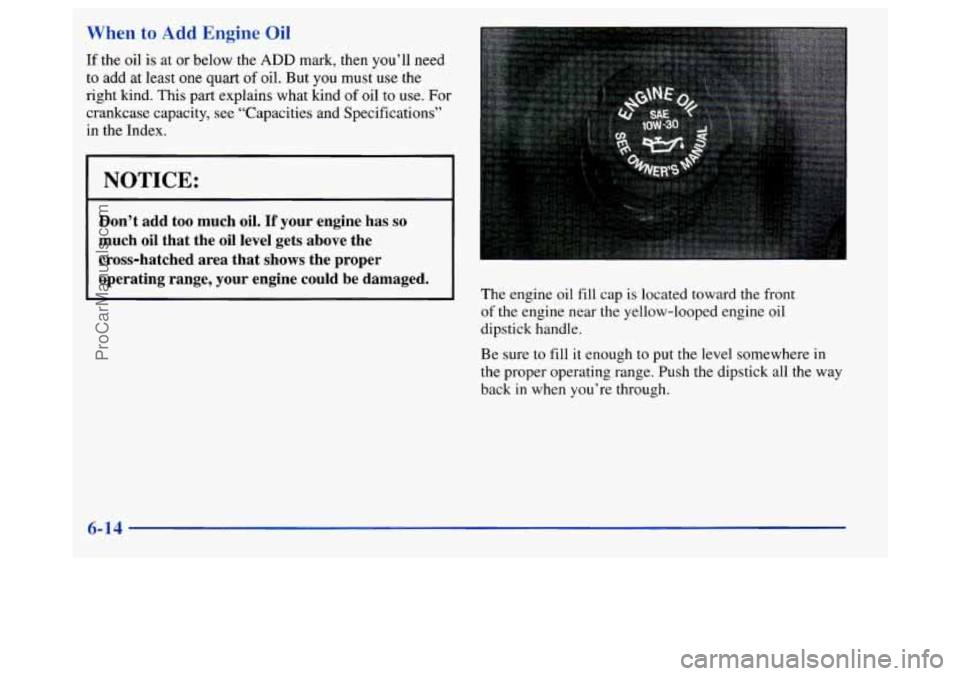
The engine oil fill cap is located toward the front
of the engine near the yellow-looped engine oil
dipstick handle.
Be sure to fill it enough to put the level somewhere in
the proper operating range.
Push the dipstick all the way
back in when you’re through.
6-14
ProCarManuals.com
Page 284 of 388
How to Check and Add Oil
Check oil only when the engine is cold. Allow the
engine
to cool two to three hours after running.
~ ~ -
A CAUTION:
If you remove the supercharger oil fill plug while
the engine is hot, pressure may cause hot oil to
blow out
of the oil fill hole. You may be burned.
Do
not remove the plug until the engine cools.
1.
2.
3.
4.
Clean the area around the oil fill plug before
removing it.
Remove the oil fill plug using a
3/ 16 inch
Allen wrench.
The oil level is correct when it just reaches the
bottom of the threads of the inspection hole.
Replace the oil plug with the O-ring
in place. Torque
to
88 lb-in (10 N-m).
Automatic Transaxle Fluid
When to Check and Change
A good time to check your automatic transaxle fluid
level is when the engine oil is changed.
Change both the fluid and filter every
50,000 miles
(83 000 km) if the vehicle is mainly driven under one or
more of these conditions:
In heavy city traffic where the outside temperature
regularly reaches
90°F (32” C) or higher.
0 In hilly or mountainous terrain.
0 When doing frequent trailer towing.
0 Uses such as found in taxi, police or delivery service.
If you do not use your vehicle under any of these
conditions, the
fluid and filter do not require changing.
See “Scheduled Maintenance Services” in the Index.
6-20
ProCarManuals.com
Page 286 of 388
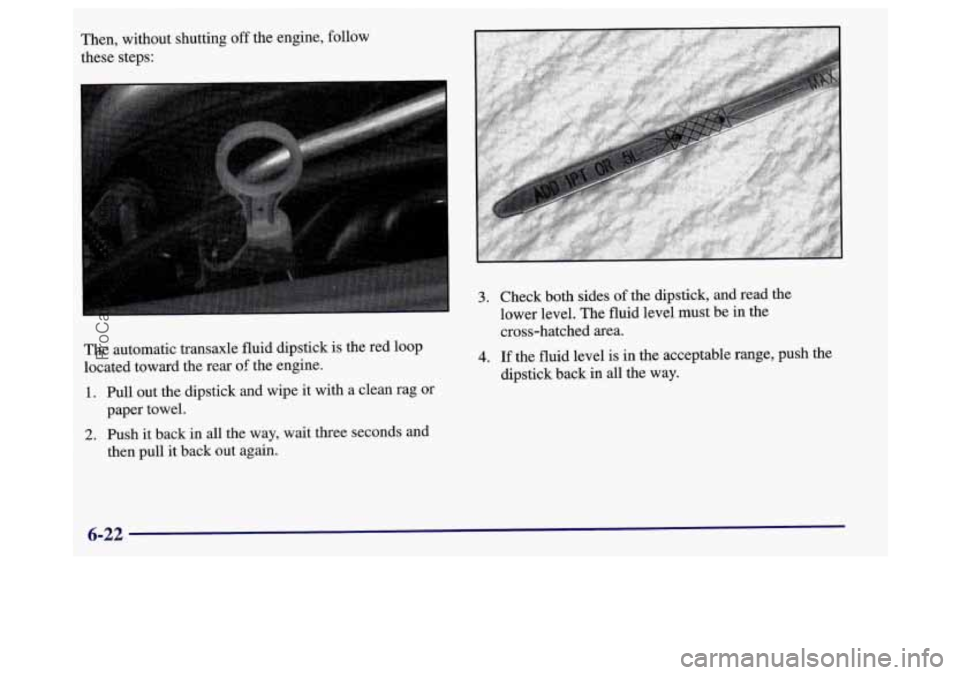
The automatic transaxle fluid dipstick is the red loop
located toward the rear
of the engine.
1. Pull out the dipstick and wipe it with a clean rag or
paper towel.
2. Push it back in all the way, wait three seconds and
then pull it back out again.
3. Check both sides of the dipstick, and read the
lower level. The fluid level must be in the
cross-hatched area.
4. If the fluid level is in the acceptable range, push the
dipstick back in
all the way.
ProCarManuals.com
Page 306 of 388
2. Turn off the ignition while the wipers are at the
outer positions of the wiper pattern. The blades are
more accessible for removalh-eplacement while in
this position.
3. Pull the windshield wiper arm 3 to 4 inches
(7.5 to 10 cm) away from the windshield.
4. While holding the wiper arm away from the glass,
push the release clip from under the blade
connecting point and pull the blade assembly down
toward the glass to remove it from the wiper arm.
5. Push the new wiper blade securely on the wiper arm
until
you hear the release clip “click” into place.
For wiper blade replacement length and type, see
“Capacities and Specifications”
in the Index.
Tires
Your new vehicle comes with high-quality tires made by
a leading tire manufacturer. If you ever have questions
about your tire warranty and where
to obtain service, see
your Buick Warranty booklet for details.
Poorly maintained and improperly used tires
are dangerous.
Overloading your tires can cause
overheating
as a result of too much friction.
You could have an air-out and
a serious
accident. See “Loading Your Vehicle” in
the Index.
Underinflated tires pose the same danger as
overloaded tires. The resulting accident
could cause serious injury. Check all tires
frequently to maintain the recommended
pressure. Tire pressure should be checked
when your tires are cold.
Overinflated tires are more likely to be cut,
punctured or broken by a sudden impact
--
such as when you hit a pothole. Keep tires
at the recommended pressure.
Worn, old tires can cause accidents. If your
tread
is badly worn, or if your tires have
been damaged, replace them.
6-42
ProCarManuals.com
Page 310 of 388
When rotating your tires, always use the correct
rotation pattern shown here.
Don’t include the compact spare tire in your
tire rotation.
After the tires have been rotated, adjust the front and
rear inflation pressures
as shown on the Tire-Loading
Information label. Make certain that all wheel nuts are
properly tightened. See “Wheel Nut Torque”
in
the Index.
Rust or dirt on a wheel, or on the parts to which
it is fastened, can make wheel nuts become loose
after
a time. The wheel could come off and cause
an accident. When
you change a wheel, remove
any rust or dirt from places where the wheel
attaches to the vehicle. In an emergency, you can
use a cloth or
a paper towel to do this; but be
sure to use a scraper or wire brush later,
if you
need to,
to get all the rust or dirt off. (See
“Changing a Flat, Tire” in the Index.)
When It’s Time for New Tires
11 One way to tell when it’s
time for new tires is to
check the treadwear
indicators, which will
appear when your tires have
only
1/16 inch (1.6 mm) or
less of tread remaining.
You need a new tire if any of the following statements
are true:
0 You can see the indicators at three or more places
around the tire.
0 You can see cord or fabric showing through the
tire’s rubber.
0 The tread or sidewall is cracked, cut or snagged deep
enough to show cord or fabric.
6-46
ProCarManuals.com
Page 316 of 388
Don’t use any of these unless this manual says you can.
In many uses, these will damage your vehicle:
0 Alcohol
Laundry Soap
Bleach
Reducing Agents
Cleaning the Inside of Your Vehicle
Use a vacuum cleaner often to get rid of dust and loose
dirt. Wipe vinyl, leather, plastic and painted surfaces
with a clean, damp cloth.
Your dealer has two cleaners, Multi-Purpose Interior
Cleaner and Capture Non-Solvent Dry Spot and Soil
Remover for cleaning fabric and carpet. They will clean
normal spots and stains very well. You can get
GM-approved cleaning products from your dealer. (See
“Appearance Care and Materials” in the Index.)
Here are some cleaning tips:
Always read the instructions on the cleaner label.
Clean up stains as soon as you can -- before they set.
Carefully scrape off any excess stain.
Use a clean cloth or sponge, and change to a clean area
0 If a ring forms after spot cleaning, clean the entire
often.
A soft brush may be used if stains
are stubborn.
area immediately or it will set.
Using Multi-Purpose Interior Cleaner
on Fabric
1.
2.
3.
4.
5.
6.
7.
Vacuum and brush the area to remove any loose dirt.
Always clean a whole trim panel or section. Mask
surrounding trim along stitch or welt lines.
Mix powdered cleaner following the directions on
the container label to form thick suds.
Use suds only and apply with a clean sponge. Don’t
saturate the material and don’t rub it roughly.
As soon as you’ve cleaned the section, use a sponge
to remove the suds.
Wipe cleaned area with a clean, damp towel or cloth.
Wipe with a clean cloth and let dry.
6-52
ProCarManuals.com
Page 319 of 388
Don’t use abrasive cleaners on glass, because they may
cause scratches. Avoid placing decals on the inside rear
window, since they may have to be scraped off later. If
abrasive cleaners are used on the inside of the rear
window, an electric defogger element may be damaged.
Any temporary license should not be attached across the
defogger grid.
Cleaning the Outside of the
Windshield and Wiper Blades
If the windshield is not clear after using the windshield
washer, or if
the wiper blade chatters when running,
wax, sap or other material may be on the blade
or windshield.
Clean the outside
of the windshield with GM
Windshield Cleaner, Bon Ami@ Powder (non-scratching
glass cleaning powder), GM Part
No. 105001 1. The
windshield is clean
if beads do not form when you rinse
it with water.
Grime from
the windshield will stick to the wiper blades
and affect their performance. Clean
the blade by wiping
vigorously with
a cloth soaked in full-strength windshield
washer solvent. Then rinse the blade with water.
Check the wiper blades and clean them as necessary;
replace blades that look worn.
Weatherstrips
Silicone grease on weatherstrips will make them last
longer, seal better, and not stick or squeak. Apply
silicone grease with
a clean cloth at least every six
months. During very cold, damp weather more frequent
application may be required. (See “Recommended
Fluids and Lubricants” in the Index.)
Cleaning the Outside of Your Vehicle
The paint finish on your vehicle provides beauty, depth
of color, gloss retention and durability.
Washing Your Vehicle
The best way to preserve your vehcle’s finish is to keep it
clean by washing it often
with lukewarm or cold water.
Don’t wash your vehicle
in the direct rays of the sun.
Don’t use strong soaps or chemical detergents. Use
liquid hand, dish
or car washing (mild detergent) soaps.
You can get GM-approved cleaning products from your
dealer. (See “Appearance Care and Materials” in the
Index.) Don’t use cleaning agents that are petroleum
based, or that contain acid or abrasives. All cleaning
agents should be flushed promptly and not allowed to
dry on the surface, or they could stain. Dry the finish
with
a soft, clean chamois or an all-cotton towel to
avoid surface scratches and water spotting.
6-55
ProCarManuals.com
Page 321 of 388
Cleaning Aluminum or Chrome
Wheels
(If Equipped)
Keep your wheels clean using a soft clean cloth with
mild soap and water. Rinse with clean water. After
rinsing thoroughly, dry with a soft clean towel.
A wax
may then
be applied.
The surface
of these wheels is similar to the painted
surface
of your vehicle. Don’t use strong soaps,
chemicals, abrasive polishes, abrasive cleaners or abrasive cleaning brushes on them because you could
damage the surface.
You may use chrome polish on
chrome wheels, but avoid any painted surface of the
wheel, and buff
off immediately after application.
Don’t take your vehicle through an automatic car wash
that has silicon carbide tire cleaning brushes. These
brushes can also damage the surface of these wheels.
Cleaning Tires
To clean your tires, use a stiff brush with a tire cleaner.
I NOTICE:
When applying a tire dressing always take care to
wipe
off any overspray or splash from all painted
surfaces on the body or wheels
of the vehicle.
Petroleum-based products may damage the paint finish.
6-57
ProCarManuals.com