ignition BUICK REGAL 1998 Workshop Manual
[x] Cancel search | Manufacturer: BUICK, Model Year: 1998, Model line: REGAL, Model: BUICK REGAL 1998Pages: 388, PDF Size: 20.19 MB
Page 178 of 388
Activating the Theft-Deterrent Feature
The instructions which follow explain how to enter your
secret code
to activate the THEFTLOCK system. It is
recommended that you read through all nine steps
before starting the procedure.
NOTE:
If you allow more than 15 seconds to elapse
between any steps, the radio automatically reverts to
time and you must start the procedure over at Step
4.
1. Write down any three or four-digit number from
000 to 1999 and keep it in a safe place separate from
the vehicle.
2. Turn the ignition to ACCESSORY or RUN.
3. Turn the radio off.
4. Press the 1 and 4 buttons together. Hold them down
until
--- shows on the display. Next you will use the
secret code number which you have written down.
5. Press MIN and 000 will appear on the display.
6. Press MIN again to make the last two digits agree
with your code.
7. Press HRS to make the first one or two digits agree
with your code.
8. Press AM-FM after you have confirmed that the
code matches the secret code you have written down.
The display will show REP
to let you know that you
need to repeat Steps 5 through 7 to confirm your
secret code.
9. Press AM-FM and this time the display will show
SEC to let you know that your radio is secure.
3-26
ProCarManuals.com
Page 179 of 388
Unlocking the Theft-Deterrent Feature After a
Power
Loss
Enter your secret code as follows; pause no more than
15 seconds between steps:
1.
2.
3.
4.
5.
LOC appears when the ignition is on.
Press MIN and
000 will appear on the display.
Press MIN again to make the last two digits agree
with your code.
Press
HRS to make the first one or two digits agree
with your code.
Press AM-FM after
you have confirmed that the
code matches the secret code you have written down.
The display will show SEC, indicating the radio
is
now operable and secure.
If you enter the wrong code eight times, INOP will
appear on the display.
You will have to wait an hour
with the ignition on before
you can try again. When
you try again, you will
only have three more chances
(eight tries per chance) to enter the colrect code before
INOP appears.
If you lose or forget your code, contact your dealer.
Disabling the Theft-Deterrent Feature
Enter your secret code as follows; pause no more than
15 seconds between steps:
1.
2.
3.
4.
5.
6.
7.
Turn the ignition to ACCESSORY or RUN.
Turn the radio off.
Press the 1 and
4 buttons together. Hold them down
until SEC shows on the display.
Press MIN and
000 will appear on the display.
Press MIN again to make the last two digits agree
with your code.
Press
HRS to make the first one or two digits agree
with your code.
Press AM-FM after you have confirmed that the
code matches the secret code you have written down.
The display will show
---, indicating that the radio is
no longer secured.
If the code entered is incorrect,
SEC will appear on the
display. The radio will remain secured
until the correct
code is entered.
When battery power is removed and later applied to a
secured radio, the radio won’t turn on and
LOC will
appear on the display.
3-27
ProCarManuals.com
Page 210 of 388
If you drive regularly in steep country, or if you’re
planning
to visit there, here are some tips that can make
your trips safer and more enjoyable.
0 Keep your vehicle in good shape. Check all fluid
levels and also the brakes, tires, cooling system
and transaxle. These parts can work hard
on
mountain roads.
Know how to go down hills. The most important
thing
to know is this: let your engine do some of the
slowing down. Shift to a lower gear when you
go
down a steep or long hill.
7-
If you don’t shift down, your brakes could
get
so hot that they wouldn’t work well. You
would then have poor braking or even none going
down
a hill. You could crash. Shift down to let
your engine assist your brakes on a steep
downhill slope.
U
Coasting downhill in NEUTRAL (N) or with the
ignition
off is dangerous. Your brakes will have to
do all the work of slowing down. They could get
so
hot that they wouldn’t work well. You would then
have poor braking
or even none going down a hill.
You could crash. Always have your engine running
and your vehicle in gear when you go downhill.
0
0
0
0
Know how to go uphill. You may want to shift down
to a lower gear. The lower gears help cool your engine
and transaxle, and you can climb the hill better.
Stay in your own lane when driving on two-lane
roads in hills or mountains. Don’t swing wide or cut
across the center
of the road. Drive at speeds that let
you stay in your own lane.
As you go over the top of a hill, be alert. There could be
something in your lane, like a stalled car or
an accident.
You may see highway signs
on mountains that warn of
special problems. Examples are long grades, passing or
no-passing zones,
a falling rocks area or winding
roads. Be alert to these and take appropriate action.
4-26
ProCarManuals.com
Page 228 of 388
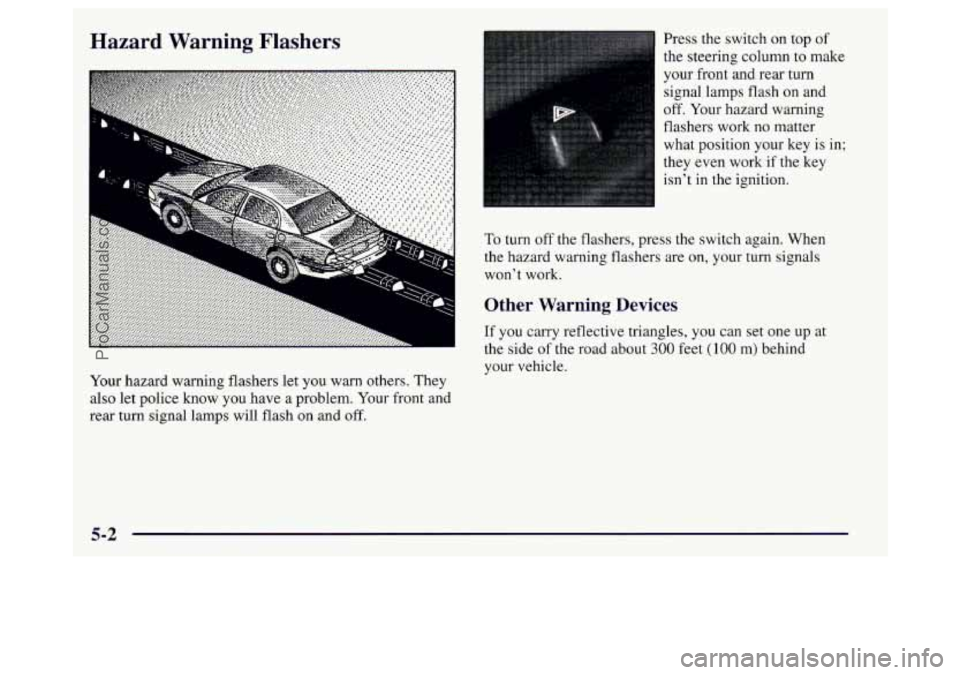
Hazard Warning Flashers
................ ..................
Your hazard warning flashers let you warn others. They
also let police know you have a problem. Your front and
rear turn signal lamps will flash on and off. Press the switch on top
of
the
steering column to make
your front and rear turn
signal lamps
flash on and
off. Your hazard warning
flashers work no matter
what position your key is in;
they even work if the key
isn’t in the ignition.
To turn off the flashers, press the switch again. When
the hazard warning flashers are on, your
turn signals
won’t work.
Other Warning Devices
If you carry reflective triangles, you can set one up at
the side of the road about
300 feet (100 m) behind
your vehicle.
5-2
ProCarManuals.com
Page 230 of 388
2. Get the vehicles close enough so the jumper cables
can reach, but be sure the vehicles aren’t touching
each other. If they are, it could cause
a ground
connection you don’t want. You wouldn’t be able to
start your vehicle, and the bad grounding could
damage the electrical systems.
To avoid the possibility of the vehicles rolling, set
the parking brake firmly on both vehicles involved in
the jump
start procedure. Put your automatic
transaxle in
PARK (P) before setting the
parking brake.
3. Turn off the ignition on both vehicles. Unplug
unnecessary accessories plugged into the cigarette
lighter
or accessory power outlet. Turn off all lamps
that aren’t needed as well
as radios. This will avoid
sparks and help save both batteries. In addition, it
could save your radio!
NOTICE:
If you leave your radio on, it could be badly
damaged. The repairs wouldn’t
be covered by
your warranty.
4. Open the hoods and locate the batteries. (Your
vehicle’s battery is located toward the front
of the
passenger’s side
of the vehicle’s engine, underneath
a diagonal brace.)
An electric fan can start up even when the engine
is not running and can injure you. Keep hands, clothing and tools away
from any underhood
electric fan.
5-4
ProCarManuals.com
Page 236 of 388
A vehicle can fall from a car carrier if it isn’t
adequately secured. This can cause
a collision,
serious personal injury and vehicle damage. The
vehicle should be tightly secured with chains or
steel cables before
it is transported,
Don’t use substitutes (ropes, leather straps,
canvas webbing, etc.) that can be cut by sharp
edges underneath the towed vehicle. Always use
T-hooks inserted in the T-hook slots. Never use
J-hooks. They will damage drivetrain and
suspension components.
When your vehicle is being towed, have the ignition key
in OFF. The steering wheel should be clamped in a
straight-ahead position, with a clamping device
designed for towing service.
Do not use the vehicle’s
steering column lock for this. The transaxle should be
in
NEUTRAL (N) and the parking brake released.
NOTICE:
Don’t have your vehicle towed on the drive
wheels, unless you must,
If the vehicle must be
towed on the drive wheels, do not tow the vehicle
more than
500 cumulative miles (800 km) or
exceed
50 mph (80 km/h). Cumulative miles are
defined
as total miles over the life of the vehicle.
For example, your vehicle cannot be towed
500 miles (800 km) each day of a trip totaling
3,000 miles (4800 km). If these limitations must
be exceeded, then the drive wheels have to be
supported on
a dolly.
5-10
ProCarManuals.com
Page 280 of 388
As shown in the chart, SAE 1OW-30 is best for your
vehicle. However, you can
use SAE 5W-30 if it’s going
to be colder than
60°F (1 6 O C) before your next oil
change. When it’s very cold,
you should use SAE
5W-30. These numbers on an oil container show its
viscosity, or thickness.
Do not use other viscosity oils,
such
as SAE 20W-50.
NOTICE:
Use only engine oil with the American Petroleum
Institute Certified For Gasoline Engines
“Starburst” symbol. Failure to use the
recommended oil can result in engine damage not
covered by your warranty.
GM Goodwrench@ oil meets all the requirements for
your vehicle.
If you are in an area where the temperature falls below
-20°F
(-29”C), consider using either an SAE 5W-30
synthetic oil or an SAE OW-30 oil. Both will provide
easier cold starting and better protection for your engine
at extremely low temperatures.
Engine Oil Additives
Don’t add anything to your oil. Your dealer is ready to
advise if you think something should be added.
When to Change Engine Oil
Your vehicle has an Oil Life Monitor. This feature
will let you know when to change your oil and
filter
-- usually between 3,000 miles (5 000 km) and
7,500 miles (12 500 km) since your last oil change.
Under severe conditions, the indicator may come on
before
3,000 miles (5 000 km). Never drive your vehicle
more than
7,500 miles (12 500 km) or 12 months
(whichever occurs first) without an oil change.
The system won’t detect dust
in the oil. So, if you
drive in a dusty area, be sure to change your oil every
3,000 miles (5 000 km) or sooner. Remember to reset
the CHANGE OIL
SOON light when the oil has been
changed. For more information, see “Change Oil Soon
Light” in the Index.
How to Reset the CHANGE OIL SOON Light
After changing the engine oil, the system must be reset.
With the ignition key in RUN but the engine off, fully
push and release the accelerator pedal slowly three times
within five seconds. If
the CHANGE OIL SOON light
flashes, the system is resetting.
Turn the key to OFF,
6-16
ProCarManuals.com
Page 283 of 388
To change the passenger compartment air filter, use the
following steps:
1. Turn off the ignition when the windshield wipers
are in the up position.
2. Raise the hood.
3. Remove (disconnect) the windshield washer pump
hose from the fender rail and air inlet grille.
4. Reposition the hood weatherstrip from the right
side
of the vehicle (peel back halfway to center).
5. Remove (disconnect) the air inlet grille retainers.
6. Remove (disconnect) the air inlet grille.
7. Remove (disconnect) the passenger compartment
8. Then install the new air filter. For the type of filter
to use, see “Normal Maintenance Replacement
Parts” in the Index.
air
filter.
9. Reposition the air inlet grille.
10. Replace the air inlet grille retainers. 11.
Reposition the hood weatherstrip.
12. Reconnect the windshield washer pump hose to the
fender rail and air inlet grille.
13. Close the hood.
14. Return the windshield wipers to the park position.
Supercharger Oil
Unless you are technically qualified and have the proper
tools,
you should let your dealer or a qualified service
center perform this maintenance.
When to Check
Check oil level every 30,000 miles (50 000 km) or every
36 months, whichever occurs first.
What Kind of Oil to Use
See “Recommended Fluids and Lubricants” in the Index
and use only the recommended oil.
6-19
ProCarManuals.com
Page 306 of 388
2. Turn off the ignition while the wipers are at the
outer positions of the wiper pattern. The blades are
more accessible for removalh-eplacement while in
this position.
3. Pull the windshield wiper arm 3 to 4 inches
(7.5 to 10 cm) away from the windshield.
4. While holding the wiper arm away from the glass,
push the release clip from under the blade
connecting point and pull the blade assembly down
toward the glass to remove it from the wiper arm.
5. Push the new wiper blade securely on the wiper arm
until
you hear the release clip “click” into place.
For wiper blade replacement length and type, see
“Capacities and Specifications”
in the Index.
Tires
Your new vehicle comes with high-quality tires made by
a leading tire manufacturer. If you ever have questions
about your tire warranty and where
to obtain service, see
your Buick Warranty booklet for details.
Poorly maintained and improperly used tires
are dangerous.
Overloading your tires can cause
overheating
as a result of too much friction.
You could have an air-out and
a serious
accident. See “Loading Your Vehicle” in
the Index.
Underinflated tires pose the same danger as
overloaded tires. The resulting accident
could cause serious injury. Check all tires
frequently to maintain the recommended
pressure. Tire pressure should be checked
when your tires are cold.
Overinflated tires are more likely to be cut,
punctured or broken by a sudden impact
--
such as when you hit a pothole. Keep tires
at the recommended pressure.
Worn, old tires can cause accidents. If your
tread
is badly worn, or if your tires have
been damaged, replace them.
6-42
ProCarManuals.com
Page 308 of 388
Tire Pressure Monitor System (If Equipped)
The tire pressure monitor system can alert you to a large
change in the pressure
of one tire. The system “learns”
the pressure at each tire throughout the operating speed
range of your vehicle. The system normally takes
between
45 and 90 minutes of driving to learn the tire
pressures. This time may be longer depending on your
individual driving habits. Learning need not be
accumulated during
a single trip. Once learned, the
system will remember the tire pressures until the system
is recalibrated.
After the system has learned tire pressures with properly
inflated tires, the LOW TIRE light will come on if the
pressure in
one tire becomes 12 psi (83 kPa) lower than
the other three tires. The tire pressure monitor system
won’t alert you if the pressure
in more than one tire is
low, if the system is not properly calibrated, or if the
vehicle
is moving faster than 70 mph (1 10 kdh).
The tire pressure monitor system detects differences
in tire rotation speeds that are caused by changes
in
tire pressure. The system can alert you about a low
tire
-- but it doesn’t replace normal tire maintenance.
See “Tires” in the Index. When the LOW
TIRE light comes
on, you should stop
as soon as you can and check all your tires for damage.
(If a tire is flat, see “If
a Tire Goes Flat” in the Index.)
Also check
the tire pressure in all four tires as soon as
you can. See “Inflation
- Tire Pressure” in the Index.
The light will come on and stay on
until you turn off the
ignition or press the
RESET button.
Don’t reset the tire pressure monitor system without first
correcting the cause of the problem and checking and
adjusting the pressure in all four tires. If you reset the
system when the tire pressures are incorrect, the tire
pressure monitor system will not work properly and may
not alert you when
a tire is low.
Any time
you adjust a tire’s pressure, rotate your tires,
or have one or more tires repaired or replaced, you’ll
need to reset (calibrate) the tire pressure monitor system.
You’ll also need to reset the system whenever you buy
new tires and whenever the vehicle’s battery has been
disconnected.
To reset (calibrate) the system,
turn the ignition switch
to
RUN. Then press and hold the RESET button for
about five seconds.
6-44
ProCarManuals.com