tire pressure reset BUICK REGAL 1998 Owners Manual
[x] Cancel search | Manufacturer: BUICK, Model Year: 1998, Model line: REGAL, Model: BUICK REGAL 1998Pages: 388, PDF Size: 20.19 MB
Page 142 of 388
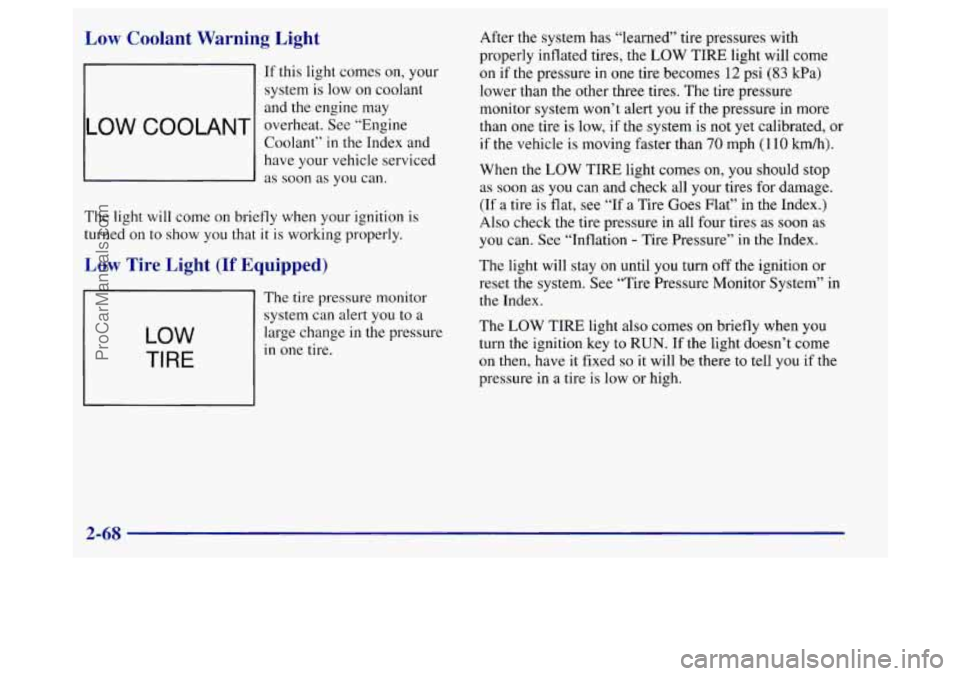
Low Coolant Warning Light
LOW COOLANT
If this light comes on, your
system is low on coolant
and the engine may
overheat. See “Engine
Coolant”
in the Index and
have your vehicle serviced
as soon as you can.
The light will come on briefly when your ignition is
turned
on to show you that it is working properly.
Low Tire Light (If Equipped)
LOW
TIRE
The tire pressure monitor
system can alert you to
a
large change in the pressure
in one tire. After the system has “learned”
tire pressures with
properly inflated tires, the
LOW TIRE light will come
on if the pressure in one tire becomes
12 psi (83 kPa)
lower than the other three tires. The tire pressure
monitor system won’t alert you if the pressure in more
than one tire
is low, if the system is not yet calibrated, or
if the vehicle is moving faster than
70 mph (1 10 kdh).
When the
LOW TIRE light comes on, you should stop
as soon as you can and check all your tires for damage.
(If a tire is flat, see “If a Tire Goes Flat” in the Index.)
Also check the tire pressure in all four tires as soon
as
you can. See “Inflation - Tire Pressure” in the Index.
The light will stay on until you turn off the ignition or
reset the system. See “Tire Pressure Monitor System” in
the Index.
The
LOW TIRE light also comes on briefly when you
turn the ignition key to RUN. If the light doesn’t come
on then, have it fixed
so it will be there to tell you if the
pressure in a tire is low or high.
2-68
ProCarManuals.com
Page 308 of 388
Tire Pressure Monitor System (If Equipped)
The tire pressure monitor system can alert you to a large
change in the pressure
of one tire. The system “learns”
the pressure at each tire throughout the operating speed
range of your vehicle. The system normally takes
between
45 and 90 minutes of driving to learn the tire
pressures. This time may be longer depending on your
individual driving habits. Learning need not be
accumulated during
a single trip. Once learned, the
system will remember the tire pressures until the system
is recalibrated.
After the system has learned tire pressures with properly
inflated tires, the LOW TIRE light will come on if the
pressure in
one tire becomes 12 psi (83 kPa) lower than
the other three tires. The tire pressure monitor system
won’t alert you if the pressure
in more than one tire is
low, if the system is not properly calibrated, or if the
vehicle
is moving faster than 70 mph (1 10 kdh).
The tire pressure monitor system detects differences
in tire rotation speeds that are caused by changes
in
tire pressure. The system can alert you about a low
tire
-- but it doesn’t replace normal tire maintenance.
See “Tires” in the Index. When the LOW
TIRE light comes
on, you should stop
as soon as you can and check all your tires for damage.
(If a tire is flat, see “If
a Tire Goes Flat” in the Index.)
Also check
the tire pressure in all four tires as soon as
you can. See “Inflation
- Tire Pressure” in the Index.
The light will come on and stay on
until you turn off the
ignition or press the
RESET button.
Don’t reset the tire pressure monitor system without first
correcting the cause of the problem and checking and
adjusting the pressure in all four tires. If you reset the
system when the tire pressures are incorrect, the tire
pressure monitor system will not work properly and may
not alert you when
a tire is low.
Any time
you adjust a tire’s pressure, rotate your tires,
or have one or more tires repaired or replaced, you’ll
need to reset (calibrate) the tire pressure monitor system.
You’ll also need to reset the system whenever you buy
new tires and whenever the vehicle’s battery has been
disconnected.
To reset (calibrate) the system,
turn the ignition switch
to
RUN. Then press and hold the RESET button for
about five seconds.
6-44
ProCarManuals.com
Page 309 of 388
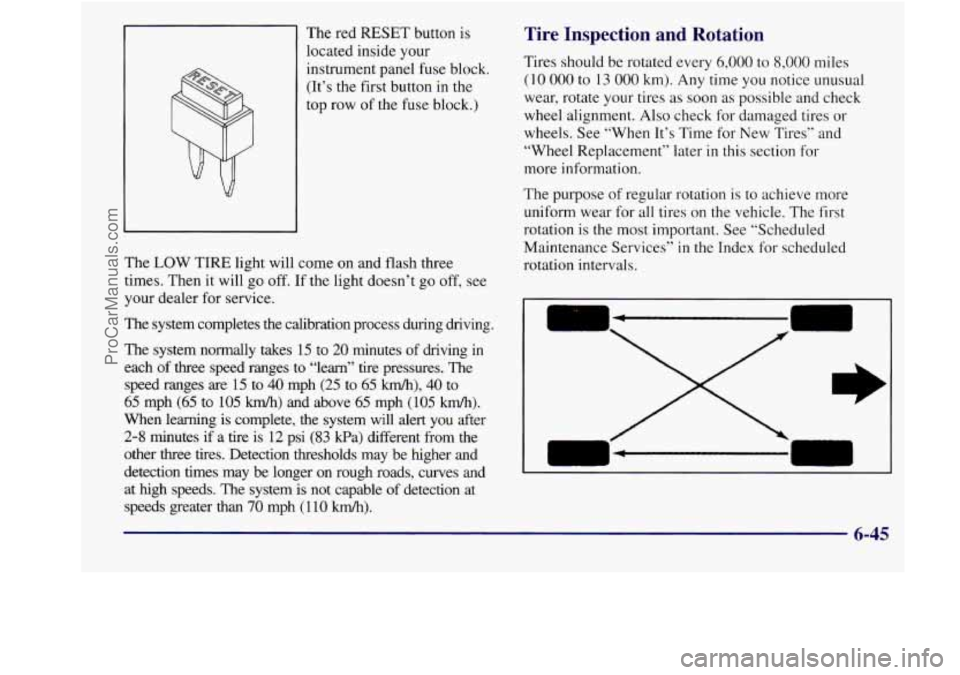
The red RESET button is
located inside your
instrument panel fuse block.
(It’s the first button in the
top row of the fuse block.)
The LOW TIRE light will come
on and flash three
times. Then it will go off. If the light doesn’t go off, see
your dealer for service.
The system completes the calibration process during driving.
The system normally takes
15 to 20 minutes of driving in
each of three speed ranges to “learn” tire pressures. The
speed ranges are 15 to 40 mph (25 to 65 km/h), 40 to
65 mph (65 to 105 km/h) and above 65 mph (105 km/h).
When learning is complete, the system will alert you after
2-8 minutes if a tire is 12 psi (83 kPa) different from the
other
three tires. Detection thresholds may be higher and
detection times may be longer on rough roads, curves and
at high speeds. The system
is not capable of detection at
speeds greater
than 70 mph (1 10 km/h).
Tire Inspection and Rotation
Tires should be rotated every 6,000 to 8,000 miles
(10 000 to 13 000 km). Any time you notice unusual
wear, rotate your tires
as soon as possible and check
wheel alignment. Also check for damaged tires or
wheels. See “When It’s Time for New Tires”
and
“Wheel Replacement” later in this section for
more information.
The purpose
of regular rotation is to achieve more
uniform wear for
all tires on the vehicle. The first
rotation is the most important. See “Scheduled
Maintenance Services”
in the Index for scheduled
rotation intervals.
6-45
ProCarManuals.com