display BUICK REGAL 2011 Workshop Manual
[x] Cancel search | Manufacturer: BUICK, Model Year: 2011, Model line: REGAL, Model: BUICK REGAL 2011Pages: 368, PDF Size: 5.35 MB
Page 227 of 368
Black plate (37,1)Buick Regal Owner Manual - 2011
Driving and Operating 9-37
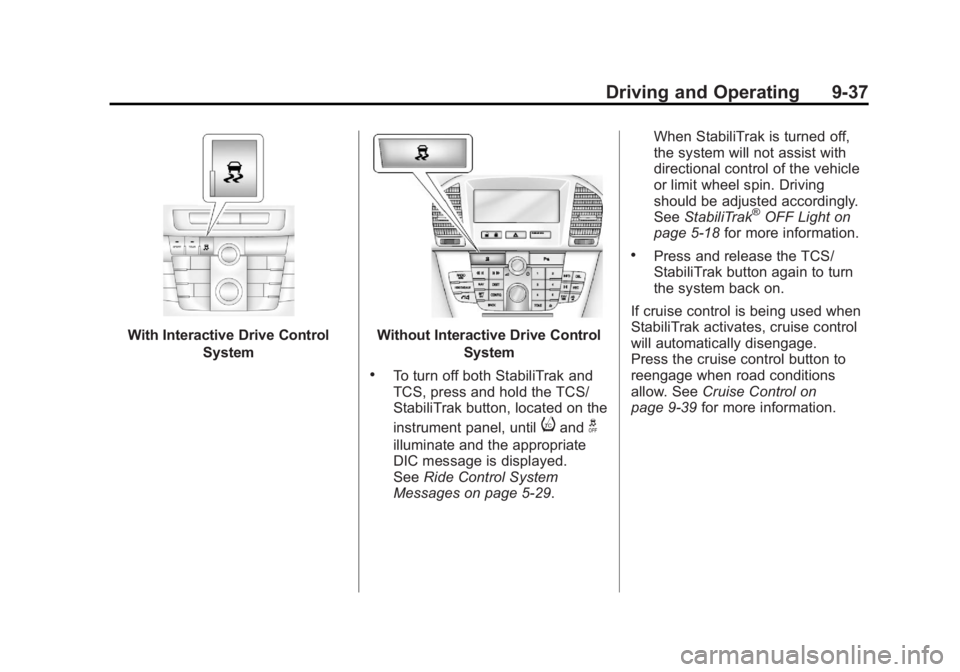
With Interactive Drive ControlSystemWithout Interactive Drive Control System
.To turn off both StabiliTrak and
TCS, press and hold the TCS/
StabiliTrak button, located on the
instrument panel, until
iandg
illuminate and the appropriate
DIC message is displayed.
SeeRide Control System
Messages on page 5‑29. When StabiliTrak is turned off,
the system will not assist with
directional control of the vehicle
or limit wheel spin. Driving
should be adjusted accordingly.
See
StabiliTrak
®OFF Light on
page 5‑18 for more information.
.Press and release the TCS/
StabiliTrak button again to turn
the system back on.
If cruise control is being used when
StabiliTrak activates, cruise control
will automatically disengage.
Press the cruise control button to
reengage when road conditions
allow. See Cruise Control on
page 9‑39 for more information.
Page 228 of 368
Black plate (38,1)Buick Regal Owner Manual - 2011
9-38 Driving and Operating
Interactive Drive Control
System
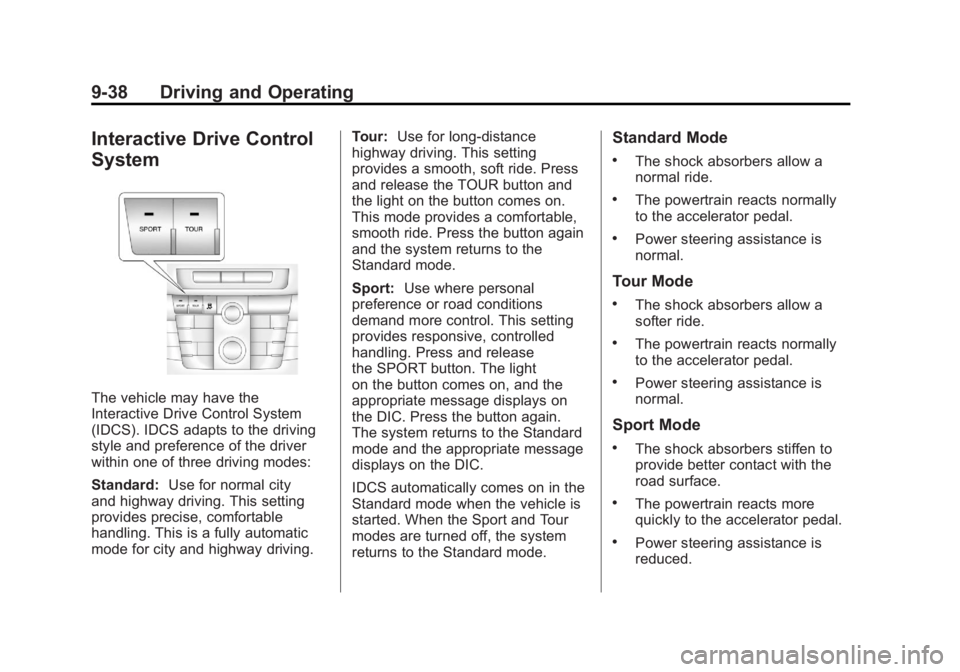
The vehicle may have the
Interactive Drive Control System
(IDCS). IDCS adapts to the driving
style and preference of the driver
within one of three driving modes:
Standard:Use for normal city
and highway driving. This setting
provides precise, comfortable
handling. This is a fully automatic
mode for city and highway driving. Tour:
Use for long-distance
highway driving. This setting
provides a smooth, soft ride. Press
and release the TOUR button and
the light on the button comes on.
This mode provides a comfortable,
smooth ride. Press the button again
and the system returns to the
Standard mode.
Sport: Use where personal
preference or road conditions
demand more control. This setting
provides responsive, controlled
handling. Press and release
the SPORT button. The light
on the button comes on, and the
appropriate message displays on
the DIC. Press the button again.
The system returns to the Standard
mode and the appropriate message
displays on the DIC.
IDCS automatically comes on in the
Standard mode when the vehicle is
started. When the Sport and Tour
modes are turned off, the system
returns to the Standard mode.
Standard Mode
.The shock absorbers allow a
normal ride.
.The powertrain reacts normally
to the accelerator pedal.
.Power steering assistance is
normal.
Tour Mode
.The shock absorbers allow a
softer ride.
.The powertrain reacts normally
to the accelerator pedal.
.Power steering assistance is
normal.
Sport Mode
.The shock absorbers stiffen to
provide better contact with the
road surface.
.The powertrain reacts more
quickly to the accelerator pedal.
.Power steering assistance is
reduced.
Page 233 of 368

Black plate (43,1)Buick Regal Owner Manual - 2011
Driving and Operating 9-43
PARK ASSIST OFF displays on the
Driver Information Center (DIC) to
indicate that URPA is off. The
message disappears after a short
period of time.
Turning the System On and Off
The URPA system can be turned on
and off using the park assist button
located next to the radio.
The park assist button lights up
when the system is on or in standby
and turns off when it has been
disabled.
URPA defaults to the on setting
each time the vehicle is started.
When the System Does Not
Seem to Work Properly
SERVICE PARK ASSIST:If this
message occurs, take the vehicle to
your dealer to repair the system.
PARK ASSIST OFF: If the URPA
system does not activate due to a
temporary condition, the message
displays on the DIC. See Driver
Information Center (DIC) on
page 5‑22 for more information.
This can occur under the following
conditions:
.The driver has disabled the
system.
.The ultrasonic sensors are not
clean. Keep the vehicle's rear
bumper free of mud, dirt, snow,
ice, and slush. For cleaning
instructions, see Exterior Care
on page 10‑77.
.An object was hanging out of the
trunk during the last drive cycle.
Once the object is removed and
URPA detects no objects of
interest, the URPA will return to
normal operation.
.The vehicle's bumper is
damaged. Take the vehicle to
your dealer to repair the system.
.Other conditions, such as
vibrations from a jackhammer or
the compression of air brakes on
a very large truck, are affecting
system performance.
If the system is still disabled after
checking all conditions listed above
and driving forward at least 40 km/h
(25 mph), take the vehicle to your
dealer.
Page 251 of 368
Black plate (11,1)Buick Regal Owner Manual - 2011
Vehicle Care 10-11
Notice:Use only engine oil that
is approved to the dexos
specification or an equivalent
engine oil of the appropriate
viscosity grade. Engine oils
approved to the dexos
specification will show the dexos
symbol on the container. Failure
to use the recommended engine
oil or equivalent can result in
engine damage not covered by
the vehicle warranty. If you are
unsure whether the oil is
approved to the dexos
specification, ask your service
provider.
Use of Substitute Engine Oils if
dexos is unavailable: In the event
that dexos‐approved engine oil is
not available at an oil change or for
maintaining proper oil level, you
may use substitute engine oil
displaying the API Starburst symbol
and of SAE 5W-30 viscosity grade.
Use of oils that do not meet the
dexos specification, however, may
result in reduced performance under
certain circumstances. Specification (2.0L Turbo Engine)
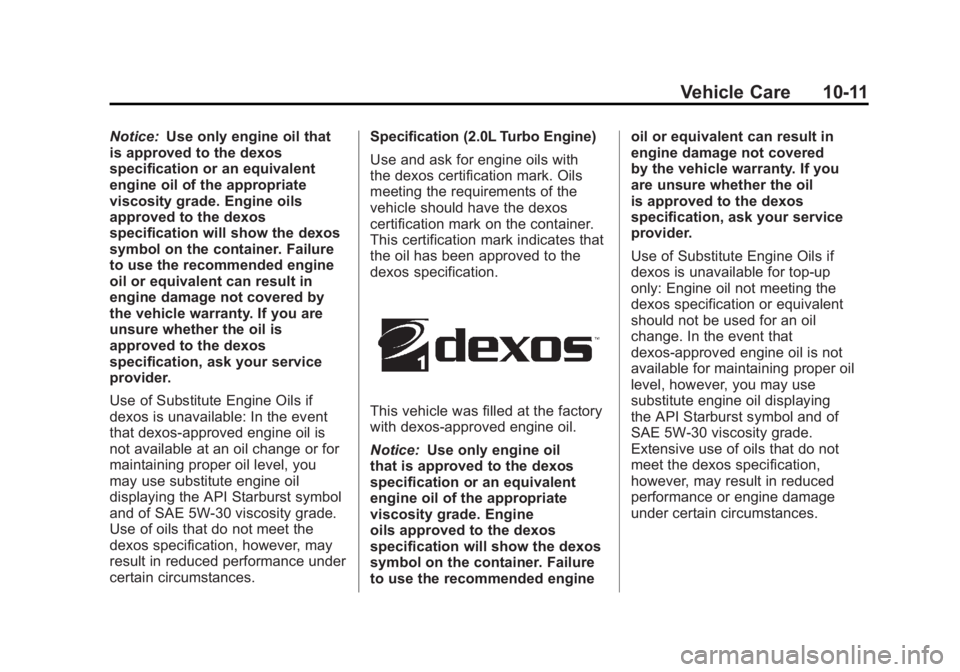
Use and ask for engine oils with
the dexos certification mark. Oils
meeting the requirements of the
vehicle should have the dexos
certification mark on the container.
This certification mark indicates that
the oil has been approved to the
dexos specification.
This vehicle was filled at the factory
with dexos‐approved engine oil.
Notice:
Use only engine oil
that is approved to the dexos
specification or an equivalent
engine oil of the appropriate
viscosity grade. Engine
oils approved to the dexos
specification will show the dexos
symbol on the container. Failure
to use the recommended engine oil or equivalent can result in
engine damage not covered
by the vehicle warranty. If you
are unsure whether the oil
is approved to the dexos
specification, ask your service
provider.
Use of Substitute Engine Oils if
dexos is unavailable for top‐up
only: Engine oil not meeting the
dexos specification or equivalent
should not be used for an oil
change. In the event that
dexos‐approved engine oil is not
available for maintaining proper oil
level, however, you may use
substitute engine oil displaying
the API Starburst symbol and of
SAE 5W-30 viscosity grade.
Extensive use of oils that do not
meet the dexos specification,
however, may result in reduced
performance or engine damage
under certain circumstances.
Page 252 of 368
Black plate (12,1)Buick Regal Owner Manual - 2011
10-12 Vehicle Care
Maintaining the proper oil level is
very important. However, if you use
a substitute oil for any reason, we
recommend that you perform a
complete oil change back to dexos
as soon as possible to protect the
engine and maintain the engine's
peak performance.
Viscosity Grade
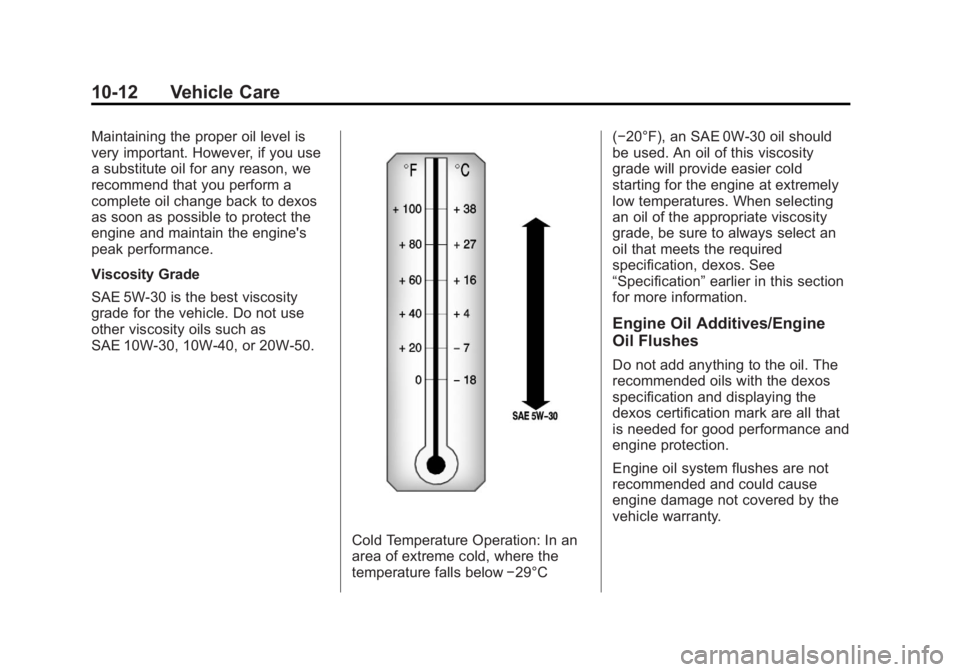
SAE 5W-30 is the best viscosity
grade for the vehicle. Do not use
other viscosity oils such as
SAE 10W‐30, 10W‐40, or 20W-50.
Cold Temperature Operation: In an
area of extreme cold, where the
temperature falls below−29°C(−20°F), an SAE 0W-30 oil should
be used. An oil of this viscosity
grade will provide easier cold
starting for the engine at extremely
low temperatures. When selecting
an oil of the appropriate viscosity
grade, be sure to always select an
oil that meets the required
specification, dexos. See
“Specification”
earlier in this section
for more information.
Engine Oil Additives/Engine
Oil Flushes
Do not add anything to the oil. The
recommended oils with the dexos
specification and displaying the
dexos certification mark are all that
is needed for good performance and
engine protection.
Engine oil system flushes are not
recommended and could cause
engine damage not covered by the
vehicle warranty.
Page 254 of 368
Black plate (14,1)Buick Regal Owner Manual - 2011
10-14 Vehicle Care
2. Press the DIC menu button onthe turn signal lever to enter the
Vehicle Information Menu. Use
the thumbwheel to scroll through
the menu items until you reach
REMAINING OIL LIFE.
3. Press the SET/CLR button to reset the oil life at 100%.
4. Turn the ignition to LOCK/OFF.
The system is reset when the
CHANGE ENGINE OIL SOON
message is off and the REMAINING
OIL LIFE 100% message is
displayed.
If the CHANGE ENGINE OIL
message comes back on when the
vehicle is started, the engine oil life
system has not been reset. Repeat
the procedure.Automatic Transmission
Fluid
How to Check Automatic
Transmission Fluid
It is not necessary to check the
transmission fluid level.
A transmission fluid leak is the only
reason for fluid loss. If a leak
occurs, take the vehicle to your
dealer service department and have
it repaired as soon as possible.
There is a special procedure for
checking and changing the
transmission fluid. Because this
procedure is difficult, you should
have this done at your dealer
service department. Contact your
dealer for additional information.
The procedure can be found in the
service manual. To purchase a
service manual, see Service
Publications Ordering Information
on page 13‑11.
Change the fluid and filter at the
intervals listed in Scheduled
Maintenance on page 11‑2, and be sure to use the fluid listed in
Recommended Fluids and
Lubricants on page 11‑6.
Manual Transmission
Fluid
It is not necessary to check the
manual transmission fluid level.
A transmission fluid leak is the only
reason for fluid loss. If a leak
occurs, take the vehicle to your
dealer service department and
have it repaired as soon as
possible. See
Recommended Fluids
and Lubricants on page 11‑6 for the
proper fluid to use.
Hydraulic Clutch
For vehicles with a manual
transmission, it is not necessary to
regularly check brake/clutch fluid
unless there is a leak suspected.
Adding fluid will not correct a leak.
A fluid loss in this system could
indicate a problem. Have the
system inspected and repaired.
Page 262 of 368
Black plate (22,1)Buick Regal Owner Manual - 2011
10-22 Vehicle Care
If it is decided not to lift the hood
when this warning appears, but
instead get service help right away,
seeRoadside Assistance Program
on page 13‑5.
If it is decided to lift the hood, make
sure the vehicle is parked on a level
surface.
Then check to see if the engine
cooling fans are running. If the
engine is overheating, both fans
should be running. If they are not,
do not continue to run the engine
and have the vehicle serviced.
Notice: Engine damage from
running the engine without
coolant is not covered by the
warranty.If Steam Is Coming from the
Engine Compartment
{WARNING
Steam from an overheated engine
can burn you badly, even if you
just open the hood. Stay away
from the engine if you see or hear
steam coming from it. Just turn it
off and get everyone away from
the vehicle until it cools down.
Wait until there is no sign of
steam or coolant before you open
the hood.
If you keep driving when the
engine is overheated, the liquids
in it can catch fire. You or others
could be badly burned. Stop the
engine if it overheats, and get out
of the vehicle until the engine
is cool.
If No Steam Is Coming from
the Engine Compartment
If an engine overheat warning is
displayed but no steam can be seen
or heard, the problem may not be
too serious. Sometimes the engine
can get a little too hot when the
vehicle:
.Climbs a long hill on a hot day.
.Stops after high-speed driving.
.Idles for long periods in traffic.
.Tows a trailer.
If the overheat warning is displayed
with no sign of steam:
1. Turn the air conditioning off.
2. Turn the heater on to the highest temperature and to the highest
fan speed. Open the windows as
necessary.
3. In heavy traffic, let the engine idle in N (Neutral) while stopped.
If it is safe to do so, pull off the
road, shift to P (Park) or
N (Neutral), and let the
engine idle.
Page 263 of 368
Black plate (23,1)Buick Regal Owner Manual - 2011
Vehicle Care 10-23
If the temperature overheat gauge
is no longer in the overheat zone
or an overheat warning no longer
displays, the vehicle can be driven.
Continue to drive the vehicle slow
for about 10 minutes. Keep a safe
vehicle distance from the car in front
of you. If the warning does not come
back on, continue to drive normally.
If the warning continues, pull over,
stop, and park the vehicle
right away.
If there is no sign of steam, idle
the engine for three minutes while
parked. If the warning is still
displayed, turn off the engine until it
cools down.Power Steering Fluid
SeeEngine Compartment Overview
on page 10‑6 for reservoir location.
When to Check Power Steering
Fluid
It is not necessary to regularly
check power steering fluid unless a
leak is suspected in the system,
or an unusual noise is heard. A fluid
loss in this system could indicate a
problem. Have the system inspected
and repaired.
How to Check Power Steering
Fluid
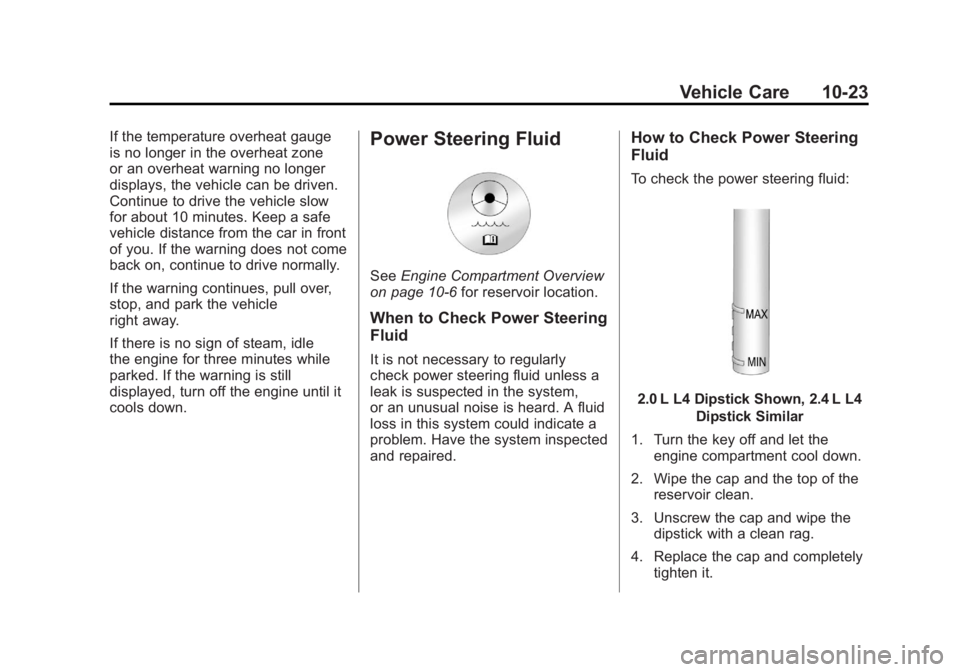
To check the power steering fluid:
2.0 L L4 Dipstick Shown, 2.4 L L4
Dipstick Similar
1. Turn the key off and let the engine compartment cool down.
2. Wipe the cap and the top of the reservoir clean.
3. Unscrew the cap and wipe the dipstick with a clean rag.
4. Replace the cap and completely tighten it.
Page 280 of 368
Black plate (40,1)Buick Regal Owner Manual - 2011
10-40 Vehicle Care
Instrument Panel Fuse
Block
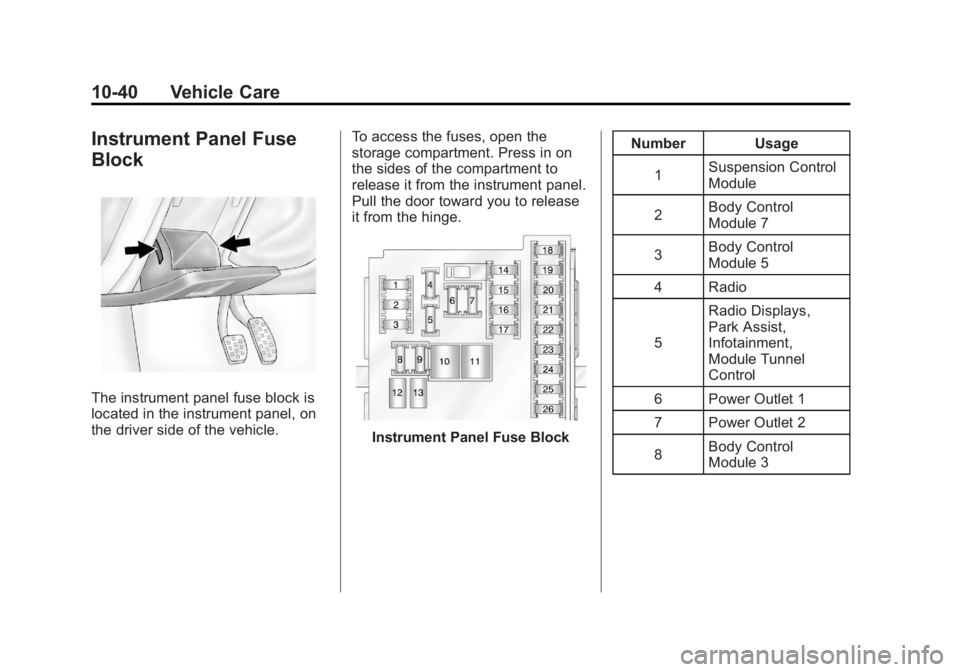
The instrument panel fuse block is
located in the instrument panel, on
the driver side of the vehicle.To access the fuses, open the
storage compartment. Press in on
the sides of the compartment to
release it from the instrument panel.
Pull the door toward you to release
it from the hinge.
Instrument Panel Fuse BlockNumber Usage
1 Suspension Control
Module
2 Body Control
Module 7
3 Body Control
Module 5
4 Radio
5 Radio Displays,
Park Assist,
Infotainment,
Module Tunnel
Control
6 Power Outlet 1
7 Power Outlet 2
8 Body Control
Module 3
Page 292 of 368

Black plate (52,1)Buick Regal Owner Manual - 2011
10-52 Vehicle Care
Federal Communications
Commission (FCC) and
Industry Canada
SeeRadio Frequency Statement on
page 13‑15 for information
regarding Part 15 of the Federal
Communications Commission (FCC)
rules and Industry Canada
Standards RSS-210/220/310.
Tire Pressure Monitor
Operation
This vehicle may have a Tire
Pressure Monitor System (TPMS).
The TPMS is designed to warn the
driver when a low tire pressure
condition exists. TPMS sensors are
mounted onto each tire and wheel
assembly, excluding the spare tire
and wheel assembly. The TPMS
sensors monitor the air pressure in
the tires and transmit the tire
pressure readings to a receiver
located in the vehicle.
When a low tire pressure condition
is detected, the TPMS illuminates
the low tire pressure warning light
located on the instrument cluster.
If the warning light comes on, stop
as soon as possible and inflate the
tires to the recommended pressure
shown on the Tire and Loading
Information label. See Vehicle Load
Limits on page 9‑12.
A message to check the pressure in
a specific tire displays in the Driver
Information Center (DIC). The low
tire pressure warning light and the
DIC warning message come on at
each ignition cycle until the tires are
inflated to the correct inflation
pressure. Using the DIC, tire
pressure levels can be viewed. For
additional information and details about the DIC operation and
displays, see
Driver Information
Center (DIC) on page 5‑22.
The low tire pressure warning light
may come on in cool weather when
the vehicle is first started, and then
turn off as the vehicle is driven. This
could be an early indicator that the
air pressure is getting low and
needs to be inflated to the proper
pressure.
A Tire and Loading Information label
shows the size of the original
equipment tires and the correct
inflation pressure for the tires when
they are cold. See Vehicle Load
Limits on page 9‑12, for an example
of the Tire and Loading Information
label and its location. Also see Tire
Pressure on page 10‑49.
The TPMS can warn about a
low tire pressure condition, but
it does not replace normal tire
maintenance. See Tire Inspection
on page 10‑55, Tire Rotation on
page 10‑55, and Tires on
page 10‑42.