change time BUICK RIVIERA 1993 User Guide
[x] Cancel search | Manufacturer: BUICK, Model Year: 1993, Model line: RIVIERA, Model: BUICK RIVIERA 1993Pages: 324, PDF Size: 16.01 MB
Page 159 of 324
Brake Pedal Travel
See your dealer if the brake pedal does not return to
normal height, or if there is a rapid increase in pedal
travel. This could be
a sign of brake trouble.
Brake Adjustment
Every time you make a moderate brake stop, your disc
brakes adjust for wear.
If you rarely make a moderate or heavier stop, then your
brakes might not adjust correctly.
If you drive in that
way, then
-- very carefully -- make a few moderate
brake stops about every
1000 miles ( 1600 km), so your
brakes will adjust properly.
Braking in Emergencies
Use your anti-lock braking system when you need to.
With anti-lock, you can steer and brake at the same time.
In many emergencies, steering can help you more than
even the very best braking.
Steering
Power Steering
If you lose power steering assist because the engine
stops or the system fails to function, you can steer but it
will take much more
effort.
Steering Tips
Driving on Curves
It’s important to take curves at a reasonable speed.
A lot of the “driver lost control” accidents mentioned on
the news happen on curves. Here’s why:
Experienced driver or beginner, each of us is subject to
the same laws of physics when driving on curves. The
traction
of the tires against the road surface makes it
possible for the vehicle to change its path when you turn
the front wheels.
If there’s no traction, inertia will keep
the vehicle going
in the same direction. If you’ve ever
tried to steer a vehicle on wet ice, you’ll understand this.
The traction you can get in a curve depends on the
condition of your tires and the road surface, the angle at
which the curve is banked, and your speed. While
you’re in a curve, speed is the one factor you can
control.
157
Page 174 of 324
~ Before Leaving on a
Long Trip 0 Weather Forecasts: What’s the weather outlook along
your route? Should
you delay your trip a short time
Make sure you’re ready. Try to be well rested. If you to avoid a major storm system?
must start when you’re not fresh
-- such as after a day’s
work
-- don’t plan to make too many miles that first part 0 Maps: Do you have up-to-date maps?
I
of the journey. Wear comfortable clothing and shoes you
can easily drive in. On the Road
Is your vehicle ready for a long trip? If you keep it
serviced and maintained, it’s ready to go. If it needs
service, have it done before starting out. Of course,
you’ll find experienced and able service experts in
Buick dealerships all across North America. They’ll be
ready and willing to help if
you need it.
Here are
some things you can check before a trip:
0 Windshield Washer Fluid: Is the reservoir full? Are
all windows clean inside and outside?
0 Wiper Blades: Are they in good shape!
0 Fuel, Engine Oil, Other Fluids: Have you checked all
levels?
0 Lights: Are they all working? Are the lenses clean?
0 Tires: They are vitally important to a safe,
trouble-free trip.
Is the tread good enough for
long-distance driving?
Are the tires all inflated to the
recommended pressure? Unless you
are the only driver, it is good to share
the
driving task with others. Limit turns behind the wheel to
about
100 miles (160 km) or two hours at a sitting.
Then, either change drivers or stop for some refreshment
like coffee, tea or soft drinks and some limbering up. But do stop and move around. Eat lightly along the way.
Heavier meals tend to make some people sleepy.
On two-lane highways or undivided multilane highways
that do not have controlled access, you’ll want to watch for some situations not usually found on freeways.
Examples are: stop signs and signals, shopping centers with direct access to the highway, no passing zones and school zones, vehicles turning left and right off the road,
pedestrians, cyclists, parked vehicles. td even animals.
Highway Hypnosis
Is there actually such a condition as “highway
hypnosis”?
Or is it just plain falling asleep at the wheel?
Call
it highway hypnosis, lack of awareness, or
whatever.
172
Page 211 of 324
A CAUTION:
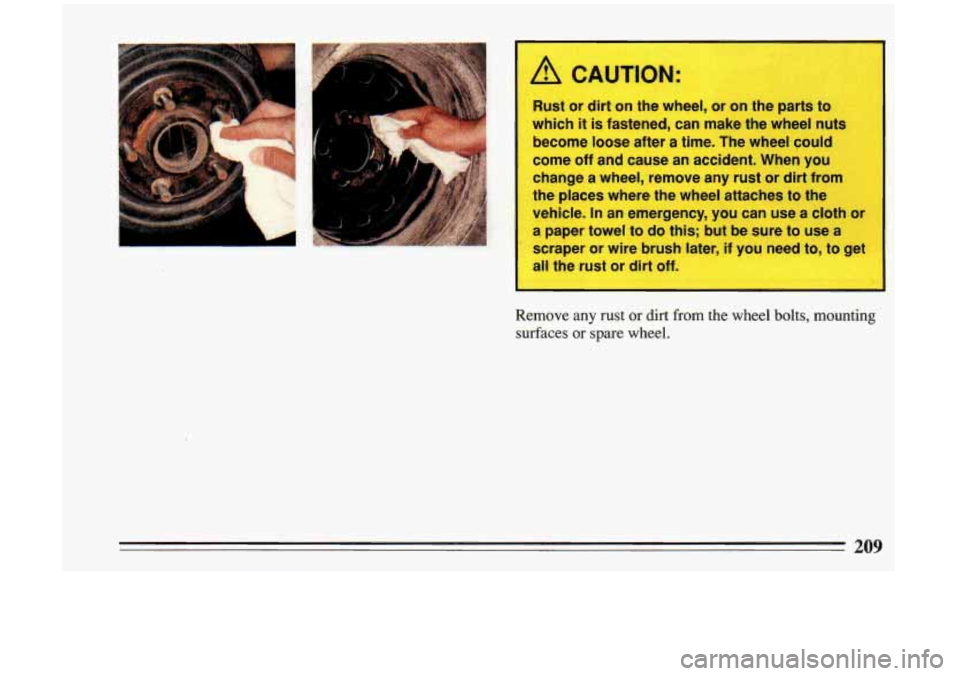
Rust or dirt on the wheel, or on the parts to
which it
is fastened, can make the wheel nuts
become loose after
a time. The wheel could
come off and cause an accident. When you
change a wheel, remove any rust or dirt from
the places where the wheel attaches to the
vehicle.
In an emergency, you can use a cloth or
a paper towel to do this; but be sure to use a
scraper or wire brush later, if you need to, to get
all the rust or dirt off.
Remove any rust or dirt from the wheel bolts, mounting
surfaces or spare wheel.
Page 229 of 324
When to Change Engine Oil: See if any one of these is
true for you:
Most trips are less than 4 miles (6 km).
a It’s below freezing outside and most trips are less
than
10 miles (16 km).
0 The engine is at low speed most of the time (as in
door-to-door delivery, or in stop-and-go traffic).
Most trips are through dusty places.
If any one of these is true for your vehicle, then you
need to change your oil and filter every
3,000 miles
(5 000 km) or 3 months -- whichever comes first.
If none of them is true, change the oil every 7,500 miles
(12
500 km) or 12 months -- whichever comes first.
Change the filter at the first oil change and at every
other oil change after that.
Engine Block Heater: An engine block heater can be a
big help if you have to park outside in very cold
weather, -20
OF (-29 C) or colder. If your vehicle has
this option, see ?Engine Block Heater”
in the Index.
What to Do with Used Oil:
1
Used oil can be a real threat to the environment. If you
change your own oil, be
sure to drain all free-flowing oil
from the filter before disposal. Don’t ever dispose of oil
by pouring it on the ground, into sewers, or into streams
or bodies
of water. Instead, recycle it by taking it to 2
place that collects used oil. If you have a problem
properly disposing
of your used oil, ask your dealer, a
service station or a local recycling center for help.
227
Page 231 of 324
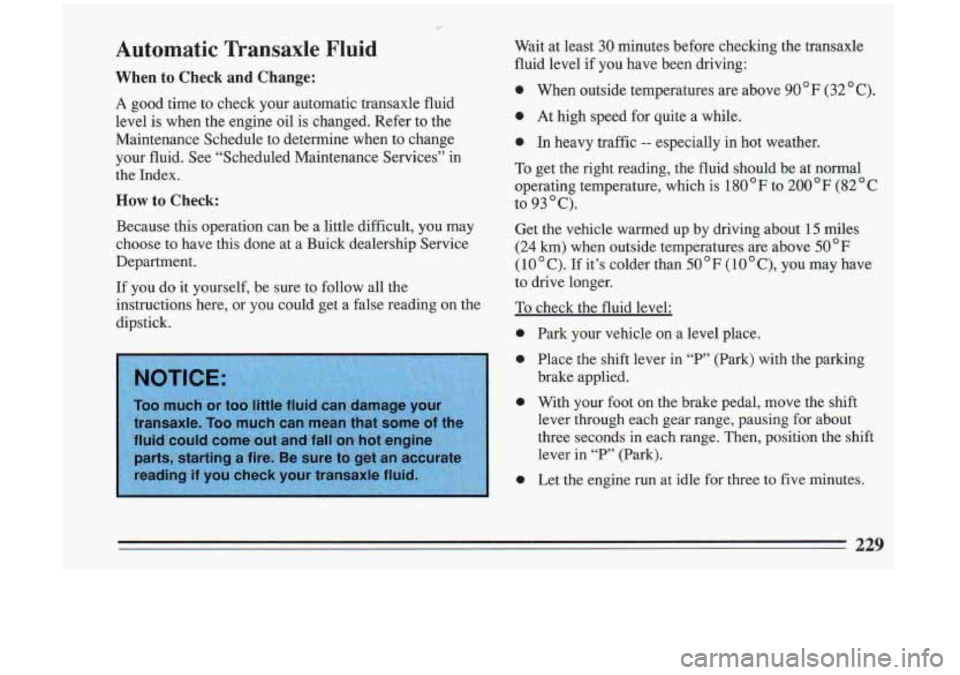
Automatic Transaxle Fluid
When to Check and Change:
A good time to check your automatic transaxle fluid
level is when the engine oil is changed. Refer to the
Maintenance Schedule to determine when
to change
your fluid. See “Scheduled Maintenance Services” in
the Index.
How to Check:
Because this operation can be a little difficult, you may
choose to have this done at a Buick dealership Service
Department.
If you do it yourself, be sure to follow all the
instructions here, or you could get a false reading on the
dipstick.
Page 239 of 324
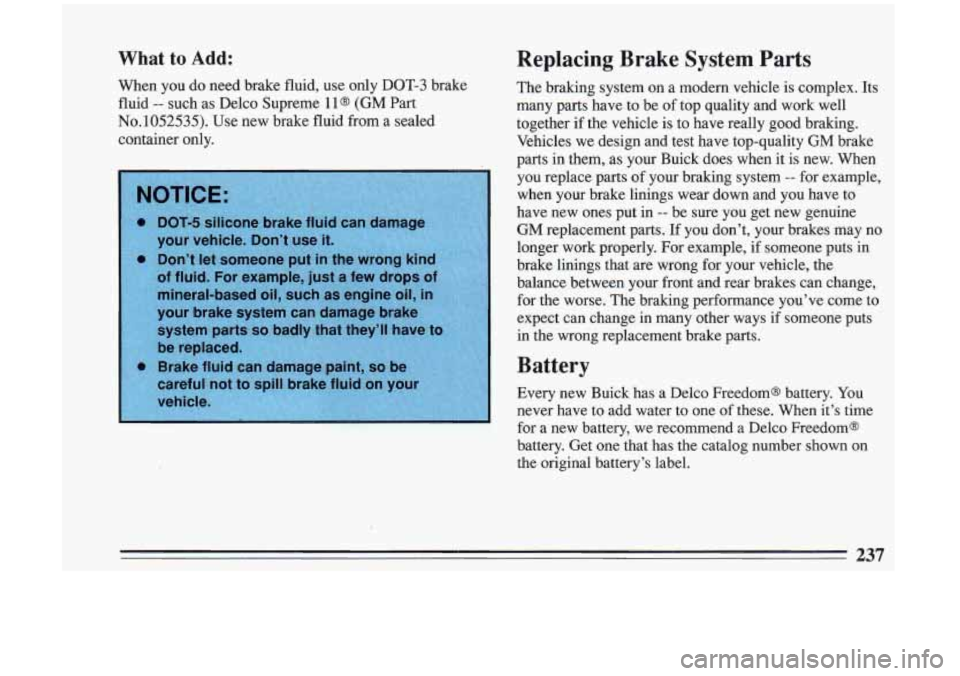
What to Add: Replacing Brake System Parts
When you do need brake fluid, use only DOT-3 brake
fluid
-- such as Delco Supreme 11 (GM Part
No.1052535). Use new brake fluid from a sealed
container only. The
braking system on a modern vehicle is complex. Its
many parts have to be of top quality and work well
together if the vehicle is to have really good braking.
Vehicles we design and test have top-quality GM brake
parts in them, as your Buick does when it is new. When
you replace parts of your braking system
-- for example,
when your brake linings wear down and you have to
have new ones put in
-- be sure you get new genuine
GM replacement parts.
If you don’t, your brakes may no
longer work properly. For example,
if someone puts in
brake linings that are wrong for your vehicle, the
balance between your front and rear brakes can change, for the worse. The braking performance you’ve come to
expect can change in many other ways if someone puts
in the wrong replacement brake parts.
Battery
Every new Buick has a Delco Freedoms battery. You
never have to add water to one of these. When it’s time
for a new battery, we recommend a Delco Freedoma
battery. Get one that has the ‘catalog number shown on
the original battery’s label.
h
237
Page 272 of 324
IMPORTANT:
KEEP ENGINE OIL
AT THE PROPER
LEVEL AND CHANGE AS
RECOMMENDED
This part covers the maintenance required for your Buick. Your vehicle needs these services to retain its
safety, dependability and emission control performance.
Plan
Have you purchased the GM Protection Plan? The
Plan supplements your new vehicle warranties. See
your Buick dealer for details.
Introduction
A Word About Maintenance
We at General Motors want to help you keep your
vehicle in good working condition. But we don't know
exactly how you'll drive it. You may drive very short
distances only a few times a week.
Or you may drive
long distances all the time in very hot, dusty weather.
You may use your vehicle in making deliveries. Or you
may drive it to work, to do errands or in many other
ways.
Because of all the different ways people use their GM
vehicles, maintenance needs vary. You may even need
more frequent checks and replacements than you
will
find in the schedules in this part. So please read this part
and note how you drive.
If you have any questions on
how to keep your vehicle in good condition, see your Buick dealer, the place many GM owners choose to
have their maintenance work done. Your dealer can be
relied upon to use proper parts and practices.
Page 304 of 324
High Speed. Shifting When Your Engine is Running ..... 76 Jack. Tire ..................................... 205
Highway Hypnosis
............................... 172 Jacking Up the Car ............................... 205
Hill and Mountain Roads
.......................... 173 Jump Starting ................................... 186
Hills. Parking on
................................. 175
Holding a Baby in Your Car
......................... 43
Hood. Opening the
............................... 221
Horn ........................................... 84 Keys 59
Hot Coolant Warning Light
........................ 113 Keyless Entry System. Remote 64
Hydroplaning
................................... 166
..........................................
......................
Hot Engine. Safety Warnings About 196 Kilomefa- J&$q$cx .. +... .? . ... _. % ......... . ... .’_ rs.z7 t- ........ . 105 .................
Ice. Driving on ................................. 179
Identification Label. Service Parts
................... 261
Identification Number. Vehicle
..................... 261
Idling Your Engine
................................ 82
If You’re Stuck: In Sand. Mud. Ice or Snow
........... 214
Indicator. Turn Signal
............................. 85
Indicators. Disc Brake Wear ....................... 156
Indicators. Warning Lights and Gages
................ 107
Infant Restraint
................................... 45
Inflation. Tire
................................... 245
Inside Mirror
.................................... 99
Inspection. Tire
................................. 245
Instrument Panel
................................ 105
Interior Cleaning
................................ 253
Interlock. Brake-Transaxle Shift
.................. 75. 81
Introduction
. How To Use This Manual ............... 10
Ignition Key Positions
............................. 71
Label.
Service Parts Identification
.................. 261
Lane Change Indicator
............................. 85
Lap-Shoulder Belt Usage by Children
................. 55
Leaving Your Vehicle .............................. 80
Level Control. Electronic
.......................... 104
License Plate Holder. Rear
......................... 104
Light. Safety Belt
................................. -25
Light.
Turn Signal Indicator ......................... 85
Lighter. Cigarette
................................ 111
Lights Daytime Running
.............................. 98
Panel and Interior
.............................. 96
Traffic
...................................... 145
“On” Warning
................................. 96
Operation
.................................... 86
Loading Your Vehicle ............................ 242
Lap Belt
........................................ -42
Lights
& Gages. Warning Indicators ................. 107
302