ignition BUICK RIVIERA 1993 User Guide
[x] Cancel search | Manufacturer: BUICK, Model Year: 1993, Model line: RIVIERA, Model: BUICK RIVIERA 1993Pages: 324, PDF Size: 16.01 MB
Page 73 of 324
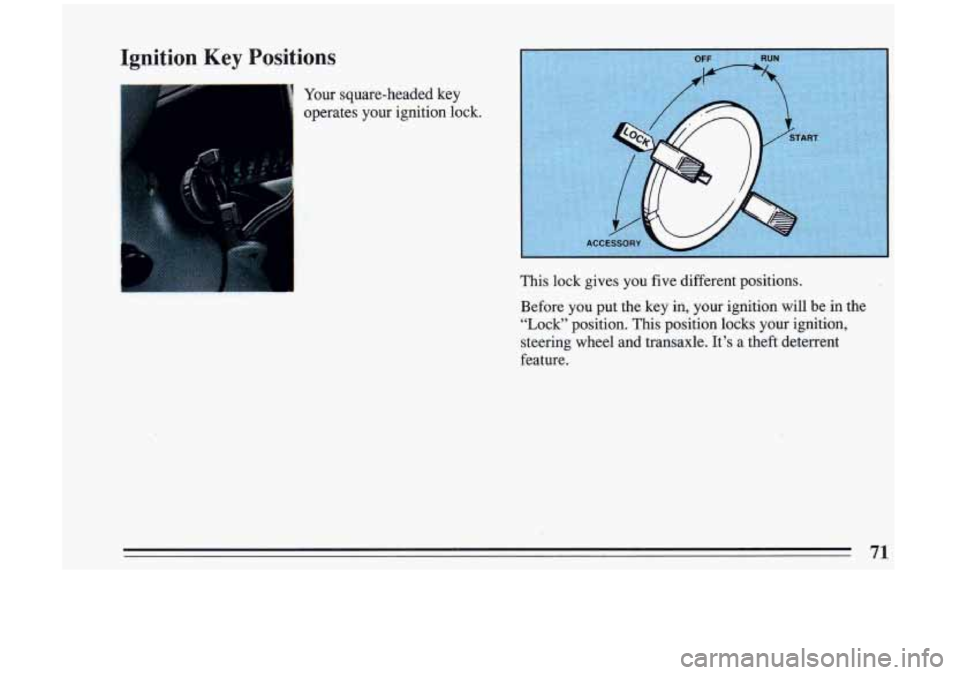
Ignition Key Positions
Your square-headed key
operates your ignition lock.
71
Page 74 of 324
Starting Your Engine The other positions let you perform these functions:
ACC: Accessory lets you use things like the radio and
the windshield wipers when the engine is
off. To use
Acc, push
in the key and turn it toward you. Your
steering wheel will remain locked, just as it was before
you inserted the key.
OFF: This position lets you turn off the engine but still
turri the steering wheel. It doesn’t lock the steering wheel like “Lock.” Use “Off’ if you must have your car
in motion while the engine is off.
RUN: This is the position for driving.
START This key position starts your engine. Move your shift lever
to “P,’ (Park) or “N’ (Neutral).
Your engine won’t start in any other position
-- that’s a
safety feature, To restart when you’re already moving,
use
“N” (Neutral) only.
1. Don’t push the accelerator pedal before starting your
engine.
In some other vehicles you might need to do
this, but because of your vehicle’s computer systems,
you don’t.
starts, let go of the key. The idle speed will go down
as your engine gets warm.
3. If it doesn’t start right away, hold your key in “Start”
for about three seconds at a time until your engine
2. Turn your ignition key to “Start.” When the engine
72
Page 77 of 324
Automatic- Transaxle
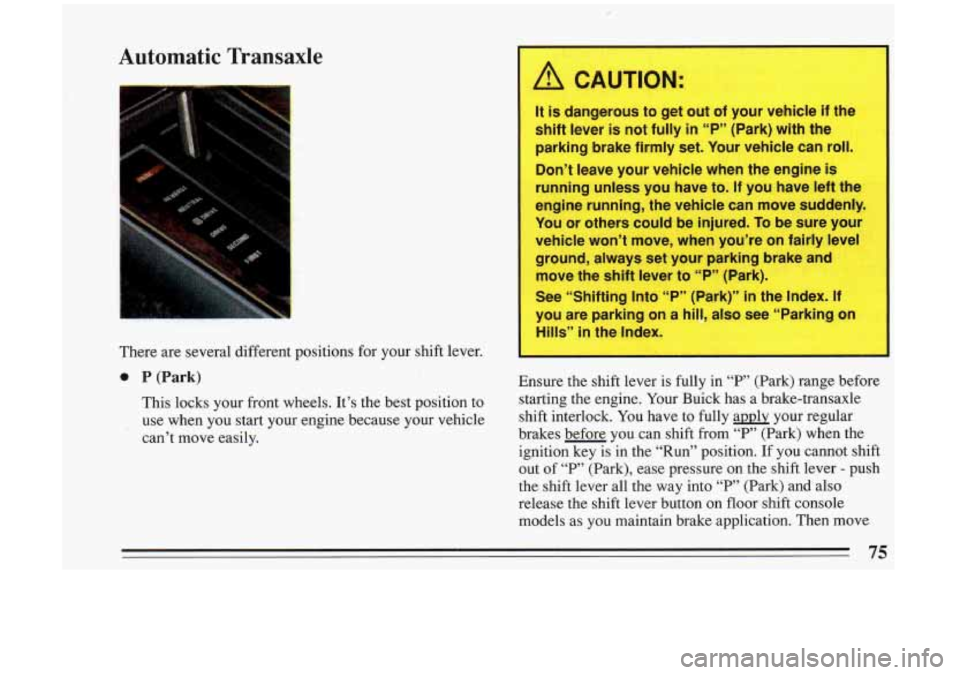
There are SL . dral different positions for your shift lever.
0 P (Park)
This locks your front wheels. It’s the best position to
use when you start your engine because your vehicle
can’t move easily.
A CAU ION:
It is dangerous to get out of your vehicle if the
shift lever
is not fully in “P” (Park) with the
parking brake firmly set. Your vehicle can roll.
Don’t leave your vehicle when the engine
is
running unless you have to. If you have left the
engine running, the vehicle can move suddenly.
You or others could be injured.
To be sure your
vehicle won’t move, when you’re on fairly level
ground, always set your parking brake and move the shift lever to “P” (Park).
See “Shifting Into “P” (Park)”
in the Index. If
you are parking on a hill, also see “Parking on
Hills” in the Index.
L
Ensure the shift lever is fully in “P’ (Park) range before
starting the engine. Your Buick has a brake-transaxle
shift interlock. You have to fully apply your regular
brake.s before you can shift from
“P’ (Park) when the
ignition key is in the “Run” position. If you cannot shift
out of
“P’ (Park), ease pressure on the shift lever - push
the shift lever all the way into “P” (Park) and also
release the shift lever button on floor shift console models as you maintain brake application. Then move
75
Page 80 of 324
1 (First Gear) Parking Brake
This position gives you even more power (but lower
fuel economy) than
“2.” You can use it on very steep
hills, or in deep snow or mud. If the selector lever is
put in
“1,” the transaxle won’t shift into first gear
until the vehicle is going slowly enough.
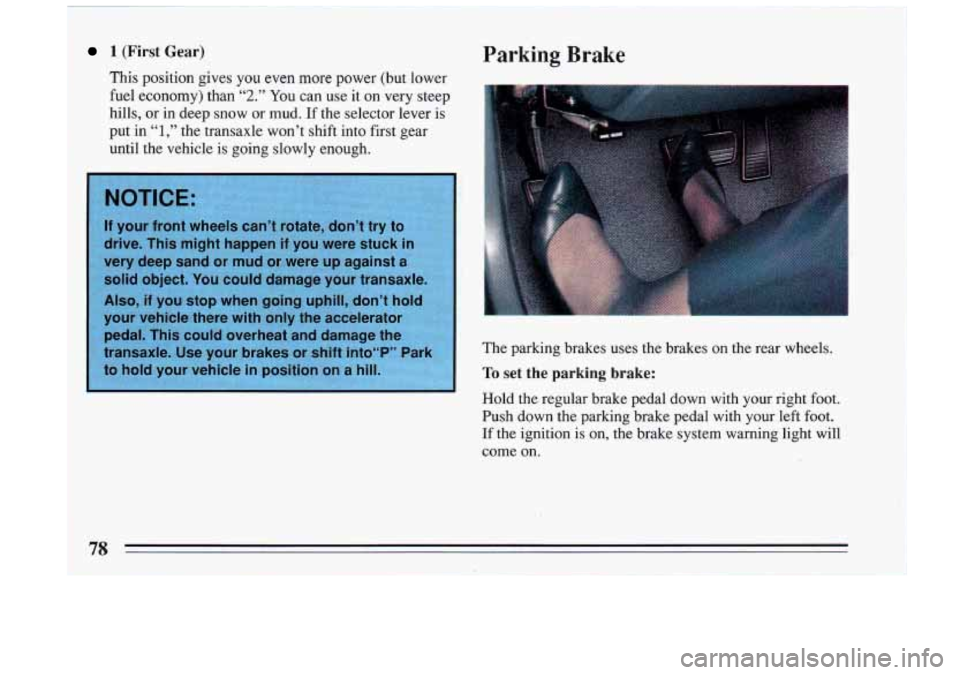
The parking brakes uses the brakes on the rear wheels.
To set the parking brake:
Hold the regular brake pedal down with your right foot.
Push down the parking brake pedal with your left foot.
If the ignition is on, the brake system warning light will
come on.
Page 82 of 324
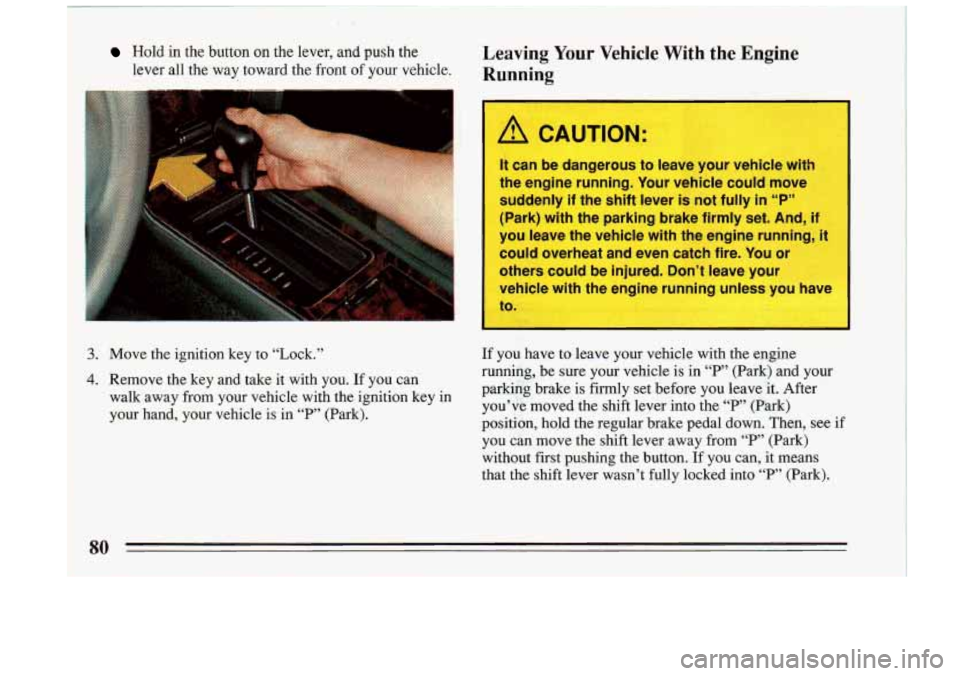
Hold in the button on the lever, and push the Leaving Your Vehicle With the Engine
I lever all the way toward the front of your vehicle. Running
3. Move the ignition key to “Lock.”
4. Remove the key and take it with you. If you can
walk away from your vehicle with the ignition key in
your hand, your vehicle is in
“P)’ (Park).
A CAUTION:
It can be dangerous to leave your vehicle with
the engine running. Your vehicle could move
suddenly
if the shift lever is not fully in “P”
(Park) with the parking brake firmly set. And,
if
you leave the vehicle with the engine running, it
could overheat and even catch fire. You or
others could be injured. Don’t leave your
vehicle with the engine running unlesr --ou have
to.
I
If you. have to leave your vehicle .with the engine
running, be sure your vehicle is in
“P” (Park) and your
parking brake is firmly set before
you leave it. After
you’ve moved the shift lever into the
“P” (Park)
position, hold the regular brake pedal down. Then, see if
you can move the shift lever away from “P,’ (Park)
without first pushing the button.
If you can, it means
that the shift lever wasn’t fully locked into
T“ (Park).
so
Page 83 of 324
Shifting Out of 66 P 99 (Park)
Your Buick has a brake-transaxle shift interlock. You
have to fully applv your regular brake before you can
shift
from “P” (Park) when the ignition is in the “Run”
position. See “Automatic Transaxle” in the Index.
If you cannot shift out of
“P” (Park), ease pressure on
the shift lever
-- push the shift lever all the way into “P”
(Park) and also release the shift lever button on floor
shift console models as you maintain brake application.
Then move the shift lever into the gear you wish. (Press
the shift lever button before moving the shift lever.)
If
you ever hold the brake pedal down but still can’t shift
out
of “P” (Park), try this:
1.
2.
3.
4.
5.
Turn the key to “Off.” Open and close the driver’s
door to turn off the Retained Accessory Power
feature.
Apply and hold the brake until the end
of Step 4.
Shift to “N” (Neutral).
Start the vehicle and then shift to the drive gear you
want.
Have the vehicle fixed as soon as you can.
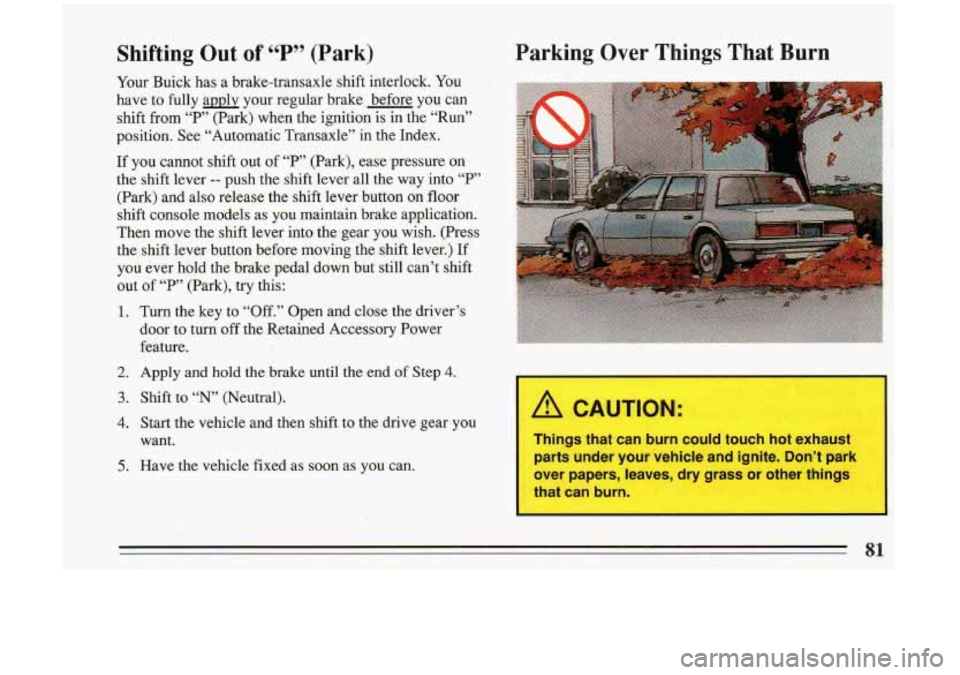
Parking Over Things That Burn
; CAUTION:
Things that can burn could touch hot exhaust
parts under your vehicle and ignite. Don’t park
over papers, leaves,
dry grass or other things
that can burn.
81
Page 85 of 324
.I
CAUTlOf _. [lConltlinulecJ~
It can be dangerous to get out of your vehicle i,.
tlhe shiift lever is not flullly in1 T” (Park) with the
parking brake
firmly set. Your vehic’le can roll.
!Don’t leave your veh!icle when the engine
is
running unless you have to. If you’ve left the
engine irunning, th8e vehicle can move su’ddenly.
You or others could
be ‘injured. To be sure your
vehic’le w&t move, even when you,’re
on fairly
level ground,
always set your parking br’ake a’nd
move the shift lever to
‘T’’ (Park).
Follow the proper steps to be sure your vehicle
won’t Imove., See Shifting Into’ ’~P’ (Park) in the
Index,.
If you are parkiing on a hil’l, also see “Pariking on
Hills” in the Index.
Retained Accessory Power
After the ignition is turned off, and before any door is
opened, the following systems will work for ten
minutes:
1’
Power windows
0 Radio
@ Clock (with radio off)
0 Windshield wiper/waSher
0 Astroroof (option) I
83
Page 97 of 324
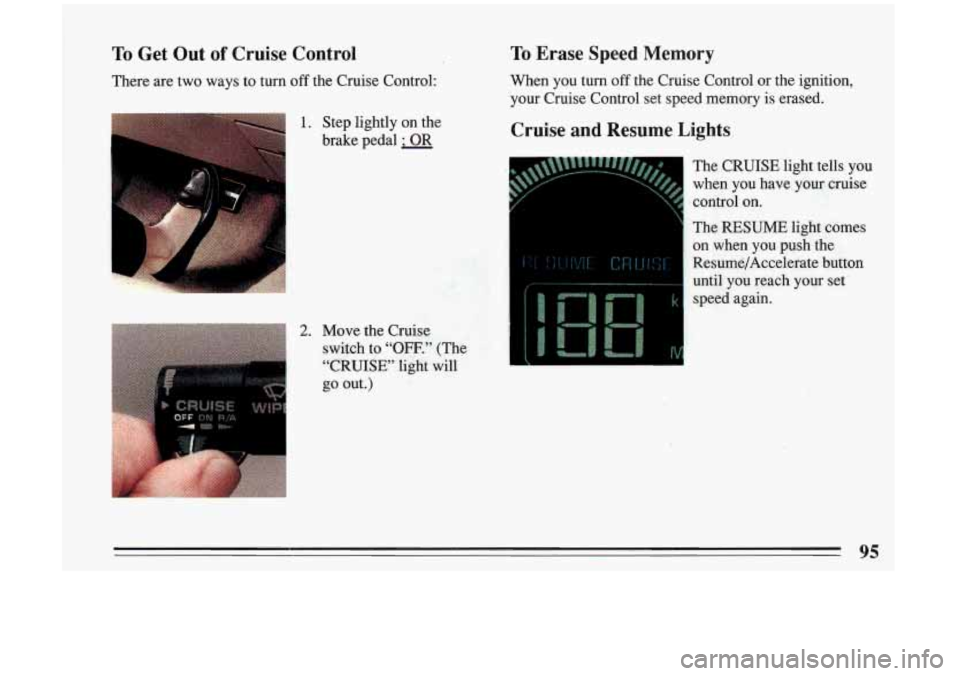
To Get Out of Cruise Control
There are two ways to turn off the Cruise Control:
To Erase Speed Memory
When you turn off the Cruise Control or the ignition,
your Cruise Control set speed memory is erased.
. ..
Move the Cruise
switch
to "'OFF.'' (The
"CRUISE' ligfit will
go aut.)
Cruise and Resume Lights
The CRUISE light tells you
when you have your cruise
control on.
The RESUME light comes
on when you push the
Resume/Accelerate button until you reach
yov set
speed again.
Page 98 of 324
Lights
'
1 0 Headlights
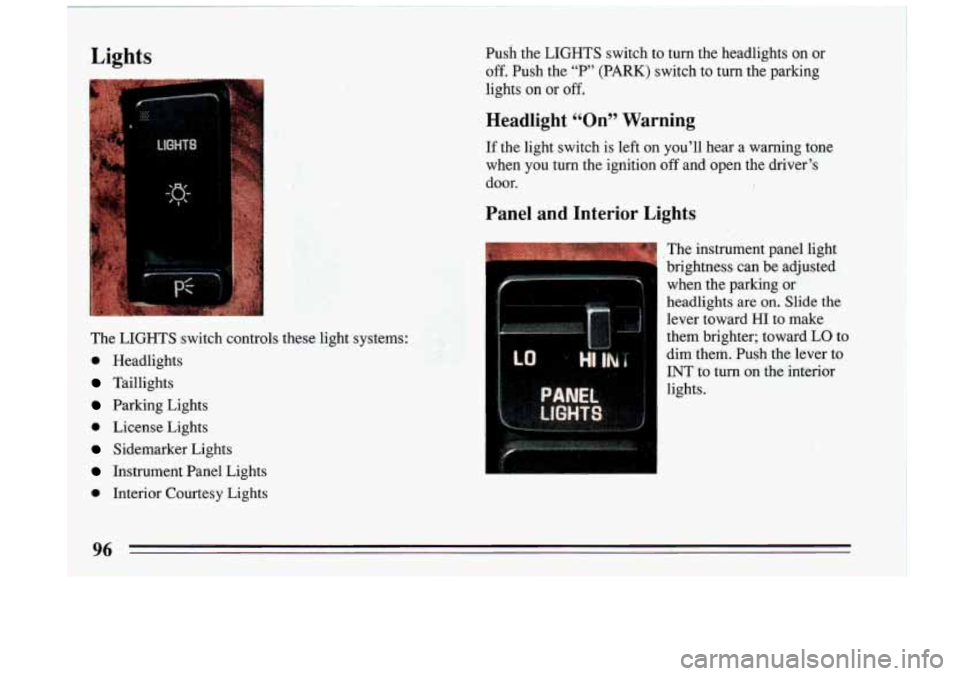
The LIGHTS switch controls these light systems:
Taillights
Parking Lights
0 License Lights
Sidemarker Lights
Instrument Panel Lights
0 Interior Courtesy Lights
Push the LIGHTS switch to turn the
headlights on or
off. Push the "P" (PARK) switch to turn the parking
lights
on or off.
Headlight ''On" Warning
If the light switch is left on you'll hear a warning tone
when you turn the ignition off and open the driver's
door.
\,
Panel and Interior Lights
The instrument panel light
brightness can be adjusted when the parking or
headlights are
on. Slide the
lever toward HI to make
them brighter; toward
LO to
dim them. Push the lever to
INT to
turn on the interior
lights.
96
Page 100 of 324
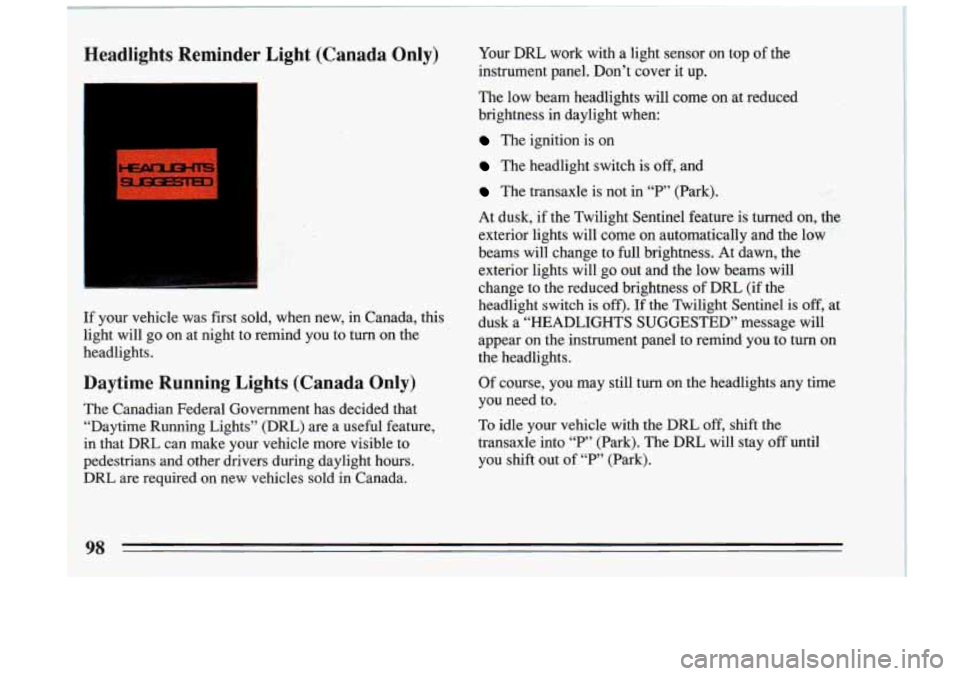
-Headlights Reminder Light (Canada Only)
If your vehicle was first sold, when new, in Canada, this
light will go on at night to remind you to turn on the
headlights.
Daytime Running Lights (Canada Only)
The Canadian Federal Government has decided that
“Daytime Running Lights” (DRL) are a useful feature,
in that DRL can make your vehicle more visible to
pedestrians and other drivers during daylight hours.
DRL are required on new vehicles sold in Canada. Your
DRL work with a light sensor on
top of the
instrument panel. Don’t cover it up.
The low beam headlights will come
on at reduced
brightness in daylight when:
The ignition is on.
The headlight switch is off, and
The transaxle is not in “P” (Park).
At dusk, if the Twilight Sentinel feature is turned
on, the
exterior lights will come on automatically and the low
beams will change to
full brightness. At dawn, the
exterior lights will
go out and the low beams will
change to the reduced brightness of DRL (if the
headlight switch is
off). If the Twilight Sentinel is off, at
dusk a “HEADLIGHTS SUGGESTED” message will
appear on the instrument panel to remind you to turn. on
the headlights.
Of course, you may still turn on the headlights any time
you need to.
.
To idle your vehicle with the DRL off, shift the
transaxle into
T“ (Park). The DRL will stay off until
you shift out of “P”.(Park).
98