tires BUICK RIVIERA 1993 User Guide
[x] Cancel search | Manufacturer: BUICK, Model Year: 1993, Model line: RIVIERA, Model: BUICK RIVIERA 1993Pages: 324, PDF Size: 16.01 MB
Page 178 of 324
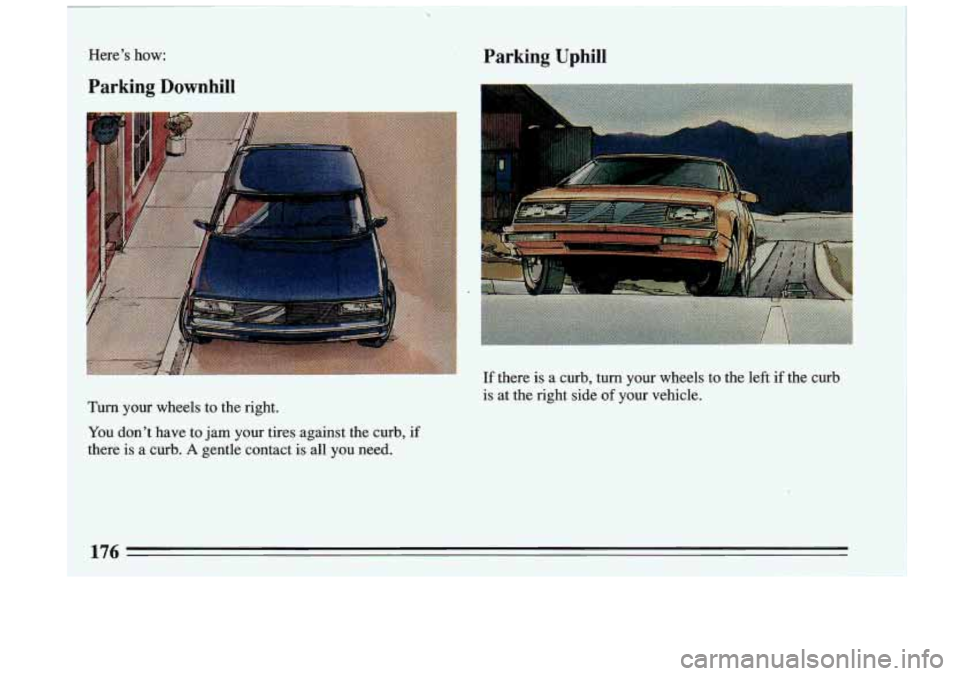
Parking Downhill
Parking Uphill
Turn your wheels to the right.
You don't have to
jam your tires against the curb, if
there is
a curb. A gentle contact is all you need.
If there is a curb, turn your wheels to the left if the curb
is at the right side of your vehicle.
1 I 176
Page 181 of 324
h
Driving on Snow or Ice
Most of the time, those places where your tires meet the
road probably have good traction.
I
However, if there is snow or ice between your tires and
the road, you can have a very slippery situation. You’ll
have
a lot less traction or “grip” and will need to be very
careful.
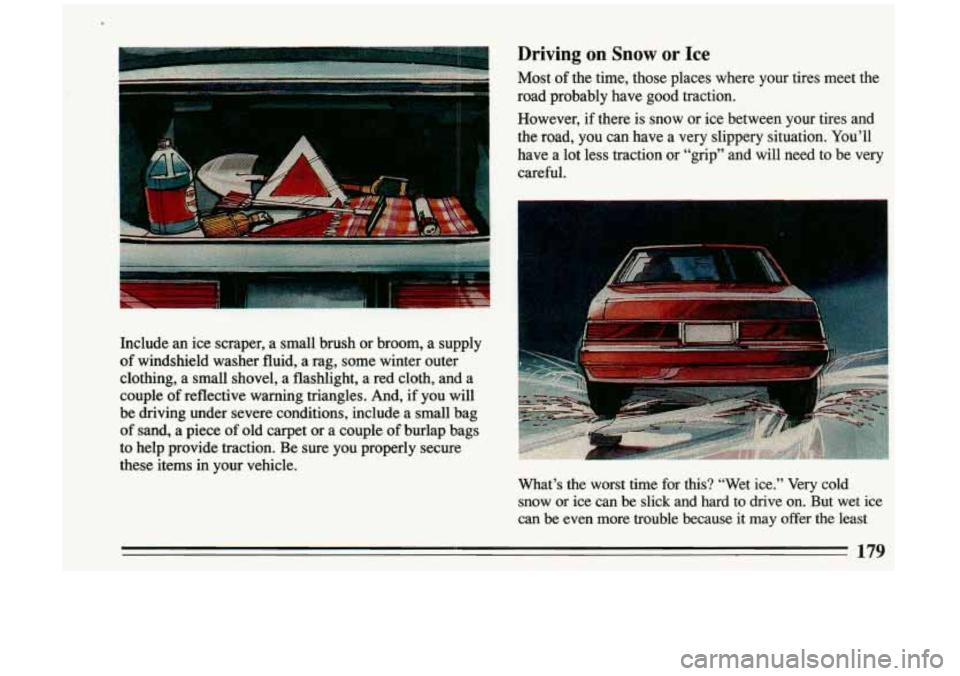
Include
an ice scraper, a small brush or broom, a supply
of windshield washer fluid, a rag, some winter outer
clothing, a small shovel, a flashlight,
a red cloth, and a
couple of reflective warning triangles. And,
if you will
be driving under severe conditions, include a small bag
of sand, a piece of old carpet or a couple of burlap bags
to help provide traction. Be sure you properly secure
these items
in your vehicle.
What’s the worst time for this? “Wet ice.” Very cold snow or ice can be slick and hard to drive on. But wet ice \
can be even more trouble because it may offer the least
179
Page 182 of 324
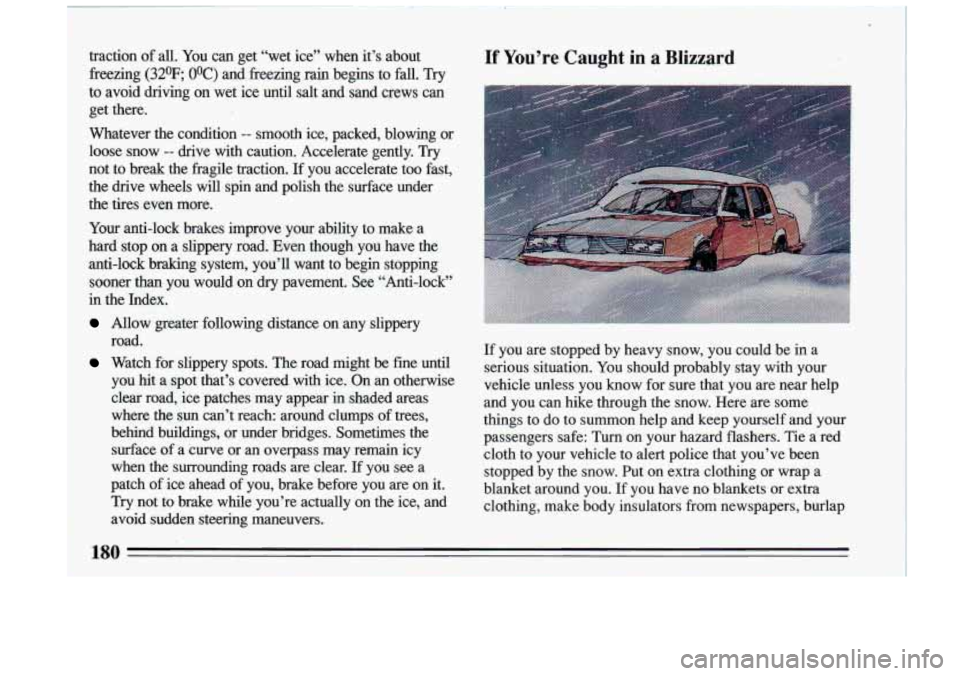
traction of all. You can get “wet ice” when it’s about If You’re Caught in a Blizzard
freezing (32oF; O°C) and freezing rain begins to fall. Try
to avoid driving on wet ice until salt and sand crews can
get there. Y
. . ._ . . .
Whatever the condition -- smooth ice, packed, blowing or
loose snow
-- drive with caution. Accelerate gently. Try
not to break the fragile traction. If you accelerate too fast,
the drive wheels will spin and polish the surface under
the tires even more.
Your anti-lock brakes improve your ability to make a
hard stop on a slippery road. Even though you have the
anti-lock braking system, you’ll want to begin stopping sooner than you would on
dry pavement. See “Anti-lock”
in the Index.
Allow greater following distance on any slippery
road.
Watch for slippery spots. The road might be fine until
you hit a spot that’s covered with ice. On an otherwise
clear road, ice patches may appear
in shaded areas
where the
sun can’t reach: around clumps of trees,
behind buildings, or under bridges. Sometimes the
surface of a curve or an overpass may remain icy
when the surrounding roads are clear.
If you see a
patch
of ice ahead of you, brake before you are on it.
Try not to brake while you’re actually on the ice, and
avoid sudden steering maneuvers.
180
Page 193 of 324
Towing Your Vehicle Before you do anything, turn on the hazard warning
flashers.
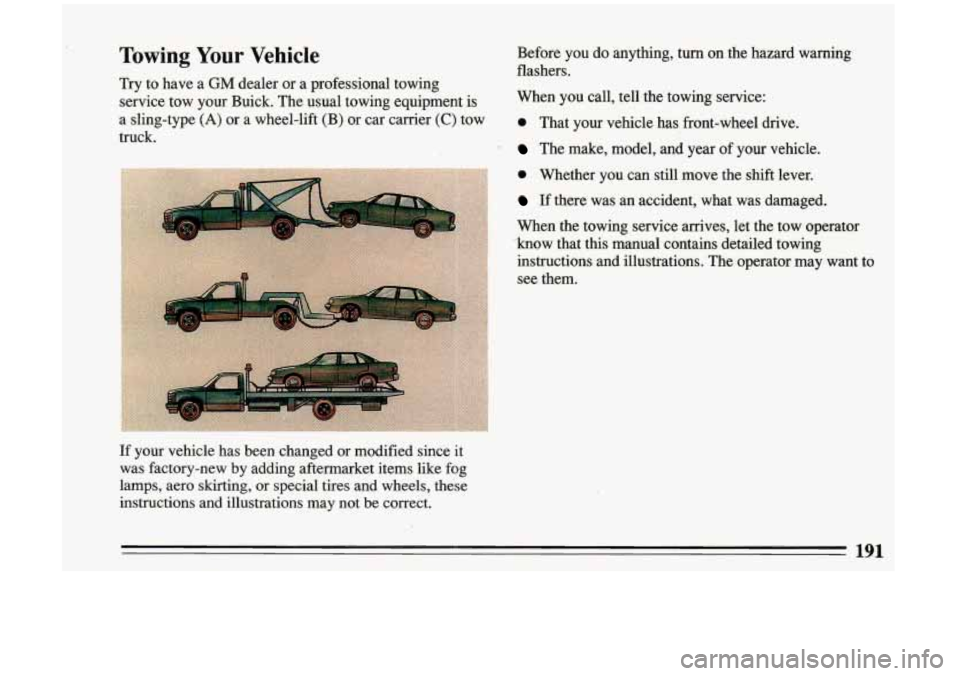
Try to have a
GM dealer or a professional towing
service tow your Buick. The usual towing equipment is When you call, tell the towing service:
a sling-type
(A) Or a wheel-lift (B) Or Car carrier (c) tow 0 That your vehicle has front-wheel drive.
truck.
. The make, model, and year of your vehicle.
If your ‘vehicle has been changed or modified since it
was factory-new by adding aftermarket items like fog
lamps, aero skirting,
or special tires and wheels, these
instructions and illustrations may not be correct.
0 Whether you can still move the shift lever.
If there was an accident, what was damaged.
When the towing service arrives, let the tow operator
-know that this manual contains detailed towing instructions and illustrations. The operator may want to
see them.
191
Page 206 of 324
I
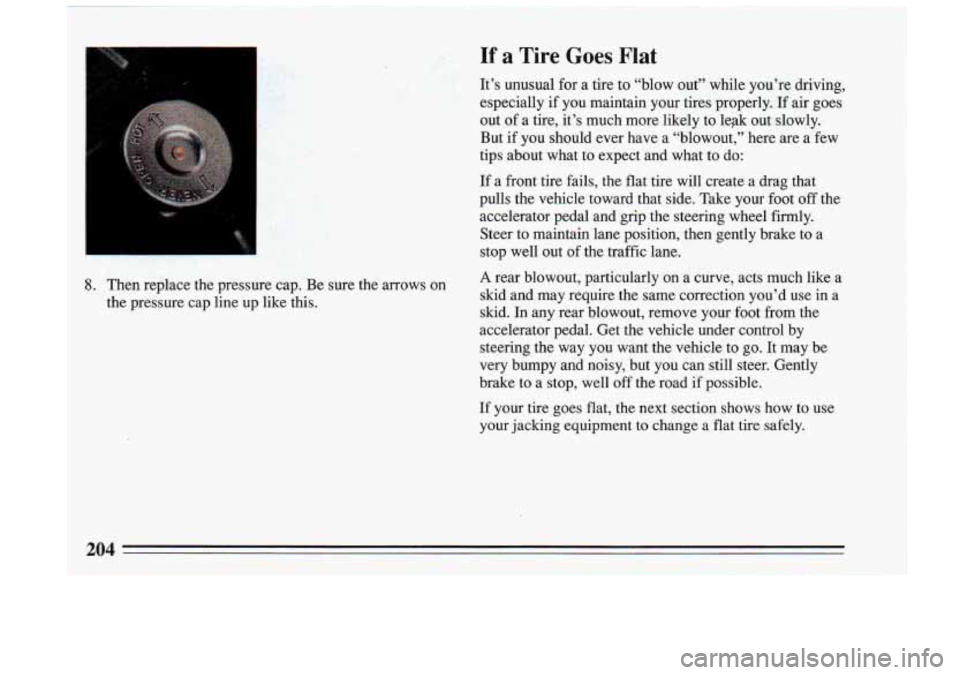
8.
If a Tire Goes Flat
It’s unusual for a tire to “blow out” while you’re driving,
especially if you maintain your tires properly.
If air goes
out of a tire, it’s much more likely to lepk out slowly.
But if you should ever have a “blowout,” here are a few\
tips about what to expect and what to do:
If a front tire fails, the flat tire will create a drag that
pulls the vehicle toward that side. Take your foot
off the
accelerator pedal and grip the steering wheel firmly.
Steer to maintain lane position, then gently brake to a
stop well out of the traffic lane.
Then replace the pressure cap. Be sure the arrows on
the pressure
cap line up like this.
A rear blowout, particularly on a curve, acts much like a
skid and may require the same correction you’d use in
a
skid. In any rear blowout, remove your foot from the
accelerator pedal. Get the vehicle under control by
steering the way you want the vehicle
to go. It may be
very bumpy and noisy, but you can still steer. Gently
brake to a stop, well
off the road if possible.
If your tire goes flat, the next section shows how to use
your jacking equipment to change a flat tire safely.
204
____
Page 215 of 324
Don’t use your compact spare on some other vehicle.
And don’t mix^ your compact spare or wheel with other
wheels or tires. They won’t fit. Keep your spare
and its
wheel together.
A CAUTION:
Storing a jack, a tire, or other equipment in the
passenger compartment
of the vehicle could
cause injury. In a sudden .stop or collision,
loose equipment could strike someone. Store all
these in the proper place.
213
Page 216 of 324
L I
If You’re Stuck: In Sand, Mud, Ice or
Snow
What you don’t want to do when your vehicle is stuck is
to spin your wheels. The method known
as “rocking”
can help
you get out when you’re stuck, but you must
use caution.
A CAUTION:
If you let your tires spin at high speed, they can
explode and you or others could be injured.
And, the transaxle or other parts of the vehicle
can overheat. That could cause an engine
compartment fire or other damage. When you’re
stuck, spin the wheels as little as possible.
Don’t spin the wheels above
35 mph (55 km/h)
as shown on the speedometer.
Page 244 of 324
Remove the bulb from the Loading Your Vehicle
bulb socket by turning it
counterclockwise.
%I OCCUPANTS VEHICLE CAP. WT.
I
TIRE-LOADING INFORMATION,
FRT. CTR. RR. TOTAL
LBS. KG
MAX. LOADING & GVWR SAME AS VEHICLE
CAPACITY WEIGHT XXX COLD
TIRE
TIRE SIZE SPEED PRESSURE
RTG PSI/KPa
FRT.
RR.
SPA.
IF TIRES ARE HOT, ADD 4PS1128KPa
SEE OWNER'S MANUAL FOR ADDITIONAL
1 Install a new bulb into the socket turning it clockwise INFORMATION 111-p ?j$##..:,
(right) until it is locked in place. Insert the socket into \
the lamp and turn it clockwise (right) to lock it into
place. Reverse the instructions to replace the taillamp assembly.
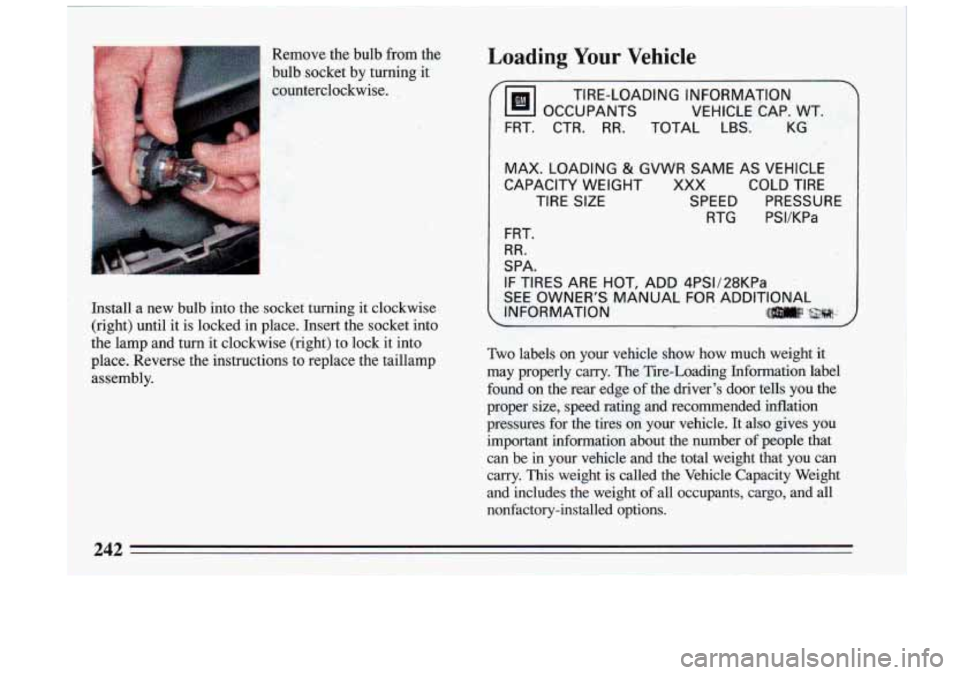
Two labels on your vehicle show how much weight it
may properly carry. The Tire-Loading Information label
found on the rear edge of the driver's door tells you the
proper size, speed rating and recommended inflation
pressures for the tires on your vehicle. It also gives you
important information about the number of people that can be in your vehicle and the total weight that you can
carry. This weight is called the Vehicle Capacity Weight
and includes the weight
of all occupants, cargo, and all
nonfactory-installed options.
242
Page 246 of 324
TI
I
A CAUTION:
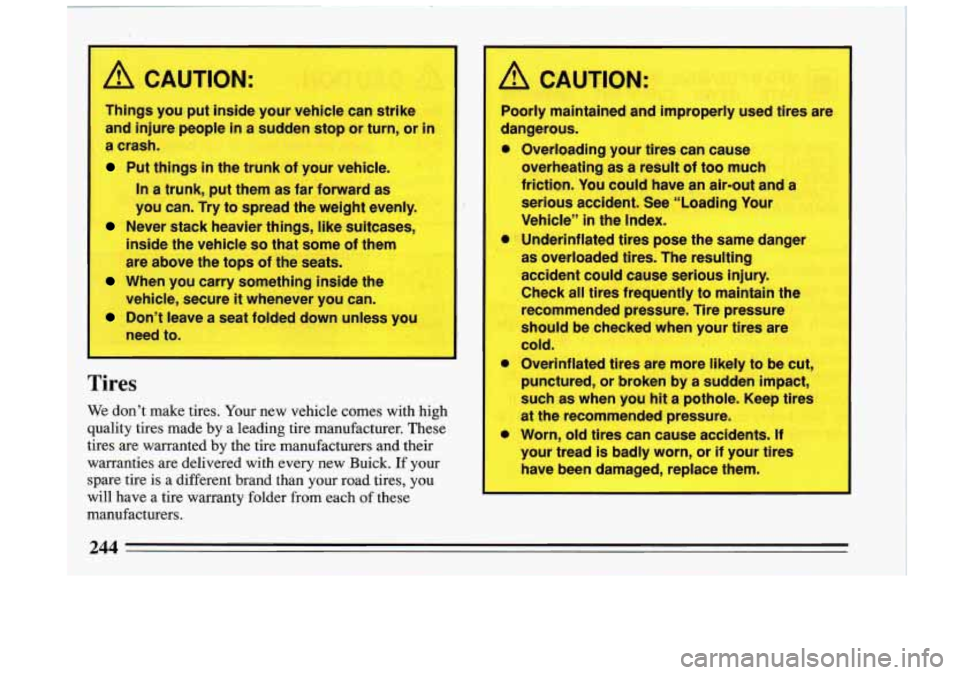
1 Things you put inside your vehicle can strike
! I
' and injure people in a sudden stop or turn, or in
j a crash.
Put things in the trunk of your vehicle.
In a trunk, put them as far forward as
you can. Try to spread the weight evenly.
Never stack heavier things, like suitcases,
inside the vehicle
so that some of them
are above the tops of the seats.
vehicle, secure it whenever you can.
need to.
When you carry something inside the
Don't leave a seat folded down unless you
Tires
We don't make tires. Your new vehicle comes-with high
quality tires made by a leading tire manufacturer. These
tires are warranted by the tire manufacturers and their warranties are delivered with every new Buick.
If your
spare tire is a different brand than your road tires, you
will have
a tire warranty folder from each of these
manufacturers.
I
A?!,, CAUTION:
1
Poorly maintained and' i!rn,pvaget.ly used tires are
dangemus.
* Owrloadi'ng your tlires can cause
overheatingl
as a result of too much,
friction. You could have an air-crut and a
Vehicle"
in the Index.
Underinflated tires pose tlhe same danger
6s overloaded tires. The viesulting
acci'dent could cause seriouls injury.
Check all1 tires frequently to msintdn the "
recormmended pressure,. Tire (pressure
shoul,d
be checked w'hsn your tires a're
I * averinflated tires are moire likely t'o be ,GU!~,
punctured, 'or broken by a sudden impact,,
such as when you, hit a pothole. Keep tires
at the recommended pres'sura
0 Worn, old tires can cause accidents. If
your tread is ;badily worm,, lor if your tires
have been damaged, replace them
I serious accident. See "kading Your
Gold.
244
Page 247 of 324
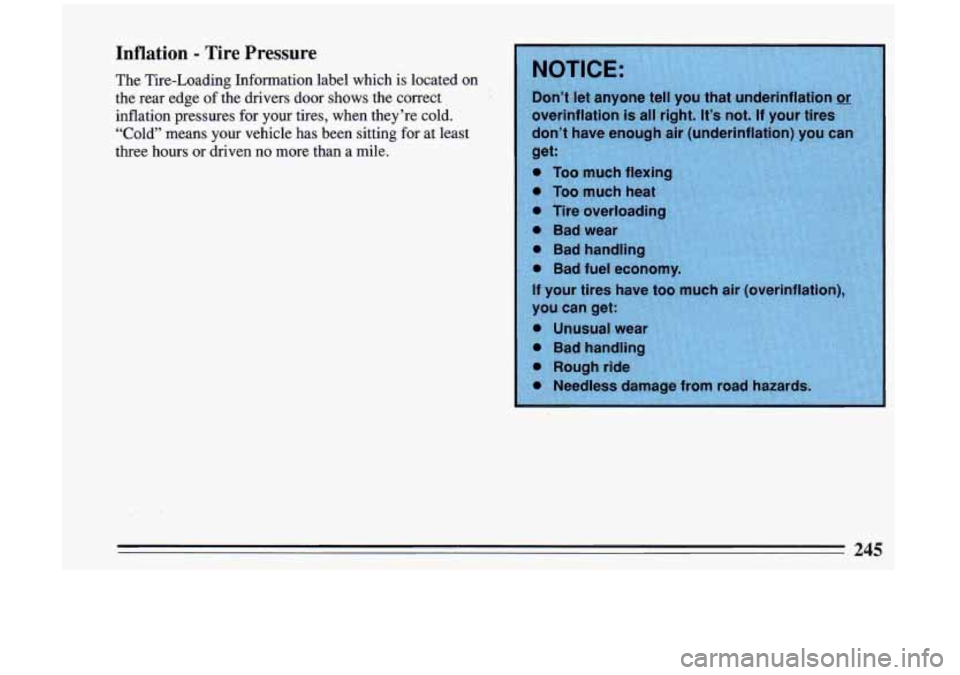
Inflation - Tire Pressure
The Tire-Loading Information label which is located on
the rear edge
of the drivers door shows the correct
inflation pressures
for your tires, when they’re cold.
“Cold” means your vehicle has been sitting for at least
three hours or driven no more than a mile.
245