lights BUICK RIVIERA 1993 Owner's Manual
[x] Cancel search | Manufacturer: BUICK, Model Year: 1993, Model line: RIVIERA, Model: BUICK RIVIERA 1993Pages: 324, PDF Size: 16.01 MB
Page 169 of 324
if the pressure in one or more is low. It can happen if a
lot of water
is standing on the road. If you can see
reflections from trees, telephone poles, or other vehicles, and raindrops “dimple” the water’s surface, there could \
be hydroplaning.
Hydroplaning usually happens at higher speeds. There
just isn’t a hard and fast rule about hydroplaning. The
best advice is to slow down when it is raining, and be
.
careful.
Some Other .Rainy Weather Tips
0
0
0
0
0
Turn on your headlights -- not just your parking
lights
-- to help make you more visible to others.
Look for hard-to-see vehicles corning from behind.
You may want to use your headlights even in
daytime if it’s raining hard.
Besides slowing down, allow some extra following
distance. And be especially careful when you pass
another vehicle. Allow yourself more clear room
ahead, and be prepared to have your view restricted
by road spray. If the road spray is
so heavy you are
actually blinded, drop back. Don’t pass until conditions improve. Going more slowly
is better
than having an accident.
Use your defogger
if it helps.
Have good tires with proper tread depth. (See
“Tires” in the Index.)
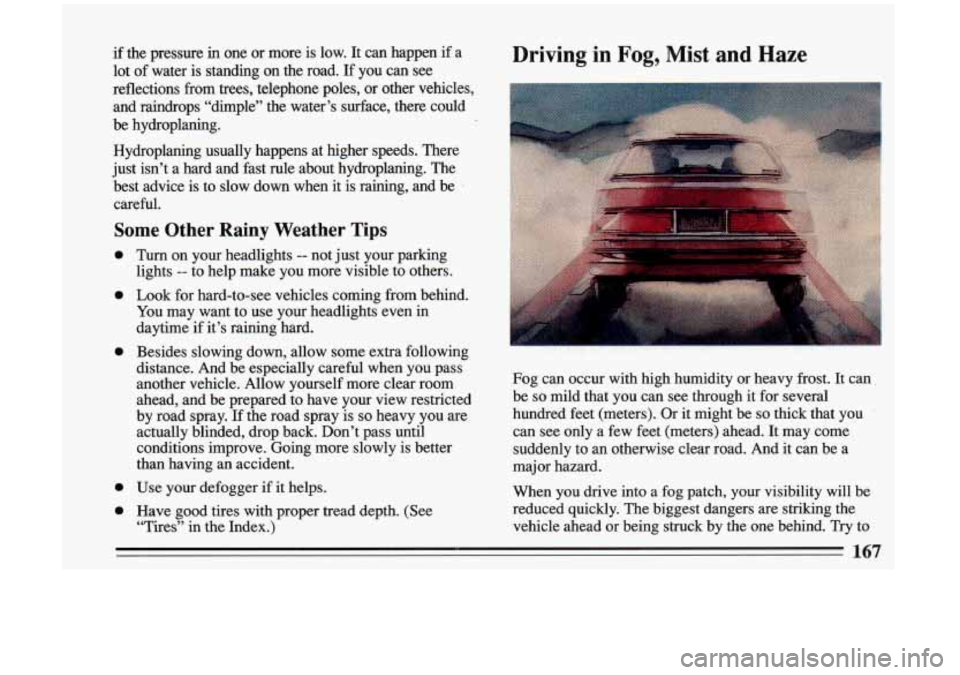
Driving in Fog, Mist and Haze
IIII
Fog can occur with high humidity or heavy frost. It can,
be
so mild that you can see through it for several
hundred feet (meters).
Or it might be so thick that you
can see only a few feet (meters) ahead. It may come
suddenly to an otherwise clear road. And it can be a
major hazard.
When you drive into a fog patch, your visibility will be
reduced quickly. The biggest dangers are striking the
vehicle ahead
or being struck by the one behind. Try to
167
Page 170 of 324
Don’t use your high beams. The light will bounce off
the water droplets that make up fog and reflect back at
you.
Use your defogger.
In high humidity, even a light
buildup of moisture on the inside of the glass will cut
down on your already limited visibility.
Run your
windshield wipers and washer ‘occasionally. Moisture
can build up on the outside glass, and what seems to be
fog may actually be moisture on the outside of your
windshield.
Treat dense fog as an emergency.
Try to find a place to
pull off the road. Of course you want to respect
another’s property, but you might need to put something
between you and moving vehicles
-- space, trees,
telephone poles, a private driveway, anything ,that
removes you from other traffic.
If visibility is near zero and you
must stop but are
unsure whether you are away from the road, tu_m your
lights on, start your hazard warning flasher, and sound your horn at intervals or when you hear approaching
traffic.
Pass other vehicles in fog only if you can see far enough
ahead to pass safely. Even then, be prepared to delay
your pass if you suspect the fog is worse up ahead.
If
other vehicles try to pass you, make it easy for them.
Page 173 of 324
Just before you leave the lane, glance quickly over your
shoulder to make sure there isn’t another vehicle in your
“blind” spot.
If you are moving from an outside to a center lane on a
freeway having more than two lanes, make sure another
vehicle isn’t about to move into the same spot. Look at
the vehicles two lanes over and watch for telltale signs:
turn signals flashing, an increase in speed,
or moving
toward the edge of the lane. Be prepared to delay your
move.
Once you are moving on the freeway, make certain you
allow a reasonable following. distance. Expect to move
slightly slower at night.
Leaving the Freeway
When you want to leave the freeway, move to the proper
lane well in advance. Dashing across lanes at the last
minute is dangerous.
If you miss your exit do not, under
any circumstances, stop and back up. Drive on to the
next exit.
At each exit point is a deceleration lane. Ideally it
should be long enough for you to enter it at freeway
speed (after signaling, of course) and then do your
braking before moving onto the exit ramp.
Unfortunately, not all deceleration lanes are long enough
-- some are too short for all the braking. Decide when to
start braking. If you must brake on the through lane, and
if there is traffic close behind you, you can allow a little \
extra time and flash your brake lights (in addition to
your turn signal) as extra warning that you are about to
slow down and exit.
The exit ramp can be curved, sometimes quite sharply.
The exit spwd is usually posted. Reduce your speed
according to your speedometer, not to your sense of
motion. After driving for any distance at higher speeds,
you may tend to think you are going slower than you
actually are. For example,
40 mph (65 h/h) might
seem like only
20 mph (30 km/h). Obviously, this. could
lead to serious trouble on a ramp designed for
20 mph
(30 km/h)!
Driving a Long Distance
Although most long trips today are made on freeways,
there are still many made
on regular highways.
Long-distance driving on freeways and regular
highways is the same in some ways. The
trip has to be
planned and the vehicle prepared, you drive at
higher-than-city speeds, and there are longer
turns
behind the wheel. You’ll enjoy your trip more if you and
your vehicle are in good shape. Here are some tips for
a
successful long trip.
171
Page 174 of 324
~ Before Leaving on a
Long Trip 0 Weather Forecasts: What’s the weather outlook along
your route? Should
you delay your trip a short time
Make sure you’re ready. Try to be well rested. If you to avoid a major storm system?
must start when you’re not fresh
-- such as after a day’s
work
-- don’t plan to make too many miles that first part 0 Maps: Do you have up-to-date maps?
I
of the journey. Wear comfortable clothing and shoes you
can easily drive in. On the Road
Is your vehicle ready for a long trip? If you keep it
serviced and maintained, it’s ready to go. If it needs
service, have it done before starting out. Of course,
you’ll find experienced and able service experts in
Buick dealerships all across North America. They’ll be
ready and willing to help if
you need it.
Here are
some things you can check before a trip:
0 Windshield Washer Fluid: Is the reservoir full? Are
all windows clean inside and outside?
0 Wiper Blades: Are they in good shape!
0 Fuel, Engine Oil, Other Fluids: Have you checked all
levels?
0 Lights: Are they all working? Are the lenses clean?
0 Tires: They are vitally important to a safe,
trouble-free trip.
Is the tread good enough for
long-distance driving?
Are the tires all inflated to the
recommended pressure? Unless you
are the only driver, it is good to share
the
driving task with others. Limit turns behind the wheel to
about
100 miles (160 km) or two hours at a sitting.
Then, either change drivers or stop for some refreshment
like coffee, tea or soft drinks and some limbering up. But do stop and move around. Eat lightly along the way.
Heavier meals tend to make some people sleepy.
On two-lane highways or undivided multilane highways
that do not have controlled access, you’ll want to watch for some situations not usually found on freeways.
Examples are: stop signs and signals, shopping centers with direct access to the highway, no passing zones and school zones, vehicles turning left and right off the road,
pedestrians, cyclists, parked vehicles. td even animals.
Highway Hypnosis
Is there actually such a condition as “highway
hypnosis”?
Or is it just plain falling asleep at the wheel?
Call
it highway hypnosis, lack of awareness, or
whatever.
172
Page 183 of 324
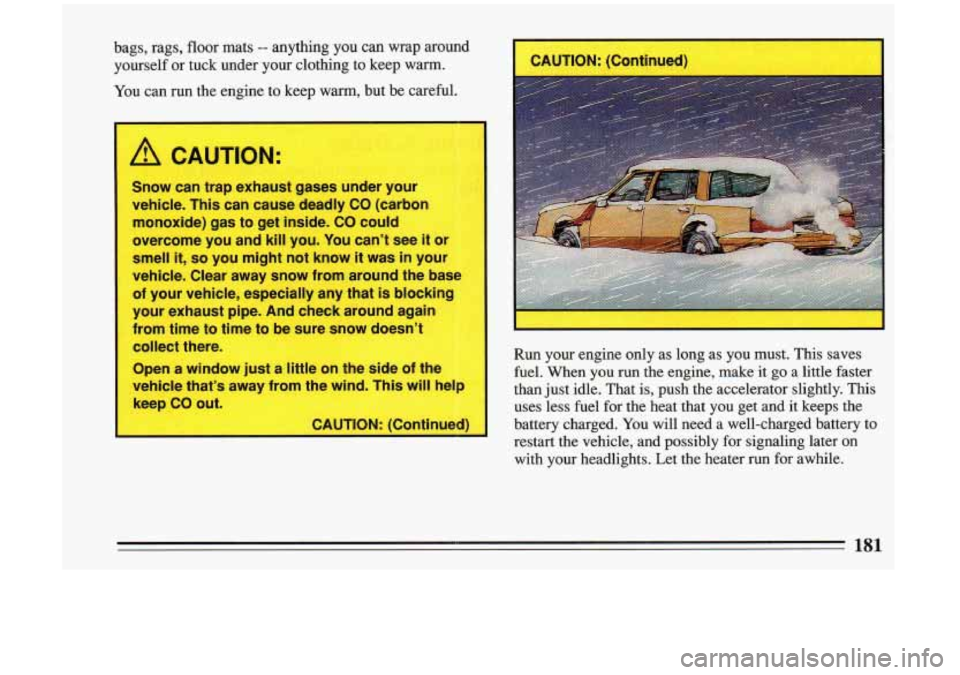
bags, rags, floor mats -- anything you can wrap around
yourself or tuck under your clothing to keep warm.
You can run the engine to keep warm, but be careful.
Snow can trap exhaust gases under your
vehicle. This can cause deadly CO (carbon
monoxide) gas to get inside. CO could
overcome you and kill you. You can’t see
it or
smell it,
so you might not know it was in your
vehicle. Clear away snow from around the ba
!
of your vehicle, especially any that is blocking
your exhaust pipe- And check ar
from time to time to be sure snow
collect there.
Open a window just a little on the side of the
vehicle that’s away from the wind. This
will heir
keep CO out.
I CAUTION: (Continued)
Run your engine only
as long as you must. This saves
fuel. When you run the engine, make
it go a little faster
than just idle. That is, push the accelerator slightly.
This
uses less fuel for the heat that you get and it keeps the
battery charged. You will need a well-charged battery to
restart the vehicle, and possibly for signaling later on
with your headlights. Let the heater run for awhile.
181
Page 186 of 324
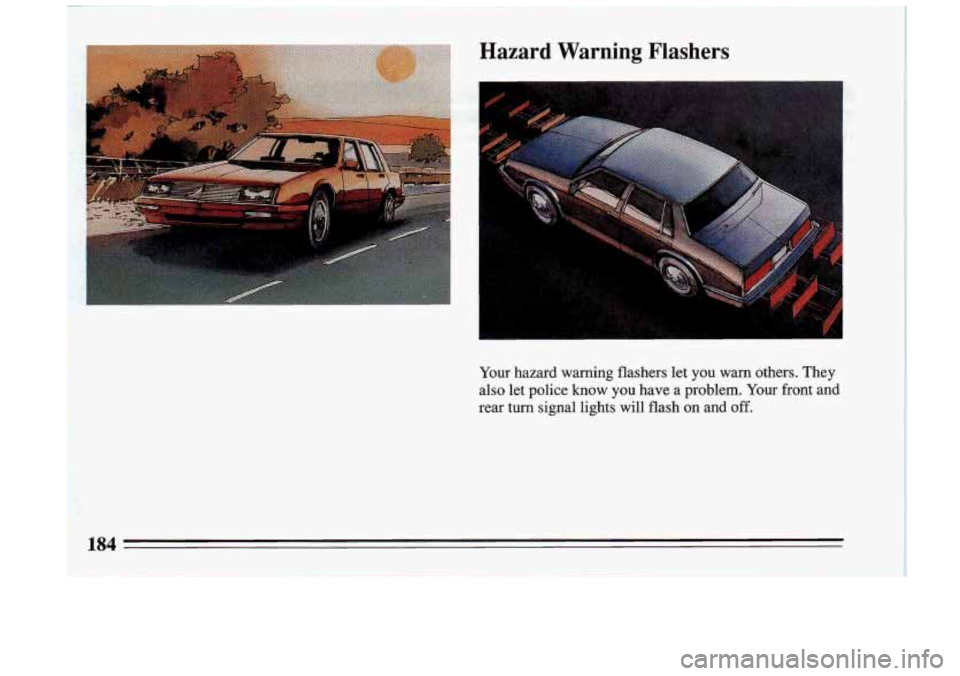
Hazard Warning Flashers
c
Your hazard warning flashers let you warn others. They
also let police know you have a problem. Your front and
rear turn signal lights will flash on and
off.
Page 187 of 324
I
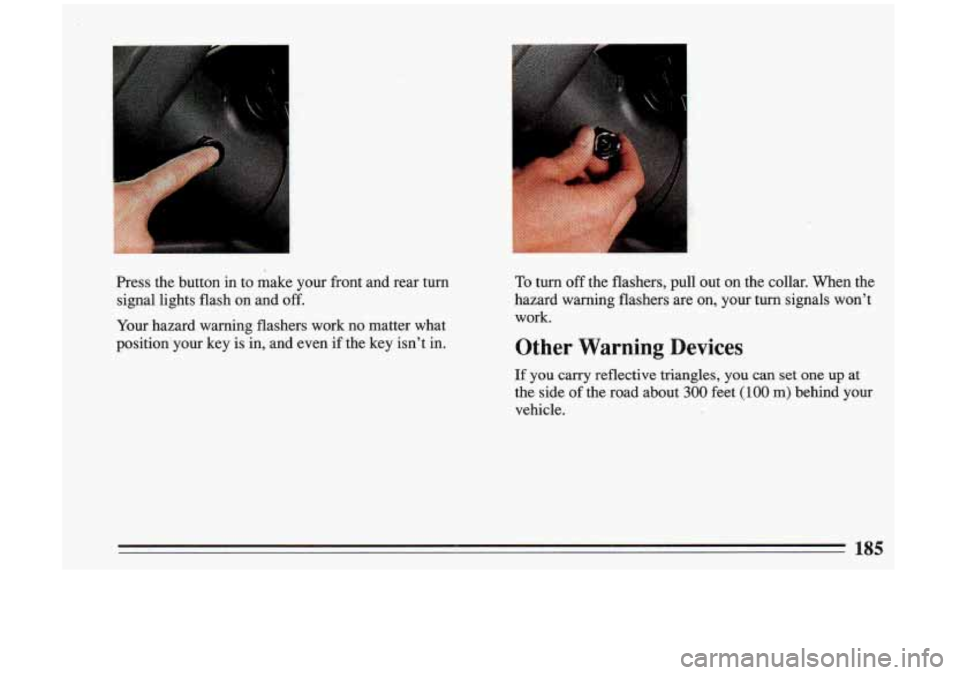
Press the button in to make your front and rear turn
signal lights flash on and
off.
Your hazard warning flashers work no matter what
position your key is in, and even
if the key isn't in.
To turn off the flashers, pull out on the collar. When the
hazard warning flashers are on, your
turn signals won't
work.
Other Warning Devices
If you carry reflective triangles, you can set one up at
the side
of the road about 300 feet (100 m) behind your
vehicle.
185
Page 189 of 324
I A CAUTION:
u could be injured if the vehicles roll. Set the
arking brake firmly on each vehicle. Put an
utomatic transaxle
in “P” (Park) or a manual
axle
in “N” (Neutral).
P
3. Turn off the ignition on both vehicles. Turn off all
lights that aren’t needed, and radios. This
will avoid
sparks and help save both batteries. And it could
save your radio!
4. Open the hoods and locate the batteries.
I A CAUTION:
An electric fan can start up even when the
engine is not running and can injure you. Keep
hands; clothing and tools away from any
underhood electric fan.
~~
Find the positive .(+) and negetive (-), terminals on
each battery.
Page 233 of 324
are made especially for your automatic transaxle.
Damage caused by fluid other than
DEXRONs-IIE is
not covered by your new vehicle warranty.
After adding fluid, recheck the fluid level as
described under
“How to Check.”
When the correct fluid level is obtained, push the
dipstick back in all the way.
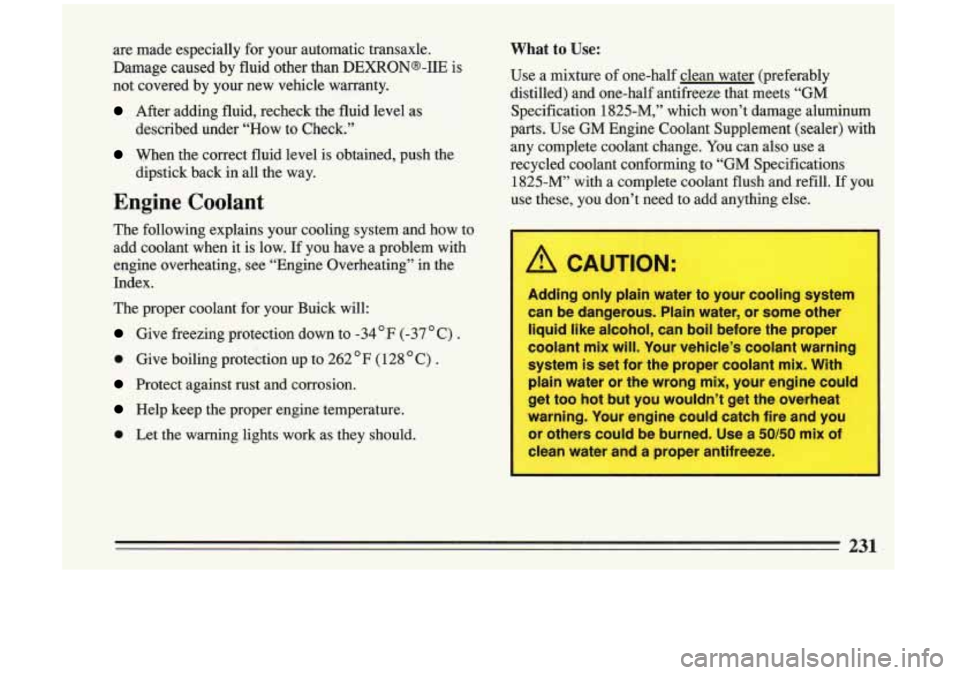
Engine Coolant
The following explains your cooling system and how to
add coolant when it is low. If you have a problem with
engine overheating, see “Engine Overheating” in the
Index.
The proper coolant for your Buick
will:
Give freezing protection down to -34’F (-37 ’ C) .
0 Give boiling protection up to 262 ’ F ( 128 ’ C) .
Protect against rust and corrosion.
Help keep the proper engine temperature.
0 Let the warning lights work as they should.
What to Use:
Use a mixture of one-half clean water (preferably
distilled) and one-half antifreeze that meets “GM Specification 1825-M,” which won’t damage aluminum
parts. Use GM Engine Coolant Supplement (sealer) with
any complete coolant change. You can also use a
recycled coolant conforming to “GM Specifications
1825-M” with a complete coolant flush and-refill.
If you
use these, you don’t need to add anything else.
Adding only plain water to your cooling system
can be dangerous. Plain water, or some other
liquid like alcohol, can boil before the proper
coolant mix will. Your vehicle’s coolant warnin!
system
is set for the proper coolant mix. With
plain water or the wrong mix, your engine coul
get
too hot but you wouldn’t get the overheat
warning. Your engine could catch fire and you
or others could be burned. Use a
50150 mix of
clean water and
a proper antifreeze.
231
Page 266 of 324
i
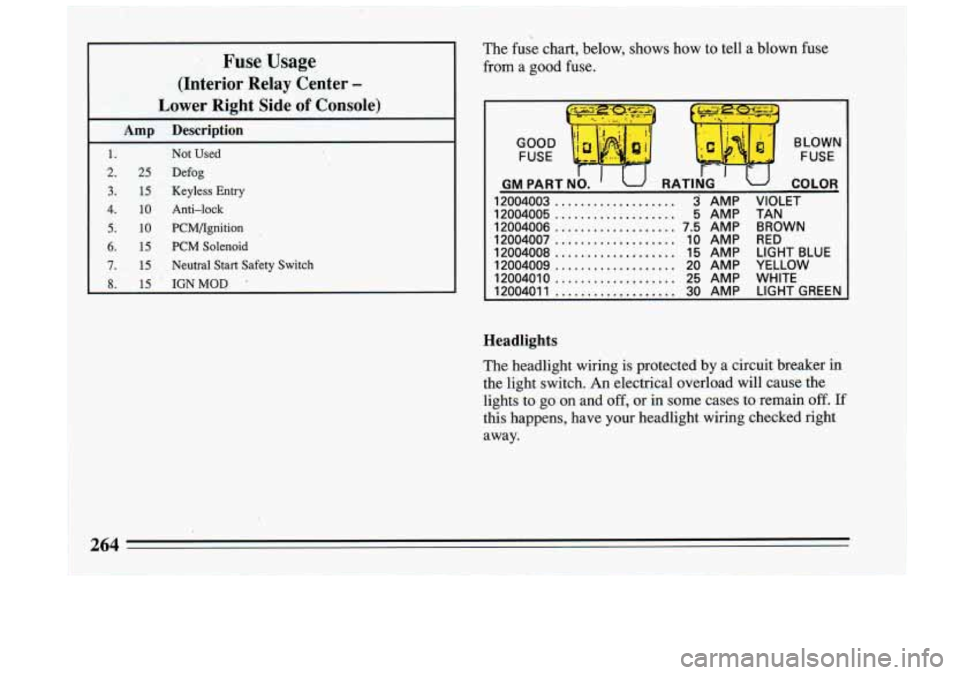
Fuse Usage
(Interior Relay Center -
Lower Right Side of Console)
Amp Description
1. Not Used
2. 25 Defog
3. 15 Keyless Entry
4. 10 Anti-lock
5. 10 PCMflgnition
6. 15 PCM Solenoid
7. 15 Neutral Start Safety Switch
8. 15 ' IGN MOD -
The fuse chart, below, shows how to tell a blown fuse
from a good fuse.
GOOD
FUSE '
rll
-1
I
BLOWN
FUSE
GM PARTNO. ' U RATING ' U COLO~
12004003
................... 3 AMP VIOLET
'12004005
................... 5 AMP TAN
12004006
................... 7.5 AMP BROWN
12004007
................... 10 AMP RED
12004008
.................... 15 AMP LIGHT BLUE
12004009
................... 20 AMP
YELLOW
12004010
................... 25 AMP WHITE
120040.1 1
................... 30 AMP LIGHT GREEN
Headlights
The headlight wiring is protected by a circuit breaker in
the light switch.
An electrical overload will cause the
lights to go on and
off, or in some cases to remain off. If
this happens, have your headlight wiring checked right away.