light BUICK RIVIERA 1993 Service Manual
[x] Cancel search | Manufacturer: BUICK, Model Year: 1993, Model line: RIVIERA, Model: BUICK RIVIERA 1993Pages: 324, PDF Size: 16.01 MB
Page 148 of 324
We’re all familiar with traffic lights or stop lights. Often
green arrows are being used in the lights for improved
traffic control. On some multilane roads, green arrows light up, indicating that traffic
in one or more lanes can
move or make
a turn. Green arrows don’t mean “go no
matter what.” You’ll still need to proceed with caution,
yielding the right of way to pedestrians and sometimes
to other vehicles.
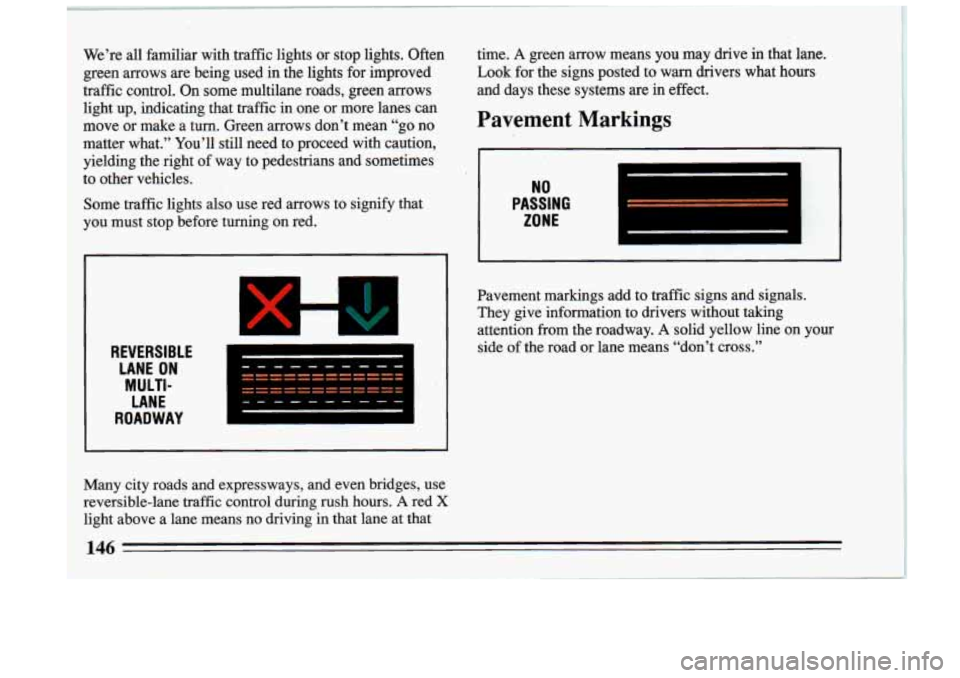
Some traffic lights also use red arrows to signify that
you must stop before turning on red.
REVERSIBLE LANE
0.N
LANE
ROADWAY MULTI-
time. A green arrow means you may drive in that lane.
Look for
the signs posted to warn drivers what hours
and days these systems are in effect.
Pavement Markings
NO
PASSING ZONE
I
I
Pavement markings add to traffic signs and signals.
They give information to drivers without taking
attention from the roadway.
A solid yellow line on your
side of the road or lane means “don’t cross.”
I
I
I
Many city roads and expressways, and even bridges, use
reversible-lane traffic control during rush hours.
A red X
light above a lane means no driving in that lane at that
Page 149 of 324
Your Own Signals
Drivers signal to others, too. It’s not only more polite,
it’s safer to let other drivers know what you are doing.
And in some places the law requires driver signals.
urn and lane change signals. Always signal when you
plan to turn or change lanes.
If necessary, you can use hand signals out the window:
Left arm straight out for a left turn, down for slow or
about-to-stop, and up for a right turn.
Slowing down. If time allows, tap the brake pedal once
or twice in advance of slowing or stopping. This warns
the driver behind you.
Disabled. Your four-way flashers signal that your
vehicle is disabled or is a hazard. See “Hazard Warning
Flasher” in the Index.
Traffic Officer
The traffic police officer is also a source of important
information. The officer’s signals govern, no matter
what the traffic lights or other signs say.
The next section discusses some of the road conditions
you may encounter.
Defensive Driving
The best advice anyone can give about driving is: Drive
defensively.
Please start with
a very important safety device in your
Buick: Buckle up. (See “Safety Belts” in the Index.)
Defensive driving really means “be ready for anything.”
On city streets, rural roads, or freeways, it means
“always expect the unexpected.”
Assume that pedestrians or other drivers are going to be
careless and make mistakes. Anticipate what they might
do. Be ready for their mistakes.
Expect children to dash out from behind parked cars, often- followed by other children. Expect occupants in
parked cars to open doors into traffic. Watch for
movement in parked cars
-- someone may be about to
open a door.
Expect other drivers to run stop signs when
you are on a
through street. Be ready to brake if necessary as you go
through intersections. You may not have to use the
brake, but
if you do, you will be ready.
If you’re driving through a shopping center parking lot
where there are well-marked lanes, directional arrows,
and designated parking areas, expect some drivers to
147
Page 152 of 324
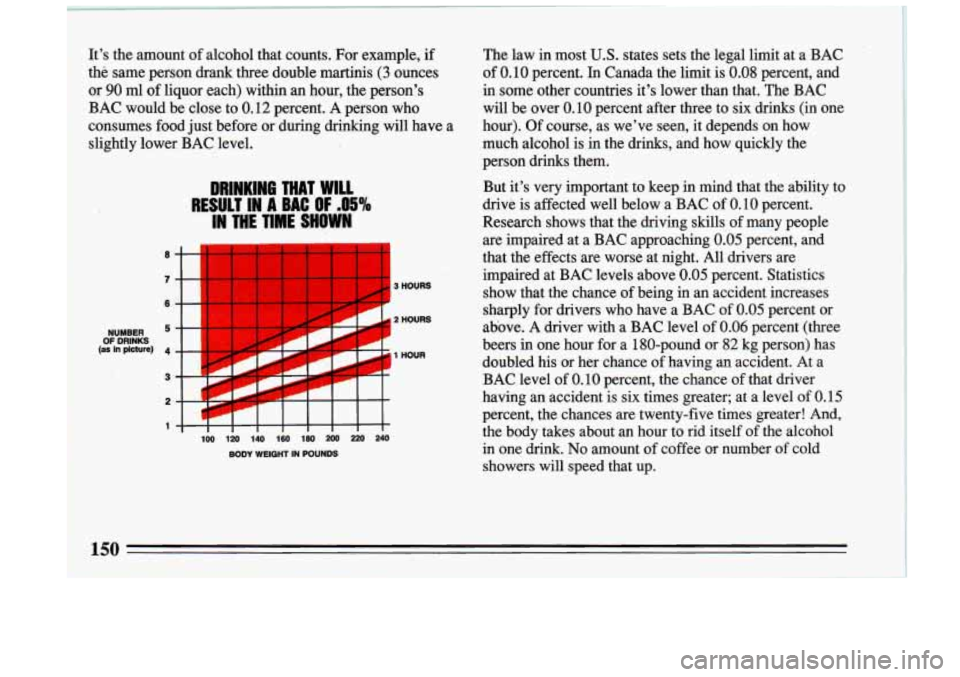
It’s the amount of alcohol that counts. For example, if
the same person drank three double martinis (3 ounces
or
90 ml of liquor each) within an hour, the person’s
BAC would be close to
0.12 percent. A person who
consumes food just before or during drinking will have a
,slightly lower BAC, level.
DRINKING THAT WILL
RESULT IN A BAC OF .05%
IN THE TIME
.:i= 6 - - ’
I
OF DRINKS (as In picture) 4
‘IOURS
1 HOUR
PI I’
‘t , , -1 ,I !j-/j
1
100 120 140 160 180 200 220 240
BODY WEIGHT IN POUNDS
The law in most U.S. states sets the legal limit at a BAC
of
0.10 percent. In Canada the limit is 0.08 percent, and
in some other countries it’s lower than that. The BAC
will be over
0.10 percent after three to six drinks (in one
hour). Of course, as we’ve seen, it depends on how
much alcohol is in the drinks, and how quickly the
person drinks them.
But it’s very important to keep in mind that the ability t\
o
drive is affected well below a BAC of
0.10 percent.
Research shows that the driving skills of many people
are impaired at a BAC approaching
0.05 percent, and
that the effects are worse at night. All drivers are
impaired at BAC levels above
0.05 percent. Statistics
show that the chance
of being in an accident increases
sharply for drivers who have a BAC of
0.05 percent or
above. A driver with a BAC level of
0.06 percent (three
beers in one hour for a 180-pound or
82 kg person) has
doubled his or her chance of having
an accident. At a
BAC level of
0.10 percent, the chance of that driver
having an accident is six times greater; at a level of
0.15
percent, the chances are twenty-five times greater! And,
the body takes about an hour to rid itself of the alcohol
in one drink.
No amount of coffee or number of cold
showers will speed that up.
Page 155 of 324
spurts -- heavy acceleration followed by heavy
braking
-- rather than keeping pace ‘with traffic. This
is a mistake. Your brakes may not have time to cool
between hard stops. Your brakes will wear out much
faster
if you do a lot of heavy braking.
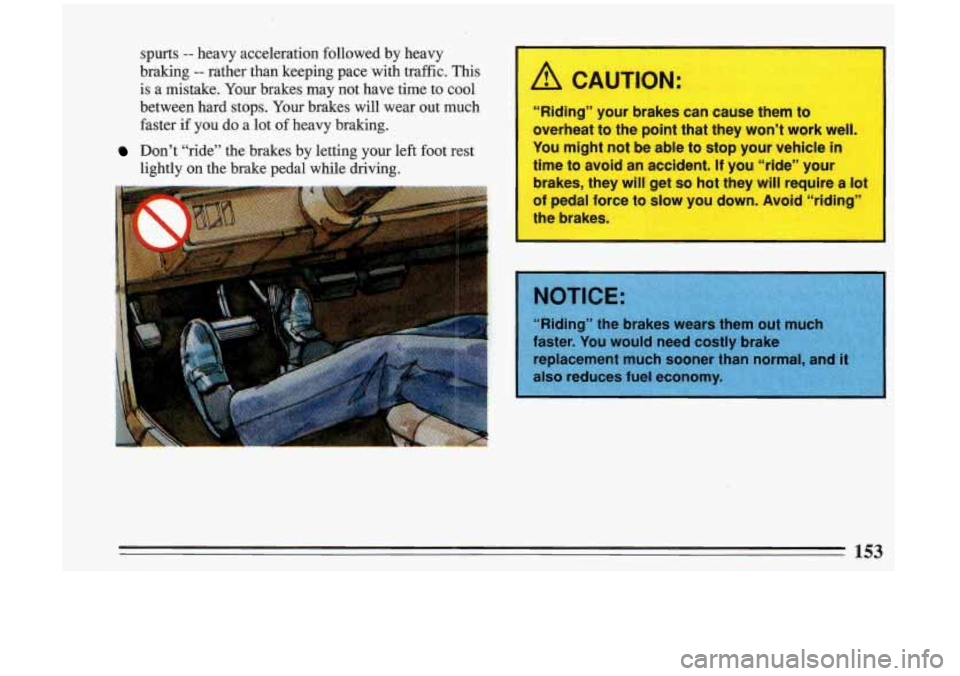
Don’t “ride” the brakes by letting your left foot rest
lightly on the brake pedal while driving.
I
A CAUTION:
“Riding” your brakes can cause them to
overheat to the point that they won’t work well.
You might not be able to stop your vehicle in
time to avoid an accident. If you “ride” your
brakes, they will get
so hot they will require a lot
of pedal force to slow you down. Avoid “riding”
the brakes.
I
I
153
Page 158 of 324
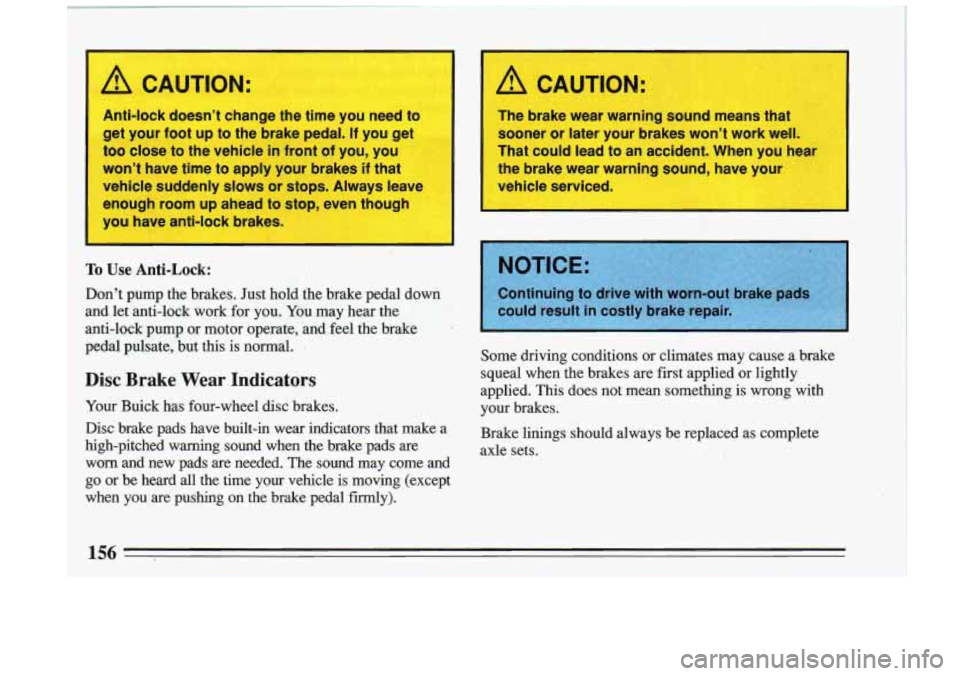
I A CAUTION:
Anti-lock doesn’t change the time you need to
get your foot up
to the brake pedal. If you get
too close to the vehicle in front of you, you
won’t have time to apply your brakes
if that
vehicle suddenly slows or stops. Always leave
enough room up ahead to stop, even though
you have anti-lock brakes.
. 5 ’,.
To Use Anti-Lock:
Don’t pump the brakes. Just hold the brake pedal down
and let anti-lock work for you. You may hear the
anti-lock pump or motor operate, and feel the brake
pedal pulsate, but this is normal.
.
Disc Brake Wear Indicators
Your Buick has four-wheel disc brakes.
Disc brake pads have built-in wear indicators that make a
high-pitched warning sound when the brake pads are worn and new pads are needed. The sound may come and
go or
be heard all the time your vehicle is moving (except
when you are pushing on the brake pedal firmly).
I ‘
A CAUTION:
The brake wear warning sound means that
sooner or later your brakes won’t work well.
That could lead to an accident. When you hear
the brake wear warning sound, have your
:~
vehicle serviced. &tz
some driving conditions or climates may cause a brake
squeal when the brakes are first applied or lightly
applied.
This does not mean something is wrong with
your brakes.
Brake linings should always be replaced as complete
axle sets.
156
Page 161 of 324
either hand. But you have to act fast, steer quickly, and
just as quickly straighten the wheel once
you have
avoided the object. You must then be prepared to steer
back to your original lane and then brake to a controlled
stop.
Depending on your speed, this can be rather violent for
an unprepared driver. This is one
of the reasons driving
experts recommend that you use your safety belts and
keep both hands on the steering wheel.
The fact that such emergency situations are always
possible is a good reason to practice defensive driving at
all times.
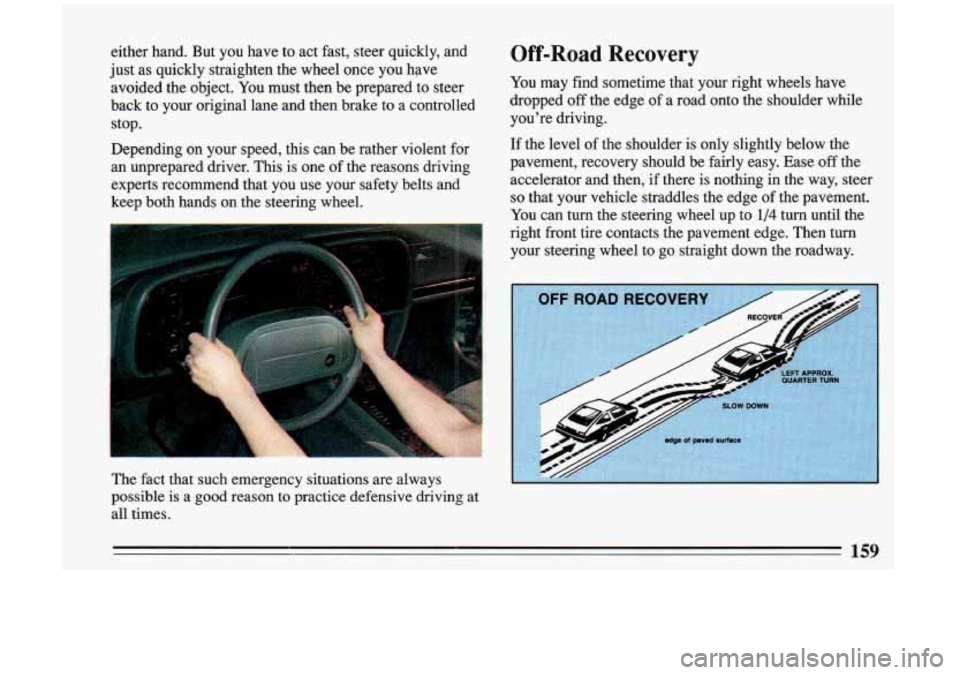
Off-Road Recovery
You may find sometime that your right wheels have
dropped
off the edge of a road onto the shoulder while
you’re driving.
If the level of the shoulder is only slightly below the
pavement, recovery should be fairly easy. Ease
off the
accelerator and then, if there is nothing in the way, steer
so that your vehicle straddles the edge of the pavement.
You can turn the steering wheel
up to 1/4 turn until the
right front tire contacts the pavement edge. Then turn
your steering wheel to
go straight down the roadway.
159
Page 163 of 324
0
0
0 0
0
Don’t overtake a slowly moving vehicle too rapidly.
Even though the brake lights are not flashing, it may
be slowing down
or starting to turn.
If you’re being passed, make it easy for the
following driver to get ahead
of you. Perhaps you
can ease a little to the right.
Loss of Control
Let’s review what driving experts say about what
happens when the thee control systems (brakes, steering
and acceleration) don’t have enough friction where the
tires meet the road to do what the driver has asked.
In any emergency, don’t give up. Keep trying to steer
and constantly seek an escape route or area
of less
danger.
Skidding
In a skid, a driver can lose control of the vehicle.
Defensive drivers avoid most skids by taking reasonable
care suited to existing conditions, and by not
“overdriving” those conditions. But skids are always
possible.
The three types of skids correspond to your Buick’s
three control systems. In the braking skid your wheels aren’t rolling. In the steering or cornering skid, too
Page 165 of 324
by alcohol or drugs, with night vision problems, or by
fatigue.
Here are some tips on night driving.
0
0
0
0
0
0
0
Drive defensively. Remember, this is the most
dangerous time.
Don’t drink and drive. (See “Drunken Driving” in
the Index for more on this problem.)
Adjust your inside rearview mirror to reduce the
glare
from headlights behind you.
Since you can’t see as well, you may need to slow
down and keep more space between you and other
vehicles. It’s hard to tell how fast the vehicle ahead
is going just by looking at its tail’lights.
Slow’’ down, especially on higher speed roads. Your
headlights can light up only
so much road ahead.
In remote areas, watch for’animals.
If you’re tired, pull off the road in a safe place and
rest.
Night Vision
No one can see as well at night as in the daytime. But as
we get older these differences increase. A 50-year-old
driver may require at least twice as much light to see the
same thing at night as a 20-year-old. What you
do in the daytime can also affect your night
I
vision. For example, if you spend the day in bright
sunshine you are wise to wear sunglasses. Your eyes will
have less trouble adjusting to night.
But if you’re driving, don’t wear sunglasses at night.
They may cut down on glare from headlights, but they
also make a lot of things invisible that should remain
visible
- such as parked cars, obstacles, pedestrians, or
even trains blocking railway crossings. You may want to
put on your sunglasses after you have pulled into a
brightly-lighted service or refreshment area. Eyes
shielded from that glare may adjust more quickly to
darkness back on the road. But be sure to remove your
sunglasses before you leave the service area.
You can be temporarily blinded by approaching lights. It
can take a second or two, or even several seconds, for
your eyes
to readjust to the dark. When you are faced
with severe glare (as from a driver who doesn’t lower
the hi.gh beams, or a vehicle with misaimed headlights),
slow down a little. Avoid staring directly into the
approaching lights.
If there is a line of opposing traffic,
make occasional glances over the line of headlights to
make certain that one of the vehicles isn’t starting to
move into your lane. Once you are past the bright lights,
give
your eyes time to readjust before resuming speed.
163 ,
Page 166 of 324
I
-
contract repeatedly. You might even want to keep a cloth
and some glass cleaner in your vehicle if you need to
clean your glass frequently.
Remember that your headlights light up.far less of a
roadway when you are in a turn or curve.
Keep your eyes moving; that way, it’s easier to pick out
dimly lighted objects.
Just as your headlights should be checked regularly for
proper aim,
so should your eyes be examined regularly.
Some drivers suffer from night blindness
-- the inability
to see in dim light
-- and aren’t even aware of it.
f
164
Page 168 of 324
r/d CAUTION:
Wet brakes can cause accidents. They won’t
work well in a quick stop and may cause pulling
to one side. You could lose control of the
vehicle.
After driving through a large puddre of water or
a car wash, apply your brake pedal lightly until
your brakes work normally.
I- Hydroplaning
I
1 Hydroplaning is dangerous. So much water can build up
under your tires that they can actually ride on the water.
This can happen if the road is wet enough and you’re
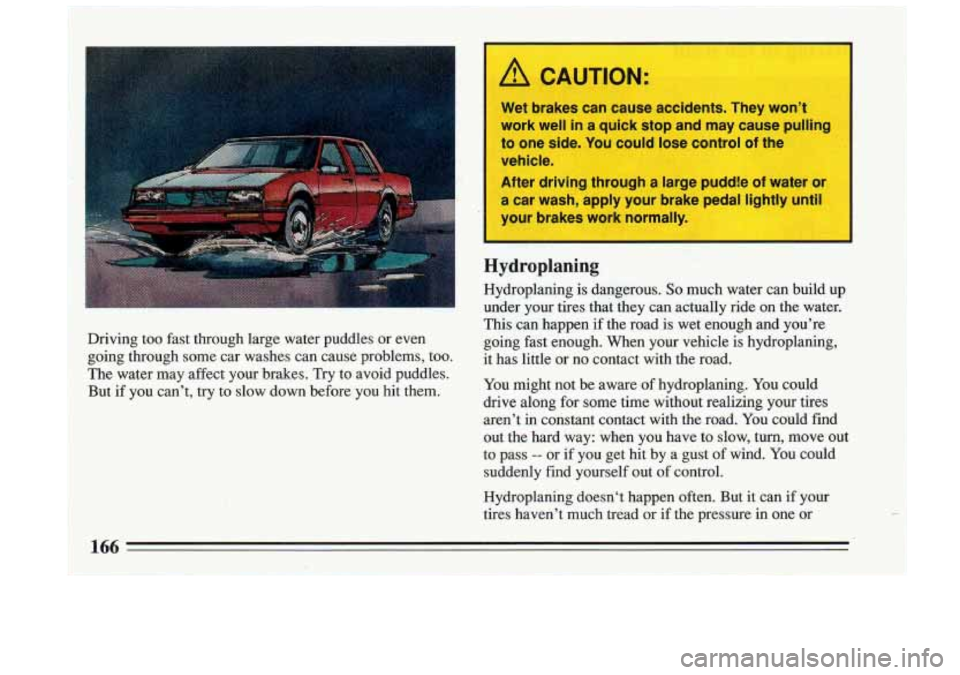
Driving too fast through large water puddles or even
going fast enough. When your vehicle is hydroplaning,
going through some car washes can cause problems, too. it has little or no contact with the road.
The water may affect your brakes. Try to avoid puddles.
But if you can’t, try to slow down before you hit them. You
might not be aware of hydroplaning. You could
drive along for some time without realizing your tires aren’t
in constant contact with the road. You could find
out the hard way: when you have to slow, turn, move out
to pass
-- or if you get hit by a gust of wind. You could
suddenly find yourself out of control.
Hydroplaning doesn‘t happen often. But it can if your
tires haven’t much tread or if the pressure in one or