parking brake BUICK RIVIERA 1993 Owners Manual
[x] Cancel search | Manufacturer: BUICK, Model Year: 1993, Model line: RIVIERA, Model: BUICK RIVIERA 1993Pages: 324, PDF Size: 16.01 MB
Page 77 of 324
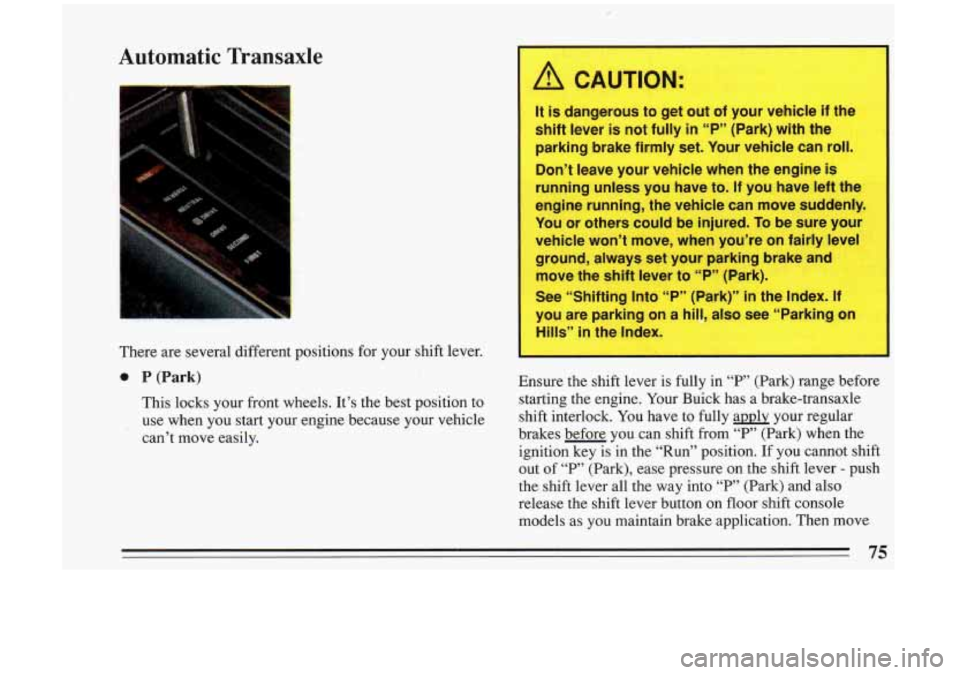
Automatic- Transaxle
There are SL . dral different positions for your shift lever.
0 P (Park)
This locks your front wheels. It’s the best position to
use when you start your engine because your vehicle
can’t move easily.
A CAU ION:
It is dangerous to get out of your vehicle if the
shift lever
is not fully in “P” (Park) with the
parking brake firmly set. Your vehicle can roll.
Don’t leave your vehicle when the engine
is
running unless you have to. If you have left the
engine running, the vehicle can move suddenly.
You or others could be injured.
To be sure your
vehicle won’t move, when you’re on fairly level
ground, always set your parking brake and move the shift lever to “P” (Park).
See “Shifting Into “P” (Park)”
in the Index. If
you are parking on a hill, also see “Parking on
Hills” in the Index.
L
Ensure the shift lever is fully in “P’ (Park) range before
starting the engine. Your Buick has a brake-transaxle
shift interlock. You have to fully apply your regular
brake.s before you can shift from
“P’ (Park) when the
ignition key is in the “Run” position. If you cannot shift
out of
“P’ (Park), ease pressure on the shift lever - push
the shift lever all the way into “P” (Park) and also
release the shift lever button on floor shift console models as you maintain brake application. Then move
75
Page 80 of 324
1 (First Gear) Parking Brake
This position gives you even more power (but lower
fuel economy) than
“2.” You can use it on very steep
hills, or in deep snow or mud. If the selector lever is
put in
“1,” the transaxle won’t shift into first gear
until the vehicle is going slowly enough.
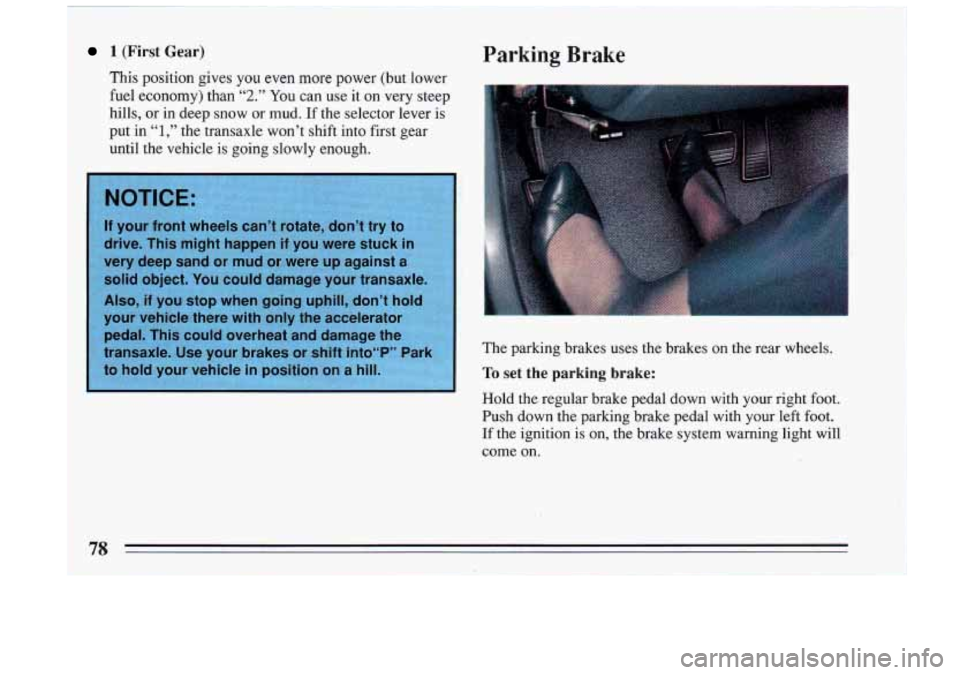
The parking brakes uses the brakes on the rear wheels.
To set the parking brake:
Hold the regular brake pedal down with your right foot.
Push down the parking brake pedal with your left foot.
If the ignition is on, the brake system warning light will
come on.
Page 81 of 324
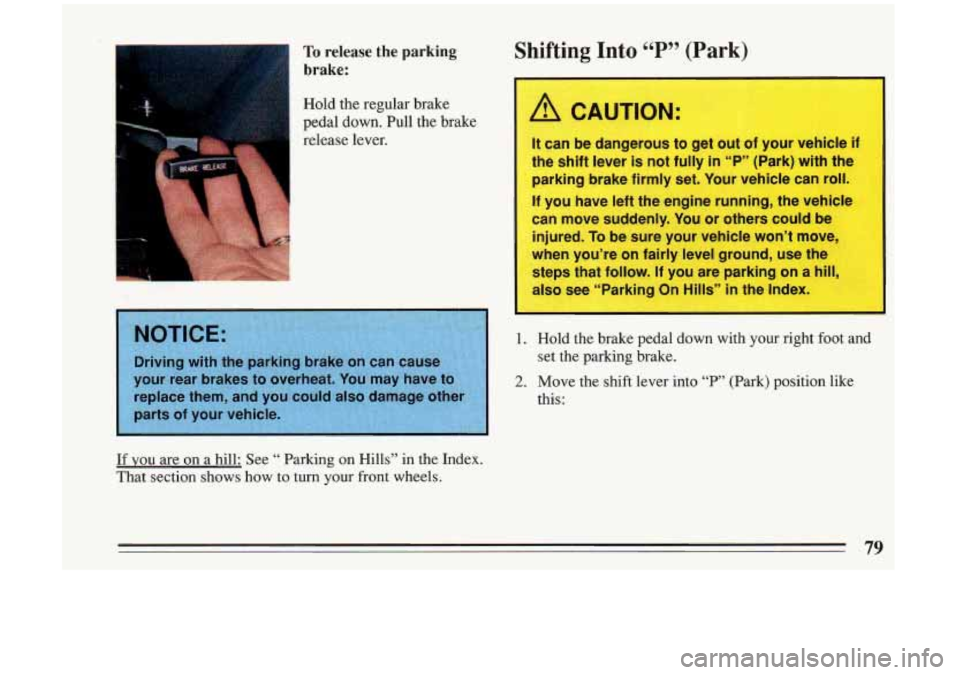
To release the parking
brake:
I
Hold the regular brake
pedal down. Pull the brake
release lever.
Shifting Into 66 P S? (Park)
A CAUTION:
It can be dangerous to get out of your vehicle if
the shift lever is not fully in “P” (Park) with the
parking brake firmly set. Your vehicle can roll.
If you have left the engine running, the vehicle
can move suddenly. You or others could be
injured.
To be sure your vehicle won’t move,
when you’re on fairly level ground, use the
steps that follow. If you are parking on a
hill,
also see “Parking On Hills” in the Index.
1. Hold the brake pedal down with your right foot and
2. Move the shift lever into “P” (Park) position like
set the parking brake.
this:
If YOU are on a hill: See “ Parking on Hills” in the Index.
That section show$ how to turn your front wheels.
79
Page 82 of 324
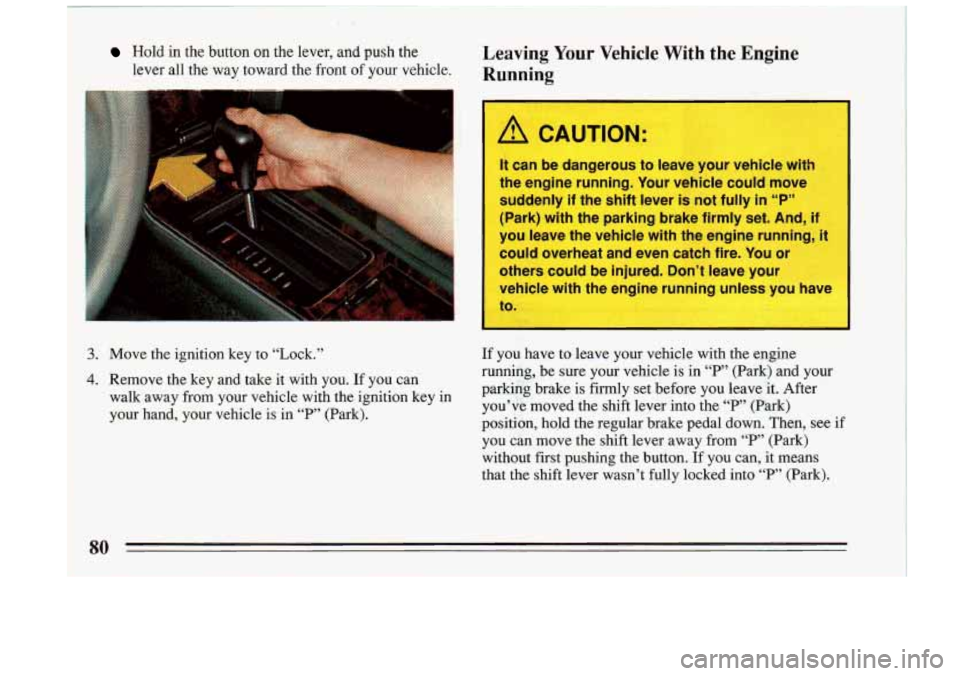
Hold in the button on the lever, and push the Leaving Your Vehicle With the Engine
I lever all the way toward the front of your vehicle. Running
3. Move the ignition key to “Lock.”
4. Remove the key and take it with you. If you can
walk away from your vehicle with the ignition key in
your hand, your vehicle is in
“P)’ (Park).
A CAUTION:
It can be dangerous to leave your vehicle with
the engine running. Your vehicle could move
suddenly
if the shift lever is not fully in “P”
(Park) with the parking brake firmly set. And,
if
you leave the vehicle with the engine running, it
could overheat and even catch fire. You or
others could be injured. Don’t leave your
vehicle with the engine running unlesr --ou have
to.
I
If you. have to leave your vehicle .with the engine
running, be sure your vehicle is in
“P” (Park) and your
parking brake is firmly set before
you leave it. After
you’ve moved the shift lever into the
“P” (Park)
position, hold the regular brake pedal down. Then, see if
you can move the shift lever away from “P,’ (Park)
without first pushing the button.
If you can, it means
that the shift lever wasn’t fully locked into
T“ (Park).
so
Page 83 of 324
Shifting Out of 66 P 99 (Park)
Your Buick has a brake-transaxle shift interlock. You
have to fully applv your regular brake before you can
shift
from “P” (Park) when the ignition is in the “Run”
position. See “Automatic Transaxle” in the Index.
If you cannot shift out of
“P” (Park), ease pressure on
the shift lever
-- push the shift lever all the way into “P”
(Park) and also release the shift lever button on floor
shift console models as you maintain brake application.
Then move the shift lever into the gear you wish. (Press
the shift lever button before moving the shift lever.)
If
you ever hold the brake pedal down but still can’t shift
out
of “P” (Park), try this:
1.
2.
3.
4.
5.
Turn the key to “Off.” Open and close the driver’s
door to turn off the Retained Accessory Power
feature.
Apply and hold the brake until the end
of Step 4.
Shift to “N” (Neutral).
Start the vehicle and then shift to the drive gear you
want.
Have the vehicle fixed as soon as you can.
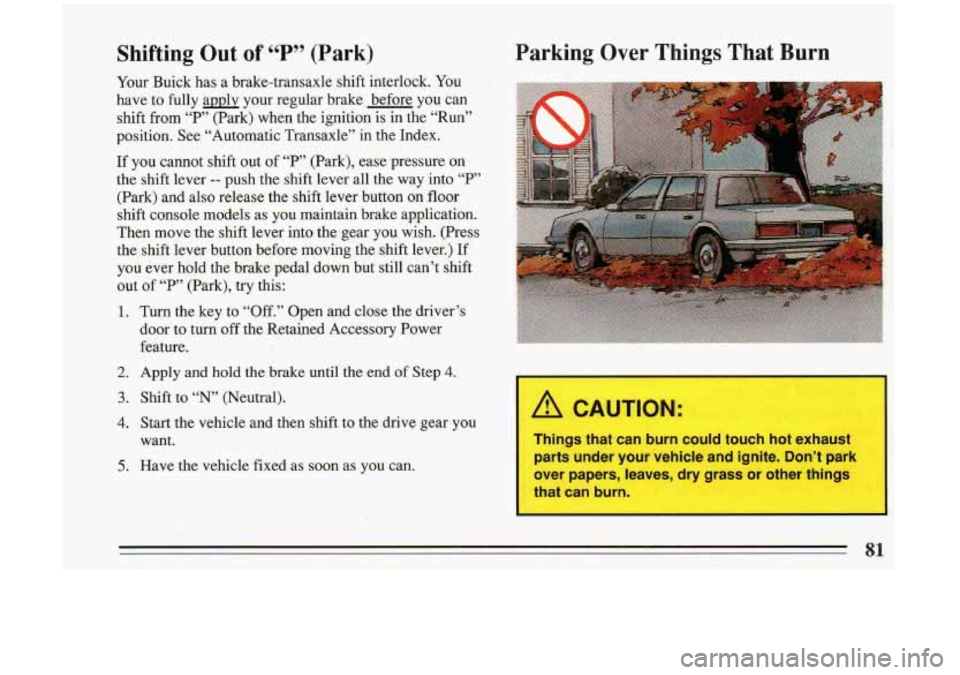
Parking Over Things That Burn
; CAUTION:
Things that can burn could touch hot exhaust
parts under your vehicle and ignite. Don’t park
over papers, leaves,
dry grass or other things
that can burn.
81
Page 85 of 324
.I
CAUTlOf _. [lConltlinulecJ~
It can be dangerous to get out of your vehicle i,.
tlhe shiift lever is not flullly in1 T” (Park) with the
parking brake
firmly set. Your vehic’le can roll.
!Don’t leave your veh!icle when the engine
is
running unless you have to. If you’ve left the
engine irunning, th8e vehicle can move su’ddenly.
You or others could
be ‘injured. To be sure your
vehic’le w&t move, even when you,’re
on fairly
level ground,
always set your parking br’ake a’nd
move the shift lever to
‘T’’ (Park).
Follow the proper steps to be sure your vehicle
won’t Imove., See Shifting Into’ ’~P’ (Park) in the
Index,.
If you are parkiing on a hil’l, also see “Pariking on
Hills” in the Index.
Retained Accessory Power
After the ignition is turned off, and before any door is
opened, the following systems will work for ten
minutes:
1’
Power windows
0 Radio
@ Clock (with radio off)
0 Windshield wiper/waSher
0 Astroroof (option) I
83
Page 113 of 324
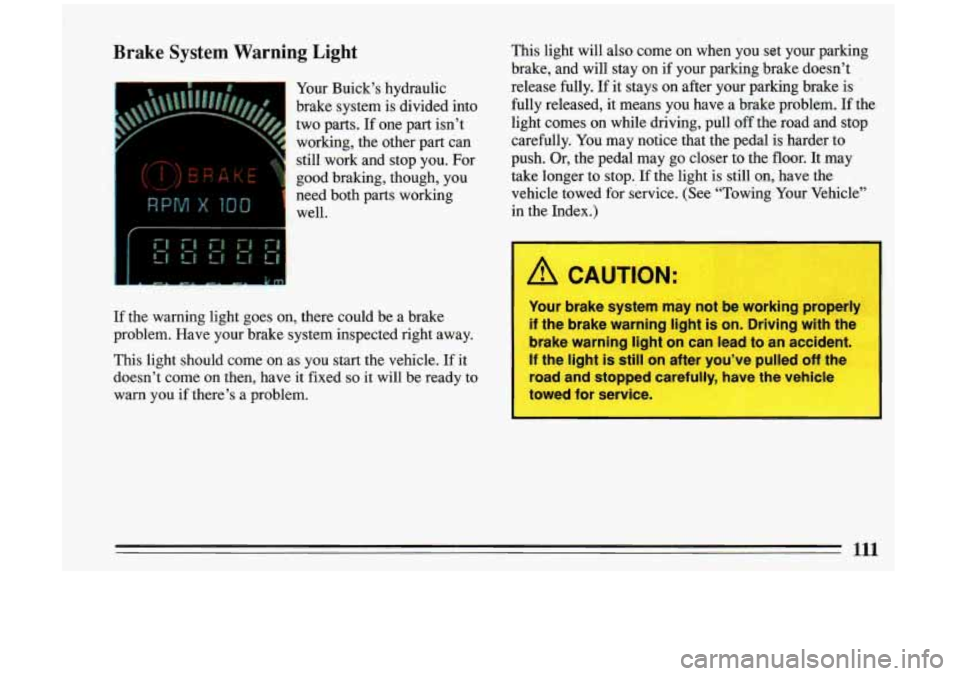
Brake System Warning Light
1 Your Buick’s hydraulic
I two parts. If one part isn’t
~ working, the other part can
~ still work and stop you. For ’ good braking, though, you
brake system is divided
into
1 well.
need both parts working
If the
warning light goes on, there could be a brake
problem. Have your brake system inspected right away.
This light should come on as you start the vehicle. If it
doesn’t come on then, have it fixed
so it will be ready to
warn you if there’s a problem. This light will
also come
on when you set your parking
brake, and will stay on if your parking brake doesn’t
release fully. If it stays on after your parking brake
is
fully released, it means you have a brake problem. If the
light comes on while driving, pull
off the road and stop
carefully. You may notice that the pedal is harder to
push. Or, the pedal may
go closer to the floor. It may
take longer to stop. If the light is still on, have the
vehicle towed for service. (See “Towing Your Vehicle”
in the Index.)
I A CAUTION:
Your brake system may not be working properly
if the brake warning light is on. Driving with the
brake warning light on can lead
to an accident.
If the light is still on after you’ve pulled off the
road and stopped carefully, have the vehicle
towed for service.
I
111
i
Page 149 of 324
Your Own Signals
Drivers signal to others, too. It’s not only more polite,
it’s safer to let other drivers know what you are doing.
And in some places the law requires driver signals.
urn and lane change signals. Always signal when you
plan to turn or change lanes.
If necessary, you can use hand signals out the window:
Left arm straight out for a left turn, down for slow or
about-to-stop, and up for a right turn.
Slowing down. If time allows, tap the brake pedal once
or twice in advance of slowing or stopping. This warns
the driver behind you.
Disabled. Your four-way flashers signal that your
vehicle is disabled or is a hazard. See “Hazard Warning
Flasher” in the Index.
Traffic Officer
The traffic police officer is also a source of important
information. The officer’s signals govern, no matter
what the traffic lights or other signs say.
The next section discusses some of the road conditions
you may encounter.
Defensive Driving
The best advice anyone can give about driving is: Drive
defensively.
Please start with
a very important safety device in your
Buick: Buckle up. (See “Safety Belts” in the Index.)
Defensive driving really means “be ready for anything.”
On city streets, rural roads, or freeways, it means
“always expect the unexpected.”
Assume that pedestrians or other drivers are going to be
careless and make mistakes. Anticipate what they might
do. Be ready for their mistakes.
Expect children to dash out from behind parked cars, often- followed by other children. Expect occupants in
parked cars to open doors into traffic. Watch for
movement in parked cars
-- someone may be about to
open a door.
Expect other drivers to run stop signs when
you are on a
through street. Be ready to brake if necessary as you go
through intersections. You may not have to use the
brake, but
if you do, you will be ready.
If you’re driving through a shopping center parking lot
where there are well-marked lanes, directional arrows,
and designated parking areas, expect some drivers to
147
Page 177 of 324
As you go over the top of a hill, be alert. There could
be something in your lane, like a stalled car or an
accident. Parking on Hills
You may see highway signs on mountains that warn
of special problems. Examples are long grades,
passing or no-passing zones,
a falling rocks area, or
winding roads. Be alert to these and take appropriate
action.
Winter driving can present special problems. See ,
“Winter Driving” in the Index.
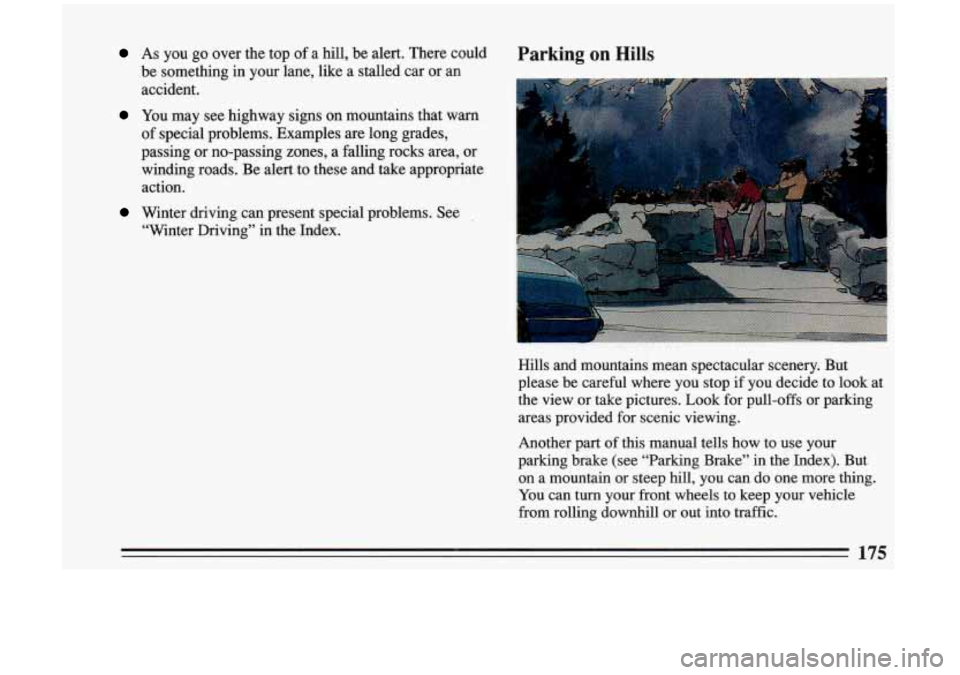
Hills and mountains mean spectacular scenery. But
please be careful where you stop if you decide to look at
the view or take pictures. Look for pull-offs or parking
areas provided for scenic viewing.
Another part of this manual tells how to use your
parking brake (see “Parking Brake” in the Index). But
on a mountain or steep hill, you can do one more thing.
You can turn your front wheels to keep your vehicle
from rolling downhill or out into traffic.
175
Page 194 of 324
/! CA TlON:
To help-avok rjury to you or others:
Never let passengers ride in a vehicle that I
Never tow fastt than safe or postec
Never tow ith damaged parts not fully
Never get under your vehicle after it has
Always use separate safety chains on
is being towed.
speec
secured.
been lifted by the tow truck.
each.side when towing a vehicle.
CAUTION: (Continued)
CAUTION: (Continued)
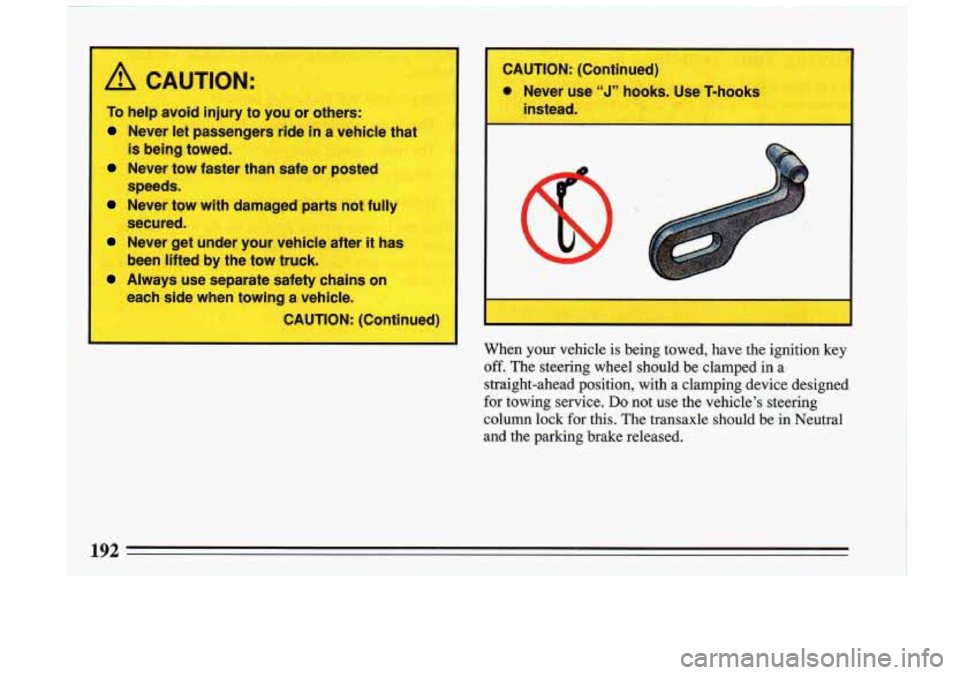
0 Never use “J” hooks. Use T-hooks
instead.
When your vehicle is being towed, have the ignition key off. The steering wheel should be clamped in a.
straight-ahead position, with a clamping device designed
for towing service.
Do not use the vehicle’s steering
column lock for this. The transaxle should be in Neutral
and the parking brake released.
192