radiator cap BUICK RIVIERA 1993 Owners Manual
[x] Cancel search | Manufacturer: BUICK, Model Year: 1993, Model line: RIVIERA, Model: BUICK RIVIERA 1993Pages: 324, PDF Size: 16.01 MB
Page 200 of 324
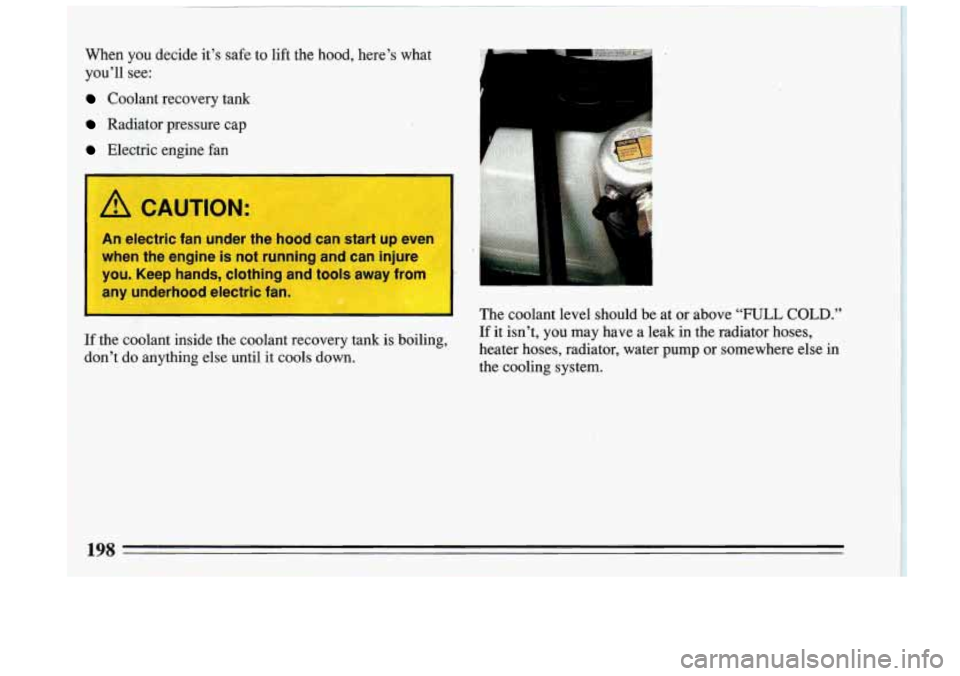
When you decide it’s safe to lift the hood, here’s what
you’ll
see:
Coolant recovery tank
Radiator pressure cap
Electric engine fan
An electric fan under the hood can start up even
when the engine is not running and can injure
you. Keep hands, clothing and tools away from
any underhood electric fan.
I
If the coolant inside the coolant recovery tank is boiling,
don’t do anything else until it coals down. The coolant level should be at or above
“FULL COLD.”
If it isn’t, you may have a leak in the radiator hoses,
heater hoses, radiator, water pump or somewhere else
in
the cooling system.
198
Page 203 of 324
A CAUTION:
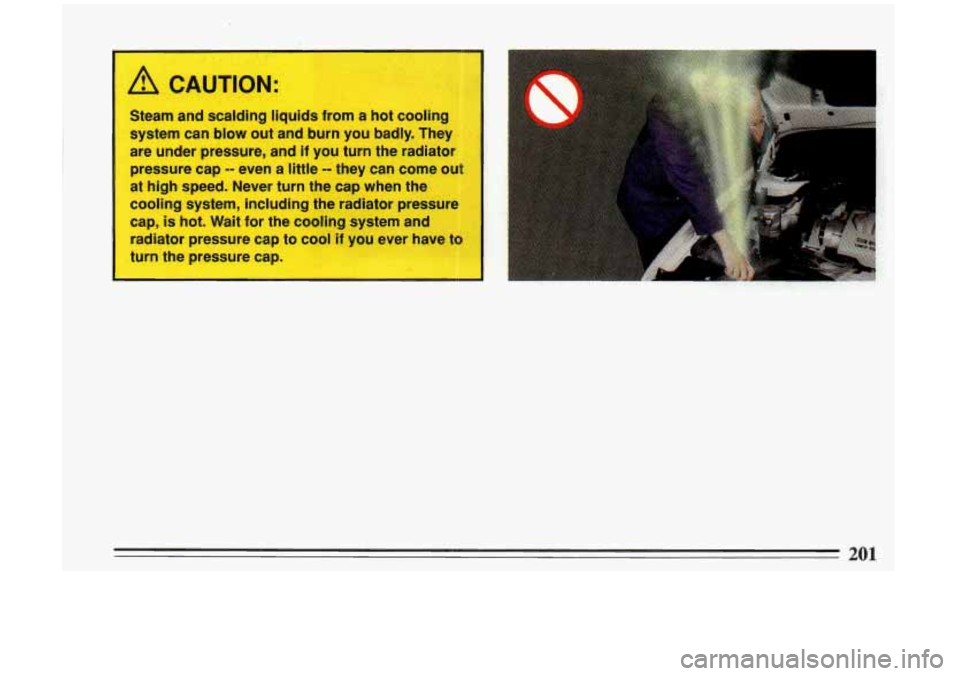
Steam and scalding liquids from a hot cooling
system can blow out and burn you badly. They
are under pressure, and if you turn the radiator
pressure cap
-- even a little -- they can come out I
at high speed. Never turn the cap when the
cooling system, including the radiator pressure
cap, is hot. Wait for the cooling system and
radiator pressure cap to cool if you ever have
to
turn the pressure cap. $@.:;<;J &gjK&p
sa , Ad
Page 204 of 324
How to Ad,d Coolant to the Radiator
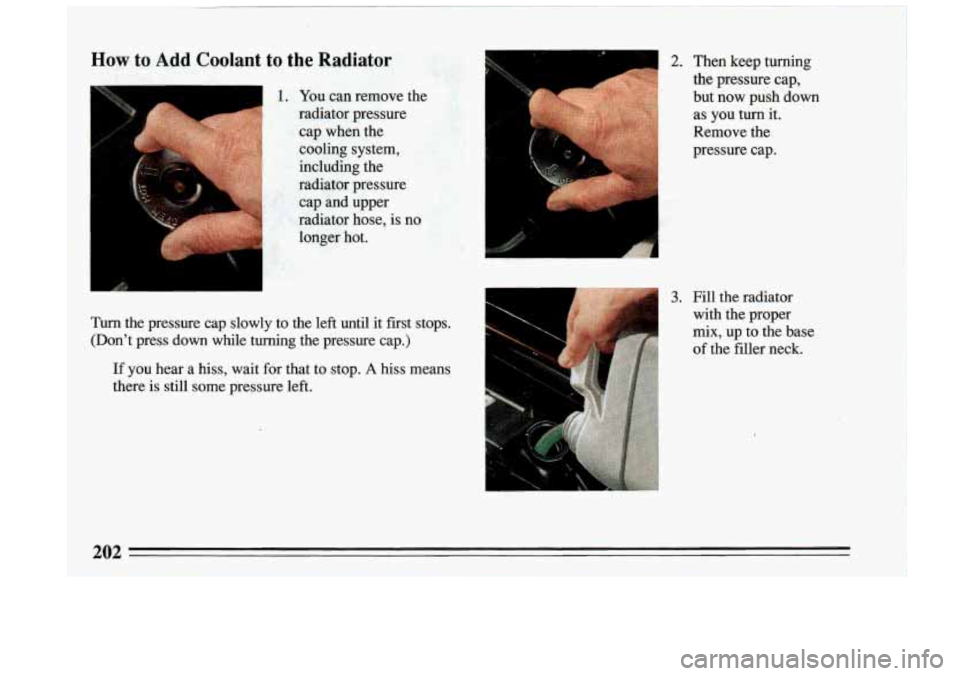
You can remove the
radiator pressure
cap when the
cooling system,
including the
radiator pressure cap
and upper
radiator hose, is no
longer hot.
Turn the pressure cap slowly to the left until it first stops\
.
(Don't press down while turning the pressure cap.)
If you hear a hiss, wait for that to stop. A hiss means
there is still some pressure left.
1 2. Then keep turning
the pressure cap,
but now push down as you turn it.
Remove the pressure cap.
3. Fill the radiator
with the proper
mix, up to the base
of the filler neck.
202
Page 205 of 324
1
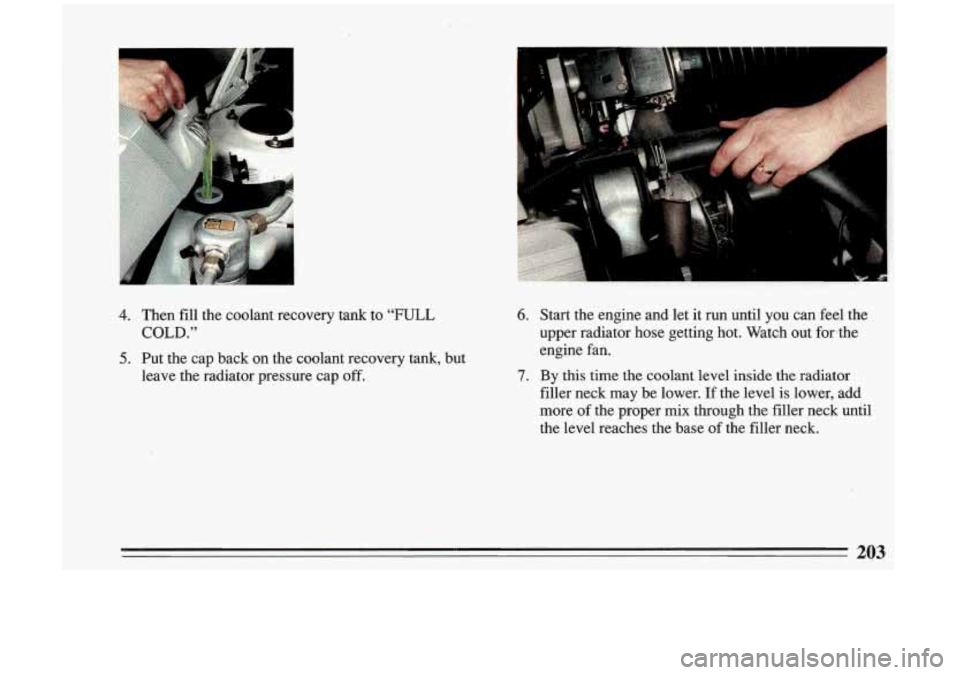
4. Then fill the coolant recovery tank to “FULL
COLD.’3
6. Start the engine and let it run until you can feel the
upper radiator hose getting hot. Watch out forthe
-
5. Put the cap back on the coolant recovery tank, but engine fan.
filler neck may be lower. If the level is lower, add
more of the proper mix through the filler neck until
the level reaches the base of the filler neck.
leave the
radiator pressure cap
off. 7. By this time the coolant level inside the radiator
203
Page 235 of 324
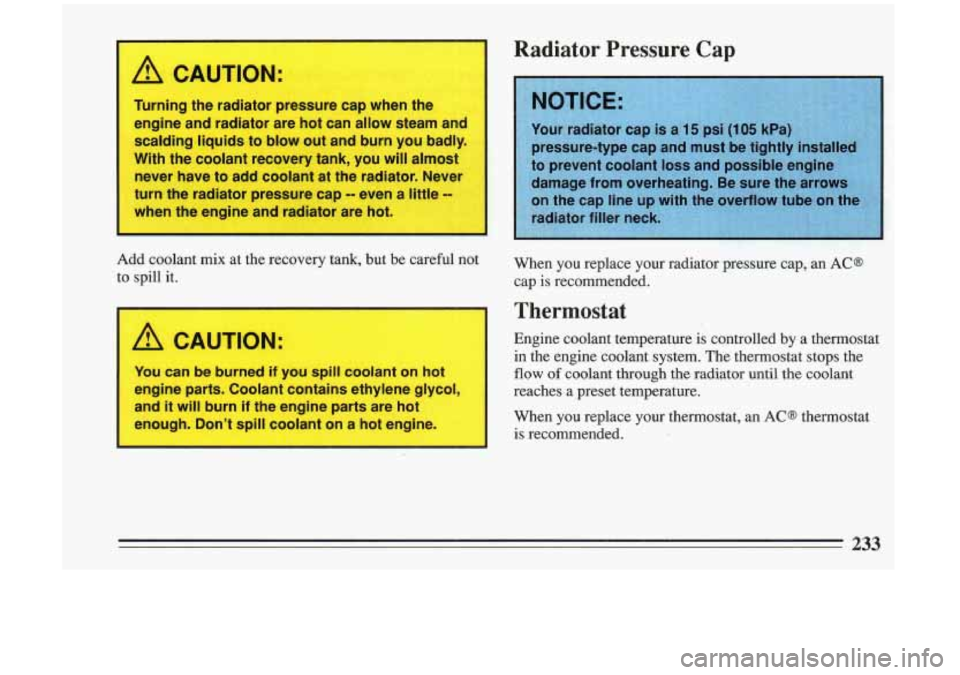
A CAUTION:
Turning the radiator pressure cap when the
engine and radiator are hot can
allow steam and
scalding liquids to blow out and burn you badly.
With the coolant recovery tank, you
will almost
never have to add coolant at the radiator. Never
turn the radiator pressure cap
-- even a little --
when the engine and radiator are hot.
Add coolant mix at the recovery tank, but be careful not
to spill it.
A CAUTION:
You can be burned if you spill coolant on hot
engine parts. Coolant contains ethylene glycol,
and it
will burn if the engine parts are hot
enough. Don’t spill coolant on a hot engine.
Radiator Pressure Cap
When you replace your radiator pressure cap, an ACS
cap
is recommended.
Thermostat
Engine coolant temperature is controlled by a thermostat
in the engine coolant system. The thermostat stops ,the
flow of coolant through the radiator until the coolant
reaches a preset temperature.
When you replace your thermostat, an AC@ thermostat
is recommended. I
233