ESP BUICK ROADMASTER 1993 User Guide
[x] Cancel search | Manufacturer: BUICK, Model Year: 1993, Model line: ROADMASTER, Model: BUICK ROADMASTER 1993Pages: 340, PDF Size: 18.34 MB
Page 196 of 340
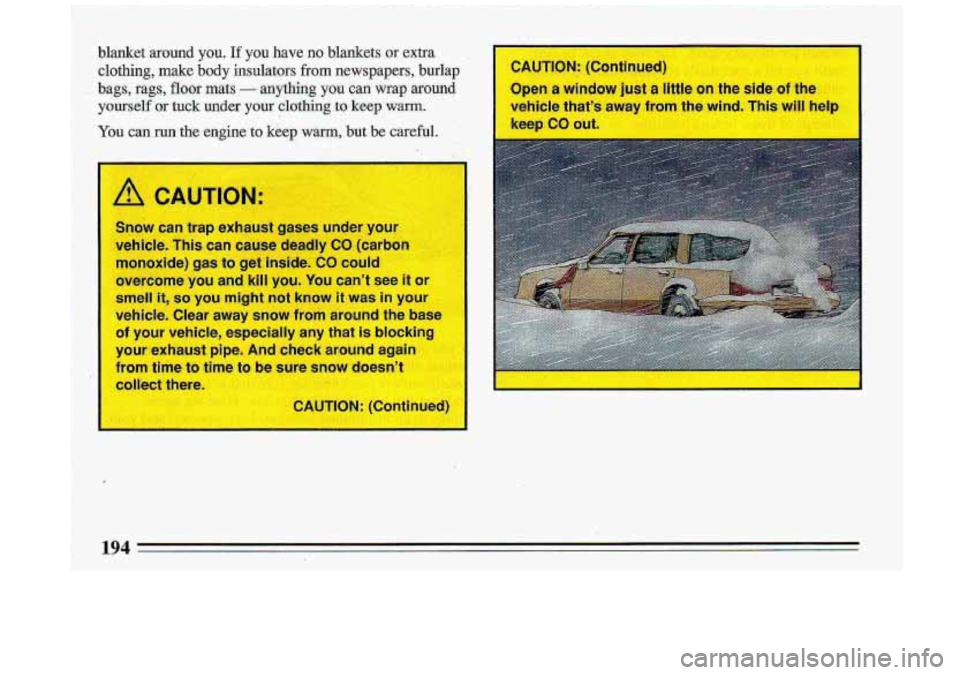
blanket around you. If you have no blankets or extra. II
clothing, make body insulators. from newspapers, burlap I CAUTION: (Continued)
bags, rags, floor math - anything you can wrap around 3pen a window just a Iihz oh &he side of the
yourself OX tuck under your clothing to keep warm. ._ .. ,... r’ ,. . I vehicle that’s away from the wind. This will helr
Yon can run the engine to keep warm, but. be careful.
,. ,
/A CAUTION:
Snow can trap exhaust gases under your
vehicle. This can
cause deadly CO (carbnn
monoxide)
gas to get inside. CQ could
overcome you and kill you. You can’t see it o
smell it, so y~u might not know it was in you1
vehicle. Clear
away snow from around the base
of your vehicle, especially any that is blockina
your exhaust
gibe. And check around again
from time to ti P to be sure snow doesn’t
collect there.
CAUTION: (Continued)
Page 201 of 340
Driving with a Trailer
Towing a trailer requires a certain amount of experience. Before setting out for the open road, you’ll want to get
to
know your rig. Acquaint yourself with the feel of
handling and braking. with the added weight of the
trailer. And always keep in mind that the vehicle you are
driving is now
a good deal longer and not nearly so
responsive as your vehicle is by itself.
Before you start, check the trailer hitch and platform,
safety chains, electrical connector, lights, tires and
mirror adjustment.
If the trailer has electric biakes, start
your yehicle and trailer moving and then apply the
trailer brake controller by hand to be sure the- brakes are
working. This lets you check your electrical connection
at the same time.
During your trip, check occasionally to
be sure that the
load
is secure, and that the Lights.and any trailer brakes
are .still working.
Following Distance
Stay at least twice as far behind the vehicle ahead as you
would when driving your vehicle without a trailer. This
can help
you avoid situations that require heavy braking
and sudden turris.
.
Passing
You’ll need. more passing distance up ahead when
you’re towing a trailer. And, because you’re a good deal \
longer, you’ll need to go much farther beyond the
.
passed vehicle before you can return to your lane.
Backing Up
Hold the bottom of the steering wheel with one hand.
Then, to move the trailer
to the left, just move that hand
to the left.
To mo.ve the trailer to the right, move your
hand to the right. Always back up slowly and, if
possible, have someone guide
you.
Making Turns
When you’re turning with a trailer, make wider turns
than normal.
Do this so your trailer won’t strike soft
shoulders, curbs, road signs, trees, or other objects.
Avoid jerky or sudden maneuvers. Signal well in
advance.
Turn Signals When Towing a Trailer
When you tow a trailer, your vehicle has to have .a
different turn signal flasher and extra wiring. The green
arrows on your instrument panel will
flash whenever
you signal a
turn or lane change. Properly hooked up,
199
Page 246 of 340
What about gasoline with blending materials that contain oxygen, such as MTBE or alcohol?
MTBE is “methyl tertiary-butyl ether.” Fuel that is, no
more than 15% MTBE is fine for your vehicle.
Ethanol is ethyl or .grain alcohol. Properly-blended fuel
that
is no more than 10% ethanol is fine for your
vehicle.
Methanol is methyl or
wood alcohol. Gasolines
for Cleaner Air
Your use
of gasoline with detergent additives will help
prevent deposits from forming in your engine:and
fuel
system. That helps keep your ,engine in. tune and your
emission control system working properly. It’s good
for
your vehicle, and you’ll be doing your part for cleaner
air.
Many gasolines are now blended with materials called
oxygenates. General Motors .recommends that you use
gasolines with these blending materials, such as MTBE
and-ethanol. By doing so, you can help clean the
ak,
especially in those parts of the country that have high
carbon monoxide levels.
In addition, som-e gasoline suppliers are now .producing
reforniulated gasolines. These gasolines are specially
designed to reduce vehicle emissions. General Motors
recommends that you use reformulated gasoline. By
doing
so, you can help clean the air, especially in those
parts
of the country that have high ozone levels.
You should ask your service station operators if their
gasolines contain detergents and oxygenates, and
if they
have been reformulated to reduce vehicle emissions.
.
Page 258 of 340
How to Add Fluid:
Refer to the Maintenance Schedule to determine what
kind
of transmission fluid to use. See “Recommended
Fluids and.lLubricants” in the Index.
If the fluid level is low, add only enough of the proper
fluid to bring the level up to the COLD area for a cold
check or the
HOT area fora hot check. It doesn’t take
much fluid, generally less than a pint. Don’t overfill.
we
recommend you use only fluid labeled DEXRONBIIE,
because fluids with that label are made-especially for
you automatic transmission. Damage caused by fluid
other than DEXRON@IIE
is not covered by your new
vehicle warranty.
0 After adding fluid, recheck the fluid level as
described under “How to Check.77
0 When the correct-fluid level is obtained, push the
dipstick back in all the way.
Rear Axle
When to Check and Change Lubricant:
Refer to the Maintenance Schedule to determine how
often to check the lubricant and when to change it. See
“Periodic Maintenance Inspections” in the Index.
How to Check Lubricant:
If the level is below the bottom of the filler plug hole,
you’ll need to add some lubricant. Add enough lubricant
to raise the level to the bottom
of the filler plug hole.
What
to Use:
Standard Differential
Use Axle Lubricant (GM Part
No. 1052271) or SAE
80W-90 GL-5 gear lubricant.
Limited-Slip Differential
To add lubricant when the level is low, use Axle
Lubricant (GM Part
No. 1052271) or SAE 8OW-90
GL-5 gear lubricant.
To completely refill after draining,
add
4 ounces (1 18 ml) of Limited-Slip Differential
Lubricant Additive (GM Part
No. 1052358). Then fill to
the bottom of the filler plug hole with Axle Lubricant
(GM Part
No. 1052271) or SAE 80W-90 GL-5 gear
lubricant.
Page 275 of 340
When to Check: Check your tires once .a month or
more.
Don’t forget
your compact spare-tire (if SO equipped). It
should be at 60 psi (420 Pa).
How to Check: Use a good quality pocket-type gage to
check tire pressure. Simply looking at the tires will not
tell you the pressure, especially if
you have radial tires
- which may look properly inflated even if they’re
underinflated.
If your tires have valve caps, be sure to put them back
.on. They help prevent leaks by keeping
out dirt and
moisture.
Tire Inspection and Rotation
To make your tires last longer, have them inspected and
rotated at the mileages recommended in the, Maintenance Schedule. See “Scheduled Maintenance Services”
in the Index.
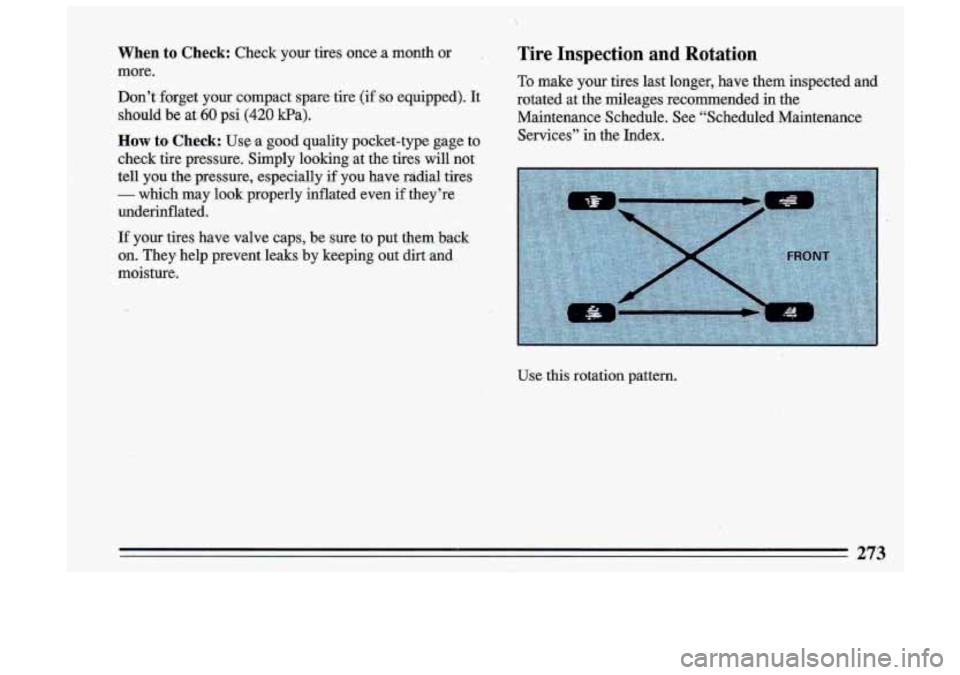
Use this rotation pattern.
t
273
Page 321 of 340
a Part 8 Customer Assistance Information
Here you will find out how to contact Buick if you need assistance. This Part also tells you how to obtain service
publications and how
to report any safety defects.
Part
8 includes:
Customer Satisfaction
..............................................................
Customer Assistance for Hearing/Speech Impaired ........................................ 320
Reporting Safety Defects
............................................................ 321
ServicePublications
................................................................ 322 319
.
Cwtomer
Satisfaction Procedure
Your satisfaction and goodwill are important to your STEP ONE - Discuss your problem with a member of
dealer and Buick. Normally, any problems with the sales dealership management. Complaints can often be
transaction or the operation of your vehicle will be quickly resolved at that level. If the m\
atter has already
resolved by
your dealer’s Sales or Service Departments. been reviewed with the\
Sales, Service, or Parts Manager
Sometimes, however, despite the best intentions
of all contact the owner of the dealership or the General
concerned, misunderstandings can occur. If your Manager.
concern has not been resolved to your satisfaction, the following steps should be taken:
319