lights BUICK ROADMASTER 1993 Owners Manual
[x] Cancel search | Manufacturer: BUICK, Model Year: 1993, Model line: ROADMASTER, Model: BUICK ROADMASTER 1993Pages: 340, PDF Size: 18.34 MB
Page 14 of 340
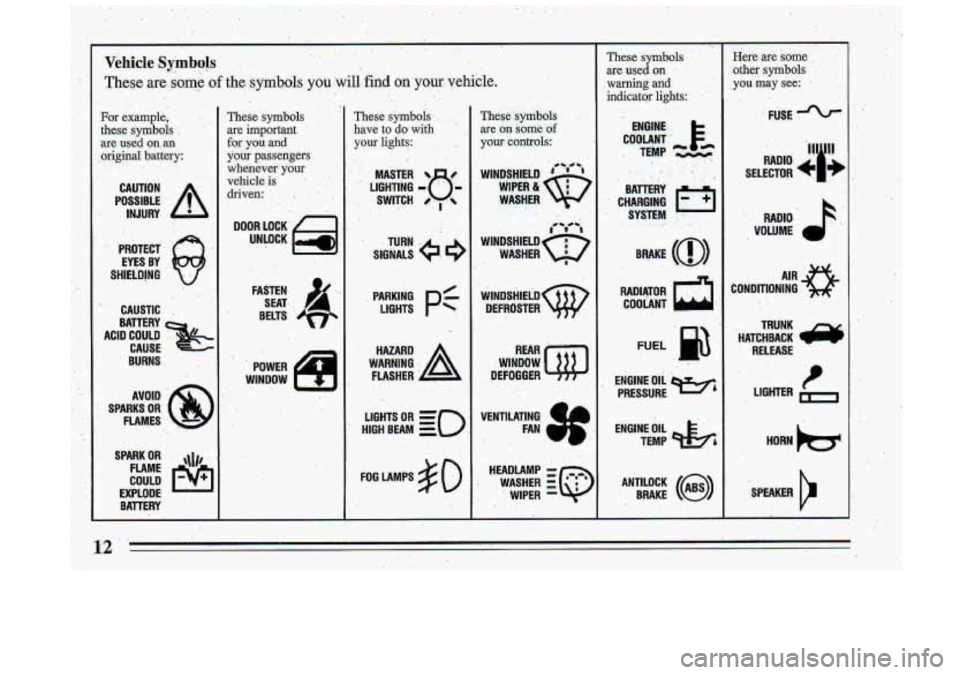
Vehicle Symbols . , . '
mcese are some .of the,symbols you will find on your vehicle. . ' . '".' . '*
I. .. . .- . .* . t . . :.
.. ... .. , I. .'
For example,
these symbols
'
are used on an
original battery:
CAUTION
INJURY
..
POSSIBLE: .' A
.' PR~TECT @
EYES BY
SHIELDING
CAUSTIC
ACID COULD
&
BATTERY CAUSE
BURNS
SPARKS AVOID
OR '"8
FLAMES
COULD
EXPLODE BATTERY
I,
These symbols
are
important
for you.and.
your passengers
whenever your
vehicle-is- ' .
driven: ~ , E , .. , .,
iI
..
DOOR LOCK,' f 1
UNLOCK e
SEAT,
BELTS
WlNDOW
f -1
POWER
These symbols, . _.
have to'do with , .
your lights: ' ,. , - .<
*_
' 'LIGHTING
-8-
MASTER %. . 8
. 'SWITCH /., .
PARKING pf
LIGHTS
HAZARD
WARNING
:A
FLASHER
HIGH
'IGHTS BEAM OR = =o
,. T.hese symbols ',
are on some bf
your controls.:
WIN'DSHIELD. ' ' ' 0- c,
WIPER a Q
WINDSHIELDQ WASHER
** ri I91
WASHER I
. WlNDSHlELD(fji)
DEFROSTER
,) .
WINDOW
DEFOGGER
' WASHER EG
HEADLAMP -
WIPER
These symbols
are used on '
,warning and
indicator lights:
RADIATOR COOLANT
FUEL
ENGINE OIL 'e,
PRESSURE
TEMP
Oli 4%
ANTILOCK. (a)
BRAKE
Bere are some
other symbols
,you may see:
FUSE
RADIO.
CONDITIONING ..
TRUNK
HATCHBACK
e
RELEASE --
LIGHTER e,
SPEAKER
b
?
Page 63 of 340
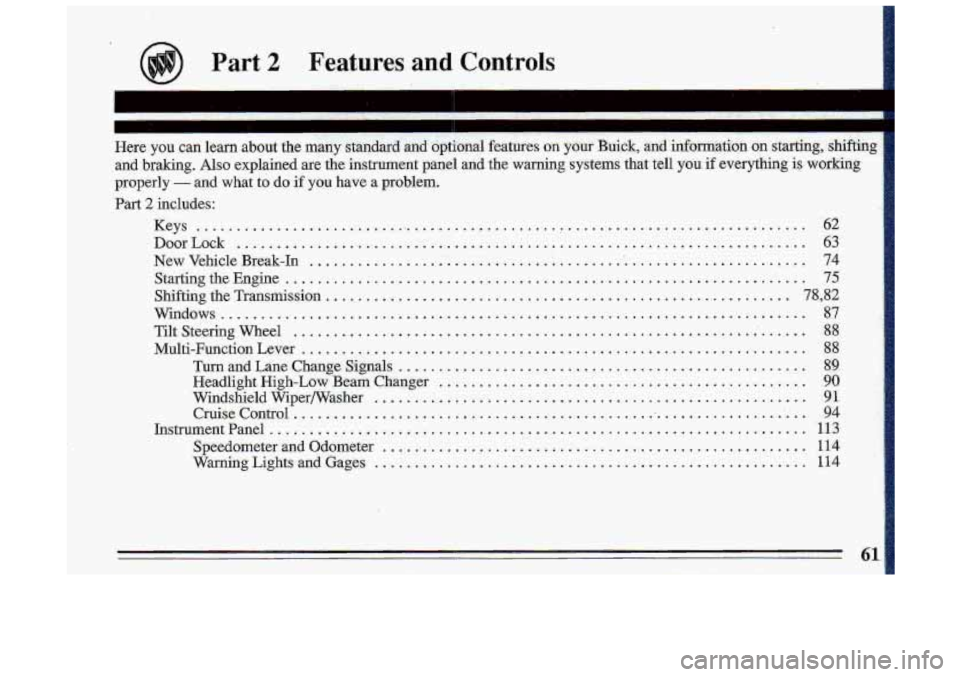
Part 2 Feat.ures and Controls
n .
Here you can learn about the many standard and optional features on your Buick, and infom.ation on starting. shifting
and braking
. Also explained are the instrument panel and the warning systems that tell you if everything is working
properly
. and what to do if you have a problem .
Part 2 includes:
Keys
........................................................................\
..... 62
DoorLock ....................................................................... \
63
New Vehicle Break-In ............................................................... 74
Starting the Engine
................................................................. 75
Shifting the Transmission
.......................................................... 78, 82
Windows ........................................................................\
. 87
TiltSteeringWheel
................................................................ 88
Multi-IFunctionLever ............................................................... 88
TurnandLaneChangeSignals ................................................... 89
Headlight High-Low Beam Changer .............................................. 90
Windshield WiperWasher
....................................................... 91
Cruise Control
.................................................................. 94
Instrument Panel
................................................................... 1 13
Speedometer and Odometer
..................................................... 114
Warning Lights and Gages
...................................................... 114
61
.
Page 92 of 340
As you signal a turn or a lane change, if the arrows don't
flash but just stay on, a signal bulb may be burned out
and other drivers won't see your turn signal.
If a bulb is burned out, replace it to help avoid an
accident. If the green arrows don't go on at all when you
signal a turn, check the fuse (see "Fuses" in the Index)
and for burned-out bulbs.
If you have a trailer towing option with added wiring for
the .trailer lights, a different
turn signal flasher is used.
With this flasher installed, the signal indicator will flash
even if
a turn signal bulb is burned out. Check the front
and rear turn signal lights regularly to make sure they
are working.
Turn Signal Reminder
A chime will sound if your turn signal remains on after
having driven
1/2 mile, to remind you to turn off your
signal.
Operation of Lights
Although your vehicle's lighting system (headlamps,
parking lamps, fog lamps, side marker lamps and tail
lamps) meet all applicable Federal lighting
requirements, certain States and Provinces may apply their own lighting regulations that may require special
attention before you operate these lamps. For.example,
some jurisdictions may require that you operate your
lower beam lamps with fog lamps at -all times, or that
headlamps. be turned
on whenever you.must use your
windshield wipers. In addition, most jurisdictions
prohibit driving solely with parking lamps, especially at
dawn or dusk. It is recommended that you check with
you own State or Provincial highway authority. for
applicable lighting regulations.
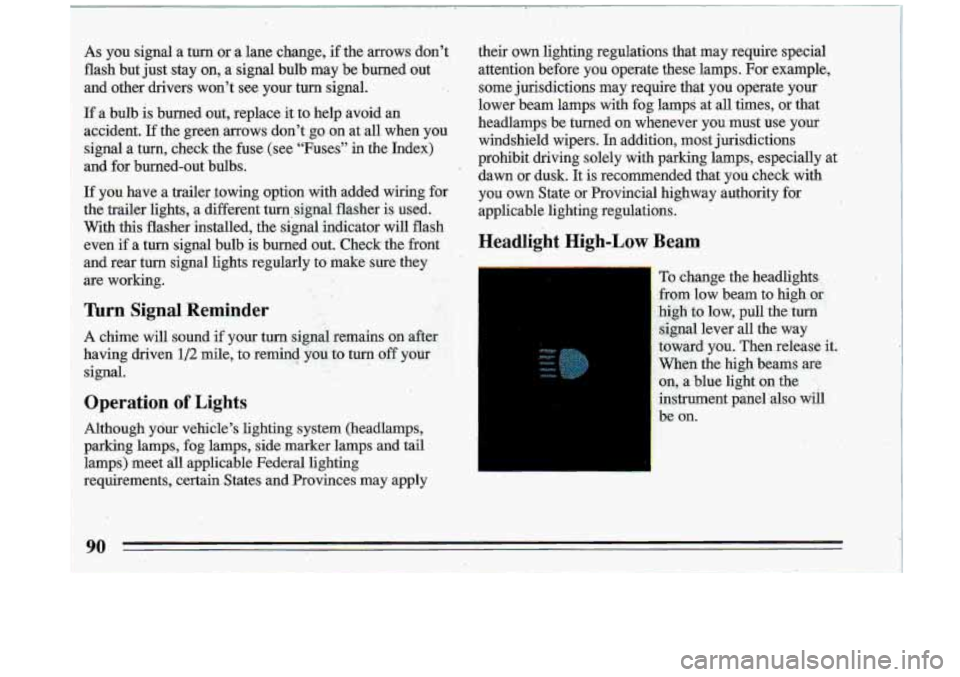
Headlight High-Low Beam
To change the headlights.
l .from low beam to high or..'
:hi:& -to low, pull the turn
signal lever all the way
'toward you. Then .release it.
When the high beams are
on, a blue light, on the
instrument panel -also will
be on.
90
Page 101 of 340
i
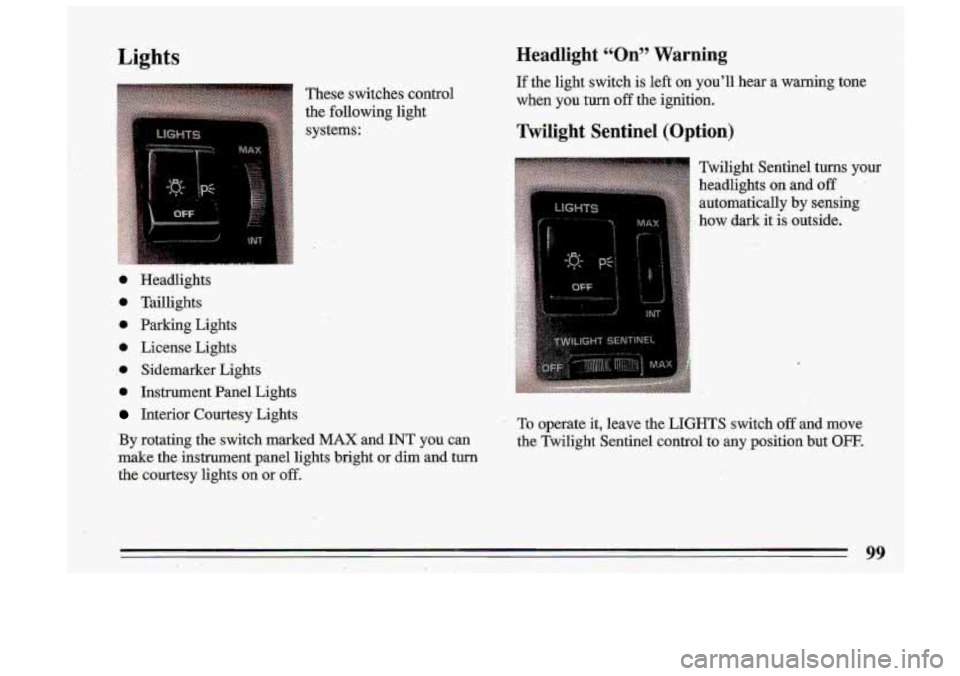
Lights
These switches control
the following li-ght
systems:
Headlight C60n?' Warning
If the light switch is left on you'll hear a warning tone
when
you turn off the ignitbn.
Twilight Sentinel (Option)
0
a
*
0
,*
a
Headlights
Taillights
Parking Lights
License Lights Sidemarker Lights
Instrument Panel Lights
Interior Courtesy Lights
By rotating the switch marked MAX and INT you can
make the instrument panel lights bright
or dim and turn
the courtesy lights
on or off.
Twilight Sentinel turns your
headlights on and
off '
autcimatically by sensing
how dark it is outside.
.. To operate it, leave the LIGHTS switch off and move
the Twilight Sentinel control to any position but
OFF.
99
Page 104 of 340
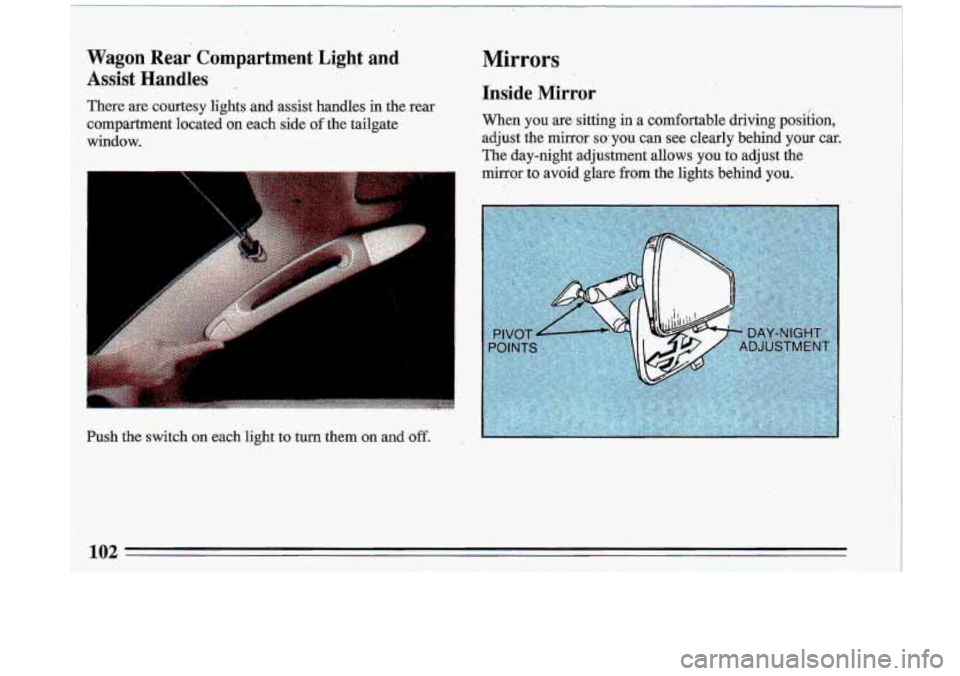
Wagon Rear Lompartment Light and
Assist Handles .
There are courtesy lights and assist handles in the rear
compartment located on each side
of the tailgate
window.
Mirrors
Inside Mirror
When you are sitting in a comfortable driving position,
adjust the mirror
so: you can see clearly behind your car.
The day-night adjustment allows you
to adjust the
mirror
to avoid glare from the lights behind you.:
Page 105 of 340
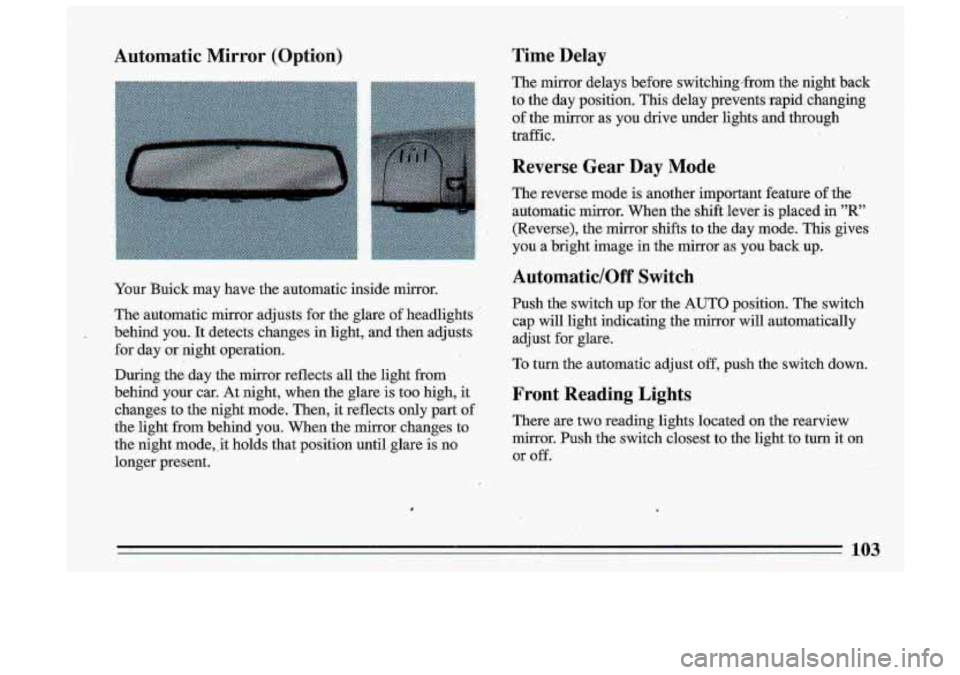
Automatic Mirror (Option)
Your Buick may have the automatic inside mirror.
The automatic mirror adjusts for the glare
of headlights
behind you. It detects changes
in light, and then adjusts
for day
or night operation.
During the day the mirror reflects all the light from
behind your car. At night; when the glare
is too high, it
changes to the night mode. Then, it reflects only part of
the light from behind you. When the mirror changes to
the night-mode,jt holds that position until glare is no
longer present.
d
Time Delay
The mirror delays before switchingcfrom the night back
to the day position. This delay prevents rapid changing
of the mirror as you drive under li-ghts and through
traffic.
Reverse Gear Day Mode
The-reverse mode is another important €eature of the
automatic mirror. When the shift lever
is placed in "R'
(Reverse), the mirror shifts to the day mode. This gives
you a bright image in the mirror
as you back up.
Automatic/Off Switch
Push the switch up for the AUTO position. The switch
cap will light indicating the mirror will automatically
adjust for glare.
To turn the automatic adjust off, push the switch down.
Front Reading Lights
There are two reading lights located on .the rearview
mirror. Push the switch closest'to the light to turn it on
or off.
103
Page 112 of 340
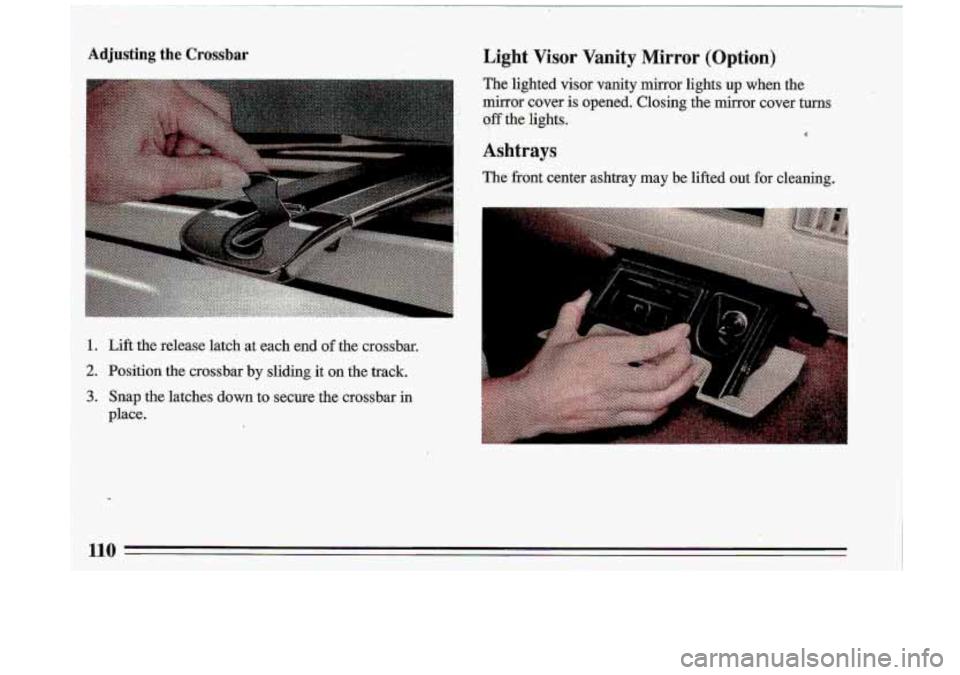
Light Visor Vanity Mirror (Option) , .I. .. ,
The lighted visor vanity mirror lights up when the
mirror cover is opened.
Closing the mirror cover turns
off the lights.
i
Ashtrays
The front center ashtray may be lifted out for cleaning.
Page 116 of 340
Speedometer and Odometer
Your speedometer lets you See your speed in both miles
per hour (mph) and kilometers per hour (km/h). Your
odometer shows how far your vehicle has been driven,:...
in either miles (used in the
U.S.) or klometers (usedbj:l::.r
Canad,a).
UT Buicli hasa "tamper7&ist.mt-odometer." If you ' .
;can see silyet lines betweiin. ttie numbers, probably "
!somehe has. tried to turn it, back. The,.numbers may not
. .. .I
..
:be accurate.
'You .may wonder what happens if.a car has to have a
. .
;new odometer installed. The new one should be set to
"the same reading as the old one. If that is not possible,
"hen it's set at zero, and a label on. the driver's door must
:show the old reading and when the new one was
::installed.
..
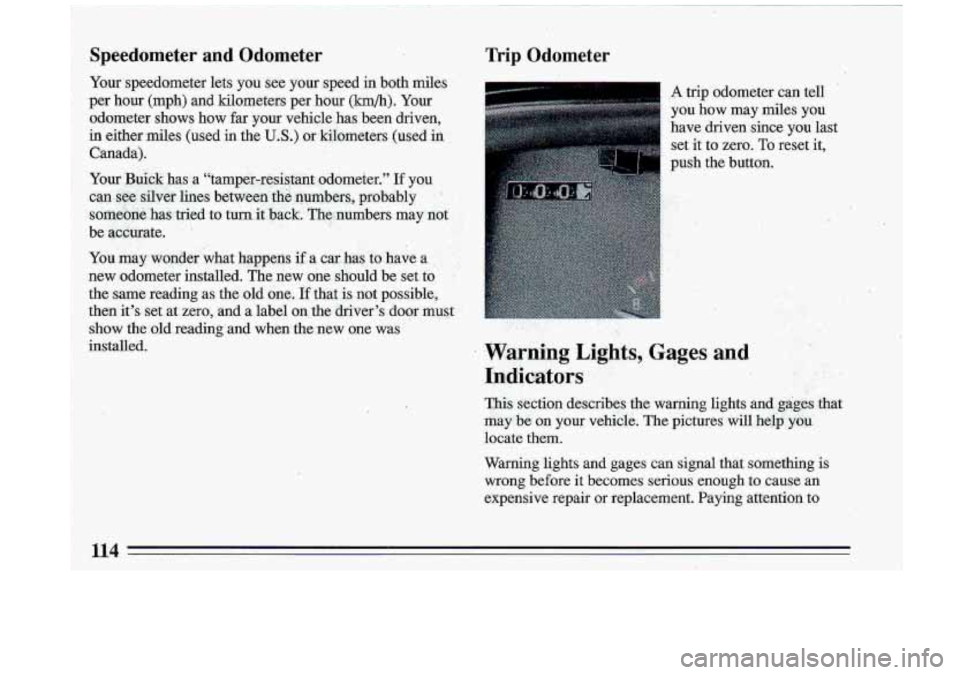
Trip Odometer
A trip odometer can tell
you how may 'miles you
have driven since you last
set it to zero.
To reset it,
sh the button.
- .. :,:j:?+jp$ 4 , '4'
Warning Lights, Gages and , .) ,~~~~~'~~$$~:' . I l, ?&&- I , ,
_* .;,,".' , . ' y;.. _' ' -" , *: .?..< 7' , .I. ' , 3,;. &.*:;>$y+ , 1. . ->?&$&..
This, section describes the warning lights and gkges that
may'
be on your vehicle. The pictures will help yb~'
locate them.
Warning 'lights and gages can signal that something is
wrong before it becomes
serious enough to cause an
expensive repair or replacement. Paying attention to
,.
- 1:7.
1.n.dicators - ._
Page 161 of 340
Your Own Signals Defensive Driving
Drivers signal
to others, too. It’s not only more polite,
it’s safer ‘to let other drivers know what you are doing.
And in some places the law requires driver signals.
Turn and lane change signals. Always signal when you
plan to turn or change lanes.
If necessary, you can
use hand signals out the window:
Left arm straight out for
a left turn, down- for slow or
about-to-stop, and up for a right turn.
Slowing. down. If time allows, tap the brake pedal once
or twice
in advance of slowing or stopping. This warns
the driver behind you.
Disabled. Your -four-way flashers signal that your
vehicle is disabled or is a hazard. See “Hazard Warning
Flasher” in the Index.
Traffic Officer
The traffic police officer is also a source of important
information.
The officer’s signals govern, no matter
what the traffic lights or other signs say.
The next section discusses some of the road conditions
you
may encounter. The
best advice anyone can give about driving is: Drive
i
defensively. !
Please start with a very important safety device in your
Buick: Buckle up. (See “Safety Belts” in the Index.) i
Defensive driving really means “be ready for anything.”
On city streets, rural roads, or freeways, it means
“always expect the unexpected.”
Assume that pedestrians or other drivers are going to be
careless and make mistakes. Anticipate what they might
do. Be ready for their mistakes.
Expect children to dash out from behind parked cas,
often-followed by other children. Expect occupants
in
parked cars to open doors into traffic., Watch for
movement
in parked cars - someone may be about to
open a door.
Expect other drivers to run stop signs when. you are on a
through street. Be ready to brake if necessary
as you go
through intersections. You may not have
to use the
brake, but if you do, you will be ready.
If you’re driving through a shopping center parking lot
where there are well-marked lanes, directional arrows,
and designated parking areas, expect.some drivers to
159
__
Page 172 of 340
Try to adjust‘ your speed so you can “drive” through the
curve. Maintain a reasonable, steady speed. Wait to
accelerate until you are out
of the curve, and then
accelerate gently
into the straightaway.
When you drive into a curve at night, it’s harder to see
the road ahead
of you because it bends away from the
straight beams
of your lights. This is one good reason. to
drive slower.
Steering in Emergencies
There are times when steering can be more effective
than braking. For example, you come over a hill and
find a truck stopped
in your lane, or a car suddenly pulls
out
f-rom nowhere, or a child darts out from between
parked
cars and stops right in front of you. You can
avoid these problems by braking
- if you can stop in
time. But sometimes you can’t; there isn’t room. That’s\
the time for evasive action
- steering around the
problem.
Your Buick can perform very well in emergencies like
these. First apply your brakes. It is better to remove as
much speed as you can
from a possible collision. Then
steer around the problem, to the left
or right depending
on the space available,