lights BUICK ROADMASTER 1993 User Guide
[x] Cancel search | Manufacturer: BUICK, Model Year: 1993, Model line: ROADMASTER, Model: BUICK ROADMASTER 1993Pages: 340, PDF Size: 18.34 MB
Page 177 of 340
vehicle is skidding. Learn to recognize warning clues -
such as enough water, ice or packed snow on the road to
make a “mirrored surface’’
- and slow .down when you
.have any doubt.
Remember: Any anti-lock braking system (ABS) helps
avoid only the braking skid. Steer the way you want
to
go-
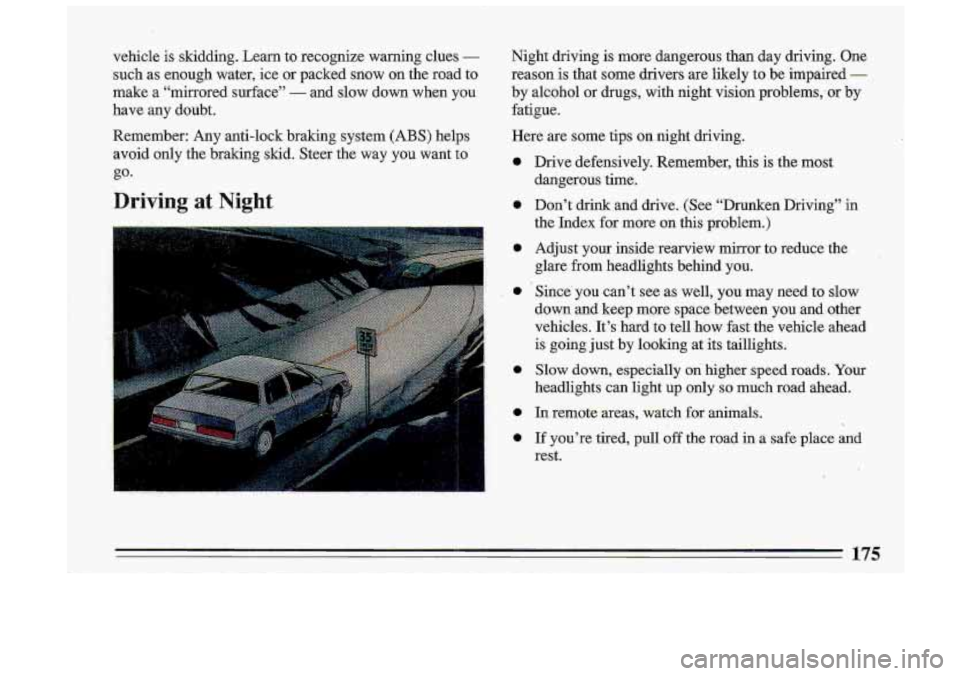
Driving at Night
Night driving is more dangerous than day driving. One
reason is that some drivers are likely to be impaired
-
by alcohol or drugs, with night vision prob1ems;or by
fatigue.
Here are some tips on night driving.
0
0
0
0
a
0
0
Drive defensively. Remember, this is the most
dangerous time.
Don’t drink and drive. (See “Drunken Driving.” in
the Index for more on this problem.)
Adjust your inside rearview mirror to reduce the
glare from headlights behind you.
Since’ you can’t see as well,
you may need to slow
down and
keep more space between you and other
vehicles. It’s hard to tell how fast the vehicle ahead
is going just
by looking at its taillights,
Slow down, especially on higher speed roads. Your
headlights can light up only
so much road ahead.
In remote areas, watch for animals.
If you’re tired, pull
off the road in a safe place and
rest.
175
I
.!
I
Page 178 of 340
Night Vision
'No one can see as we11 at night as in the daytime. But as
we get older these differences increase.
A 50-year-old
driver may require .at least twice as much light
to see the
same thing at night as a 20-year-old.
What you do in the daytime can also affect your night
vision.
For example, if you spend the day in bright
sunshine you are wise to wear sunglasses.
Your eyes will
have less trouble adjusting to night.
But'if you're driving, don't wear sunglasses at night.
They.may cut down on glare from headlights, but they
also make a lot
of things invisible that should remain
yisible
- such as parked cars, obstacles, pedestrians, or
even train5 blocking railway crossings. You mzy want to
put on
your sunglasses -after ,you have pulled into a
brightly-lighted service or refreshment area. Eyes shie1ded.from that glare
may adjust.more quickly to
darkne,ss back on the road. But be sure to remove your
sunglasses before
you leave the service area.
When you .follow another vehicle
on a freeway or
highday, use low beams. True, most vehic1e.s now.have,
day-night mirrors that enable the driver to reduce glare.
But outside mirrors are not
of this type and.high beams
from behind can bother the driver ahead.
176
Page 182 of 340
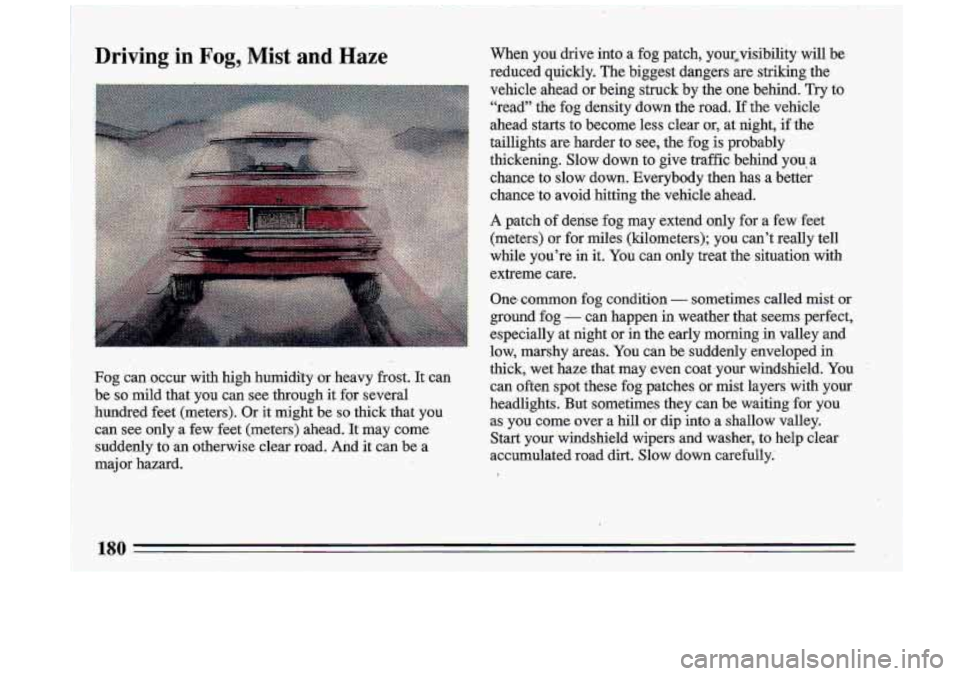
Driving in Fog, Mist and Haze When you drive into a fog patch, your$sibility will be
reduced quickly. The biggest dangers
are striking the
vehicle ahead or being struck by the
one behind. Try to
‘‘read” the fog density down the road.
If the vehicle
ahead starts to become less clear
or, at night; if the
taillights are harder to see,
-the fog is probably
thickening. Slow down to give- traffic behind you. a
chance to slow down. Everybody then has a better chance.to avoid hitting the vehicle ahead.
A patch of derise fog may extend only for a few feet
(meters) or for miles (kilometers); you can’t really tell
while you’re
in it. You can only treat ‘the situation with
extreme tare.
One, common fog condition - sometimes called mist or
ground fog - can happen in weather that seems perfect,
especially at night or in the early
morning in valley and
low, marshy areas. You can be suddenly enveloped
in
thick, wet haze that may even coat ,your windshield. You
can often spot these fog patches .or mist layers with
your
headlights. But sometimes they can be waiting for you
as you come over a hill or dip into a. shallow valley.
Start your windshield wipers and washer, to help clear
accumulated road dirt. Slow down carefully.’
Fog can occur with high humidity or heavy frost. It can
be
so mild that- you can see through it for several
hundred feet (meters). Or-it might
he so thick .that you
can see only
a few feet (meters) ahead. It may come
suddenly
to an otherwise clear road. And it can be a
major hazard.
Page 183 of 340
Tips on Driving in Fog
If you get caught in fog, turn your headlights on low
beam, even in daytime. You’ll see
- and be seen -
better.
Pass other vehicles in fog only if you can see far enough
ahead to pass safely. Even then, be prepared to delay
your pass if you suspect the
fog.is worse up ahead. If
other vehicles try to pass you, make it easy for them.
*
If visibility is near zero and you must stop but are
unsuTe whether you are away
from the road, turn your
lights on, start
your hazard warning flasher, and sound
your
Born at intervals or when you hear approaching
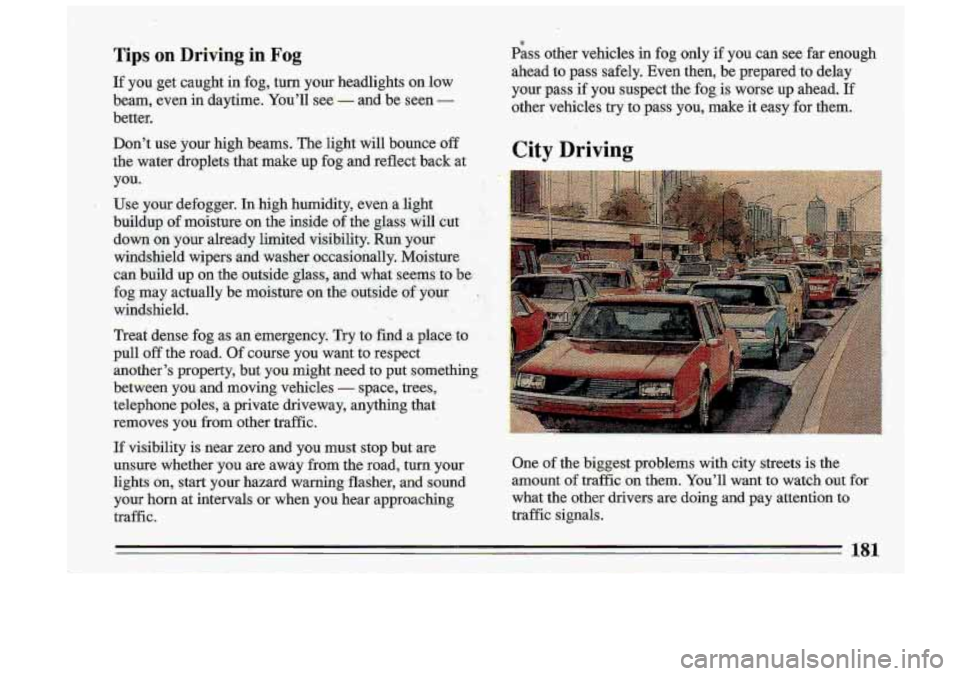
traffic. One
of the
biggest problems with city streets is the
amount of traffic
on them. You’ll want to watch out for
what the other drivers are doing and pay attention
to
traffic signals.
181
Page 197 of 340
Run your engine only as long as you must. This saves
fuel. When you
run the engine, make it go a little faster
than just idle. That is, push the accelerator slightly. This:
uses less fuel for the heat that you get and it keeps the
battery charged.
You will need a well-charged battery to
restart the vehicle, and possibly for signaling later
on
with your headlights. Let the heater run for awhile.
Then, shut the engine
off and close the window almost
all the way to preserve the heat. Start the engine again
and repeat this only when you feel really uncomfortable
from the cold. But do
it as 'little as possible. Preserve the
fuel
as long as you can. To help keep warm, you can get
out of the vehicle and
do some fairly vigorous exercises
every half hour or
so until help comes.
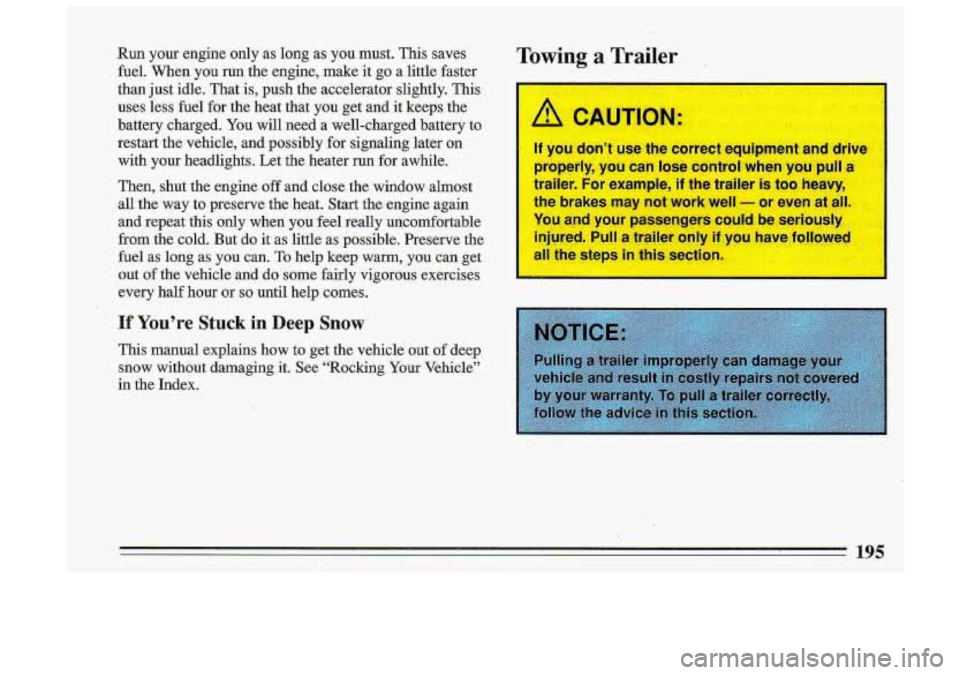
Towing, a Trailer
/! CAUTION-
If you don't use the correct equipment and drive
properly, you can lose control when you
pull a
trailer.
For example, if the trailer is too heavy,
I the brakes may not work well - or even at all,
You and your passengers could be seriously'
injured. Pull
a trailer only if you have followed
I the steps in this section.
Page 201 of 340
Driving with a Trailer
Towing a trailer requires a certain amount of experience. Before setting out for the open road, you’ll want to get
to
know your rig. Acquaint yourself with the feel of
handling and braking. with the added weight of the
trailer. And always keep in mind that the vehicle you are
driving is now
a good deal longer and not nearly so
responsive as your vehicle is by itself.
Before you start, check the trailer hitch and platform,
safety chains, electrical connector, lights, tires and
mirror adjustment.
If the trailer has electric biakes, start
your yehicle and trailer moving and then apply the
trailer brake controller by hand to be sure the- brakes are
working. This lets you check your electrical connection
at the same time.
During your trip, check occasionally to
be sure that the
load
is secure, and that the Lights.and any trailer brakes
are .still working.
Following Distance
Stay at least twice as far behind the vehicle ahead as you
would when driving your vehicle without a trailer. This
can help
you avoid situations that require heavy braking
and sudden turris.
.
Passing
You’ll need. more passing distance up ahead when
you’re towing a trailer. And, because you’re a good deal \
longer, you’ll need to go much farther beyond the
.
passed vehicle before you can return to your lane.
Backing Up
Hold the bottom of the steering wheel with one hand.
Then, to move the trailer
to the left, just move that hand
to the left.
To mo.ve the trailer to the right, move your
hand to the right. Always back up slowly and, if
possible, have someone guide
you.
Making Turns
When you’re turning with a trailer, make wider turns
than normal.
Do this so your trailer won’t strike soft
shoulders, curbs, road signs, trees, or other objects.
Avoid jerky or sudden maneuvers. Signal well in
advance.
Turn Signals When Towing a Trailer
When you tow a trailer, your vehicle has to have .a
different turn signal flasher and extra wiring. The green
arrows on your instrument panel will
flash whenever
you signal a
turn or lane change. Properly hooked up,
199
Page 207 of 340
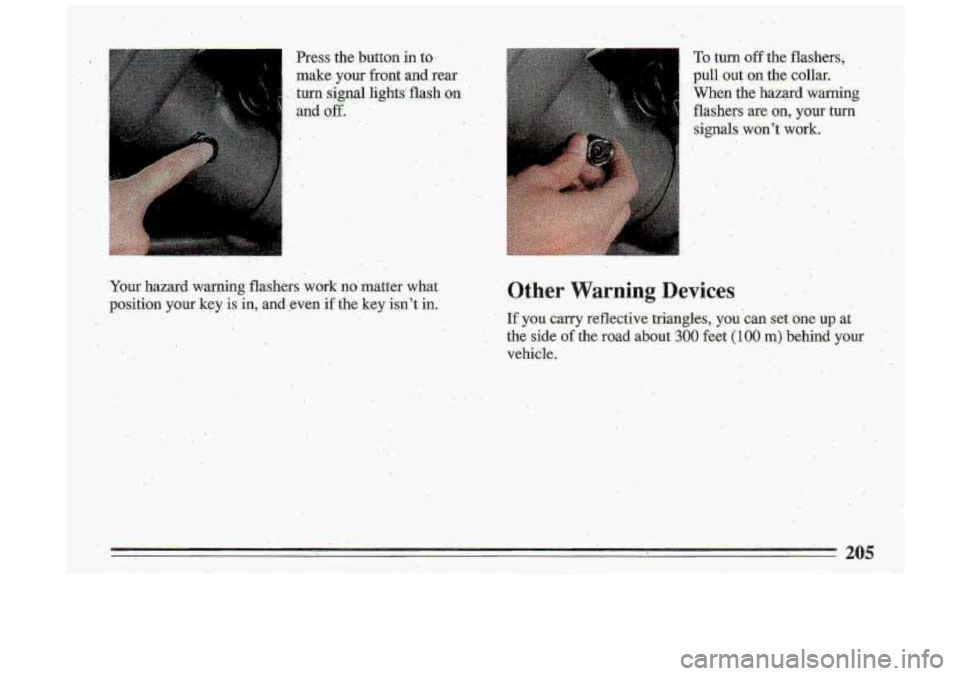
7 Press the button in to. ~ make your front and, rear
i : turn s$gnal .lights' flash on
and
off. .. . ,.
,.
I .'
Your hazard warning -flashers work no' matter wnat
position your key is in, and even if the key isn't in.
To turn off the flashers,
pull out on the collar.
When the hazard
warning
flashers are on, your turn
signals won't work.
Other Warning Devices
If you carry reflective triangles; you can set one up at
the side
of the road about 300 feet (100 m) behind your
vehicle.
205
Page 209 of 340
I
I
You eou be injured ! V€ !s roll
parking brake firmly on each vehicle. Put an
automatic transmission
in ‘‘P” (Park) or a
manu nsl in 9
3. Twm off the ignition .on both vehicles. Turn ofr all
lights that aren’t needed, and radios. This will avoid
sparks- and help save both batteries. And
it could
save your radio!
4. Open the hoods and locate the batteries. Find the
positive (+) and negative (-) terminals on each
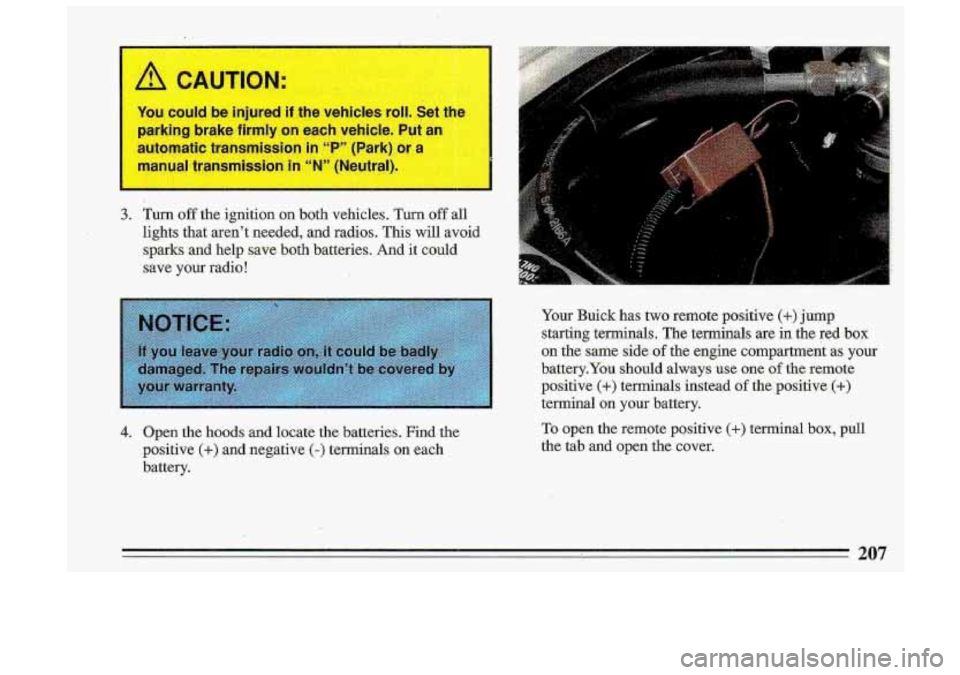
battery. Your Buick has two remote positive.
(+) jump
starting terminals.
The terminals are in the red box
on the. same side’of the engine compartment BS your
battery.You should always use one, of the remote
.positive
(+) terminals instead of the positive (+)
terminal on your battery.
To open the remote positive (+) terminal box, pull
the tab and open the cover.
Page 293 of 340
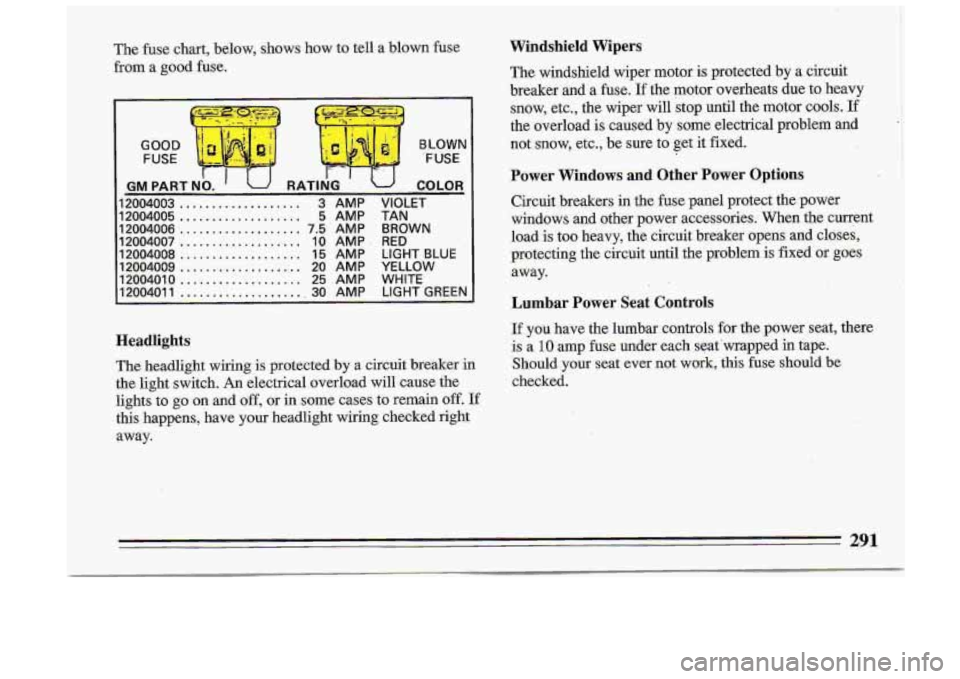
The fuse chart, below, shows how to tell a blown fuse
from a good fuse.
GOOD
FUSE
I
BLOWN
-FUSE
I
GM PARTNO.. ' RATING ' LJ COLOR
12004003 ................... 3 AMP VIOLET
I2004005 ................... 5 AMP TA-N- .
12004006 ................... 7.5 AMP BROWN
12004007 ................... IO AMP . RED
12004008 ................... 15 AMP LIGHT BLUE
12004009 ................... 20 AMP YELLOW
12004010 ................... 25 AMP WHITE
1200401 1 .................... 30 AMP LI'GHT GREEN
Headlights
The headlight wiring is protected by a circuit breaker in
the light switch. An electrical overload will cause the
lights to
go on and off, or in some cases to remain off. If
this happens, have your headlight wiring checked right
away.
Windshield Wipers.
The windsheld wiper motor is protected hy a circuit
breaker and a fuse.
If the motor overheats due to heavy
snow, etc., the wiper will stop until the motor cools.
If
the .overload is caused by some electrical problem and
not snow, etc., be sure to get it fixed.
Power Windows and Other Power Options
Circuit .breakers in the fuse panel protect the power
windows and other power accessories. When the current
load is too heavy, the circuit breaker opens. and closes,
protecting the circuit until the problem is fixed or goes
away.
Lumbar Power Seat Controls
If you have the lumbar controls for the power seat, there
is a
10 amp fuse under each seat 'wrapped in tape.
Should your
seat ever not work, this fuse should be
checked.
Page 333 of 340
.Gasoline ....................................... 243
Gasoline Tank. Filling Your
........................ 245
Gate Ajar Light
................................. 124
Gear Positions
................................... 78
Glass Cleaning
.................................. 282
Graphic Symbols
................................. 12
Guard Against Theft
.............................. 72
Guide en Francais
................................. 2
Halogen
Bulbs ................................. 265
Hazard Warning Flasher ........................... 204
Haze. Driving in ................................. 180
Headlamp Bulb Replacement
....................... 265
Headlight High-Low Beam Switch
. : ................. 90
Head Restraints ................................... 18
Heater
..................................... 128.. '13 1
Highway Hypnosis ............................... 185
Hill and Mountain Roads
.......................... 186
Hills. Parking on
.............. : ................. 188
Hitches. Trailer
.................................. 198
Holding
a Baby in Your Car ......................... 46
Hood. Opening the
............................... 247
Horn
........................................... 88
Hot Coolant Warning Light
........................ 122
Hot Engine. Safety Warnings About
................. 216
Hydroplaning
................................... 179
Ice. Driving
on ................................. 192
Identification Label. Service Parts
................... 287
Identification Number. Vehicle
..................... 287
Hearing Impaired. Customer Assistance
for
........... 320
High Speed Shifting When Your Engine
is Running ...... 79 Idling
Your Engine
................................ 86
If You're Stack: In Sand. Mud. Ice or Snow ........... 239
Ignition Key Positions
............................. 74
Indicator. Turn Signal
.............................. 89
Indicators. Disc Brake Wear
....................... 168
Infant Restraint
.................................. -47
Inflation. Tire
................................... 272
Inside Mirror
.................................... 102
Inspection. Tire
................................. 273
Instrument Panel
................................ 113
Interior Cleaning
............ *- .................. -280
Interlock. Brake-Transmission
Shift ............... 78. 84
Introduction. How
to Use this Manual ................. 10
Jack. Tire ..................................... 224
Jacking Up the Car
............................... 232
Jump Starting
................................... 206
Keys
.......................................... 62
Keyless Entry System. Remote
...................... 69
Kilometer Indicator
.............................. 114
Label. Service Parts Identification
.................. 287'
Lane Change Indicator
............................. 89
Lap-Shoulder Belt Usage by Children
.................. 56
Leaving Your Vehicle ............................ 65. 84
Light Bulbs. Replaceable
........................... 294
Light. Safety Belt
.............................. 21. 27
Light. Turn Signal Indicator
......................... 89
Indicators. Warning Lights. Gages
& ................. 114
LapBelt
........................................ 41