steering BUICK SKYLARK 1993 User Guide
[x] Cancel search | Manufacturer: BUICK, Model Year: 1993, Model line: SKYLARK, Model: BUICK SKYLARK 1993Pages: 306, PDF Size: 15.84 MB
Page 156 of 306
When you drive into a curve at night, it's harder to see
the road ahead
of you because it bends away from the
straight beams
of your lights. This is one good reason to
drive slower.
Steering in Emergencies
There are times when steering can be more effective
than braking. For example,
you come over a hill and
find a truck stopped in your lane, or a car suddenly pulls
out from nowhere, or a child darts out from between
parked cars and stops right in front
Qf you. You can
avoid these problems by braking
-- if you can stop in
time. But sometimes you can't; there isn't room. That's
the time for evasive action
-- steering around the
problem.
Your Buick can perform very well in emergencies like
these. First apply your brakes. It is better to remove as
much speed as you can from a possible collision. Then
steer around the problem, to the left or right depending
on the space available.
An emergency like this requires close attention and a
quick decision.
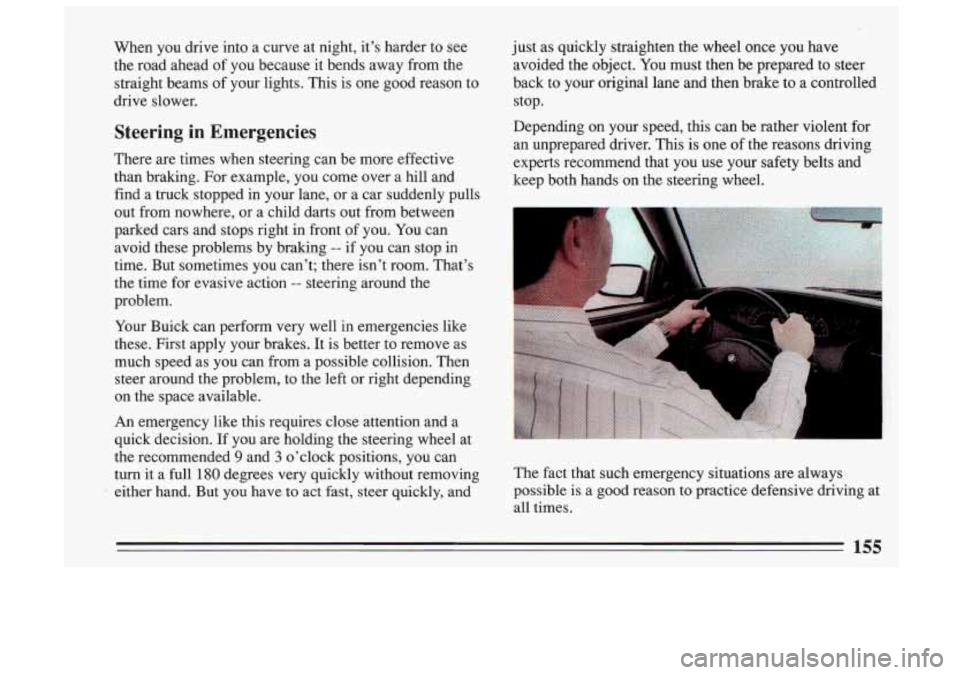
If you are holding the steering wheel at
the recommended
9 and 3 o'clock positions, you can
turn it a full
180 degrees very quickly without removing
either hand. But you have to act fast, steer quickly, and just as
quickly straighten the wheel once you have
avoided the object. You must then be prepared to steer
back to your original lane and then brake to a controlled
stop.
Depending
on your speed, this can be rather violent for
an unprepared driver. This is one of the reasons driving
experts recommend that you use your safety belts and
keep both hands on the steering wheel.
-1
3'
The fact that such emergency situations are always
possible is a good
reason to practice defensive driving at
all times.
155
Page 157 of 306
I
Off-Road Recovery
You may find sometime that your right wheels have
dropped off the edge
of a road onto the shoulder while
you’re driving.
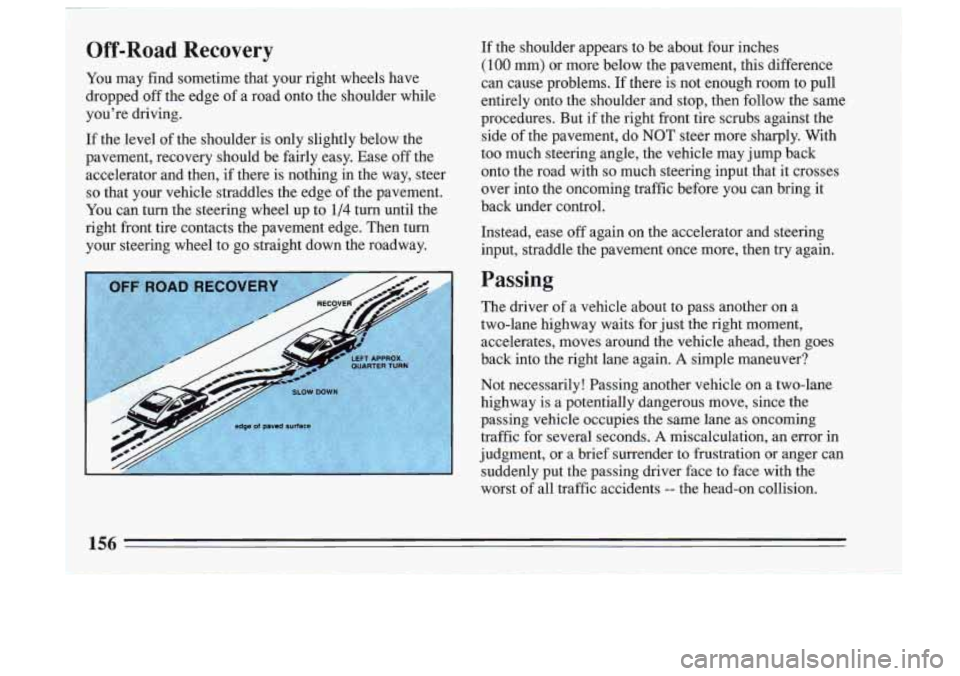
If the level of the shoulder is only slightly below the
pavement, recovery should be fairly easy. Ease off the
accelerator and then, if there is nothing in the way, steer
so that your vehicle straddles the edge of the pavement.
You can turn the steering wheel up to
1/4 turn until the
right front tire contacts the pavement edge. Then turn
your steering wheel to go straight down the roadway. If
the shoulder appears to be about four inches
(100 mm) or more below the pavement, this difference
can cause problems. If there
is not enough room to pull
entirely onto the shoulder and stop, then follow the same
procedures. But if the right front tire scrubs against the
side
of the pavement, do NOT steer more sharply. With
too much steering angle, the vehicle may jump back
onto the road with
so much steering input that it crosses
over into the oncoming traffic before you can bring it
back under control.
Instead, ease off again on the accelerator and steering
input, straddle the pavement once more, then try again.
Passing
The driver of a vehicle about to pass another on a
two-lane highway waits for just the right moment,
accelerates, moves around the vehicle ahead, then goes
back into the right lane again.
A simple maneuver?
Not necessarily! Passing another vehicle on a two-lane
highway is a potentially dangerous move, since the
passing vehicle occupies the same lane as oncoming
traffic for several seconds.
A miscalculation, an error in
judgment, or a brief surrender to frustration or anger can
suddenly put the passing driver face to face with the
worst of all traffic accidents
-- the head-on collision.
Page 159 of 306
0
0
0
Try not to pass more than one vehicle at a time on
two-lane roads. Reconsider before passing the next
vehicle.
Don’t overtake a slowly moving vehicle too rapidly.
Even though the brake lights are not flashing, it may
be slowing down or starting to turn.
If you’re being passed, make it easy for the
following driver to get ahead of you. Perhaps you
can ease a.little to the right.
Loss of Control
Let’s review what driving experts say about what
happens when the three control systems (brakes, steering and acceleration) don’t have enough friction where the
tires meet the road to do what the driver has asked.
In any emergency, don’t give up. Keep trying to steer
and constantly seek an escape route or area of less
danger.
Skidding
In a skid, a driver can lose control of the vehicle.
Defensive drivers avoid most skids by taking reasonable
care suited to existing conditions, and by not
“overdriving” those conditions. But skids are always
possible. The three types
of skids correspond
to your Buick’s
three control systems. In the braking skid your wheels
aren’t rolling.
In the steering or cornering skid, too
much speed or steering in a curve causes tires to slip and
lose cornering force. And in the acceleration skid too
much throttle causes the driving wheels to spin.
A cornering skid and an acceleration skid are best
handled by easing your foot off the accelerator pedal.
If your vehicle starts to slide (as when you- turn a corner
on a wet, snow- or ice-covered road), ease your foot
off
the accelerator pedal as soon as you feel the vehicle start
to slide. Quickly steer the way you want the vehicle to
go. If you start steering quickly enough, your vehicle
will straighten out. As it does, straighten the front
wheels.
Of course, traction is reduced when water, snow, ice,
gravel, or other material is on the road. For safety, you’l\
l
..
want to slow down and adjust your driving to these
conditions. It is important to slow down on slippery
surfaces because stopping distance will be longer and
vehicle control more limited.
While driving on a surface with reduced traction, try
your best to avoid sudden steering, acceleration, or
braking (including engine braking by shifting to a lower gear). Any sudden changes could cause the tires to slide.
You may not realize the surface is slippery until your
I
Page 178 of 306
remain icy when the surrounding roads are clear. If
you see a patch of ice ahead of you, brake before you
are on it. Try not to brake while you’re actually on
the ice, and avoid sudden steering maneuvers.
If You’re Caught in a Blizzard
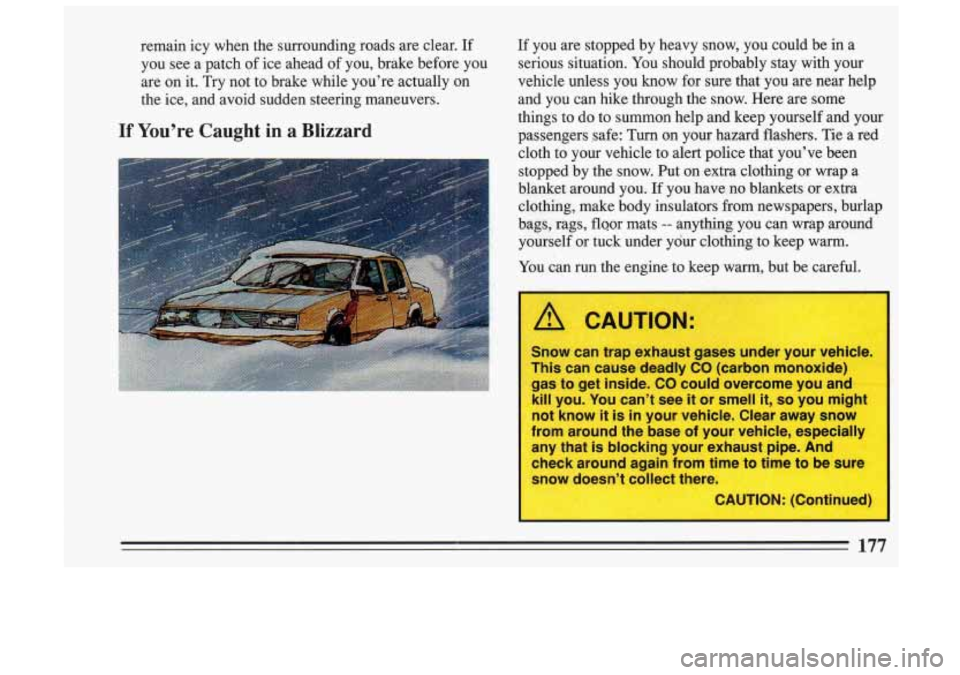
If you are stopped by heavy snow, you could be in a
serious situation. You should probably stay with your
vehicle unless you know for sure that you are near help
and you can hike through the snow. Here are some
things to do to summon help and keep yourself and your
passengers .safe: Turn on your hazard flashers. Tie a red cloth to your vehicle to alert police that you’ve been
stopped by the snow. Put on extra clothing
or wrap a
blanket around you.
If you have no blankets or extra
clothing, make body insulators from newspapers, burlap
bags, rags, flsor mats
-- anything you can wrap around
yourself
or tuck under your clothing to keep warm. I
You can run the engine to keep warm, but be careful.
I
A CAUTION:
dnow can trap exhaust gases under your vehicle
This can cause deadly
CO (carbon monoxide)
gas to get inside. CO could overcome you and
kill you. You can’t see
it or smell it, so you might
not know
it is in your vehicle. Clear away snow
from around the base of your vehicle, especia”--
any that
is blocking your exhaust pipe. And
check around again from time to time to be’su
snow doesn’t collect there.
177
Page 184 of 306

Passing
You’ll need more passing distance up ahead when
you’re towing a trailer. And, because you’re a good deal \
longer, you’ll need to go much farther beyond the
passed vehicle before you can return to your lane.
d
Backing Up
Hold the bottom of the steering wheel with one hand.
Then, to move the trailer to the left, just move that hand
to the left. To move the trailer to the right, move your
hand to the right. Always. back up slowly and, if
possible, have someone guide you.
Making Turns
When you’re turning with a trailer, make wider turns
than normal.
Do this so your trailer won’t strike soft
shoulders, curbs, road signs, trees, or other objects.
Avoid jerky or sudden maneuvers. Signal well in
advance.
nrn Signals When Towing a Trailer
When you tow a trailer, your vehicle has to have a
different turn signal flasher and extra wiring. The green
arrows on your instrument panel will flash whenever you signal a turn or lane change. Properly hooked up, the trailer lights will also flash, telling other drivers
you’re about to turn, change lanes or stop.
When towing a trailer, the green arrows on your
instrument panel will flash for turns even if the bulbs on
the trailer are burned out. Thus, you may think drivers
behind you are seeing your signal when they are not. It’s
important to check occasionally to be sure the trailer
bulbs are still working.
Driving On Grades
Reduce speed and shift to a lower gear before you start
down a long
or steep downgrade. If you don’t shift
down, you might have to use your’brakes
so much that
they would get hot and no longer work well.
On a long uphill grade, use the highest gear. possible. If
you cannot maintain posted speeds, driving at a lower
speed may help avoid overheating your engine and
transaxle.
Parking on Hills
You really should not park your vehicle, with a trailer
attached, on a hill. If something goes wrong, your rig
could
start to move. People can be injured, and both
your vehicle and the trailer can be damaged.
183
Page 195 of 306
P-
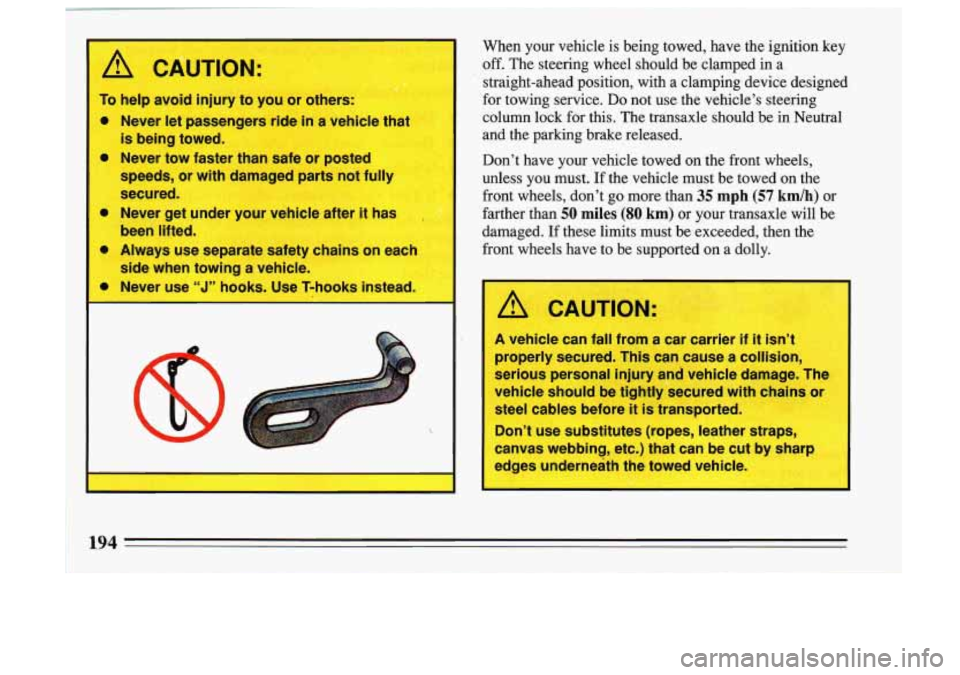
When your vehicle is being towed, have the ignition key
off. The steering wheel should be clamped in a
straight-ahead position, with a clamping device designed
for towing service.
Do not use the vehicle’s steering
column lock for this. The transaxle should be in Neutral
and the parking brake released.
Don’t have your vehicle towed on the front wheels,
unless you must.
If the vehicle must be towed on the
front wheels, don’t go more than
35 mph (57 kmh) or
farther than
50 miles (80 km) or your transaxle will be
damaged. If these limits must be exceeded, then the
front wheels have to be supported on a dolly.
CAUTION:
I A vehicle 1 fall from a car cal t It isn’t
properly secured. This can cause a collision,
serious personal injury and vehicle damage. The
vehicle should be tightly secured with chains or
steel cables before
it is transported.
on’t use substitutes (ropes, leather straps,
canvas webbing, etc.) that can be cut by
sh; 1
I
I edges underneath the towed vehicle.
Page 205 of 306
.If a Tire Goes Flat Changing a Flat Tire
It’s unusual for a tire to “blow out” while you’re driving,
especially
if you maintain yourtires properly. If air goes
out of a tire, it’s much more likely to leak out slowly.
But if you should ever have a “blowout,” here are a few
tips about what to expect and what to do:
1
If a front tire fails, the flat tire will create a drag that
pulls the vehicle toward that side: Take your foot off the
accelerator pedal and grip the steering wheel firmly. Steer to maintain lane position, then gentlv
I. - to a
stop well out of the traffic lane.
A rear blowout, particularly on a curve, acts much like a
skid and may require the same correction you’d use in a
skid. In any rear blowout, remove your foot from the
accelerator pedal. Get the vehicle under control by steering the way you want the vehicle to go. It may be
very bumpy and noisy, but you can still steer. Gently
brake to
a stop, well off the road if possible.
If your tire goes flat, the next section shows how to use
your jacking equipment to change a flat tire safely.
If a tire goes flat, avoid further tire and wheel damage
by driving slowly
to a level place. Turn on your hazard
warning flashers.
A “-CAUTION:
I Changing a tire can cause an injury. The vehicle
can slip off the jack and roll over you or other
people. You and they could be badly injured. Find
a level place to change your tire.
To help prevent
the vehicle from moving:
1. Set the parking brake K- Ay.
2. Put the shift lever in “P” (Park
3. Turn off the engine.
To be even more certain the vehicle won’t mob
you can put chocks at the front and rear of t
tire farthest away from the one being changed,
I That would be the tire on the oP?r side of the
vehicle, the oppos’-
1 end.
CAUTION: (Continued)
Page 215 of 306
Rocking your vehicle to get it out:
First, turn your steering wheel left and right. That will
clear the area around your front wheels. Then shift back
and forth between “R” and a forward gear
, spinning the
wheels as little as possible. Release the accelerator pedal
while you shift, and press lightly on the accelerator
pedal when the transaxle is in gear. If that doesn’t get
you out after a few tries, you may need
to be towed out.
If you do need to be towed out, see “Towing Your Car”
in the Index.
Page 235 of 306
Power Steering Fluid What to Add:
I
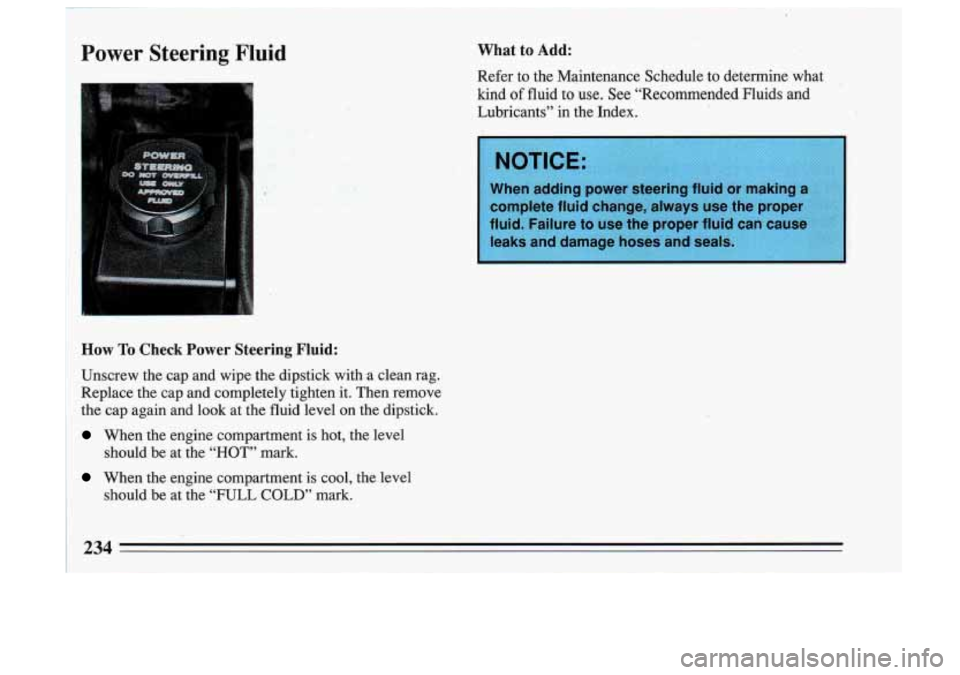
How To Check Power Steering Fluid:
Unscrew the cap and wipe the dipstick with .a clean rag.
Replace the cap and completely tighten it. Then remove
the cap again and look at the fluid level on the dipstick.
When the engine compartment is hot, the level
When the engine compartment is cool, the level
should be at the
“HOT” mark.
should be at the “FULL COLD” mark. Refer
to the Maintenance Schedule
to determine what
kind
of fluid to use. See “Recommended Fluids and
Lubricants”
in the Index.
234
Page 259 of 306
Fuses and Circuit Breakers
The wiring circuits in your car are protected from short
circuits.by a combination of fuses, circuit breakers, and
fusible thermal links in the wiring itself. This greatly
reduces the chance of fires caused by electrical
problems.
Be sure to use the correct fuse. If you ever have a
problem on the road and don’t have a spare fuse, you
I
can “borrow” one of the identical size and rating. Just
pick some feature of your car that you can get along
without
-- like the radio or cigarette lighter -- and use its
fuse, if it is of the value you need. Replace it as soon as
you can.
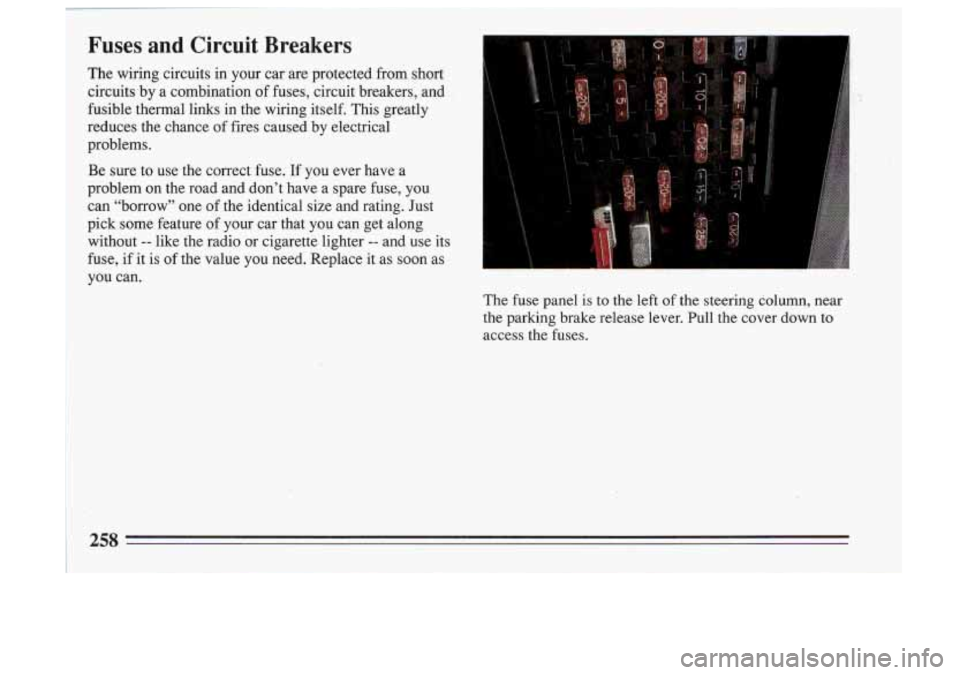
The fuse panel
is to the left of the steering column, near
the parking brake release lever. Pull the cover down to
access the fus.es.
I
258