tow BUICK SKYLARK 1993 Owner's Guide
[x] Cancel search | Manufacturer: BUICK, Model Year: 1993, Model line: SKYLARK, Model: BUICK SKYLARK 1993Pages: 306, PDF Size: 15.84 MB
Page 215 of 306
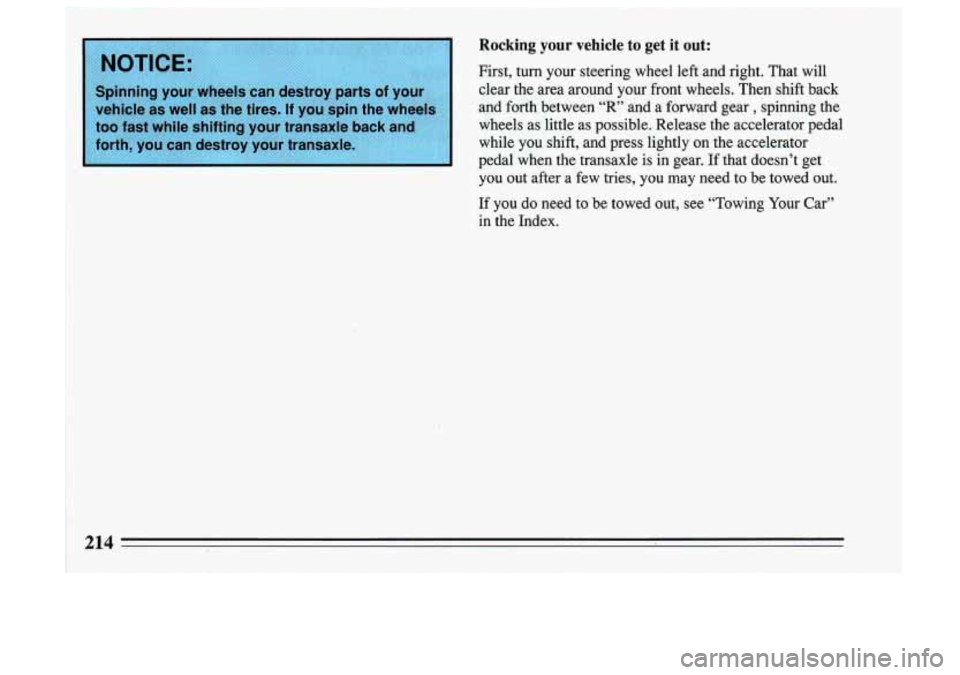
Rocking your vehicle to get it out:
First, turn your steering wheel left and right. That will
clear the area around your front wheels. Then shift back
and forth between “R” and a forward gear
, spinning the
wheels as little as possible. Release the accelerator pedal
while you shift, and press lightly on the accelerator
pedal when the transaxle is in gear. If that doesn’t get
you out after a few tries, you may need
to be towed out.
If you do need to be towed out, see “Towing Your Car”
in the Index.
Page 225 of 306
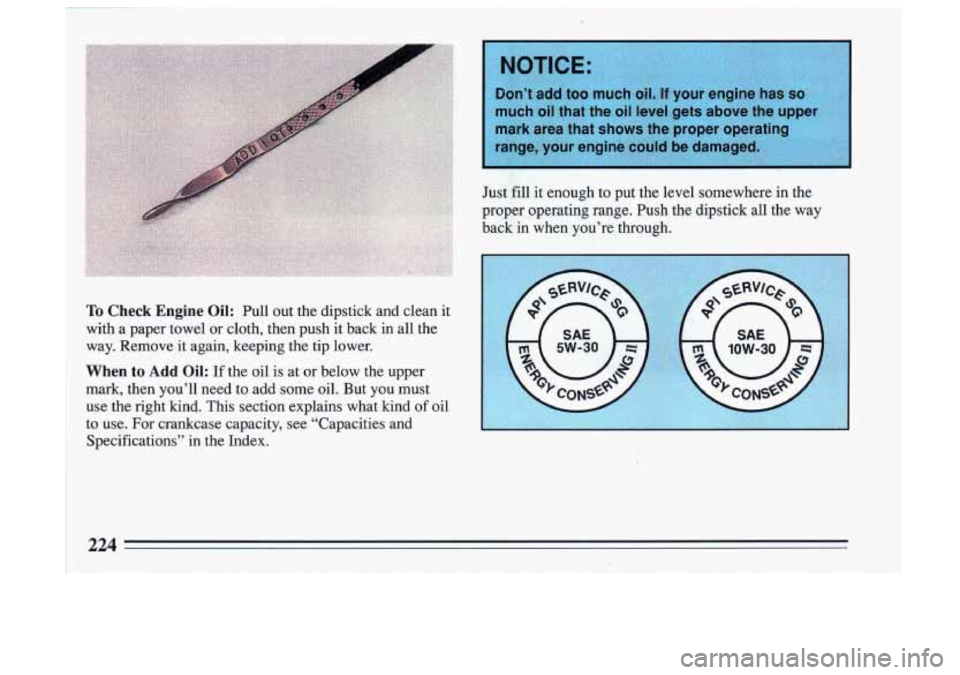
To Check Engine Oil: Pull out the dipstick and clean it
with a paper towel
or cloth, then push it back in all the
way. Remove it again, keeping the tip lower.
When to Add Oil: If the oil is at or below the upper
mark, then you’ll need
to add some oil. But you must
use the right kind,. This section explains what kind of oil
to use. For crankcase capacity, see “Capacities and Specifications” in the Index.
224
I
Page 228 of 306
0 It’s below freezing outside and most trips are less
than
10 miles (16 km).
0 The engine is at low speed most of the time (as in
door-to-door delivery, or in stop-and-go traffic).
0 You tow a trailer often.
0 Most trips are through dusty places.
If any one
of these is true for your vehicle, then you
need to change your oil and filter every
3,000 miles (5
000 km) or 3 months -- whichever comes first.
If none of them is true, change the oil every 7,500 miles
(12
500 km) or 12 months -- whichever comes first.
Change the filter at the first oil change and at every
other oil change after that.
Engine Block Heater: An engine block heater can be a
big help if you have to park outside in very cold weather, -20
F (-29 C) or colder. If your vehicle has
this option, see “Engine Block Heater.” in the Index.
What to Do with Used Oil:
I sed engine oil contains things that have caused
skin cancer in laboratory animals. Don’t let used
oil stay on your skin for very long. Clean your
skin and nails with soap and water,
or a good
hand cleaner. Wash
or properly throw away
c-othing
or rags containing used engine oil.
Used oil can be a real threat to the environment. Don’t
ever dispose of it by pouring it on the ground, into
sewers, or into streams or bodies of water. Instead,
recycle it by taking it to a place that collects used
oil. If
you have a problem propeily disposing of your used oil,
ask your dealer, a service station or a local recycling center for help.
227
Page 231 of 306
Wait at least 30 minutes before checking the transaxle
fluid level if you have been driving:
When outside temperatures are above 90 ’ F (32 ’ C).
0 At high speed .for quite a while.
In heavy traffic -- especially in hot weather.
While pulling a trailer.
To get the right reading, the fluid should be at normal
operating temperature, which is 180’F to 200’F (82OC
Get the vehicle warmed up by driving about
15 miles
(24 km) when outside temperatures are above 50’F
(1 0 C). If it’s colder than 50 OF (10 ’ C), you may have
to drive longer.
To’check the fluid level:
to 93
“C).
0
e
0
Park your vehicle on
a level place.
Place the
shift lever in “F”’ (Park) with the parking
brake applied.
With your foot on the brake pedal, move the shift
lever through each gear range, pausing for about
three seconds
in each range. Then, position the shift
lever
in “P,’ (Park).
Let the engine
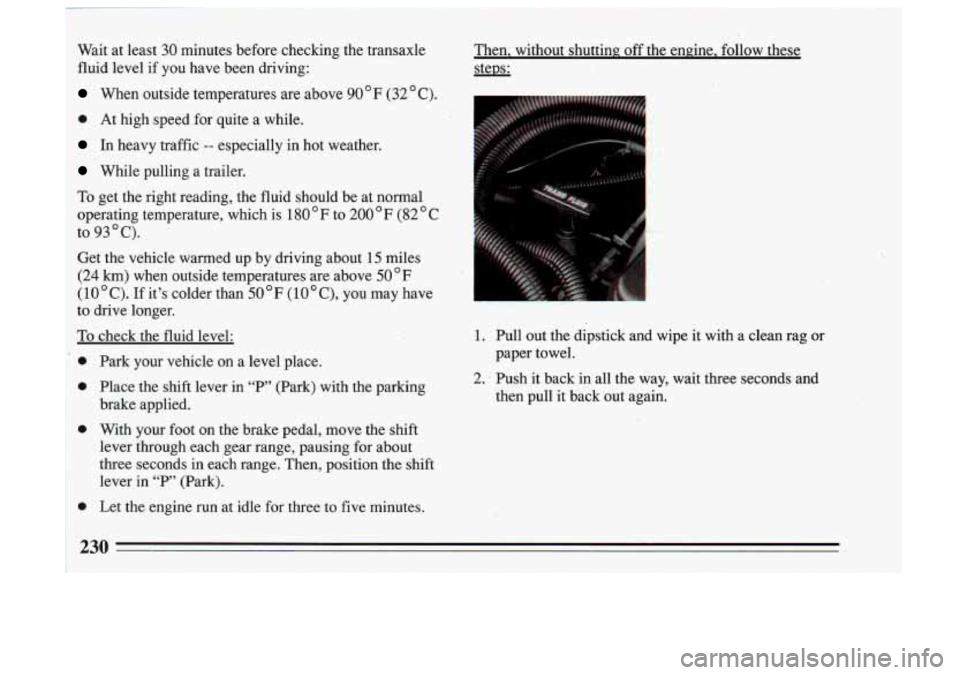
run at idle far three to five minutes. Then; without shutting off the engine, follow these
steps:
.I. Pull out the dipstick and wipe it with a clean rag or
paper towel.
2. . Push it back in all the way, wait three seconds and
then pull it back out again.
Page 251 of 306
r
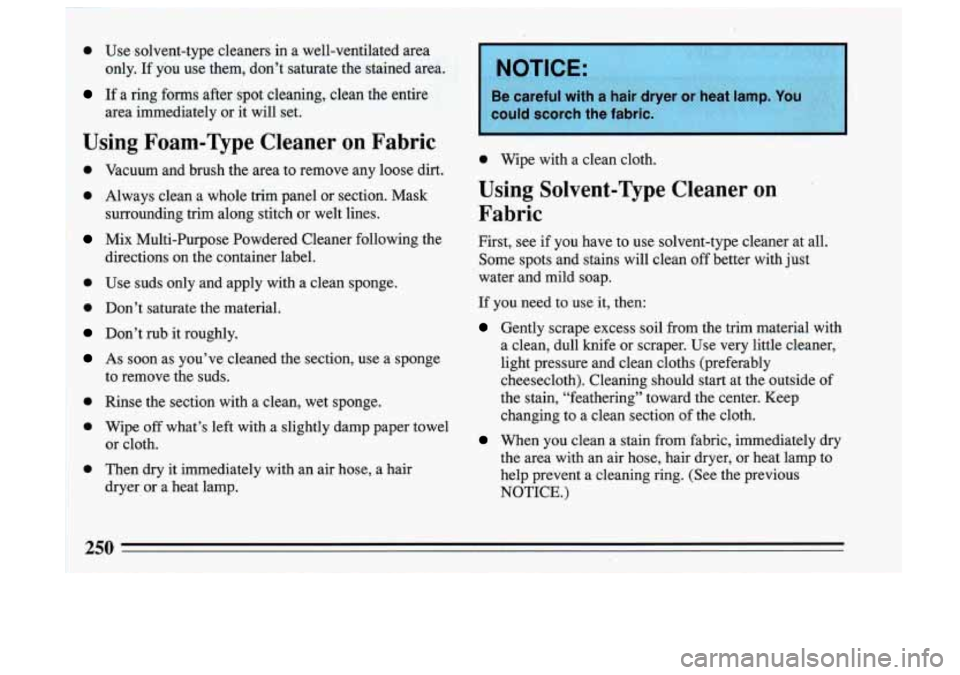
1 e Use solvent-type cleaners in a well-ventilated area
only.
If you use them, don’t saturate the stained area.
If a ring forms after spot cleaning, clean the entire
area immediately or it will
set.
Using Foam-Type Cleaner on Fabric I
0 Vacuum and brush the area to remove any loose dirt.
0 Always clean a whole trim panel or section. Mask ’
surrounding trim along stitch or welt lines.
Mix Multi-Purpose Powdered Cleaner following the
directions on the container label.
0 Use suds only and apply with a clean sponge.
0 Don’t saturate the material.
Don’t rub it roughly.
As soon as you’ve cleaned the section, use a sponge
to remove the suds.
0 Rinse the section with a clean, wet sponge.
0 Wipe off what’s left with a slightly damp paper towel
or cloth.
0 Then dry it immediately with an air hose, a hair
dryer or a heat lamp.
1
0 Wipe *with a clean cloth.
Using Solvent-Type Cleaner on
Fabric
First, see if you have to use solvent-type cleaner at all.
Some spots and stains will clean
off better with just
water and mild soap.
If
you need to use it, then:
Gently scrape excess soil from the trim material with
a clean, dull knife or scraper. Use very little cleaner,
light pressure and clean cloths (preferably cheesecloth). Cleaning should start at the outside of
the stain, “feathering” toward the center. Keep
changing to a clean section of the cloth.
When you clean a stain from fabric, immediately dry
the area with an air hose, hair dryer, or heat lamp to
help prevent a cleaning ring. (See the previous
NOTICE.)
Page 254 of 306
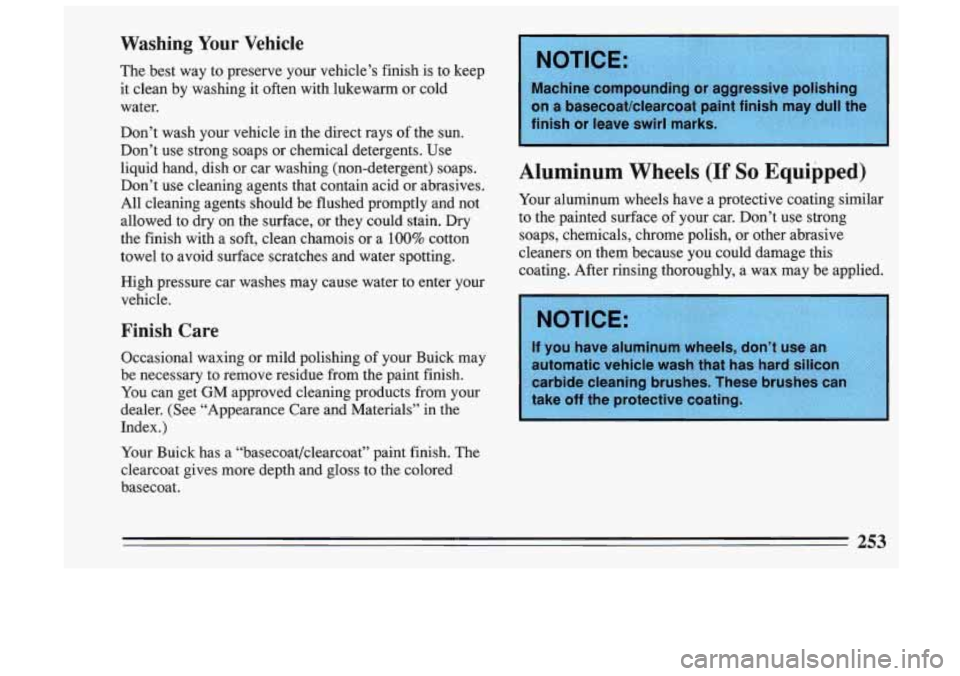
Washing Your Vehicle
The best way to preserve your vehicle’s finish is to keep
it clean by washing it often with lukewarm or cold
water.
Don’t wash your vehicle in the direct rays of the sun.
Don’t use strong soaps or chemical detergents. Use
liquid hand, dish or car washing (non-detergent) soaps.
Aluminum Wheels (If So Equipped)
Don’t use cleaning agents that contain acid or abrasives.
All cleaning agents should be flushed promptly and not Your alUminUm wheels have a protective Coating SiIdar
allowed to dry on the surface, or they could stain. Dry to the painted surface
of your car. Don’t use strong
the finish with a soft, clean chamois or a
100% cotton soaps, chemicals, chrome polish,
or other abrasive
towel to avoid surface scratches and water spotting. cleaners on them because you could damage this
High pressure car washes may cause water to enter your
vehicle. coating. After rinsing thoroughly, a wax may be applied.
Finish Care
Occasional waxing or mild polishing
of your Buick may
be necessary to remove residue from the paint finish.
You can get
GM approved cleaning pr,oducts from your
dealer. (See “Appearance Care and Materials” in the
Index.)
Your Buick has
a “basecoat/clearcoat” paint finish. The
clearcoat gives more depth and gloss to the colored
basecoat.
if you have aluminum wheels, don’t use an
automatic vehicle wash that has hard silicon
carbide cleaning brushes. These brushes can
take
off the Drotective coatina.
253
Page 270 of 306
Selecting the Right Schedule
First you’ll need to decide which of the two schedules is
right for your vehicle. Here’s how to decide which
0
schedule to follow: 0
Schedule I
Is any one of these true for your vehicle?
0 Most trips are less than 4 miles (6 km).
Most trips are less than 10 miles (16 km) when
outside temperatures are below freezing.
0 The engine is at low speed most of the time (as in
door-to-door delivery,
or in stop-and-go traffic).
You operate your vehicle in dusty areas.
You tow a trailer. (With some models, you shouldn’t
ever tow a trailer. See “Towing a Trailer” in the
Index.
)
If any one (or more) of these is true for your driving,
follow Schedule I.
Schedule I1
Follow Schedule I1 only if none of the above conditions
is true.
269
Page 271 of 306
I
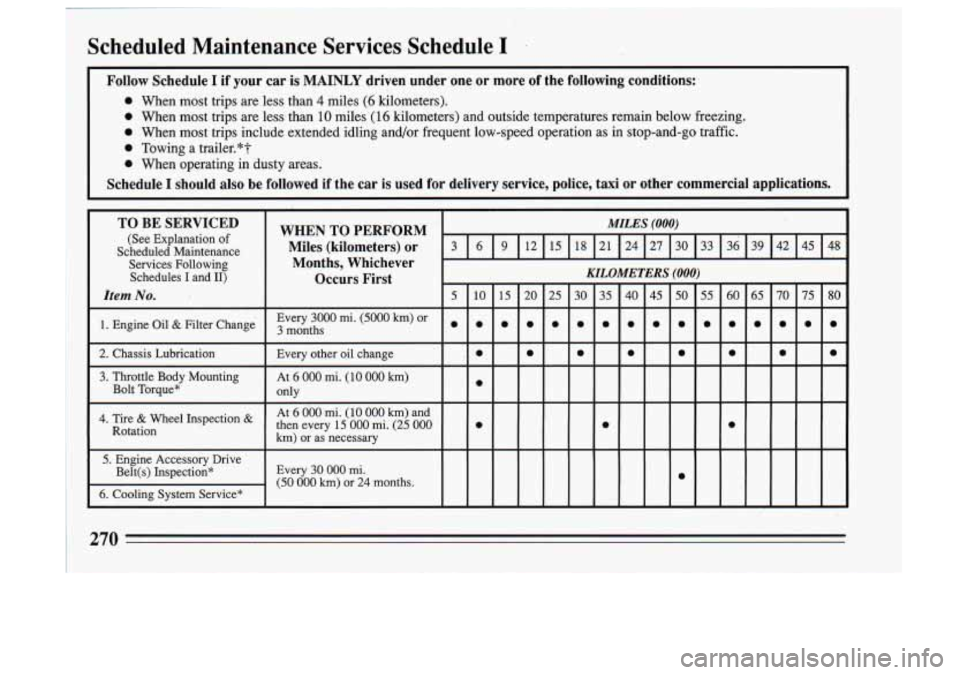
b Scheduled Maintenance Services Schedule I -
Follow Schedule I if your car is MAINLY driven under one or more of the following conditions:
0 When most trips are less than 4 miles (6 kilometers).
0 When most trips are less. than 10 miles (16 kilometers) and outside temperatures remain below freezing.
0 When most trips indude extended idling and/or frequent low-speed operation as in stop-a\
nd-go traffic.
0 Towing a trailer."?
0 When operating in dusty areas.
Schedule I should also be followed if the car is used for delivery service, police, taxi or other commercial app\
lications.
TO BE SERVICED
(See Explanation of
Scheduled Maintenance Miles (kilometers) or
Services Following Months, Whichever
WHEN
TO PERFORM
Schedules I and 10
Item No. I
Occurs First
1. hgine
Oil & Filter Change months I
Every 3000 mi. (5000 km) or
2. Chassis Lubrication I Every other oil change
3. Throttle Body Mounting At 6 000 mi. (10 000 km)
Bolt Torque*
At
6 000'mi. (10 000 km) and
km) or as necessary
4. Tire & Inspection & then every 15 000 mi. (25 000
Rotation
5. Engine Accessory Drive
Belt(s) Inspection* Every
30 000 mi. (50 000 km) or 24 months.
MILES (000)
3 16 19 112115118121124127130(33136139142145148
5 10
a.
..
0
0
KILOMETERS (000)
65 70 75 80
a...
0 a
270
Page 276 of 306
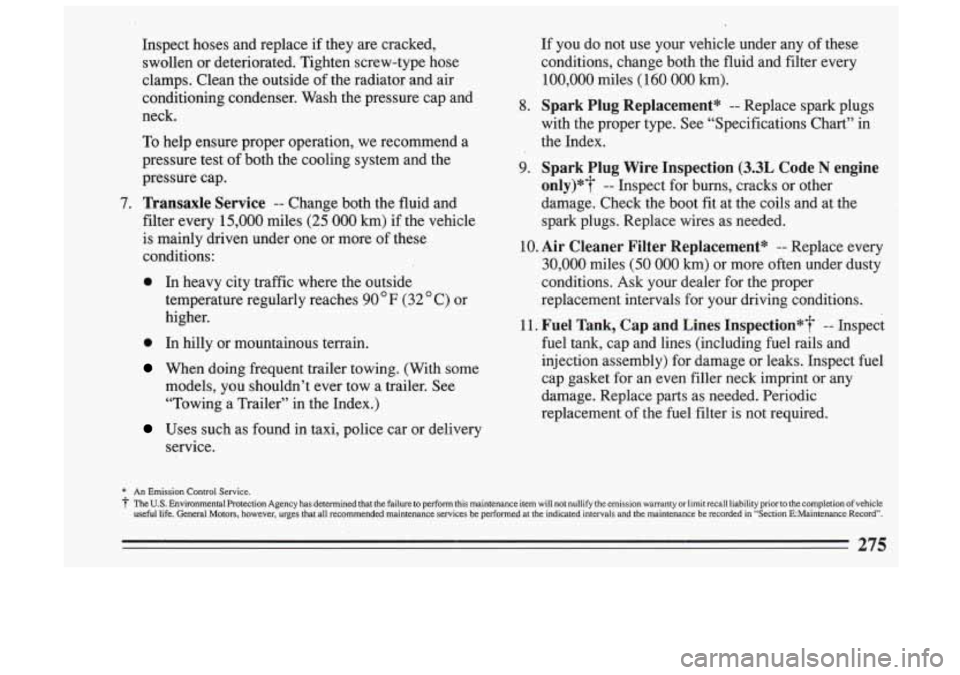
Inspect hoses and replace if they are cracked,
swollen or deteriorated. Tighten screw-type hose
clamps. Clean the outside of the~radiator and air
conditioning condenser. Wash the pressure cap and
neck.
To help ensure proper operation, we recommend a
pressure test
of both the cooling system and the
pressure cap.
7. Transaxle Service -- Change both the fluid and
filter every
15,000 miles (25 000 km) if the vehicle
is mainly driven under one or more of these
conditions:
0 In heavy city traffic where the outside
temperature regularly reaches
90 F (32 C) or
higher.
0 In hilly or mountainous terrain.
When doing frequent trailer towing. (With some
models, you shouldn’t ever tow a trailer. See
“Towing a Trailer” in the Index.)
Uses such as found in taxi, police car or delivery
service. If you
do’ not use your vehicle under any of these
conditions, change both the fluid and filter every
100,000 miles (160 000 km).
8. Spark Plug Replacement* -- Replace spark plugs
with the proper type. See “Specifications Chart” in
the Index.
9. Spark Plug Wire Inspection (3.3L Code N engine
only)*?
-- Inspect for burns, cracks or other
damage. Check the boot fit at the coils and at the
spark plugs. Replace wires as needed.
10. Air Cleaner Filter Replacement* -- Replace every
30,000 miles
(50 000 km) or more often under dusty
conditions. Ask your dealer for the proper
replacement intervals for your driving conditions.
11. Fuel Tank, Cap and Lines Inspection”? -- Inspect
fuel
tank, cap and lines (including fuel rails and
injection assembly) for damage or leaks. Inspect fuel
cap gasket for an even filler neck imprint or any
damage. Replace parts as needed. Periodic
replacement of the fuel filter is not required.
* An Emission Control Service.
The
U.S. Environmental Protection Agency has determined that the failure to perform this maintenance item will not nullify the emission warranty or limit recall liability prior to the completion of vehicle
useful life. General Motors, however, urges that all recommended maintenance services be performed at the indicated intervals and the maintenance be recorded in “Section EMaintenance Record”.
Page 301 of 306
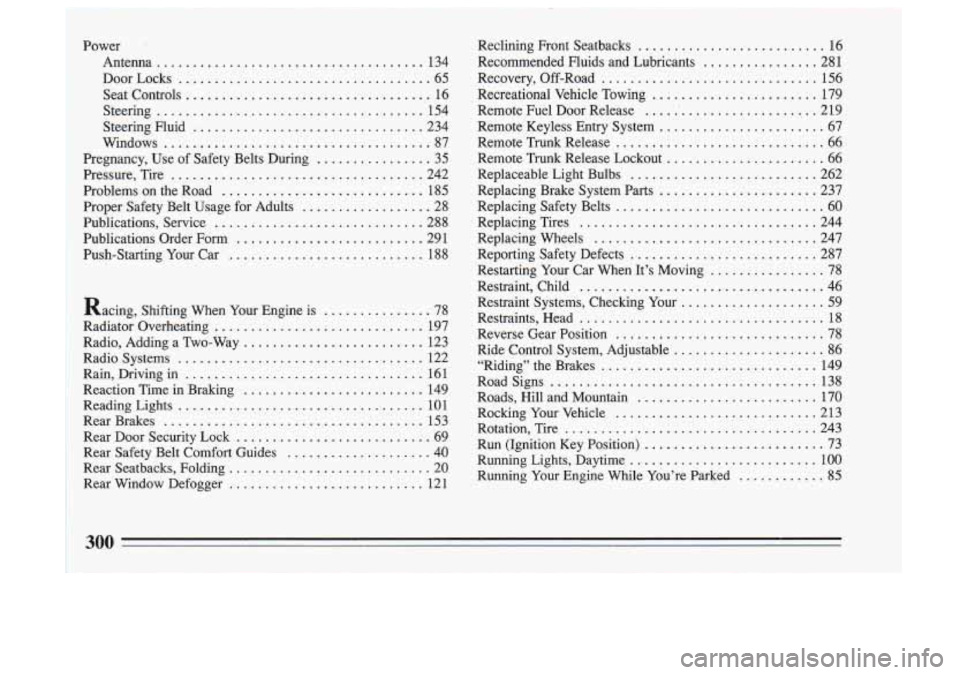
Power Antenna
..................................... 134
Door Locks
................................... 65
Seat Controls
................................... 16
Steering
..................................... 154
Windows
..................................... 87
Pregnancy. Use
of Safety Belts During ................ 35
Pressure. Tire
................................... 242
Problems on the Road
............................ 185
Publications. Service
............................. 288
Publications Order Form .......................... 291
Push-Starting Your Car
........................... 188
Steering
Fluid
................................ 234
Proper Safety Belt Usage for Adults
.................. 28
Racing. Shifting When Your Engine is
............... 78
Radiator Overheating
............................. 197
Radio. Adding a Two-way
......................... 123
Radio Systems
.................................. 122
Rain. Driving in
................................. 161
Reaction Time
in Braking ......................... 149
Reading Lights
.................................. 10 1
RearBrakes .................................... 153
Rear Door Security Lock
........................... 69
Rear Safety Belt Comfort Guides
.................... 40
Rear Seatbacks. Folding
............................ 20
Rear Window Defogger ........................... 121 Reclining Front Seatbacks
.......................... 16
Recommended Fluids and Lubricants
................. 281
Recovery. Off-Road
.............................. 156
Recreational Vehicle Towing
....................... 179
Remote Fuel Door Release
.......................... 219
Remote Keyless Entry System
....................... 67
Remote Trunk Release
............................. 66
Remote Trunk Release Lockout
...................... 66
Replaceable Light Bulbs
.......................... 262
Replacing Brake System Parts
...................... 237
Replacing Safety Belts
............................. 60
Replacing Tires
................................. 244
Replacing Wheels
............................... 247
Restarting Your Car When It’s Moving
................ 78
Restraint. Child
.................................. 46
Restraint Systems. Checking Your
.................... 59
Restraints. Head .................................. 18
Reverse Gear Position
............................. 78
Ride Control System. Adjustable
..................... 86
“Riding” the Brakes
.............................. 149
Roads. Hill and Mountain
......................... 170
Rocking Your Vehicle
............................ 213
Rotation. Tire
................................... 243
Run (Ignition Key Position)
......................... 73
Running Your Engine While You’re Parked
............ 85
Reporting Safety Defects
.......................... 287
Roadsigns
..................................... 138
Running Lights. Daytime
.......................... 100