warning lights BUICK SKYLARK 1993 Owners Manual
[x] Cancel search | Manufacturer: BUICK, Model Year: 1993, Model line: SKYLARK, Model: BUICK SKYLARK 1993Pages: 306, PDF Size: 15.84 MB
Page 13 of 306
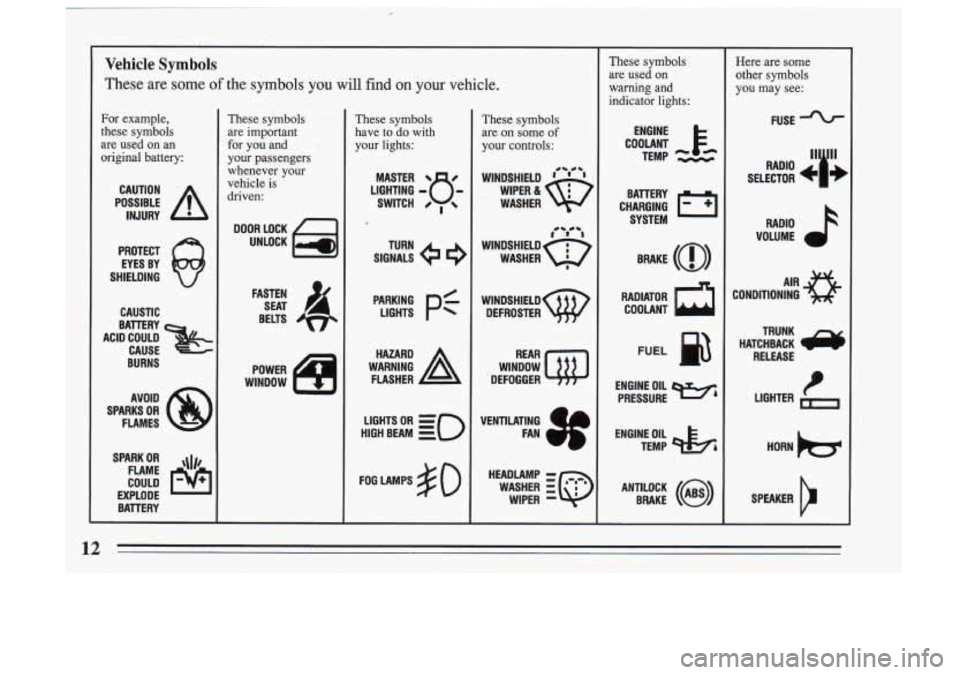
Vehicle Symbols
These are some of the symbols you will. find -on your vehicle.
For example,
these symbols
are used on an
original battery:
CAUTION
INJURY
PROTECT EYES BY
SHIELDING
Q
CAUSTIC
ACID COULD CAUSE
BA~~RY
BURNS AVOID
SPARKS
OR
FLAMES
SPARK
OR ,\I/,
COULD pq
FLAME
EXPLODE BATTERY
These symbols
are important
for you and
your passengers
whenever your
vehicle- is
driven:
FASTEN SEAT 4
BELTS
POWER
WINDOW
These symbols
have to do with
your lights:
SIGNALS e 9
TU-RN
HIGH BEAM
OR = =o
FOG LAMPS # 0
These symbols
are on some of
your controls:
WINDSHIELD ' ' '
. WASHER
CI 0s
-tO -1
WINDSHIELD
WASHER 8
wI*DsHIELDw DEFROSTER
WINDOW
Ltft,
REAR
DEFOGGER
VENTILATING FAN
3f
HEADLAMP -
WIPER
WASHER
EQ
L
~
These symbols
are used
on
warning and
indicator lights:
COOLANT F-
TEMP *-
ENGINE
CHARGING BATTERY
SYSTEM
RADIATOR
a
COOLANT
FUEL @
ENGINE OIL e,
PRESSURE
TEMP
OIL &
ANTILOCK (@)
BRAKE
Here are some
other symbols
you may see:
FUSE
RAD10 k
VOLUME
CONDITIONING
AIR e
HATCHBACK TRUNK
RELEASE
LIGHTER
1-i
HORN
SPEAKER
12
Page 110 of 306
Warning Lights, Gages and
Indicators
This section describes the warning lights and gages that
may be on your vehicle. The pictures will help you
locate them.
Warning lights and gages can signal that something is wrong before it becomes serious enough to cause an
expensive repair or replacement. Paying attention to
your warning lights and gages could also save you or
others from injury.
Warning lights go on when there may be or is a problem with one of your vehicle’s functions.
As you will see in
the details
on the next few pages, some warning lights
come on briefly when you turn the ignition key just to
let you know they’re working. If you are familiar with
this section, you should not be alarmed when this
happens.
Gages can indicate when there may be or is a problem
with one of your vehicle’s functions. Often gages and
warning lights work together to let you know when
there’s a problem with your vehicle. When
one
of the warning lights comes on and stays on
when you are driving, or when one of the gages shows
there may be a problem, check the section that tells you what to do about it. Please follow the manual’s advice.
Waiting to do repairs can be costly
-- and,even
dangerous.
So please get to know your warning lights
and gages. They’re a big help.
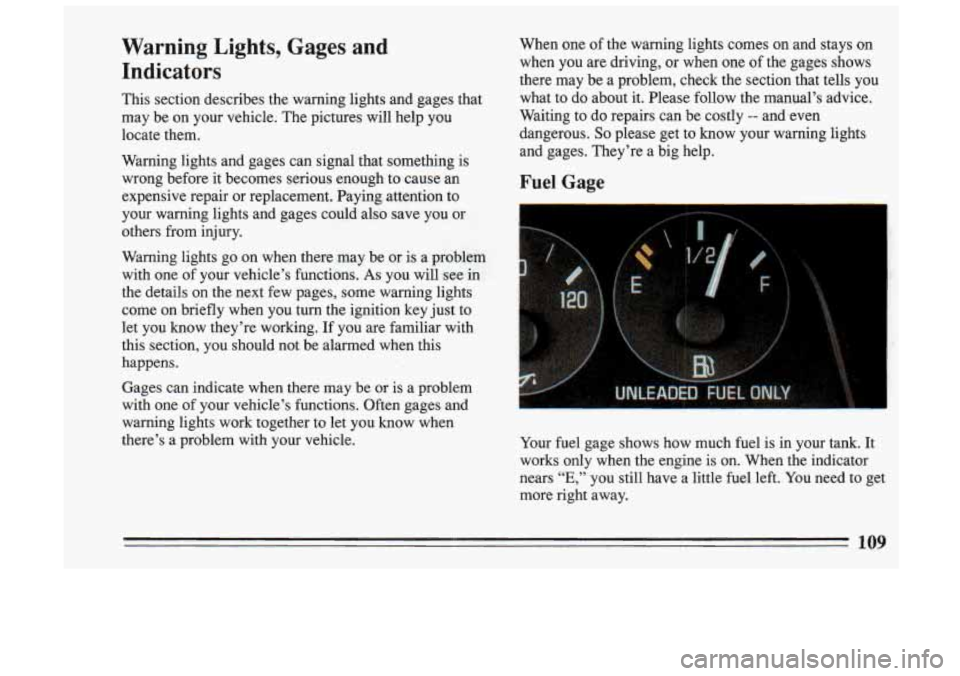
Fuel Gage
Your fuel gage shows how much fuel is in your tank. It
works only when the engine is on. When the indicator
nears
“E,” you still have a little fuel left. You need to get
more right away.
Page 145 of 306
time. A green arrow means you may drive ir&that lane. ’
and days these systems are in effect. -,i ““ ff. 4 -’ ~‘’ - .. :
1 Look for the signs posted to warn drivers. what bQ.urs. .. . ,.
1 Pavement Markings
NO
PASSING I’
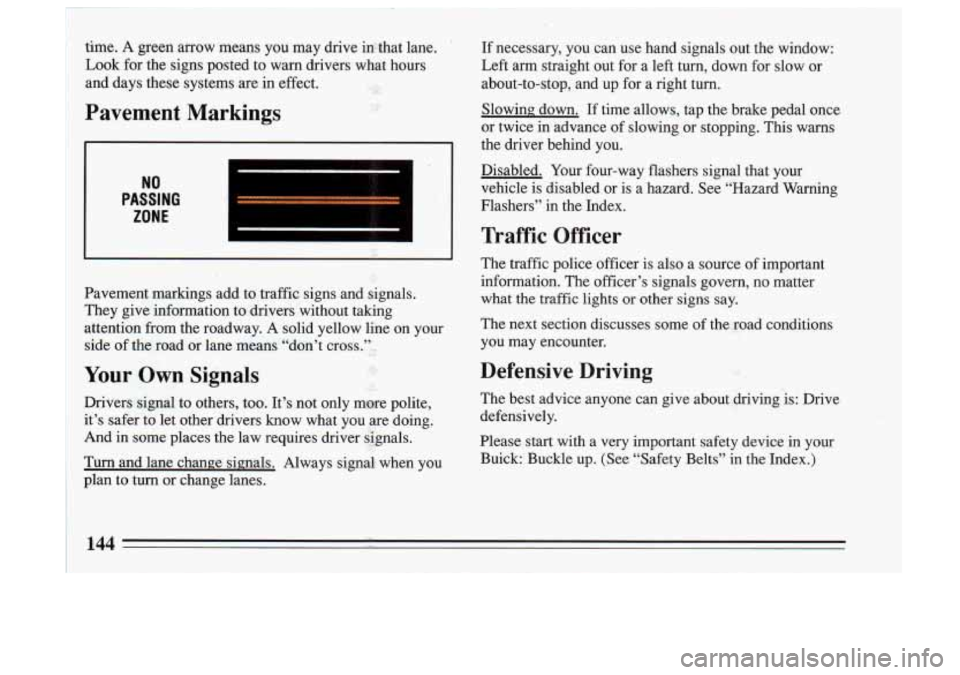
Pavement markings add to traffic signs and signals.
They give information to drivers without taking
attention from the roadway. A solid yellow line on your
side of the road or lane means “don’t cross.”
Your Own Signals
..
Drivers signal to others, too. It’s not only mare polite,
it’s safer
to let other drivers know what you are doing.
And in some places the law requires iver si.gnals.
L. ..
Turn and lane change signals. Always signal: when you
plan to turn or change lanes.
If necessary, you can use hand signals out the window:
Left arm straight out for a left turn, down for slow or
about-to-stop, and up for a right turn.
Slowing down. If time allows, tap the brake pedal once
or twice in advance of slowing or stopping. This warns
the driver behind you.
Disabled. Your four-way flashers signal that your
vehicle is disabled or
is a hazard. See “Hazard Warning
Flashers” in the Index.
Traffic Officer
The traffic police officer is also a source of important
information. The officer’s signals govern, no matter
what the traffic lights or other
signs say.
The next section discusses some of the Toad conditions
you may encounter.
._ . .-_. ;: , , .c**“jy;, “C.$ -,a,, ..,... ’ : ., - , . ,.> p :, , ,. . +.
Defensive Driving $@, *-<; .I i.?;’ * i.
, +& ’ . i *. , .. . I I- ., I.. .. \e. . *, ,
The best advice anyone can give about\driving is: Drive
defensively.
Please
start with a very important safety device in your
Buick: Buckle up. (See “Safety Belts” in the Index.)
Page 160 of 306
vehicle is skidding. Learn to recognize warning clues --
such as enough water, ice or packed snow on the road to
make a “mirrored surface”
-- and slow down when you
have any doubt.
Remember: Any anti-lock braking system (ABS) helps avoid only the braking skid. Steer the way you want to
go.
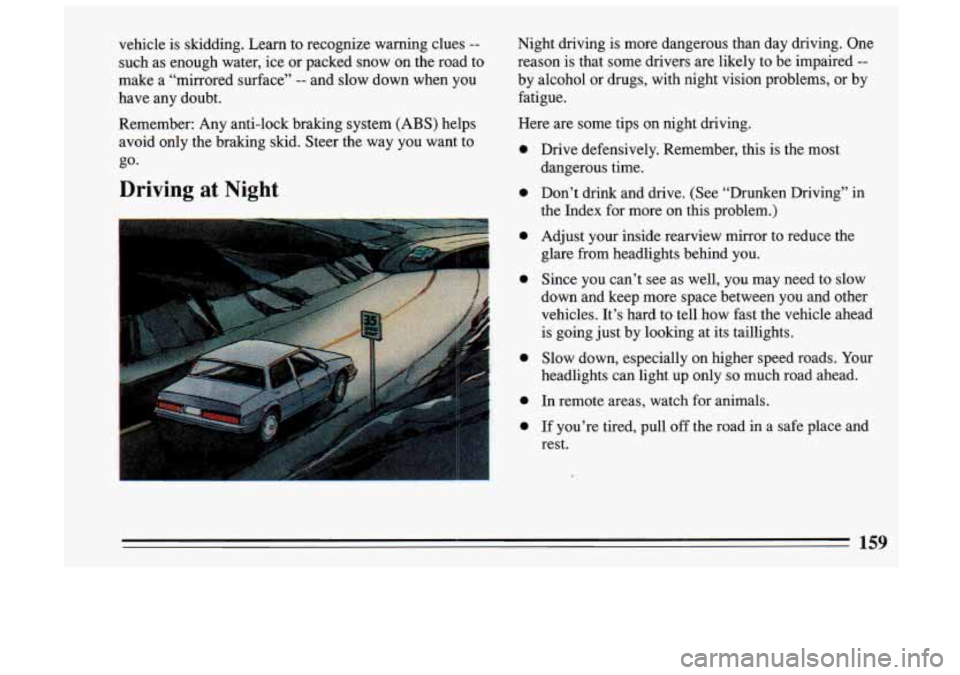
Driving at Night
Night driving is more dangerous than day driving. One
reason is that some drivers are likely to be impaired
--
by alcohol or drugs, with night vision problems, or by
fatigue.
Here are some tips on night driving.
0
0 0
0
0 Drive defensively. Remember, this is the most
dangerous time. Don’t drink and drive. (See “Drunken Driving” in
the Index for more
on this problem.)
Adjust your inside rearview mirror to reduce the glare from headlights behind you.
Since you can’t see as well, you may need to slow
down and keep more space between you and other vehicles. It’s hard to tell how fast the vehicle ahead
is going just by looking at its taillights.
Slow down, especially on higher speed roads.
Your
headlights can light up only’s0 much road ahead.
In remote areas, watch for animals.
If you’re tired, pull
off the road in a safe place and
rest.
Page 169 of 306
start bralung. If you must brake on the through lane, and
if there
is traffic close behind you, you can allow a little
extra time and flash your brake lights (in addition to your turn signal) as extra warning that you are about to
slow down and exit.
The exit ramp can be curved, sometimes quite sharply.
The exit speed is usually posted. Reduce your speed
according to your speedometer, not to your sense of
motion. After driving for any distance at higher speeds,
you may tend to think you are going slower than you
actually are. For example,
40 mph (65 km/h) might
seem like only
20 mph (30 km/h). Obviously, this could
lead to serious trouble on a ramp designed for
20 mph
(30 krn/h)!
Driving a Long Distance
Although most long trips today are made on freeways,
there are still many made on regular highways.
Long-distance driving on freeways and regular
highways is the same in some ways. The trip has to be
planned and the vehicle prepared, you drive at
higher-than-city speeds, and there are longer turns
behind the wheel. You’ll enjoy your trip more if you and
your vehicle are
in good shape. Here are some tips for a
successful long trip.
Before Leaving on a Long Trip
Make sure you’re ready. Try to be well rested. If you
must start when you’re not fresh
-- such as after a day’s
work
-- don’t plan to make too many miles that first part
of the journey. Wear comfortable clothing and shoes you
can easily drive in.
Is your vehicle ready for a long trip? If you keep it
serviced and maintained, it’s ready to go. If it needs
service, have it done before starting out. Of course,
you’ll find experienced and able service experts in
Buick dealerships all across North America. They’ll be
ready and willing to help
if you need it.
Here are some things you can check before a trip:
0 Windshield Washer Fluid: Is the reservoir full? Are
all windows clean inside and outside?
WiDer Blades: Are they in good shape/
Fuel, Engine Oil, Other Fluids: Have you checked
all levels?
0 Lights: Are they all working? Are the lenses clean?
0 Tires: They are vitally important to a safe,
trouble-free trip. Is the tread good enough for long-distance driving?
Are the tires all inflated to the
recommended pressure?
168
Page 187 of 306
Hazard Warning Flashers
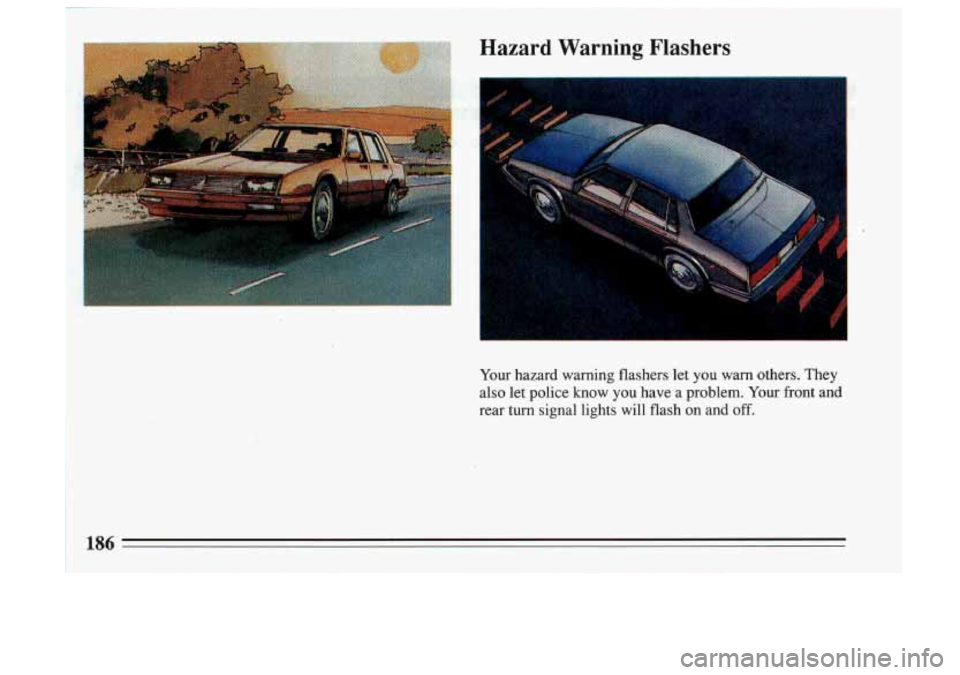
Your hazard warning flashers let you warn others. They
also let police know you have
a problem. Your front and
rear turn signal lights will flash on and
off.
186
Page 188 of 306
Move the switch to the
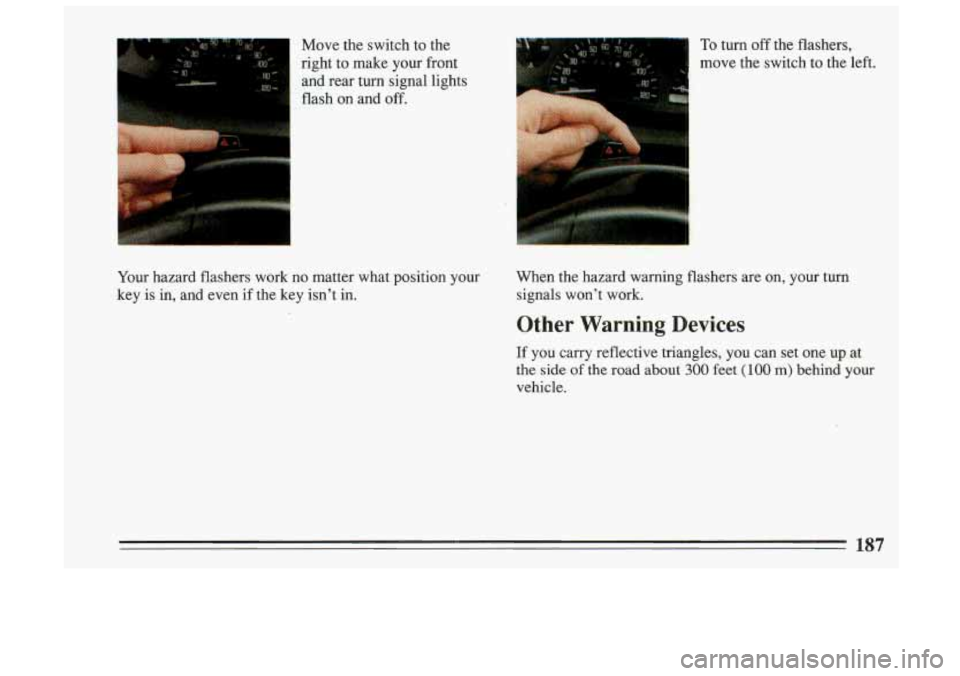
right to make your front
and rear turn' signal lights
flash on and off.
Your hazard flashers work no matter what position your
key is in, and even
if the key isn't in.
To turn off the flashers,
move the switch to the left.
When the hazard warning flashers are on, your turn
signals won't work.
Other Warning Devices
If you carry reflective triangles, you can set one up at
the side
of the road about 300 feet (100 m) behind your
vehicle.
Page 232 of 306
0
0
0
0
0
Give freezing protection down to -34°F (-37 "C) .
Give boiling protection up to 262 F (128 " C) .
Protect against rust and corrosion.
Help keep the proper engine temperature.
Let the warning lights work
as they should.
231
Page 296 of 306
Children and Safety Belts .......................... 44
Cigarette Lighter
................................ 106
Circuit Breakers and Fuses
........................ 258
City Driving
.................................... 165
Cleaner. Air
.................................... 228
Cleaning Aluminum Wheels
............................ 253
Fabric
...................................... 249
Glass
....................................... 252
InsideofyourCar
............................. 249
Instrument Panel Top
.......................... 251
Power Antenna
............................... 134
Safety Belts
.................................. 252
Underbody Of Your Car
........................ 255
Vinyl and Leather ............................. 251
Weather Strips
................................ 254
White Sidewall Tires
............................ 254
Windshield and Wiper Blades
.................... 252
Coat Hanger
.................................... 107
Comfort Control System
.......................... 119
Clock. Setting the
......................... 125.127. 129
Closed-In Places. Don’t Idle in
...................... 85
CO in Your Exhaust ............................... 84
Color of Road Signs
.............................. 138
Comfort Controls and Audio Systems
................ 119
Compact Disc Care
.............................. 133
Compact Spare Tire
.............................. 2 12
Contents. Table of
................................. 9
Control of a Vehicle ............................... 148
Outside
of your Car
........................... 252 Control. Loss
of
................................. 158
Convenience Net
................................ 104
Convex Outside Mirror
............................ 104
Coolant. Engine
................................. 231
Coolant. Engine Warning Light
..................... 112
Coolant. Safety Warnings About
.................... 197
Courtesy Lights
................................. 102
Covers. How To Remove Wheel
.................... 206
Cruise Control
................................... 93
Cruise Control. Changing Speed With
................. 96
Cruise Control on Hills
............................ 97
Cruise Control. Turning
Off ......................... 98
Curves. Driving On
............................... 154
Customer Assistance for the Hearing/Speech Impaired
... 286
Customer Assistance Information
................... 285
Customer Satisfaction Procedure
.................... 285
D (Drive) Third Gear ............................. 78
Damage to Finish
................................ 254
Damage to Sheet Metal
............................ 254
Damage Warnings
................................ 11
Daytime Running Lights
.......................... 100
Defensive Driving
............................... 144
Defogger. Rear Window
.......................... 121
Dimensions
.................................... 261
Disc Brake Wear Indicators
........................ 152
Disposal of Used Oil
............................. 227
DoorLocks
...................................... 63
295
Page 299 of 306
Jacking up the Car ............................ .. 204
Jump Starting
................................... 188
Keys
........................................... 62
Keyless Entry System. Remote
...................... 67
Kilometer Indicator
.............................. 108 Label.
Service Parts Identification
.................. 257
Lane Change Indicator
............................. 89
LapBelt
........................................ 42
Lap-Shoulder Belt Usage by Children
................. 58
Latches. Front Seatback
............................ 19
Leaving Your Vehicle
.............................. 83
Light. Safety Belt ................................. 28
Light. Turn Signal Indicator
......................... 89
Light Bulbs. Replaceable
.......................... 262
Lighter. Cigarette
................................ 106
Lights Daytime Running
............................. 100
Interior
...................................... 99
Interior Delay
................................ 102
Operation
..................................... 99
Reading
..................................... 101
Traffic ...................................... 143
Lights “On” Warning
............................. 100
Loading Your Vehicle
............................ 240
Locks. Automatic Door
............................ 65
Locks. Door
..................................... 63
Locks. Rear Door Security
.......................... 69
Long Distance Driving
............................ 168
Loss of Control
................................. 158
Low Coolant Warning Light
....................... 113
Low Oil Pressure Warning Gage
.................... 114
298