brake BUICK SKYLARK 1993 Service Manual
[x] Cancel search | Manufacturer: BUICK, Model Year: 1993, Model line: SKYLARK, Model: BUICK SKYLARK 1993Pages: 306, PDF Size: 15.84 MB
Page 223 of 306
I1
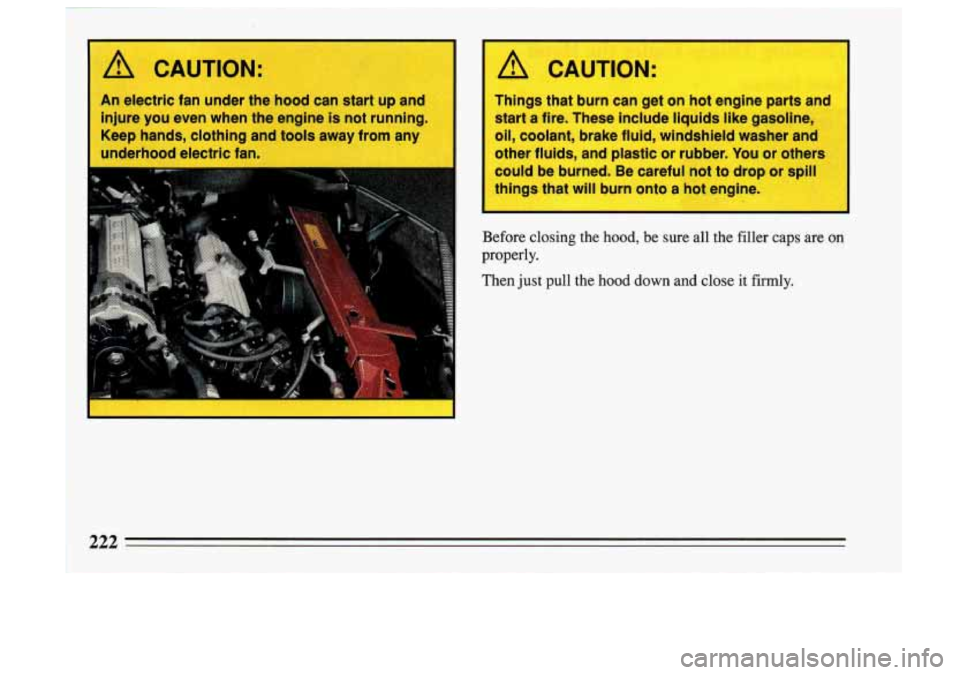
A CAUTION:
An electric fan under the hood can start up and
injure you even when the engine is not running
Keep hands, clothing and tools away from any
underhood electric fan.
CAUTION:
Things that burn can get on hot engine parts and
start a fire. These include liquids like gasoline,.
oil, coolant, brake fluid, windshield washer and
other fluids, and plastic or rubber. You or others
I could be burned. Be careful not to drop or spill
things that
will burn onto a hot engine.
I
Before closing the hood, be sure all the filler caps are on
properly.
Then just pull the hood down and close it firmly. '
Page 231 of 306
Wait at least 30 minutes before checking the transaxle
fluid level if you have been driving:
When outside temperatures are above 90 ’ F (32 ’ C).
0 At high speed .for quite a while.
In heavy traffic -- especially in hot weather.
While pulling a trailer.
To get the right reading, the fluid should be at normal
operating temperature, which is 180’F to 200’F (82OC
Get the vehicle warmed up by driving about
15 miles
(24 km) when outside temperatures are above 50’F
(1 0 C). If it’s colder than 50 OF (10 ’ C), you may have
to drive longer.
To’check the fluid level:
to 93
“C).
0
e
0
Park your vehicle on
a level place.
Place the
shift lever in “F”’ (Park) with the parking
brake applied.
With your foot on the brake pedal, move the shift
lever through each gear range, pausing for about
three seconds
in each range. Then, position the shift
lever
in “P,’ (Park).
Let the engine
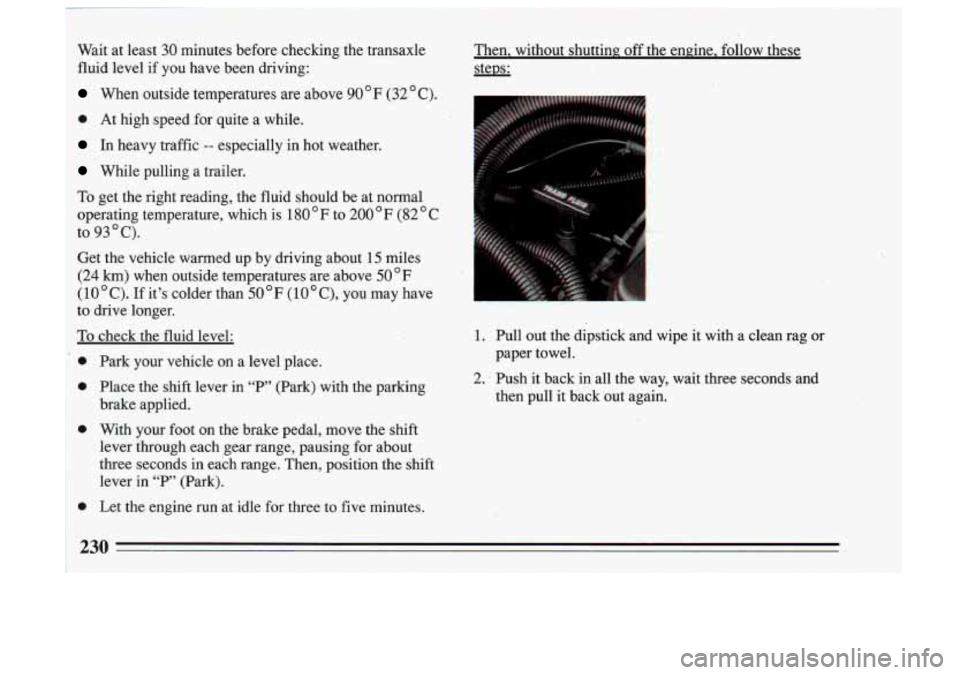
run at idle far three to five minutes. Then; without shutting off the engine, follow these
steps:
.I. Pull out the dipstick and wipe it with a clean rag or
paper towel.
2. . Push it back in all the way, wait three seconds and
then pull it back out again.
Page 237 of 306
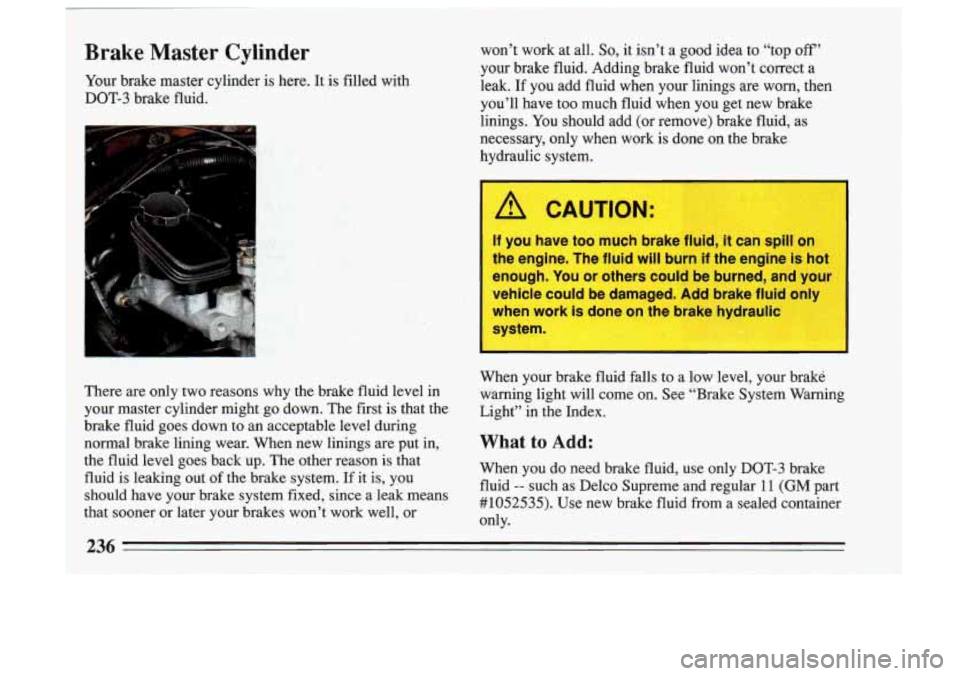
1 Brake Master Cylinder
Your brake master cylinder is here. It is filled with
1 DOT-3 brake fluid. won’t work
at all.
So, it isn’t a good idea to “top off’
your brake fluid. Adding brake. fluid won’t correct a
leak. If you add fluid when your linings are worn, then
you’ll have too much fluid when you get new brake
linings.
You should add (or remove) brake fluid, as
necessary, only when work is done
on the brake
hydraulic system.
I
A CAUTION:
If you have too much brake fluid, it can spill on
the engine. The fluid will burn
if the engine is hot
enough. You or others could be burned, and your
vehicle could be damaged. Add brake fluid only
when work is done on the br,
e hl ‘raulic
system.
1
There are only two reasons why the brake fluid level in
your master cylinder might go down. The first is that the
brake fluid goes down to an acceptable level during
normal brake lining wear. When new linings
are put in,
the fluid level goes back up. The other reason is that
fluid is leaking out
of the brake system. If it is, you
should have your brake system fixed, since a leak means
that sooner or later your brakes won’t work well, or When your brake fluid falls to a low level, your brake
warning light will come on. See “Brake System Warning
Light’’
in the Index.
What to Add:
When you do need brake fluid, use only DOT-3 brake
fluid
-- such as Delco Supreme and regular 11 (GM part
#1052535). Use new brake fluid from a sealed container only.
I
236
Page 238 of 306
Replacing Brake System Parts
The braking system on a modern vehicle is complex. Its
many parts have to be of top quality and work well
together
if the vehicle is to have really good braking.
Vehicles we design and test have top-quality GM brake balance between
your front
and rear brakes can change,
for the worse. The braking performance you’ve come to
expect. can change in many other ways
if someone puts
in the wrong replacement brake parts.
Battery
Every new Buick has a Delco Freedoms battery. You
never have to add water to one
of these. Whenit’s time
for a new battery, we recommend
a Delco Freedoms
battery. Get one that has the catalog number shown on
the original battery’s label.
Vehicle Storage
If you’re not going to drive your vehicle for 25 days or
more, take
off the black, negative (-) cable from the
battery. This will help keep your battery from running
parts in them, as your Buick does when it is new. When
4 A CAUTION:
you replace parts of your braking system -- for example,
when your brake linings wear down and you have to
have new ones put in
-- be sure you get new genuine
GM replacement parts. If you don’t, your brakes may no
longer work properly. For example, if someone puts in
brake linings that are wrong for your vehicle, the
1 Batteries have acid that can burn you and gas
that can explode. You can be badly hurt
if you
aren’t careful. See “Jump Starting” in the Index
for tips on working around a battery without
getting hurt.
237
Page 248 of 306
In most cases, you will not need to have your wheels
. aligned again. However, if you notice unusual tire wear or your vehicle pulling one way or the other, the
alignment may need to be reset. If you notice your
vehicle vibrating when driving on a smooth road, your
wheels may need to be rebalanced.
Wheel Replacement
Replace any wheel that is bent, cracked or badly rusted.
If wheel nuts keep coming loose, the wheel, wheel bolts,
and wheel nuts should be replaced. If the wheel leaks air out, replace it (except some aluminum wheels, which
can sometimes be repaired
-- See your Buick dealer) if
any of these conditions exist.
Your dealer will know the kind of wheel you need.
Each new wheel should have the same load carrying
capacity, diameter, width, offset, and be mounted the
same way
as the one it replaces.
If you need to replace any of your wheels, wheel bolts,
or wheel nuts, replace them only with new
GM original
equipment parts. This way, you will be sure to. have the
right wheel, wheel bolts, and wheel nuts for your Buick
model.
A CAUTION:
Using the wrong replacement wheels, wheel
bolts, or wheel nuts
on your vehicle can be
dangerous.
It could affect the braking and
handling
of your vehicle, make your tires lose
and make you lose control. You could have a
collision
in which you or others could be injured.
Always use the correct wheel, wheel bolts, and
wheel nuts for replacement
earing life, brake cooling,
peedQmeter/Qdometer
cali
im, bumper height, vehicl
nd tire or tire chain clearance to the body an
, 247
Page 259 of 306
Fuses and Circuit Breakers
The wiring circuits in your car are protected from short
circuits.by a combination of fuses, circuit breakers, and
fusible thermal links in the wiring itself. This greatly
reduces the chance of fires caused by electrical
problems.
Be sure to use the correct fuse. If you ever have a
problem on the road and don’t have a spare fuse, you
I
can “borrow” one of the identical size and rating. Just
pick some feature of your car that you can get along
without
-- like the radio or cigarette lighter -- and use its
fuse, if it is of the value you need. Replace it as soon as
you can.
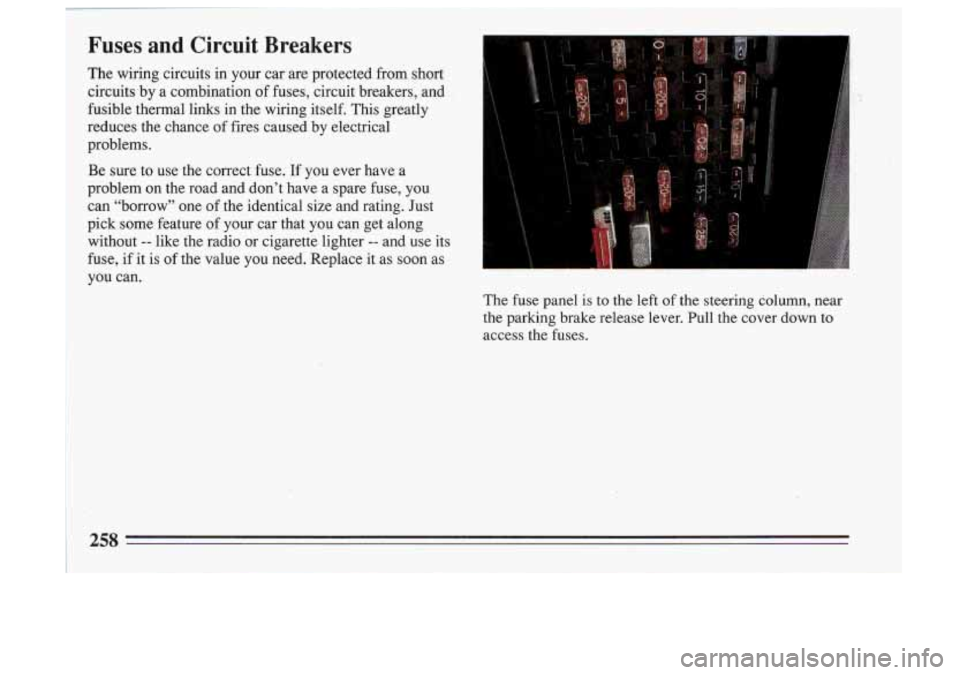
The fuse panel
is to the left of the steering column, near
the parking brake release lever. Pull the cover down to
access the fus.es.
I
258
Page 260 of 306
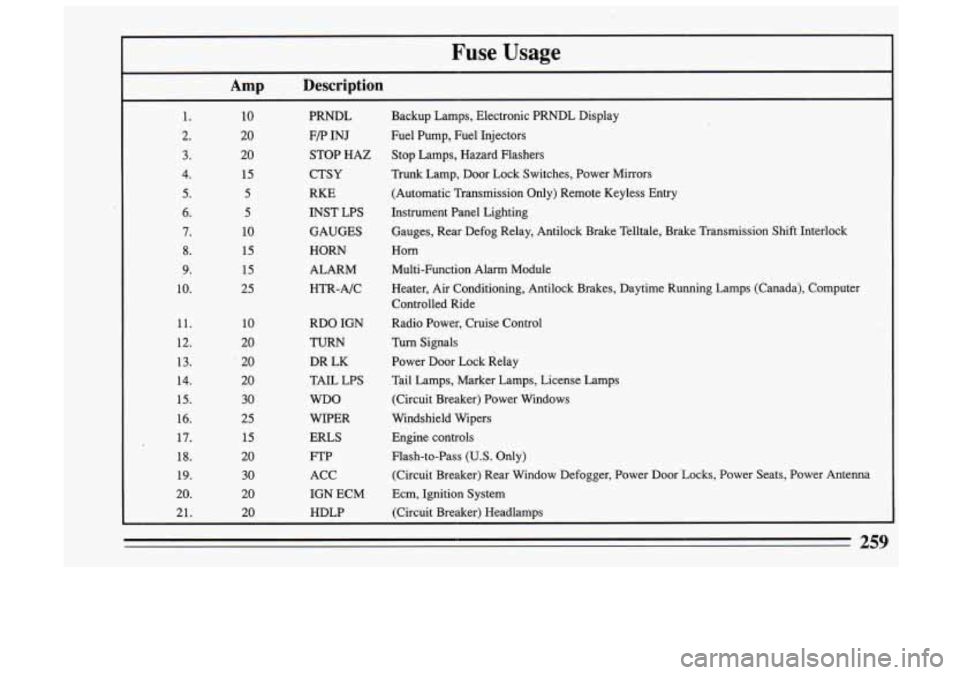
~~ Fuse Usage
Amp Description
1.
2.
3.
4.
5.
6.
7.
8.
9.
10.
11.
12.
13.
14.
15.
16.
17.
18.
19.
20.
21. 10
20
20
15
5
5
10
15
15
25
10
20
20
20
30
25 15
20
30
20
20 PRNDL
F/P INJ
STOP HAZ
CTSY
RKE
INST LPS
GAUGES
HORN
ALARM HTR-A/C
RDO IGN
TURN DR LK
TAIL LPS
WDO
WIPER
ERLS
FTP
ACC
IGN ECM HDLP Backup Lamps, Electronic PRNDL Display
Fuel Pump, Fuel Injectors
Stop Lamps, Hazard Flashers
Trunk Lamp,-Door Lock Switches, Power Mirrors
(Automatic Transmission Only) Remote Keyless Entry
Instrument Panel Lighting
Gauges, Rear Defog Relay, Antilock Brake Telltale, Brake Transmi\
ssion Shift Interlock
Horn
Multi-Function Alarm Module
Heater, Air Conditioning, Antilock Brakes, Daytime Running Lamps \
(Canada), Computer Controlled Ride
Radio Power, Cruise Control
Turn Signals
Power Door Lock Relay
.Tail Lamps, Marker Lamps, License Lamps (Circuit Breaker) Power Windows
Windshield Wipers Engine controls
Flash-to-Pass
(U.S. Only)
(Circuit Breaker) Rear Window Defogger, Power Door Locks, Powe\
r Seats, Power Antenna
Ecm, Ignition System (Circuit Breaker) Headlamps
259
Page 275 of 306
Explanation of Scheduled Maintenance equipped with grease fittings, lubricate the
Services suspension and steering linkage.
Below are explanations
of the services listed in $chediie ‘ ‘ 3. Throttle Body Mounting; Bolt Torque (3.3L Code . , I:
I and Schedule 11.
The proper fluids and lubricants to use are listed in
Section
D. Make sure whoever services your vehicle
uses these. All parts should be replaced and all
necessary repairs done before you or anyone else drives
the vehicle.
NOTE:
To determine your engine’s displacement and
code, see “Engine 1dentific.ation” in the Index.
1. Engine Oil and Filter Change* -- Always use SG
Energy Conserving
I1 oils of proper viscosity. The
“SG, designation may be shown alone or in
combination with others, such as “SG/CC”,
“SG/CD” or “SF,
SG, CC,” etc. To determine the
preferred viscosity for your vehicle’s engine (e.g.,
SAE 5W-30 or SAE 10W-30), see “Engine Oil” in
the Index.
2. Chassis Lubrication -- Lubricate the transaxle shift
linkage, parking brake cable guides, underbody
contact points and linkage. If your vehicle is
An Emission Control Service.
N engine only)* -- Che& the torque of the
mounting bolts and/or nuts.
proper wear and maximum tire life, rotate your tires
following the instructions in this manual. See “Tires,
Inspection
& Rotation” in the Index, Check the tires
for uneven wear or damage. If you see irregular or
premature wear, check
the wheel alignment. Check
for damaged wheels also.
5. Engine Accessory Drive Belt@) Inspection --
Inspect the belt(s) for cracks, fraying, wear and
proper tension. Replace as needed.
6. Cooling System Service* -- Drain, flush and refill
the system with new or approved recycled coolant
conforming to GM Specification 1825M. Keep
coolant at the proper mixture as specified. See
“Coolant” in the Index. This provides proper freeze
protection, corrosion inhibitor level and engine operating temperature.
4. Tire and Wheel Rotation and Inspection -- For
The U.S. Environmental Protection Agency has determined that the failure to perform this maintenance item will not nullify the emission war\
ranty or limit recall liability prior to the completion of vehicle
useful life. General Motors, however, urges that all recommended maintenance services be performed at the indicated i\
ntervals and the maintenance be recorded in “Section EMaintenance Record”.
274
Page 278 of 306
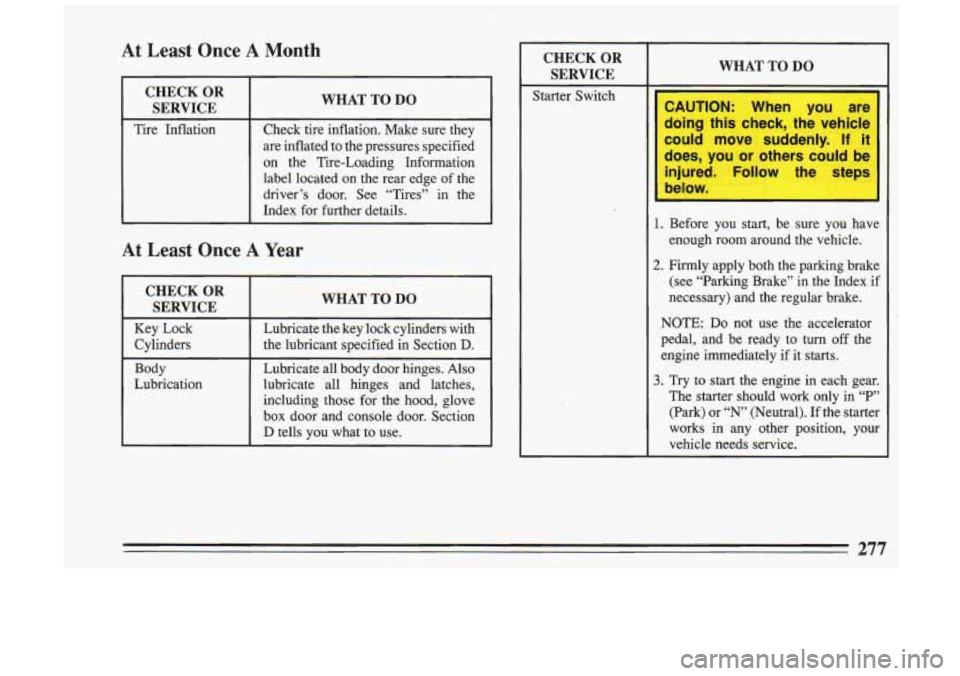
At Least Once A Month
CHECK OR SERVICE
Tire Inflation
WHAT TO DO
Check tire inflation. Make sure they
are inflated to the pressures specified
on the Tire-Loading Information
label located on the rear edge of the
driver’s door. See “Tires” in the
Index for further details.
At Least Once A Year
CHECK OR
SERVICE
I WHAT TO DO
Key Lock
Lubricate all body door hinges. Also
Body the
lubricant specified in Section
D. Cylinders Lubricate the
key lock cylinders with
Lubrication lubricate all hinges and latches,
including those for the hood, glove
box door and console door. Section
D tells you what to use.
CHECK OR
SERVICE
Starter Switch
WHAT TO DO
kAUTION: When you are
doing this check, the vehicle
could move suddenly.
If it
does, you or others could be
injured. Follow the steps
bellow.
- 1
1. Before you start, be sure you have
enough room around the vehicle.
2. Firmly apply both the parking brake
(see “Parking Brake” in the Index if
necessary) and the regular brake.
NOTE:
Do not use the accelerator
pedal, and be ready to
turn off the
engine immediately if it starts.
3. Try to start the engine in each gear.
The starter should work only in
“P’
(Park) or “N” (Neutral). If the starter
works in any other position, your
vehicle needs service.
277
Page 281 of 306
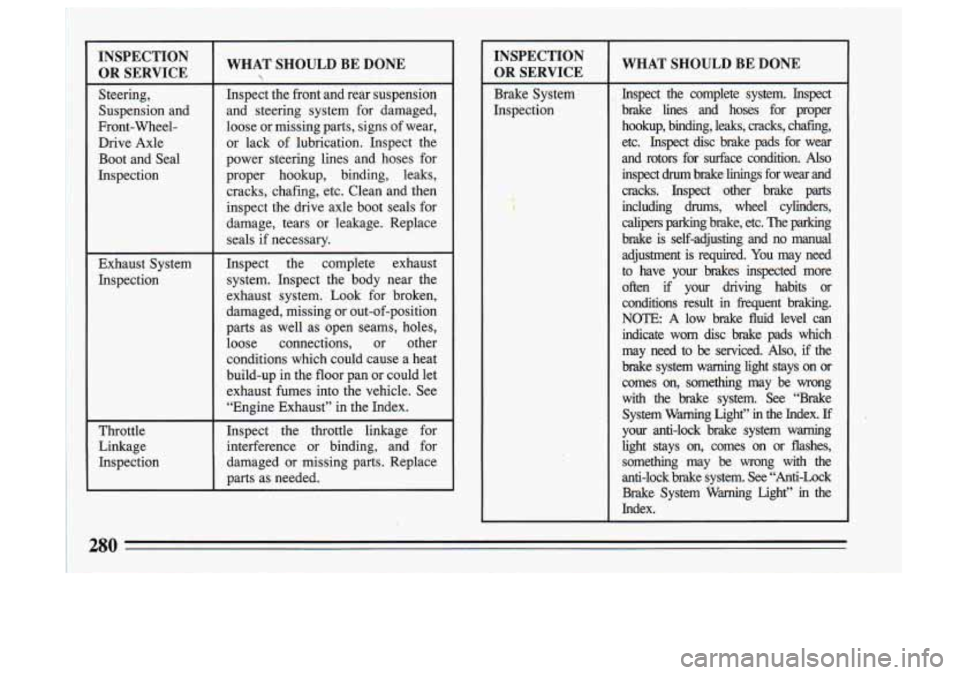
INSPECTION
OR SERVICE
Steering,
Suspension and
Front-Wheel-
Drive Axle
Boot and Seal
Inspection
Exhaust System
Inspection
Throttle
Linkage Inspection
WHAT SHOULD BE DONE
hspect the front and rear suspension
and steering system for damaged,
loose or missing parts, signs of wear,
or lack of lubrication. Inspect the
power steering lines and hoses for
proper hookup, binding, leaks, cracks, chafing, etc. Clean and then
inspect the drive axle boot seals for
damage, tears or leakage. Replace
seals
if necessary.
Inspect the complete exhaust system. Inspect the body near the
exhaust system. Look for broken,
damaged, missing or out-of-position
parts as well as open seams, holes,
loose connections,
or other
conditions which could cause a heat
build-up in the floor pan or could let
exhaust fumes into the vehicle. See
“Engine Exhaust” in the Index.
Inspect the throttle linkage for interference or binding, and for
damaged or missing parts. Replace
parts as needed.
“:
INSPECTION
OR SERVICE
Brake System
Inspection
WHAT SHOULD BE DONE
Inspect the complete system. Inspect
brake
lines and hoses for proper
hookup, binding, leaks, cracks, chafing,
etc.
Inspect disc brake pads for wear
and rotors for swrface condition.
Also
inspect Qwn brake linings for wear and
cracks. Inspect other brake
parts
including drums, wheel cylinders,
calipers parking brake, etc. The parking
brake is self-adjusting and no manual adjustment
is required. You may need
to have your brakes inspected more often
if your driving habits or
conditions result in frequent braking.
NOTE: A low brake fluid level can
indicate worn disc brake pads which
may
need to be serviced. Also, if the
brake system warning light stays on or
comes on, something may
be wrong
with the brake system. See “Brake System
Warning Light” in the Index. If
your anti-lock brake system warning
light stays
on, comes on or flashes,
something may
be wrong with the
anti-lock brake system. See “Anti-Lock
Brake System Warning Light”
in the
Index.
280 .~ . ~