light BUICK SKYLARK 1993 Workshop Manual
[x] Cancel search | Manufacturer: BUICK, Model Year: 1993, Model line: SKYLARK, Model: BUICK SKYLARK 1993Pages: 306, PDF Size: 15.84 MB
Page 215 of 306
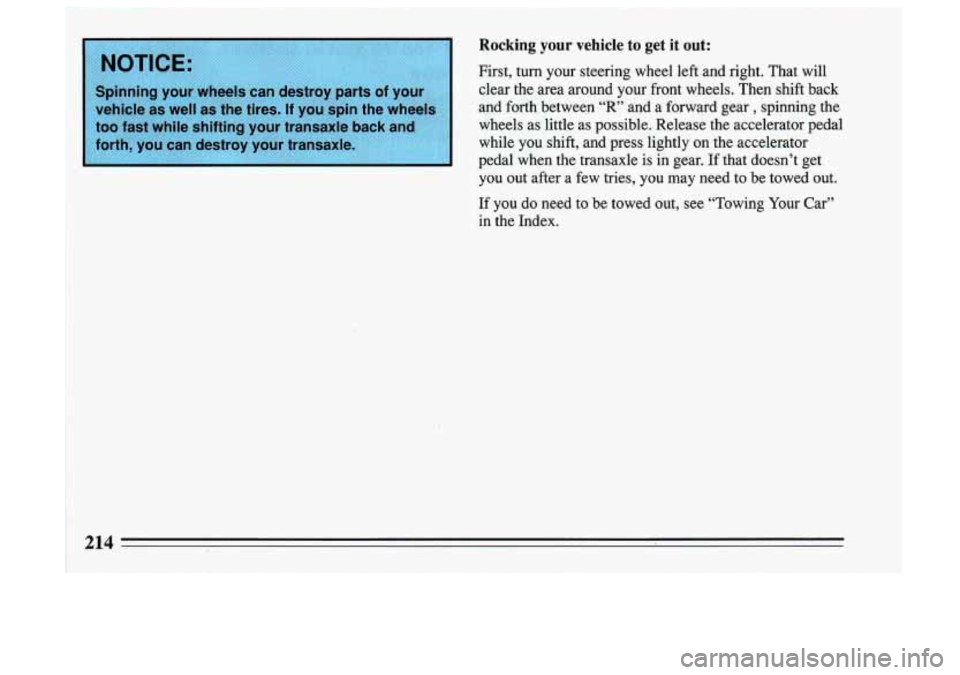
Rocking your vehicle to get it out:
First, turn your steering wheel left and right. That will
clear the area around your front wheels. Then shift back
and forth between “R” and a forward gear
, spinning the
wheels as little as possible. Release the accelerator pedal
while you shift, and press lightly on the accelerator
pedal when the transaxle is in gear. If that doesn’t get
you out after a few tries, you may need
to be towed out.
If you do need to be towed out, see “Towing Your Car”
in the Index.
Page 232 of 306
0
0
0
0
0
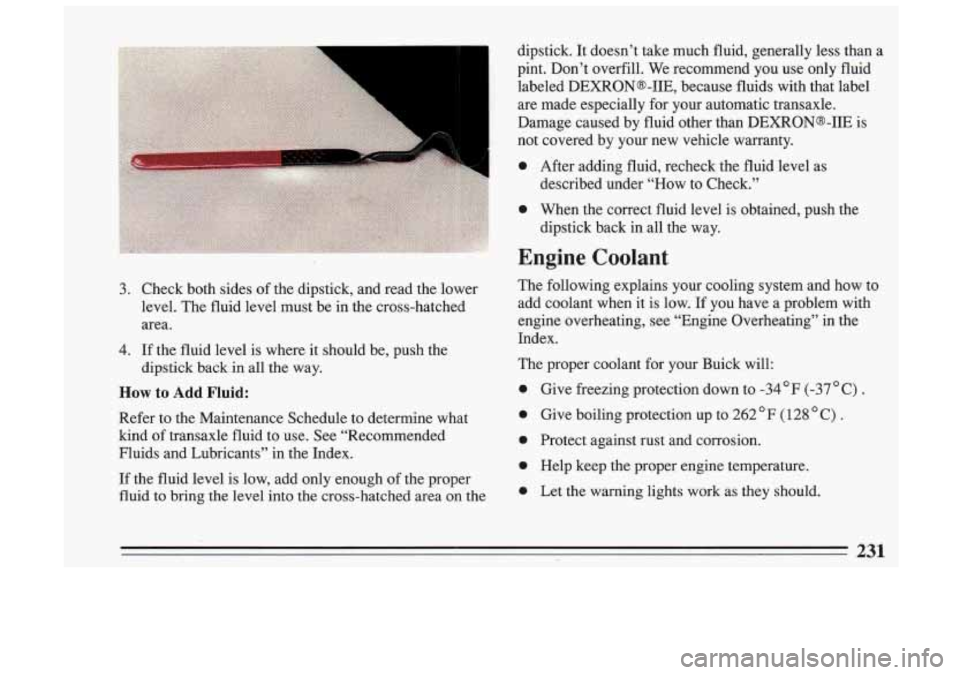
Give freezing protection down to -34°F (-37 "C) .
Give boiling protection up to 262 F (128 " C) .
Protect against rust and corrosion.
Help keep the proper engine temperature.
Let the warning lights work
as they should.
231
Page 237 of 306
1 Brake Master Cylinder
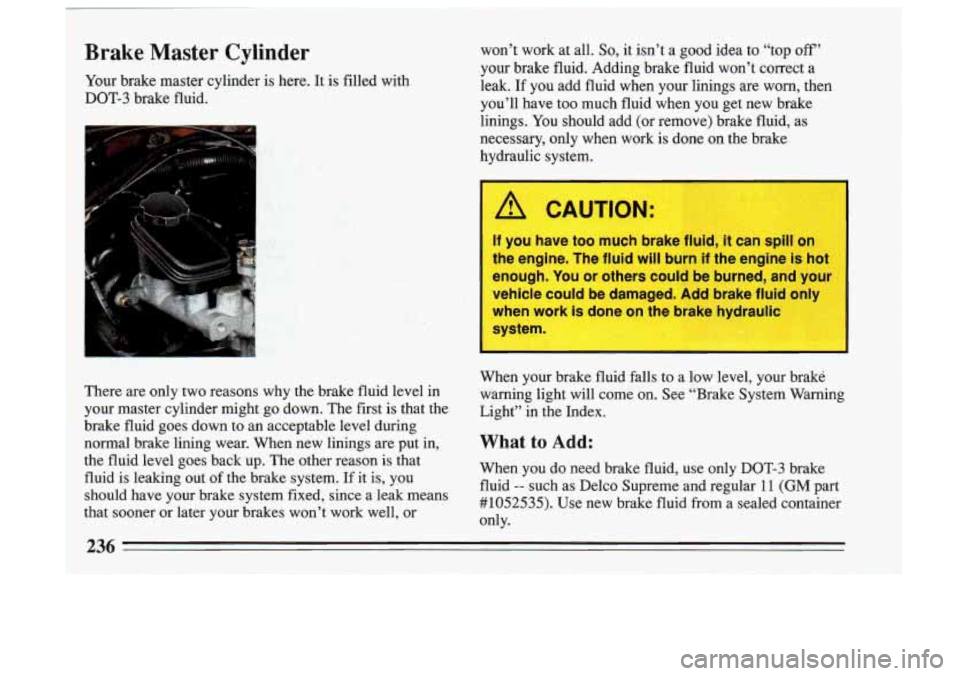
Your brake master cylinder is here. It is filled with
1 DOT-3 brake fluid. won’t work
at all.
So, it isn’t a good idea to “top off’
your brake fluid. Adding brake. fluid won’t correct a
leak. If you add fluid when your linings are worn, then
you’ll have too much fluid when you get new brake
linings.
You should add (or remove) brake fluid, as
necessary, only when work is done
on the brake
hydraulic system.
I
A CAUTION:
If you have too much brake fluid, it can spill on
the engine. The fluid will burn
if the engine is hot
enough. You or others could be burned, and your
vehicle could be damaged. Add brake fluid only
when work is done on the br,
e hl ‘raulic
system.
1
There are only two reasons why the brake fluid level in
your master cylinder might go down. The first is that the
brake fluid goes down to an acceptable level during
normal brake lining wear. When new linings
are put in,
the fluid level goes back up. The other reason is that
fluid is leaking out
of the brake system. If it is, you
should have your brake system fixed, since a leak means
that sooner or later your brakes won’t work well, or When your brake fluid falls to a low level, your brake
warning light will come on. See “Brake System Warning
Light’’
in the Index.
What to Add:
When you do need brake fluid, use only DOT-3 brake
fluid
-- such as Delco Supreme and regular 11 (GM part
#1052535). Use new brake fluid from a sealed container only.
I
236
Page 251 of 306
r
1 e Use solvent-type cleaners in a well-ventilated area
only.
If you use them, don’t saturate the stained area.
If a ring forms after spot cleaning, clean the entire
area immediately or it will
set.
Using Foam-Type Cleaner on Fabric I
0 Vacuum and brush the area to remove any loose dirt.
0 Always clean a whole trim panel or section. Mask ’
surrounding trim along stitch or welt lines.
Mix Multi-Purpose Powdered Cleaner following the
directions on the container label.
0 Use suds only and apply with a clean sponge.
0 Don’t saturate the material.
Don’t rub it roughly.
As soon as you’ve cleaned the section, use a sponge
to remove the suds.
0 Rinse the section with a clean, wet sponge.
0 Wipe off what’s left with a slightly damp paper towel
or cloth.
0 Then dry it immediately with an air hose, a hair
dryer or a heat lamp.
1
0 Wipe *with a clean cloth.
Using Solvent-Type Cleaner on
Fabric
First, see if you have to use solvent-type cleaner at all.
Some spots and stains will clean
off better with just
water and mild soap.
If
you need to use it, then:
Gently scrape excess soil from the trim material with
a clean, dull knife or scraper. Use very little cleaner,
light pressure and clean cloths (preferably cheesecloth). Cleaning should start at the outside of
the stain, “feathering” toward the center. Keep
changing to a clean section of the cloth.
When you clean a stain from fabric, immediately dry
the area with an air hose, hair dryer, or heat lamp to
help prevent a cleaning ring. (See the previous
NOTICE.)
Page 252 of 306
Special Cleaning Problems
Greasy or Oily Stains: Like grease, oil, butter,
margarine, shoe polish, coffee with cream, chewing gum, cosmetic creams, vegetable oils, wax crayon, tar
and asphalt.
Carefully scrape off excess stain.
Then follow the solvent-type instructions above.
0 Shoe polish, wax crayon, tar and asphalt will stain if
left on a vehicle seat fabric. They should be removed
as soon as possible. Be careful, because the cleaner
will dissolve them and may cause them to bleed.
Non-Greasy Stains: Like catsup, coffee (black), egg,
fruit, fruit juice, milk, soft drinks, wine, vomit, urine and
blood.
Carefully scrape off excess stain, then sponge the
soiled area with cool water.
If a stain remains, follow the foam-type instructions
above.
If an odor lingers after cleaning vomit or urine, treat
the area with a waterbaking soda solution:
1
teaspoon (5 ml) of baking soda to 1 cup (250 ml)
of lukewarm water.
Finally, if needed, clean lightly with solvent-type
cleaner.
Combination Stains: Like candy, ice cream,
mayonnaise, chili sauce and unknown stains.
Carefully scrape off excess stain, then clean with
0 If a stain remains, clean it with solvent-type cleaner.
cool water and allow to dry.
Cleaning Vinyl or Leather
Just use warm water and a clean cloth.
0 Rub with a clean, damp cloth to remove dirt. You
Things like tar, asphalt and shoe polish will stain if
may have to
do it more than once.
you don’t get them
off quickly. Use a clean cloth and
solvent-type vinylbeather cleaner.
Cleaning the Top of the Instrument
Panel
Use only mild soap and water to clean the top surfaces
of the instrument panel. Sprays containing silicones or
waxes may cause annoying reflections in the windshield
and even make it difficult to see through the windshield
under certain conditions.
251
Page 259 of 306
Fuses and Circuit Breakers
The wiring circuits in your car are protected from short
circuits.by a combination of fuses, circuit breakers, and
fusible thermal links in the wiring itself. This greatly
reduces the chance of fires caused by electrical
problems.
Be sure to use the correct fuse. If you ever have a
problem on the road and don’t have a spare fuse, you
I
can “borrow” one of the identical size and rating. Just
pick some feature of your car that you can get along
without
-- like the radio or cigarette lighter -- and use its
fuse, if it is of the value you need. Replace it as soon as
you can.
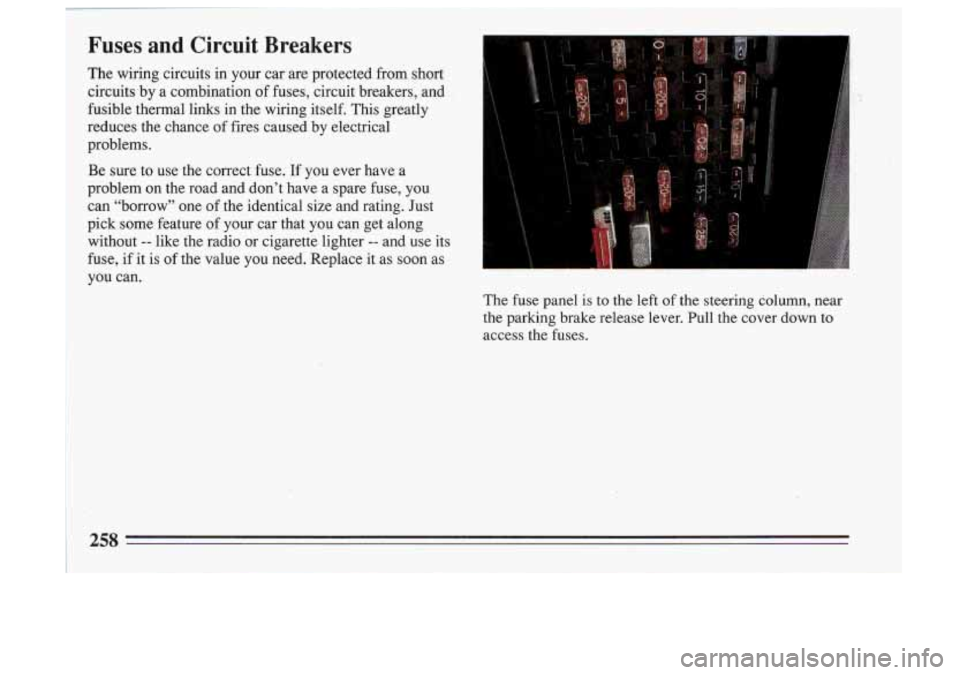
The fuse panel
is to the left of the steering column, near
the parking brake release lever. Pull the cover down to
access the fus.es.
I
258
Page 260 of 306
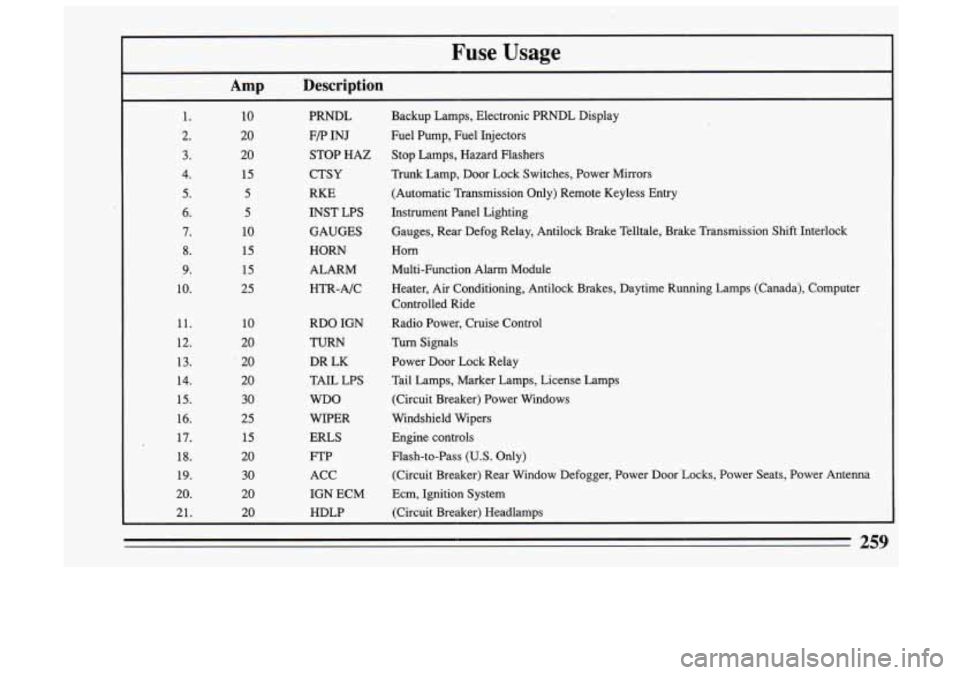
~~ Fuse Usage
Amp Description
1.
2.
3.
4.
5.
6.
7.
8.
9.
10.
11.
12.
13.
14.
15.
16.
17.
18.
19.
20.
21. 10
20
20
15
5
5
10
15
15
25
10
20
20
20
30
25 15
20
30
20
20 PRNDL
F/P INJ
STOP HAZ
CTSY
RKE
INST LPS
GAUGES
HORN
ALARM HTR-A/C
RDO IGN
TURN DR LK
TAIL LPS
WDO
WIPER
ERLS
FTP
ACC
IGN ECM HDLP Backup Lamps, Electronic PRNDL Display
Fuel Pump, Fuel Injectors
Stop Lamps, Hazard Flashers
Trunk Lamp,-Door Lock Switches, Power Mirrors
(Automatic Transmission Only) Remote Keyless Entry
Instrument Panel Lighting
Gauges, Rear Defog Relay, Antilock Brake Telltale, Brake Transmi\
ssion Shift Interlock
Horn
Multi-Function Alarm Module
Heater, Air Conditioning, Antilock Brakes, Daytime Running Lamps \
(Canada), Computer Controlled Ride
Radio Power, Cruise Control
Turn Signals
Power Door Lock Relay
.Tail Lamps, Marker Lamps, License Lamps (Circuit Breaker) Power Windows
Windshield Wipers Engine controls
Flash-to-Pass
(U.S. Only)
(Circuit Breaker) Rear Window Defogger, Power Door Locks, Powe\
r Seats, Power Antenna
Ecm, Ignition System (Circuit Breaker) Headlamps
259
Page 261 of 306
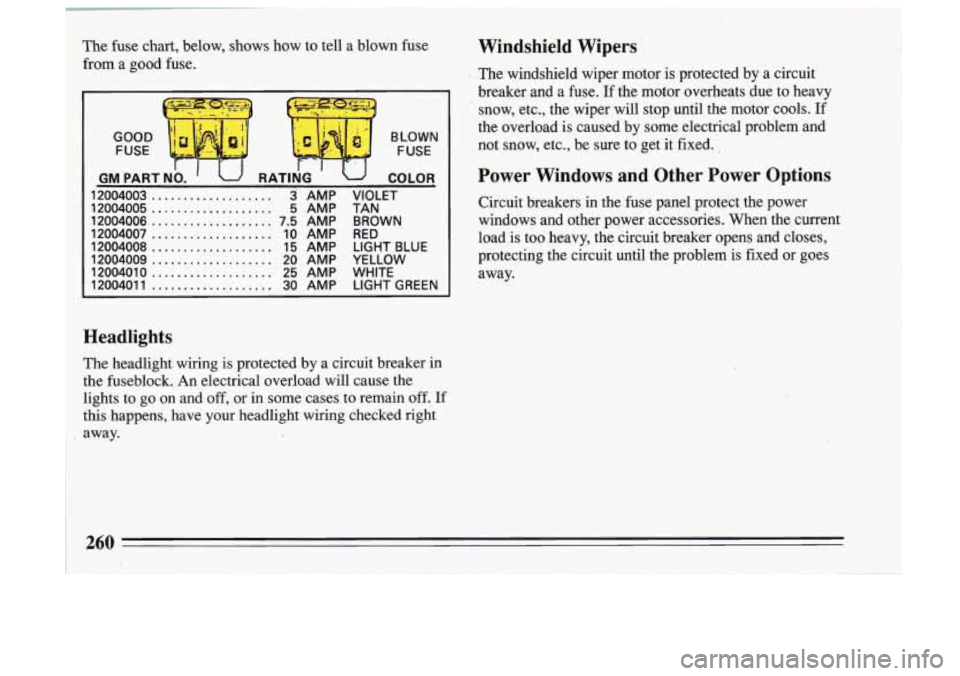
The fuse chart, below, shows how to tell a blown fuse
from
.. a good fuse.
GOOD 1
I FUSE FUSE
BLOWN
' ' u RATING GM PART NO.
12004003 ................... 3 AMP VIOLET
12004006
................... 7.5 AM.P BROWN
12004007
................... 10 AMP RED
12004008
................... 15 AMP LIGHT BLUE
12004009
................... 20 AMP YELLOW
12004010
................... 25 AMP WHITE
12004011
................... 30 AMP LIGHT GREEN
r- -tu COLOR
12004005 ................... 5 -AMP TAN
Headlights
The headlight wiring is protected by a circuit breaker in
the fuseblock. An electrical overload will cause the
lights to go on and
off, or in some cases to remain off. If
this happens, have your headlight wiring checked right
away.
Windshield Wipers
. The windshield wiper motor is protected by a circuit
breaker and a fuse. If the motor overheats due to heavy
snow, etc., the wiper will stop until the motor cools.
If
the overload is caused by some electrical problem and
not snow, etc., be sure to get
it fixed. ,
Power Windows and Other Power Options
Circuit breakers in the fuse panel protect the power
windows and other power accessories. When the current
load is too heavy, the circuit breaker opens and closes,
protecting the circuit until the problem is fixed or goes
away.
260
I
Page 263 of 306
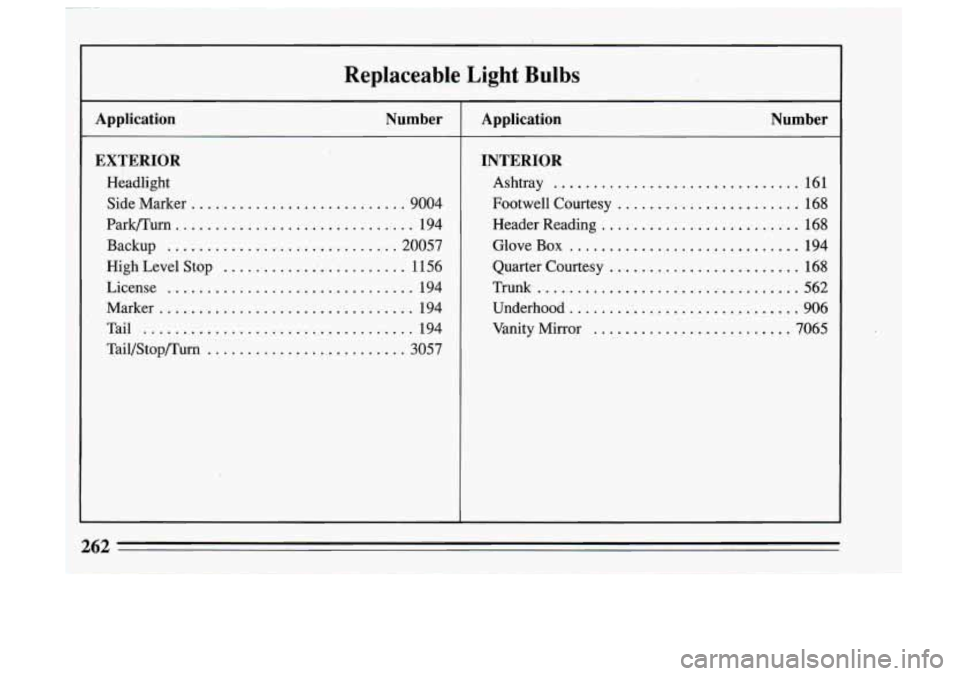
Replaceable Light Bulbs
Application Number
EXTERIOR
Headlight Side Marker
........................... 9004
Park/Tu
rn .............................. 194
Backup
............................. 20057
High Level Stop
........................ 1 156
License
............................... 194
Marker
................................ 194
Tail
.................................. 194
Tail/Stop/Turn
.......................... 3057
Application Number
INTERIOR
Ashtray ............................... 161
Footwell Courtesy
....................... 168
Header Reading
......................... 168
Glove Box
............................. 194
Quartercourtesy
........................ 168
Trunk
.................................. 562
Underhood
............................. 906
Vanity Mirror
......................... 7065
1
262
Page 281 of 306
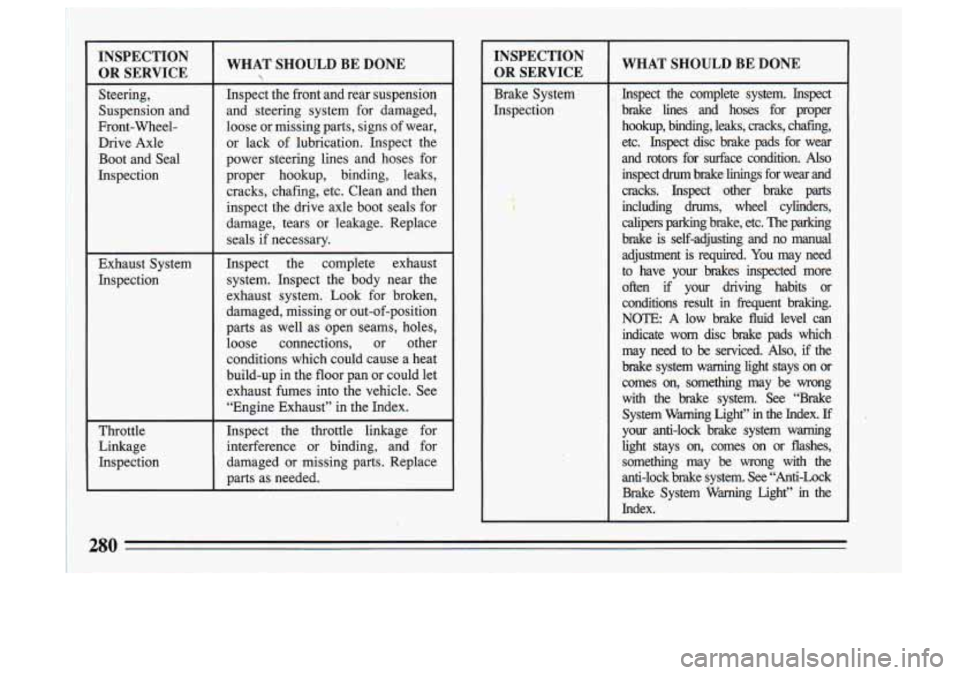
INSPECTION
OR SERVICE
Steering,
Suspension and
Front-Wheel-
Drive Axle
Boot and Seal
Inspection
Exhaust System
Inspection
Throttle
Linkage Inspection
WHAT SHOULD BE DONE
hspect the front and rear suspension
and steering system for damaged,
loose or missing parts, signs of wear,
or lack of lubrication. Inspect the
power steering lines and hoses for
proper hookup, binding, leaks, cracks, chafing, etc. Clean and then
inspect the drive axle boot seals for
damage, tears or leakage. Replace
seals
if necessary.
Inspect the complete exhaust system. Inspect the body near the
exhaust system. Look for broken,
damaged, missing or out-of-position
parts as well as open seams, holes,
loose connections,
or other
conditions which could cause a heat
build-up in the floor pan or could let
exhaust fumes into the vehicle. See
“Engine Exhaust” in the Index.
Inspect the throttle linkage for interference or binding, and for
damaged or missing parts. Replace
parts as needed.
“:
INSPECTION
OR SERVICE
Brake System
Inspection
WHAT SHOULD BE DONE
Inspect the complete system. Inspect
brake
lines and hoses for proper
hookup, binding, leaks, cracks, chafing,
etc.
Inspect disc brake pads for wear
and rotors for swrface condition.
Also
inspect Qwn brake linings for wear and
cracks. Inspect other brake
parts
including drums, wheel cylinders,
calipers parking brake, etc. The parking
brake is self-adjusting and no manual adjustment
is required. You may need
to have your brakes inspected more often
if your driving habits or
conditions result in frequent braking.
NOTE: A low brake fluid level can
indicate worn disc brake pads which
may
need to be serviced. Also, if the
brake system warning light stays on or
comes on, something may
be wrong
with the brake system. See “Brake System
Warning Light” in the Index. If
your anti-lock brake system warning
light stays
on, comes on or flashes,
something may
be wrong with the
anti-lock brake system. See “Anti-Lock
Brake System Warning Light”
in the
Index.
280 .~ . ~