air condition BUICK SKYLARK 1993 Owners Manual
[x] Cancel search | Manufacturer: BUICK, Model Year: 1993, Model line: SKYLARK, Model: BUICK SKYLARK 1993Pages: 306, PDF Size: 15.84 MB
Page 13 of 306
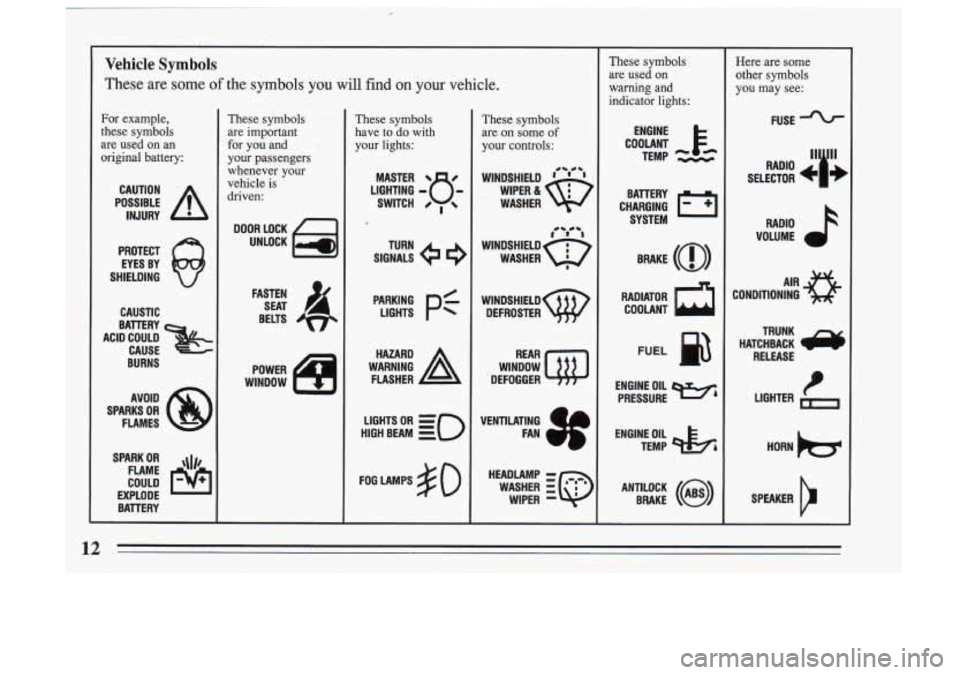
Vehicle Symbols
These are some of the symbols you will. find -on your vehicle.
For example,
these symbols
are used on an
original battery:
CAUTION
INJURY
PROTECT EYES BY
SHIELDING
Q
CAUSTIC
ACID COULD CAUSE
BA~~RY
BURNS AVOID
SPARKS
OR
FLAMES
SPARK
OR ,\I/,
COULD pq
FLAME
EXPLODE BATTERY
These symbols
are important
for you and
your passengers
whenever your
vehicle- is
driven:
FASTEN SEAT 4
BELTS
POWER
WINDOW
These symbols
have to do with
your lights:
SIGNALS e 9
TU-RN
HIGH BEAM
OR = =o
FOG LAMPS # 0
These symbols
are on some of
your controls:
WINDSHIELD ' ' '
. WASHER
CI 0s
-tO -1
WINDSHIELD
WASHER 8
wI*DsHIELDw DEFROSTER
WINDOW
Ltft,
REAR
DEFOGGER
VENTILATING FAN
3f
HEADLAMP -
WIPER
WASHER
EQ
L
~
These symbols
are used
on
warning and
indicator lights:
COOLANT F-
TEMP *-
ENGINE
CHARGING BATTERY
SYSTEM
RADIATOR
a
COOLANT
FUEL @
ENGINE OIL e,
PRESSURE
TEMP
OIL &
ANTILOCK (@)
BRAKE
Here are some
other symbols
you may see:
FUSE
RAD10 k
VOLUME
CONDITIONING
AIR e
HATCHBACK TRUNK
RELEASE
LIGHTER
1-i
HORN
SPEAKER
12
Page 120 of 306
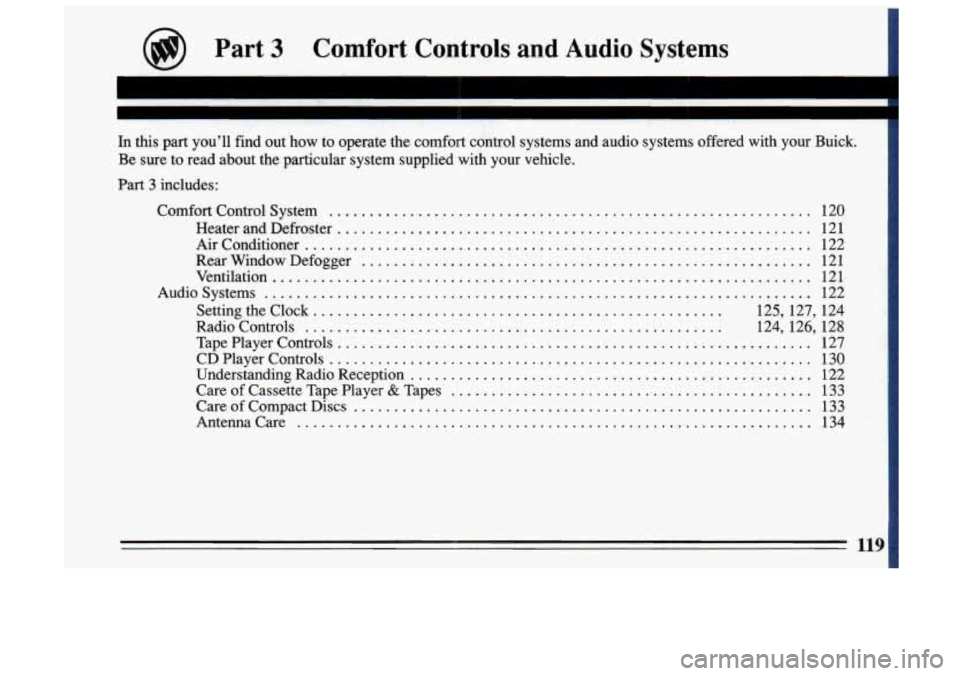
@ Part 3 Comfort Controls and Audio Systems
In this part you’ll find out how to operate the comfort control systems and audio systems offered with your Buick .
Be sure to read about the particular system supplied with your vehicle \
.
Part 3 includes:
Comfort Control System
............................................................ 120
Heater and Defroster
........................................................... 121
Air Conditioner
............................................................... 122
RearWindowDefogger
........................................................ 121
Ventilation
................................................................... 121
Audiosystems
.................................................................... 122
SeaingtheClock
................................................... 125.127. 124
RadioControls
.................................................... 124.126. 128
TapePlayerControls
........................................................... 127
CDPlayerControls
............................................................ 130
Care of Cassette Tape Player
& Tapes ............................................. 133
CareofCompactDiscs
......................................................... 133
Antennacare
................................................................ 134
Understanding Radio Reception
.................................................. 122
119
Page 123 of 306
I’ not cover thisdamage. And don’t put decals
Air Conditioner (Option)
The air conditioner cools the air coming into your
vehicle. The air conditioner won’t .work, well unless all
the windows are closed. On a very hot day, you might
want to open the windows to let the hottest air out.
Max
This setting provides maximum cooling with the least
amount of work. MAX recirculates the air inside your
vehicle, and cools the air quickly. Adjust the
temperature control to a cold setting.
Norm.
After using the MAX setting to cool the air quickly,
adjust the air conditioner to NORM and the temperature
to the desired comfort setting. This permits fresh air to
be cooled and to circulate through your vehicle.
Audio Systems
Your Delcoa audio system has been degigned to operate
easily and give years
of listening pleasure. But you will
get the most enjoyment out
of your system if you
acquaint yourself with it first. Find out what your
Delcom system can do and how to operate all its
controls,
to be sure you’re getting the most out of the
advanced engineering that went into it.
FM Stereo
FM stereo will give you the best sound. But FM signals
will reach only about
10 to 40 miles (16 to 65 km). And,
tall buildings or hills can interfere with FM signals, causing the sound to come and go.
AM
The range for most AM stations is greater than for FM,
especially at night. The longer range, however, can
cause stations to interfere with each other. AM can pick
up noise from things like storms and power lines.
Try
reducing the treble to reduce this noise.
122
1
Page 246 of 306
The tire has a puncture, cut, or other damage that
can’t be repaired well because of the size or location
of the damage.
Buying New Tires
To find out what kind and size of tires you need, look at
the Tire-Loading Information label.
The tires installed on your vehicle when it was new had
a Tire Performance Criteria Specification (TPC Spec)
number on each tire’s sidewall. When you get new tires, get ones with that same
TPC Spec number. That way,
your vehicle will continue to have tires that are designed
to give proper endurance, handling, speed rating,
traction, ride and other things during normal service on
your vehicle. If your tires have an all-season tread
design, the TPC number will be followed by a
“MS”
(for mud and snow).
If you ever replace your tires with those not having a
TPC Spec number, make sure they are the same size,
load range, speed rating and construction type (bias,
bias-belted or radial) as your original tires.
A CAUTION:
Mixing tires could cause you to lose control
while driving.
If you mix tires of different sizes or
types (radial and bias-belted tires), the vehicle
may not handle properly, and you could have a
crash. Be sure to use the same size and type
tires on all wheels.
It’s all right to drive with your compact spare,
though. It was developed for limited use on your
vehicle.
I
Uniform Tire Quality Grading
The following information relates to the system
developed by the United States National Highway
Traffic Safety Administration which grades tires by
treadwear, traction and temperature performance. (This applies only to vehicles sold in the United States.)
Treadwear
The treadwear grade is a comparative rating based on
the wear rate of the tire when tested under controlled
conditions on a specified government test course. For
example, a tire graded
150 would wear one and a half
245
Page 248 of 306
In most cases, you will not need to have your wheels
. aligned again. However, if you notice unusual tire wear or your vehicle pulling one way or the other, the
alignment may need to be reset. If you notice your
vehicle vibrating when driving on a smooth road, your
wheels may need to be rebalanced.
Wheel Replacement
Replace any wheel that is bent, cracked or badly rusted.
If wheel nuts keep coming loose, the wheel, wheel bolts,
and wheel nuts should be replaced. If the wheel leaks air out, replace it (except some aluminum wheels, which
can sometimes be repaired
-- See your Buick dealer) if
any of these conditions exist.
Your dealer will know the kind of wheel you need.
Each new wheel should have the same load carrying
capacity, diameter, width, offset, and be mounted the
same way
as the one it replaces.
If you need to replace any of your wheels, wheel bolts,
or wheel nuts, replace them only with new
GM original
equipment parts. This way, you will be sure to. have the
right wheel, wheel bolts, and wheel nuts for your Buick
model.
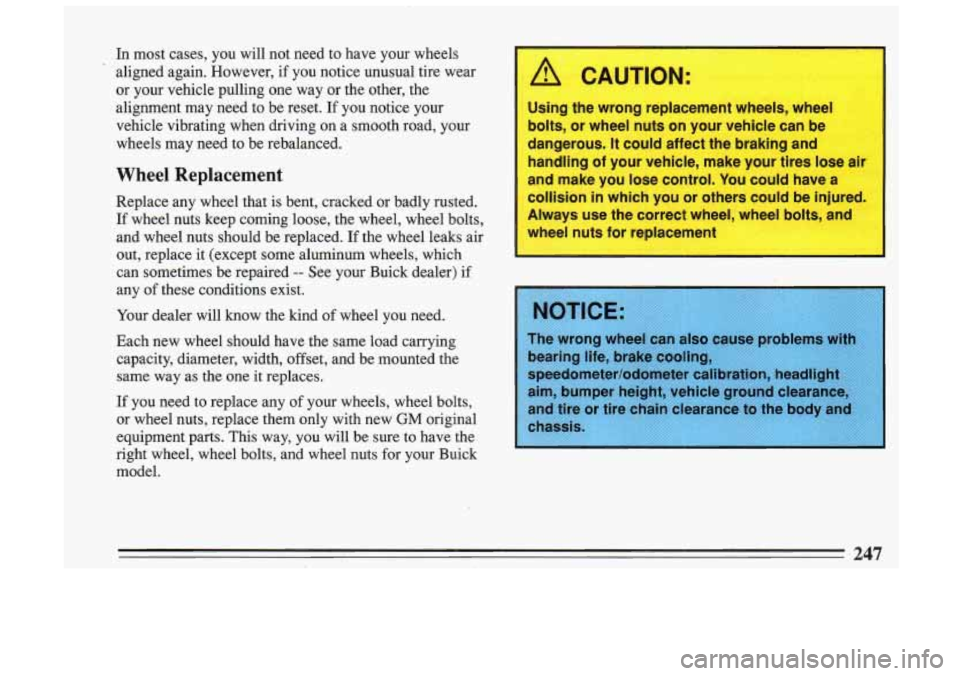
A CAUTION:
Using the wrong replacement wheels, wheel
bolts, or wheel nuts
on your vehicle can be
dangerous.
It could affect the braking and
handling
of your vehicle, make your tires lose
and make you lose control. You could have a
collision
in which you or others could be injured.
Always use the correct wheel, wheel bolts, and
wheel nuts for replacement
earing life, brake cooling,
peedQmeter/Qdometer
cali
im, bumper height, vehicl
nd tire or tire chain clearance to the body an
, 247
Page 256 of 306
Underbody Maintenance
Chemicals used for ice and snow removal and dust
control can collect on the underbody. If these are not
removed, accelerated corrosion (rust) can occur on the
underbody parts such as fuel lines, frame, floor pan, and
exhaust system even though they have corrosion
protection.
x
At least every spring, flush these materials from the
underbody with plain water. Clean any areas where mud
and other debris can collect. Dirt packed in closed areas
of the frame should be loosened before being flushed.
Your dealer or an underbody vehicle washing system
can
do this for you.
Chemical Paint Spotting
Some weather and atmospheric conditions can create a
chemical fallout. Airborne pollutants can fall upon and
attack painted surfaces on your vehicle. This damage
can take two forms: blotchy, ringlet-shaped
discolorations, and small irregular dark spots etched into
the paint surface.
Although no defect in the paint job causes this, Buick
will repair, at no charge to the owner, the surfaces of
new vehicles damaged by this fallout condition within
12 months or 12,000 miles (20 000 km) of purchase,
whichever comes first.
255
Page 260 of 306
~~ Fuse Usage
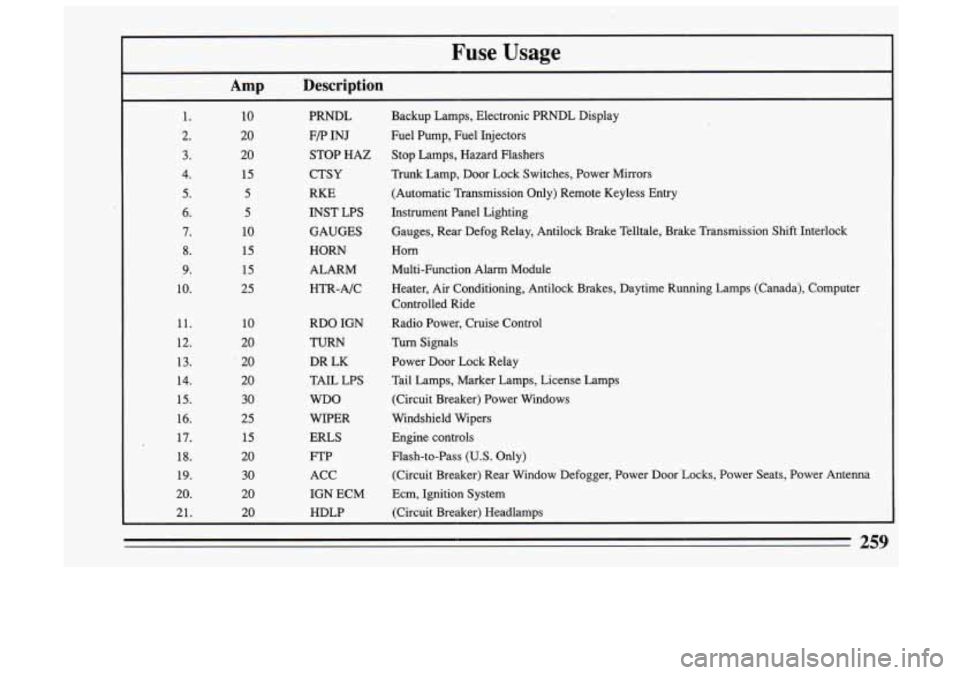
Amp Description
1.
2.
3.
4.
5.
6.
7.
8.
9.
10.
11.
12.
13.
14.
15.
16.
17.
18.
19.
20.
21. 10
20
20
15
5
5
10
15
15
25
10
20
20
20
30
25 15
20
30
20
20 PRNDL
F/P INJ
STOP HAZ
CTSY
RKE
INST LPS
GAUGES
HORN
ALARM HTR-A/C
RDO IGN
TURN DR LK
TAIL LPS
WDO
WIPER
ERLS
FTP
ACC
IGN ECM HDLP Backup Lamps, Electronic PRNDL Display
Fuel Pump, Fuel Injectors
Stop Lamps, Hazard Flashers
Trunk Lamp,-Door Lock Switches, Power Mirrors
(Automatic Transmission Only) Remote Keyless Entry
Instrument Panel Lighting
Gauges, Rear Defog Relay, Antilock Brake Telltale, Brake Transmi\
ssion Shift Interlock
Horn
Multi-Function Alarm Module
Heater, Air Conditioning, Antilock Brakes, Daytime Running Lamps \
(Canada), Computer Controlled Ride
Radio Power, Cruise Control
Turn Signals
Power Door Lock Relay
.Tail Lamps, Marker Lamps, License Lamps (Circuit Breaker) Power Windows
Windshield Wipers Engine controls
Flash-to-Pass
(U.S. Only)
(Circuit Breaker) Rear Window Defogger, Power Door Locks, Powe\
r Seats, Power Antenna
Ecm, Ignition System (Circuit Breaker) Headlamps
259
Page 264 of 306
. Capacities and Specifications
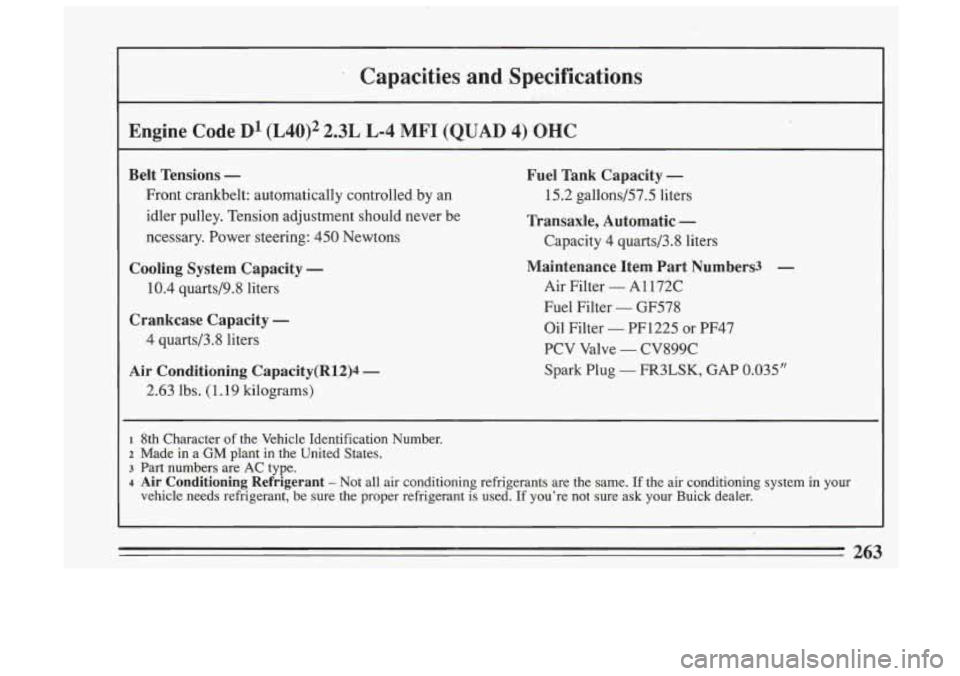
Engine Code D1 (L40)2 2.3L L-4 (QUAD 4) OHC
Belt Tensions -
Front crankbelt: automatically controlled by an
idler pulley. Tension adjustment should never be
ncessary. Power steering:
450 Newtons
Cooling System Capacity -
10.4 quarts/9.8 liters
Crankcase Capacity -
4 quarts/3.8 liters
Air Conditioning Capaeity(Rl2)4 -
2.63 lbs. (1.19 kilograms)
Fuel Tank Capacity -
15.2 gallons/57.5 liters
Transaxle, Automatic -
Capacity 4 quarts/3.8 liters
Maintenance Item Part Numbers3
Air Filter - AI 172C
Fuel Filter
- GF578
Oil Filter
- PF1225 or PF47
PCV Valve
- CV899C
Spark Plug
- FR3LSK, GAP 0.035”
~~~~
1 8th Character of the Vehicle Identification Number.
z Made in a GM plant in the United States.
3 Part numbers are AC type.
4 Air Conditioning Refrigerant - Not all air conditioning refrigerants are the same. If the air conditioning system in your
vehicle needs refrigerant, be sure the proper refrigerant
is used. If you’re not sure ask your Buick dealer.
263
Page 265 of 306
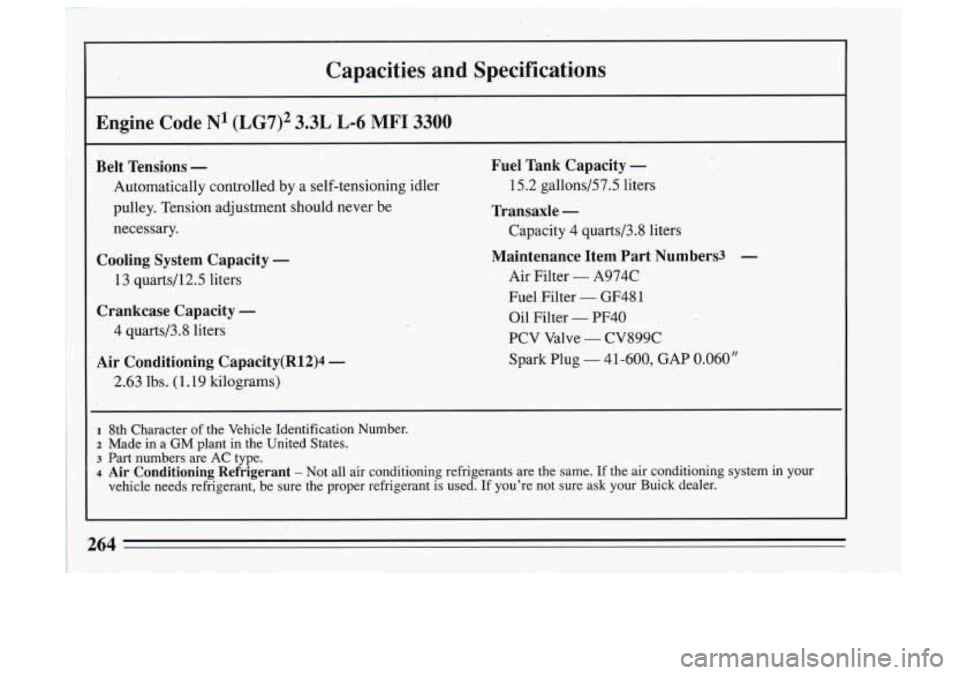
Capacities and Specifications
Engine Code N1 (LG7)2 3.3L L-6 MFI 3300
Belt Tensions -
Automatically controlled by a self-tensioning idler
pulley. Tension adjustment.should new be
necessary.
Cooling System Capacity -
13 quarts/l2.5 liters
Crankcase Capacity -
4 quarts/3.8 liters
Air Conditioning Capacity(R12)d -
2.63 lbs. (1.19 kilograms)
Fuel Tank Capacity -
Transaxle -
15.2 gallons/57.5 liters
Capacity
4 quartd3.8 liters
Maintenance Item Part Numbers3 -
Air Filter - A974C
Fuel Filter
- GF48 1
Oil Filter - PF40
PCV Valve
- CV899C
Spark Plug
- 41-600, GAP 0.060”
1 8th Character of the Vehicle Identification Number.
2 Made in a GM plant in the United States.
3 Part numbers are AC type.
4 Air Conditioning Refrigerant - Not all air conditioning refrigerants are the same. If the air conditioning system in your
vehicle needs refrigerant, be sure the proper refrigerant
is used. If you’re not sure ask your Buick dealer.
264
Page 268 of 306
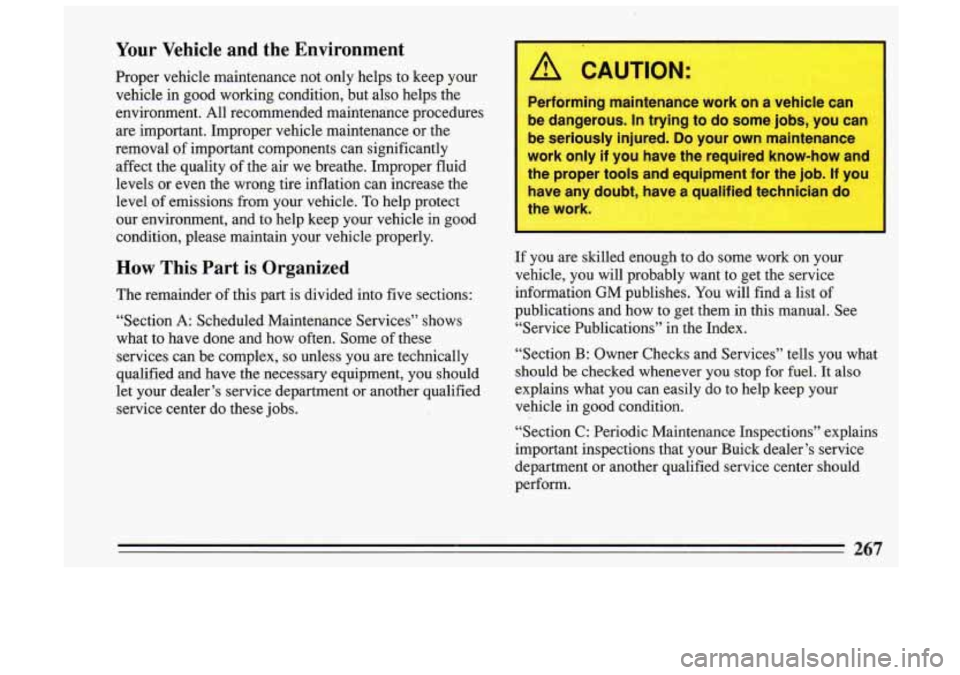
Your Vehicle and the Environment
Proper vehicle maintenance not only helps to keep your
vehicle in good working condition, but also helps the
environment. All recommended maintenance procedures
are important. Improper vehicle maintenance or the
removal
of important components can significantly
affect the quality of the-air we breathe. Improper fluid
levels or even the wrong tire inflation can increase the
level
of emissions from your vehicle. To help protect
our environment, and to help keep your vehicle in good
condition, please maintain your vehicle properly.
How This Part is Organized
The remainder of this part is divided into five sections:
“Section A: Scheduled Maintenance Services” shows
what to have done and how often. Some of these
services can be complex,
so unless you are technically
qualified and have the necessary equipment, you should
let your dealer’s service department or another qualified
service center do these jobs.
A CAUTION:
Performing maintenance work on a vehicle can
be dangerous. In trying to
do some jobs, you can
be seriously injured.
Do your own maintenance
work only
if you have the required know-how and
the proper tools and equipment for the job.
If you
have any doubt, have a qualified technician
do
the work.
If you are skilled enough to do some work on your
vehicle, you will probably want to get the service
information GM publishes. You will find a list of
publications and how to get. them in this manual. See
“Service Publications” in the Index.
“Section B: Owner Checks and Services” tells you what
should be checked whenever you stop for fuel. It also
explains what you can easily do to help keep your
vehicle in good condition.
“Section
C: Periodic Maintenance Inspections” explains
important inspections that your Buick dealer’s service
department or another qualified service center should
perform.