check oil BUICK SKYLARK 1993 Owners Manual
[x] Cancel search | Manufacturer: BUICK, Model Year: 1993, Model line: SKYLARK, Model: BUICK SKYLARK 1993Pages: 306, PDF Size: 15.84 MB
Page 116 of 306
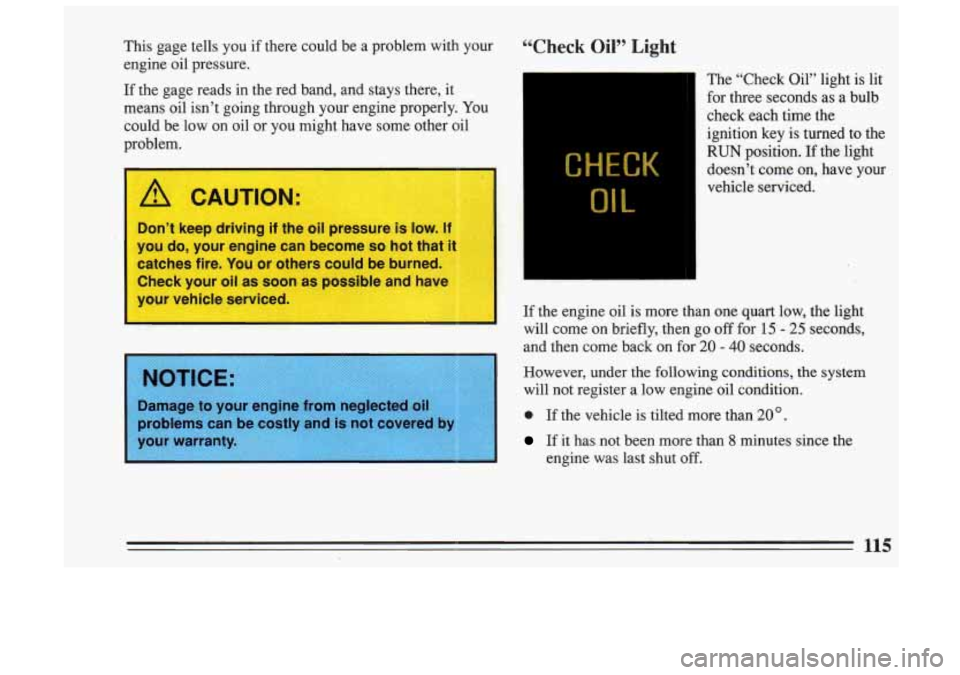
This gage tells you if there could be a problem with your
engine oil pressure.
If the gage reads in the red band, and stays there, it
means oil isn’t going through your engine properly. You
could be low on oil or you might have some other oil
problem.
Don’t keep driving if the oil pressure is low. If
you do, your engine can become so hot that it
catches fire. You or others could be burned.
Check your oil as soon as possible and hp-
I your vehicle serviced.
“Check Oil” Light
e
The “Check Oil” light is lit
for three seconds as a bulb
check each time the
ignition key
is turned to the
RUN position. If the light
doesn’t come on, have your vehicle serviced.
If ‘the engine oil is more than one quart low, the light
will come on briefly, then
go off for 15 - 25 seconds,
and then come back on for
20 - 40 seconds.
However, under the following conditions, the system
will not register a low engine oil condition.
0 If the vehicle is tilted more than 20°. I problems can be costly and is not covered by
If it has not been more than 8 minutes since the
engine was last shut off.
115
Page 117 of 306
If the “Check Oil” light comes back on, the engine oil
should be brought up to the proper level, see “Engine
j Oil” in the Index.
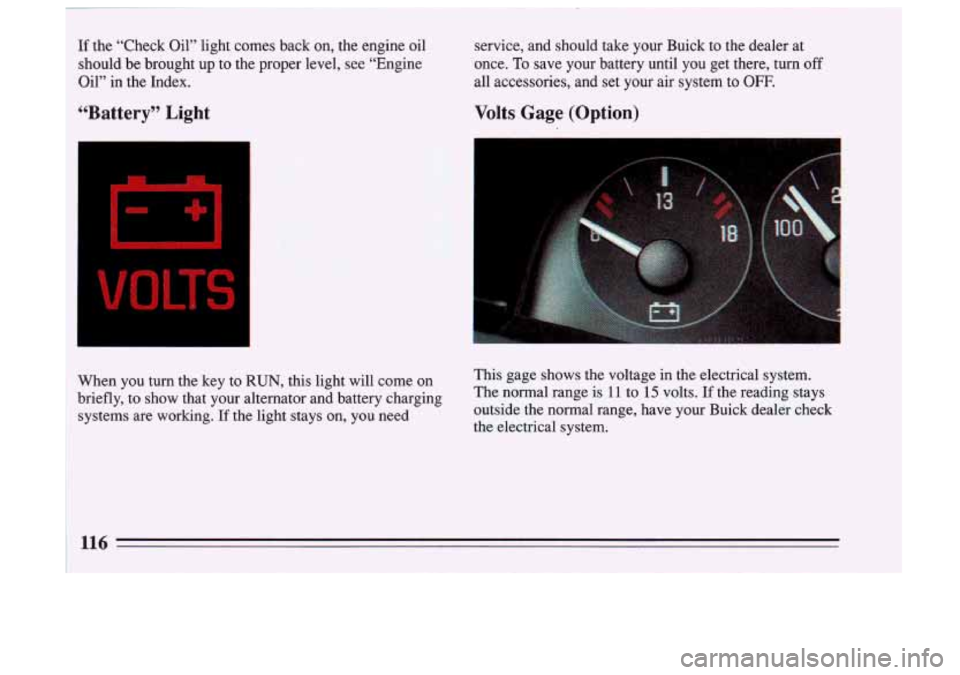
“Battery” Light
When you turn the key to RUN, this light will come on
briefly, to show that your alternator and battery charging
systems are working.
If the light stays on, you need service, and should take your Buick to the dealer
at
once. To save your battery until
you get there, turn off
all accessories, and set your air system to OFF.
Volts Gage (Option)
This gage shows the voltage in the electrical system.
The normal range is
11 to 15 volts. If the reading stays
outside the normal range, have your Buick dealer check
the electrical system.
Page 169 of 306
start bralung. If you must brake on the through lane, and
if there
is traffic close behind you, you can allow a little
extra time and flash your brake lights (in addition to your turn signal) as extra warning that you are about to
slow down and exit.
The exit ramp can be curved, sometimes quite sharply.
The exit speed is usually posted. Reduce your speed
according to your speedometer, not to your sense of
motion. After driving for any distance at higher speeds,
you may tend to think you are going slower than you
actually are. For example,
40 mph (65 km/h) might
seem like only
20 mph (30 km/h). Obviously, this could
lead to serious trouble on a ramp designed for
20 mph
(30 krn/h)!
Driving a Long Distance
Although most long trips today are made on freeways,
there are still many made on regular highways.
Long-distance driving on freeways and regular
highways is the same in some ways. The trip has to be
planned and the vehicle prepared, you drive at
higher-than-city speeds, and there are longer turns
behind the wheel. You’ll enjoy your trip more if you and
your vehicle are
in good shape. Here are some tips for a
successful long trip.
Before Leaving on a Long Trip
Make sure you’re ready. Try to be well rested. If you
must start when you’re not fresh
-- such as after a day’s
work
-- don’t plan to make too many miles that first part
of the journey. Wear comfortable clothing and shoes you
can easily drive in.
Is your vehicle ready for a long trip? If you keep it
serviced and maintained, it’s ready to go. If it needs
service, have it done before starting out. Of course,
you’ll find experienced and able service experts in
Buick dealerships all across North America. They’ll be
ready and willing to help
if you need it.
Here are some things you can check before a trip:
0 Windshield Washer Fluid: Is the reservoir full? Are
all windows clean inside and outside?
WiDer Blades: Are they in good shape/
Fuel, Engine Oil, Other Fluids: Have you checked
all levels?
0 Lights: Are they all working? Are the lenses clean?
0 Tires: They are vitally important to a safe,
trouble-free trip. Is the tread good enough for long-distance driving?
Are the tires all inflated to the
recommended pressure?
168
Page 185 of 306
But if you ever have to park your rig on a hill, here’s
, how to do it:
1 1. Apply your regular brakes, but don’t shift into.“P”
I (Park) yet.
I 2. Have someone place chocks under.the trailer wheels.
1
I
I I
I 3. When the wheel chocks are in place, release the
regular brakes until the chocks absorb the load.
4. Reapply the regular brakes. Then apply your parking
brake, and then shift to
“F’” (Park).
5. Release the regular brakes.
,. I I
~ When You Are Ready to Leave After
I Parking on a Hill
Maintenance When Trailer Towing
Your vehicle will need service more often when you’re
pulling a trailer. See the Maintenance Schedule for more
on this. Things that are especially important in trailer
operation are automatic transaxle fluid (don’t overfill),
engine oil, belt, cooling system, and brake adjustment.
Each of these is covered in this manual, and the Index
will help you find them quickly.
If you’re trailering, it’s
a good idea to review these sections before
you start
your trip.
Check periodically to see that all hitch nuts and bolts are
tight.
I 1. Apply your regular brakes and hold the pedal down
while you:
Start your engine;
0 Shift into a gear; and
0 Release the parking brake.
2. Let up on the brake pedal.
3. Drive slowly until the trailer is clear of the chocks.
4. Stop and have someone pick up and store the chocks.
284
Page 200 of 306
A CAUTION:
I
An electric fan under the hood can start up even
when the engine is not running and can injure
you. Keep hands, clothing and tools away from
any underhood electric fan.
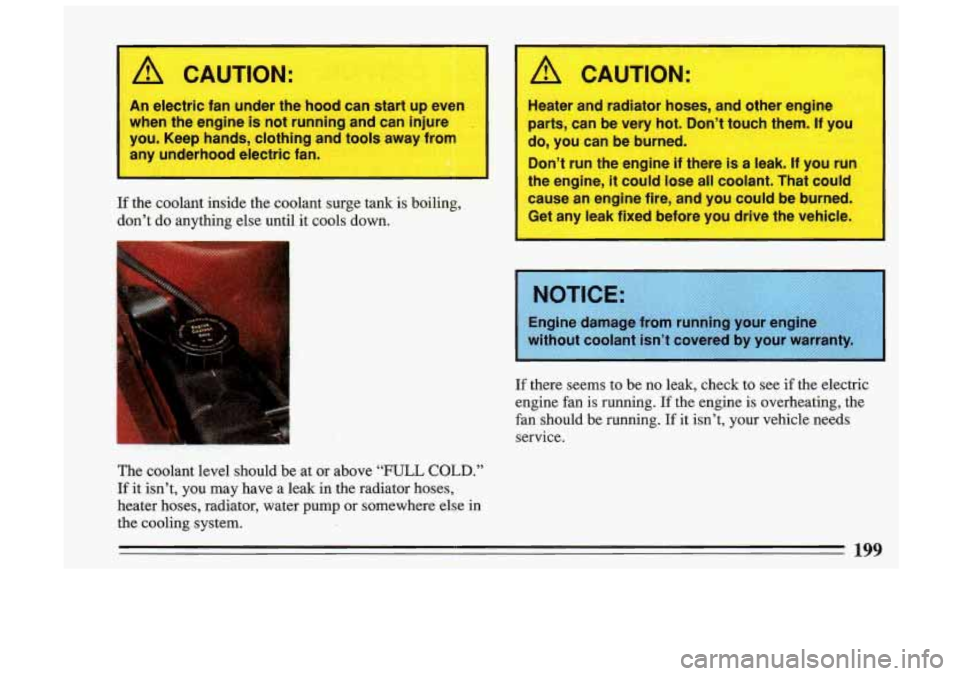
If the coolant inside the coolant surge tank is boiling,
don’t
do anything else until it cools down.
The coolant level should be at or above
“FULL COLD.”
If it isn’t, you may have a leak in the radiator hoses,
heater hoses, radiator, water pump or somewhere else in
the cooling system.
A CAUTION:
Heater and radiator hoses, and other engine
parts, can be very hot. Don’t touch them. If you
do, you can be burned.
Don’t run the engine if there is a leak. If you run
-le engine, it could lose all coolant. That could
cause an engine fire, and you could be burned.
Nt any leak fixed before you drive the vehicle.
If there seems to be no leak, check to see if the electric
engine fan is running.
If the engine is overheating, the
fan should be running.
If it isn’t, your vehicle needs
service.
199
Page 224 of 306
Engine Oil
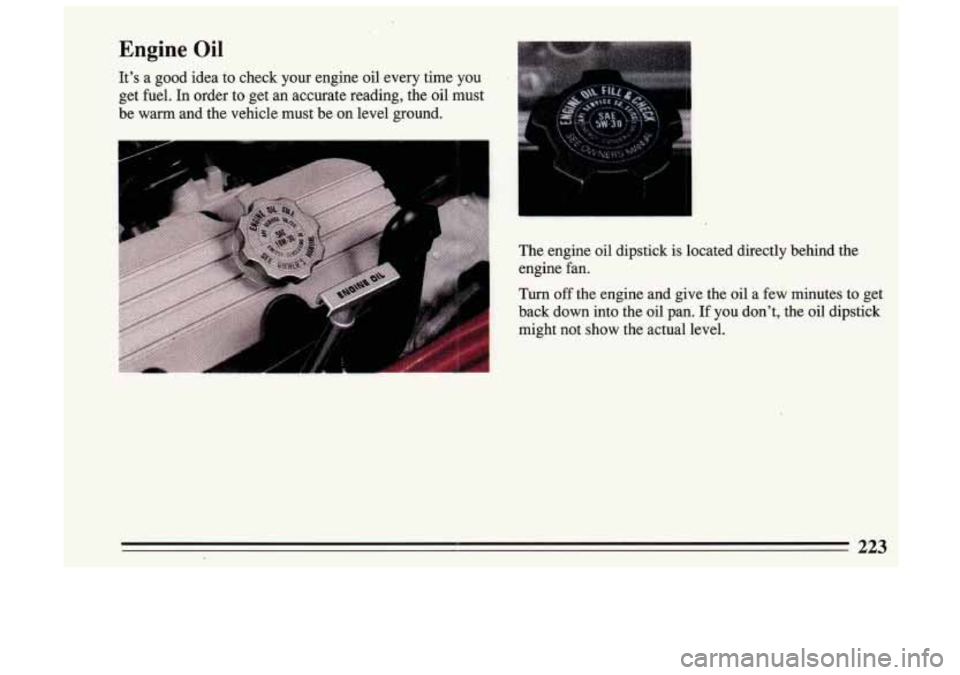
It's a good idea to check your engine oil every time you
get fuel.
In order to get an accurate reading, the oil must
be warm and the vehicle must be
on level ground.
1
I
The engine oil dipstick is located directly behind the
engine fan.
Turn
off the engine and give the oil a few minutes to get
back down into the oil pan.
If you don't, the oil dipstick
might not show the actual level.
223
Page 225 of 306
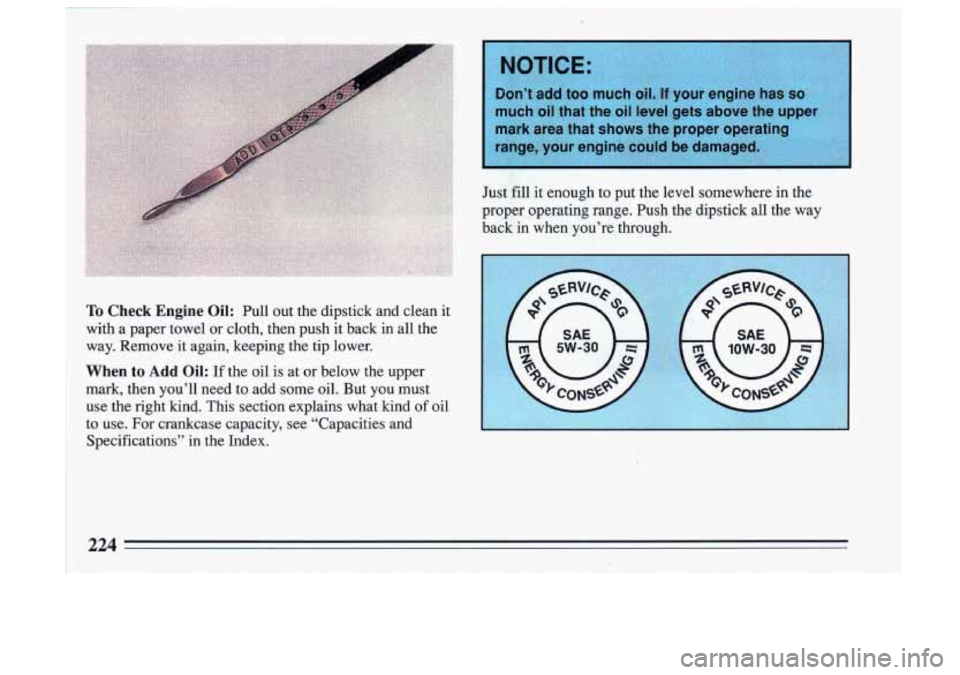
To Check Engine Oil: Pull out the dipstick and clean it
with a paper towel
or cloth, then push it back in all the
way. Remove it again, keeping the tip lower.
When to Add Oil: If the oil is at or below the upper
mark, then you’ll need
to add some oil. But you must
use the right kind,. This section explains what kind of oil
to use. For crankcase capacity, see “Capacities and Specifications” in the Index.
224
I
Page 233 of 306
~~~x~~~~ of one-half clean water (preferably
distilled) and one-half antifreeze that meets
“GM
Specification 1825-M,” which won’t damage aluminum
parts. You can also use a recycled coolant conforming to
GM Specification 1825-M with a complete coolant-flush
and refill. Use
GM Engine Coolant Supplement (sealer)
with any complete coolant change. If you use these, you
don’t need to add anything else.
n
1 A CAUTION:
Adding only plain water to your cooling system
can be dangerous. Plain water, or some other
liquid like alcohol, can boil before the proper
coolant mix will. Your vehicle’s coolant warning
system is set for the proper coolant mix. With
plain water or the wrong mix, your engine could
get too hot but you wouldn’t get the overheat
warning. Your engine could catch fire and you or
others could be burned. Use a
50150 mix of clean
water and a proper antifreeze.
I
warrantv. Too much water in the mix can freeze
Adding Coolant
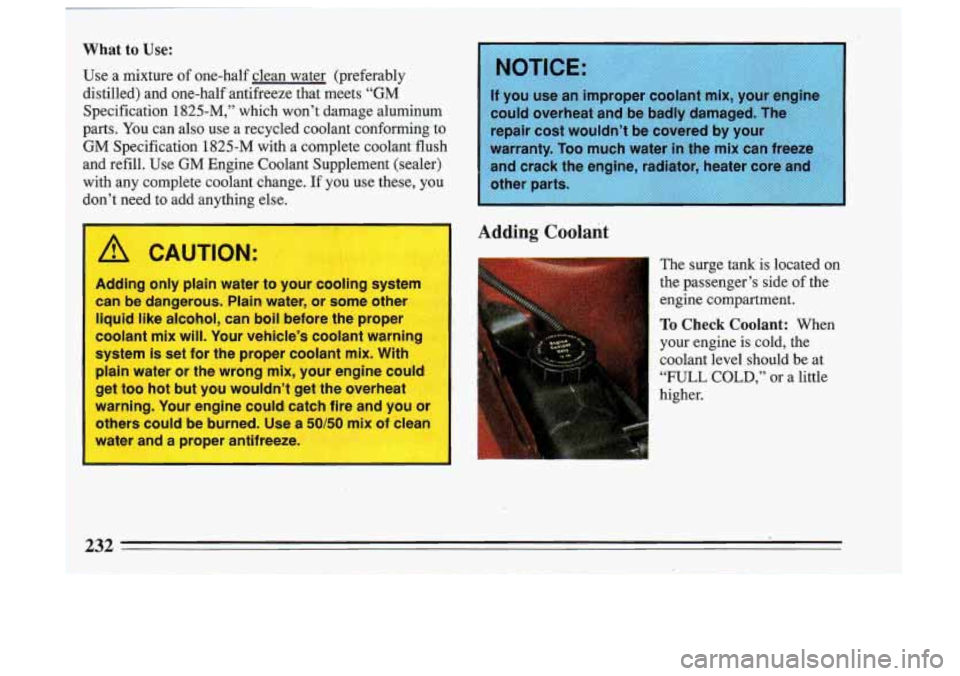
The surge tank is located on
the passenger’s side
of the
engine compartment.
To Check Coolant: When
.your engine is cold, the
coolant level should be at
“FULL COLD,” or a little
higher.
Page 267 of 306
IMPORTANT:
KEEP ENGINE OIL
AT THE PROPER
LEVEL AND CHANGE
AS
RECOMMENDED ,?.j :i i
Protection
Plan
Have you purchased the GM Protection Plan? The
Plan supplements your new vehicle warranties. See your
Buick dealer for details.
/
Introduction
A Word About Maintenance
We at General Motors want to help you keep your
vehicle in good working condition. But we don’t know
exactly how you’ll drive
it. You may drive very short
distances only a few times
a week. Or you may drive
long distances all the time in very hot, dusty weather.
You may use your Vehicle in making deliveries. Or you
may drive
it to work, to do errands or in many other
ways.
Because
of all the different ways people use their GM
vehicles, maintenance needs vary. You may even need
more frequent checks and replacements than you will
find in the schedules in this part.
So please read this part
and note how you drive. If you have any questions on
how to keep your vehicle in good condition, see your
Buick dealer, the place many GM owners choose to
have their maintenance work done.
Your dealer can be
relied upon to use proper parts and practices.
266
Page 275 of 306
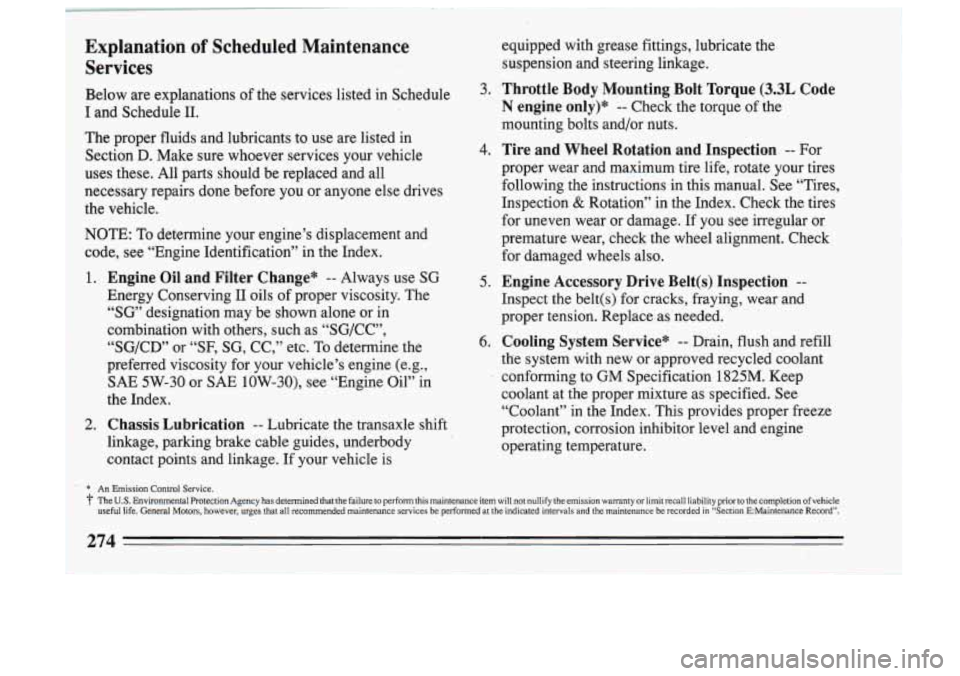
Explanation of Scheduled Maintenance equipped with grease fittings, lubricate the
Services suspension and steering linkage.
Below are explanations
of the services listed in $chediie ‘ ‘ 3. Throttle Body Mounting; Bolt Torque (3.3L Code . , I:
I and Schedule 11.
The proper fluids and lubricants to use are listed in
Section
D. Make sure whoever services your vehicle
uses these. All parts should be replaced and all
necessary repairs done before you or anyone else drives
the vehicle.
NOTE:
To determine your engine’s displacement and
code, see “Engine 1dentific.ation” in the Index.
1. Engine Oil and Filter Change* -- Always use SG
Energy Conserving
I1 oils of proper viscosity. The
“SG, designation may be shown alone or in
combination with others, such as “SG/CC”,
“SG/CD” or “SF,
SG, CC,” etc. To determine the
preferred viscosity for your vehicle’s engine (e.g.,
SAE 5W-30 or SAE 10W-30), see “Engine Oil” in
the Index.
2. Chassis Lubrication -- Lubricate the transaxle shift
linkage, parking brake cable guides, underbody
contact points and linkage. If your vehicle is
An Emission Control Service.
N engine only)* -- Che& the torque of the
mounting bolts and/or nuts.
proper wear and maximum tire life, rotate your tires
following the instructions in this manual. See “Tires,
Inspection
& Rotation” in the Index, Check the tires
for uneven wear or damage. If you see irregular or
premature wear, check
the wheel alignment. Check
for damaged wheels also.
5. Engine Accessory Drive Belt@) Inspection --
Inspect the belt(s) for cracks, fraying, wear and
proper tension. Replace as needed.
6. Cooling System Service* -- Drain, flush and refill
the system with new or approved recycled coolant
conforming to GM Specification 1825M. Keep
coolant at the proper mixture as specified. See
“Coolant” in the Index. This provides proper freeze
protection, corrosion inhibitor level and engine operating temperature.
4. Tire and Wheel Rotation and Inspection -- For
The U.S. Environmental Protection Agency has determined that the failure to perform this maintenance item will not nullify the emission war\
ranty or limit recall liability prior to the completion of vehicle
useful life. General Motors, however, urges that all recommended maintenance services be performed at the indicated i\
ntervals and the maintenance be recorded in “Section EMaintenance Record”.
274