instrument panel BUICK SKYLARK 1993 Owners Manual
[x] Cancel search | Manufacturer: BUICK, Model Year: 1993, Model line: SKYLARK, Model: BUICK SKYLARK 1993Pages: 306, PDF Size: 15.84 MB
Page 27 of 306

or the instrument panel ... or the safety belts!
With safety belts, you slow down as the vehicle does.
You get more time to
stop. You stop over more distance,
and your strongest bones take the forces. That's why
safety belts make such good sense.
Page 74 of 306
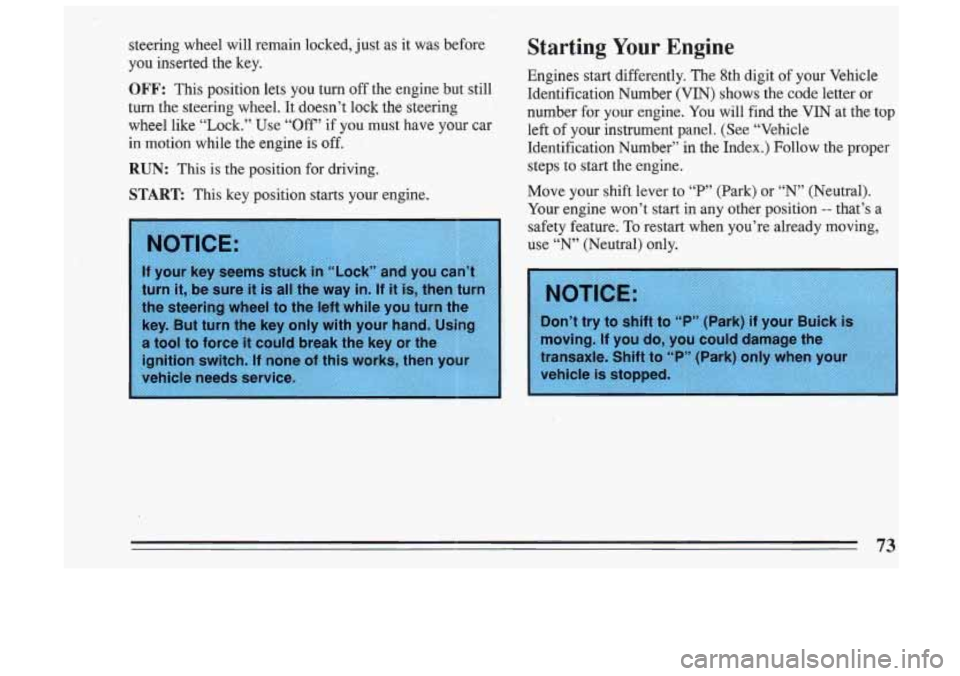
steering wheel will remain locked, just as it was before
you inserted the key.
OFF: This position lets you turn off the engine but still
turn the steering wheel. It doesn’t lock the steering
wheel like “Lock.” Use
“Off’” if you must .have your car
in motion while the engine is
off.
RUN: This is the position for driving.
START This key position starts your engine.
Starting .Your Engine
Engines start differently. The 8th digit of your Vehicle
Identification Number (VIN)
shows the code letter or
number for your engine. You will- find the VIN at the
top
left of your instrument panel. (See “Vehicle
Identification Number” in the Index.) Follow the proper
steps to start the engine.
Move your shift lever to
“P” (Park) or “N” (Neutral).
Your engine won’t start in any other position
-- that’s a
safety feature;
To restart when you’re already moving,
use
“N’ (Neutral) only.
73
Page 90 of 306
Turn Signal and Lane Change
Indicator
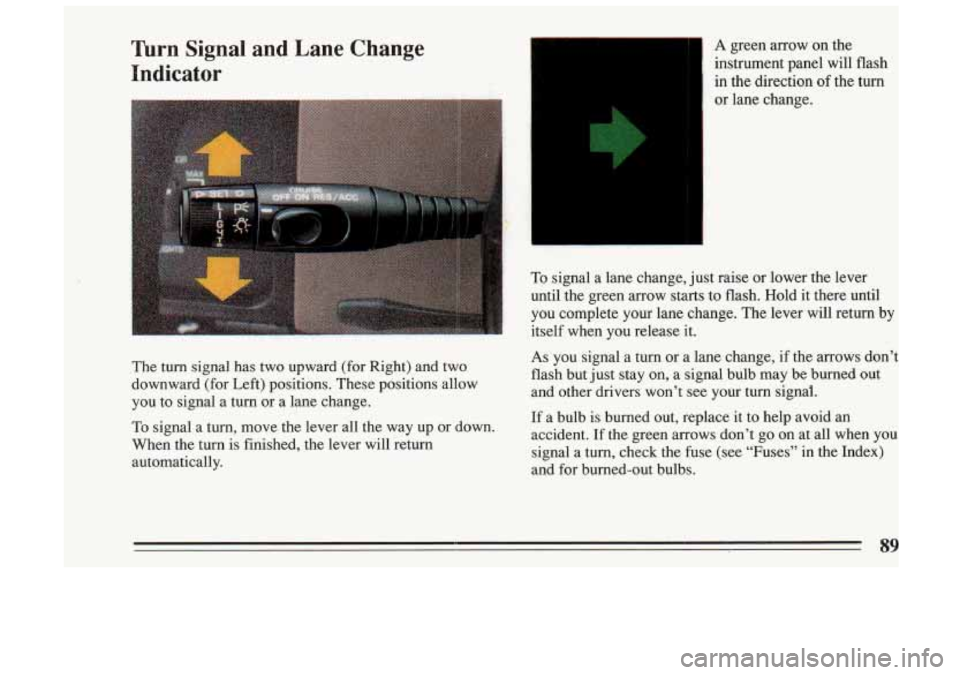
The turn signal has two upward (for Right) and two
downward (for Left) positions. These positions allow
you to signal a turn or a lane change.
To signal a turn, move the lever all the way up or down.
When the turn is finished, the lever will return
automatically.
i”’
A green arrow on the
instrument panel will flash
in the direction of the turn
or lane change.
To signal a lane change, just raise or lower the lever
until the green arrow starts to flash. Hold it there until
you complete your lane change. The lever will return by
itself when you release it.
As you signal a turn or a lane change, if the arrows don’t
flash but just stay on, a signal bulb may be burned out
and other drivers won’t see your turn signal
If a bulb is burned out, replace it to help avoid an
accident. If the green arrows don’t go on at all when you
signal a turn, check the fuse (see “Fuses” in the Index)
and for burned-out bulbs.
89
Page 91 of 306
Ihrn Signal tCONSS Chime
A chime will sound if your turn signal is left on after
having gone
3/4 of a mile, to remind you to turn your
signal
off.
Operation of Lights
Although your vehicle’s lighting system (headlights,
parking lights, fog lamps, side.marker lights and
taillights) meet all applicable federal lighting
requirements, certain states and provinces may apply their own lighting regulations that may require special
attention before you operate these lights. For example,
some jurisdictions may require that you operate your
lower beam lights with fog lamps at all times, or that
headlights be turned on whenever you must use your
windshield wipers. In addition, most jurisdictions
prohibit driving solely with parking lights, especially at
dawn or dusk. It
is recommended that you check with
you own state or provincial highway authority for
applicable lighting regulations.
Headlight High-Low Beam
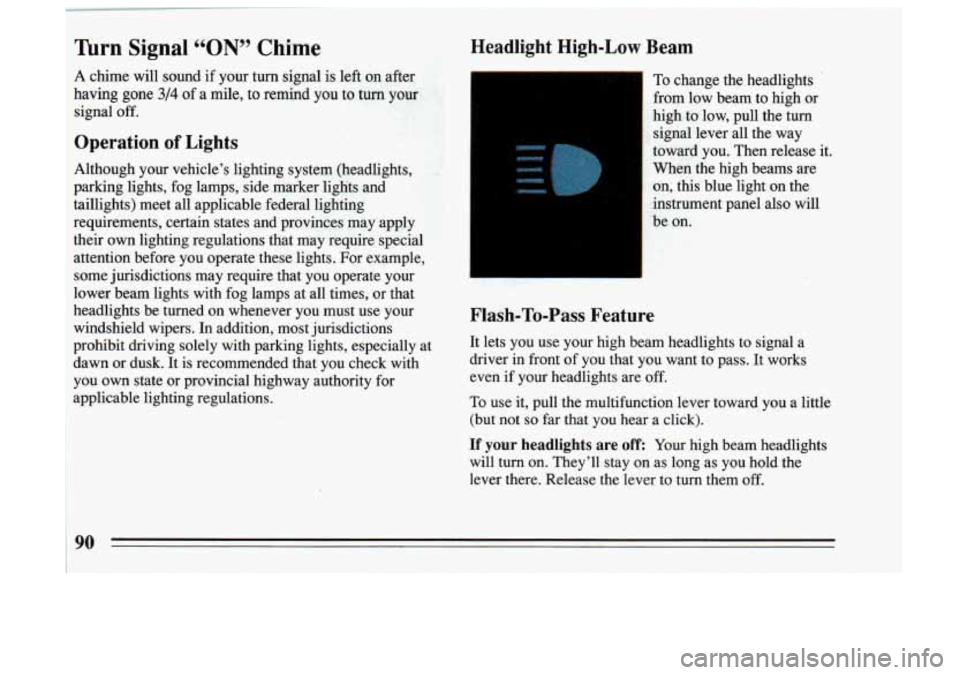
To change the headlights
from low beam to high or
high to low, pull the turn
signal lever all the way
toward you. Then release it.
When the high beams are
on, this blue light on the
instrument panel also will
be on.
Flash-To-Pass Feature
It lets you use your high beam headlights to signal a driver in front of you that you want to pass. It works
even
if your headlights are off.
To use it, pull the multifunction lever toward you a little
(but not
so far that you hear a click).
If your headlights are off Your high beam headlights
will
turn on. They’ll stay on as long as you hold the
lever there. Release the lever to turn them
off.
90
I
Page 96 of 306
3. Push in the set button at the end of the lever and
release it. (The “CRUISE’ light on the instrument
panel will come on.)
4. Take your foot off the accelerator pedal. You’ll go right back up to your chosen speed and stay
there.
A
To Resume a Set Speed
Suppose you set your Cruise Control at a desired speed
and then you apply the brake. This,
of course, shuts off
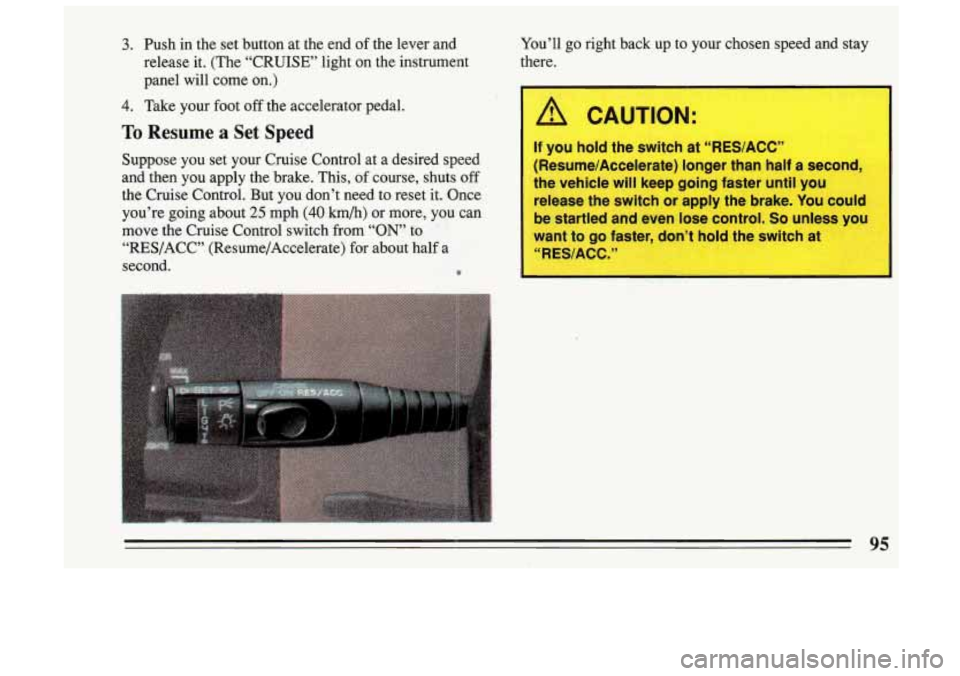
the Cruise Control. But you don’t need to reset it. Once
you’re going about
25 mph (40 km/h) or more, you can
move the Cruise Control switch from
“ON’ to
“RES/ACC” (Resume/Accelerate) for about half a
If you hold the switch at “RES/ACC”
(Resume/Accelerate) longer than half a second,
the vehicle will keep going faster until you
release the switch or apply the brake. You could
be startled and even lose control.
So unless you
want to go faster, don’t hold the switch at
“RES/ACC.”
second. 0
Page 100 of 306
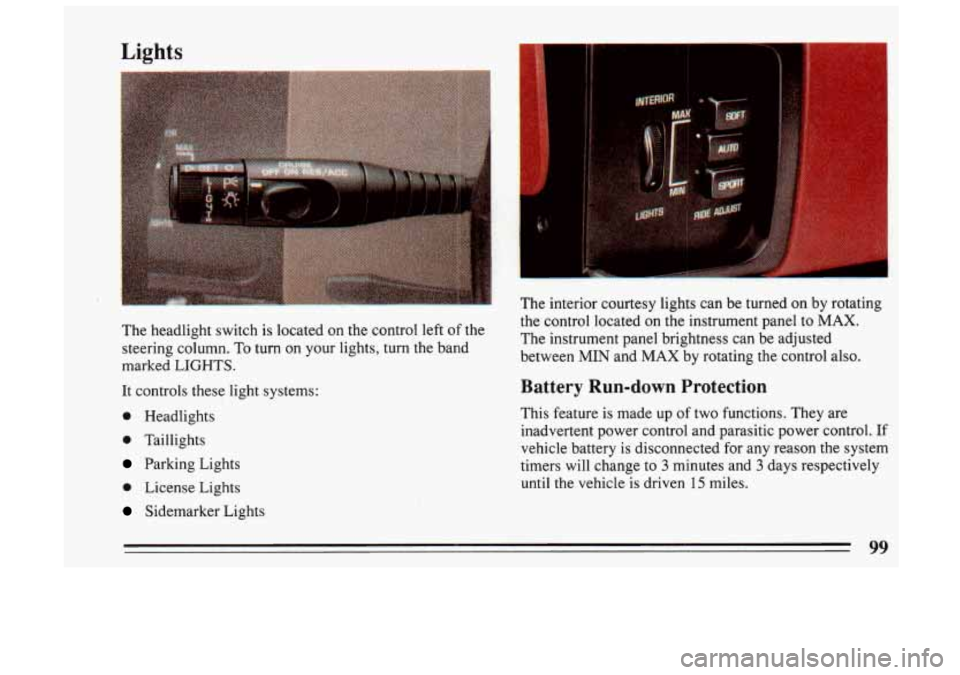
Lights
The headlight switch is located on the control left of the
steering column. To turn on your lights, turn the band
marked LIGHTS.
It controls these light systems:
0 Headlights
0 Taillights
Parking Lights
0 License Lights
Sidemarker Lights The interior courtesy lights can be turned on by rotating
the control located
on the instrument panel
to MAX.
The instrument panel brightness can be adjusted
between MIN and MAX by rotating the control also.
Battery Run-down Protection
This feature is made up of two functions. They are
inadvertent power control and parasitic power control. If
vehicle battery is disconnected for any reason the system
timers will change to
3 minutes and 3 days respectively
until the vehicle is driven 15 miles.
77
Page 101 of 306
Headlights Reminder Light (Canada Only)
If your vehicle was first sold, when new, in Canada, this
light will
go on at night to remind you to turn on the
headlights.
Daytime Running Lights (Canada Only)
The Canadian Federal Government has decided that
“Daytime Running Lights” (DRL) are
a useful feature,
in that DRL can make your vehicle more visible to
pedestrians and other drivers during daylight hours.
DRL are required on
new vehicles sold in Canada.
Your DRL work with
a light sensor on top of the
instrument panel. Don’t cover it up.
The high beam headlights will come on at reduced
brightness in daylight when:
The ignition is on
The headlight switch is off, and
The parking brake is released.
At night, the headlights reminder light on the instrument
panel will come on to remind
you to turn on the
headlights. When
you turn on your headlights, the DRL
will switch
off and the exterior lights will come on.
When
you turn off the headlights, the exterior lights will
go out and the high beams will change to the reduced
brightness of DRL again. Of course, you may still turn on the headlights
or flash to pass any time you need to.
Page 108 of 306
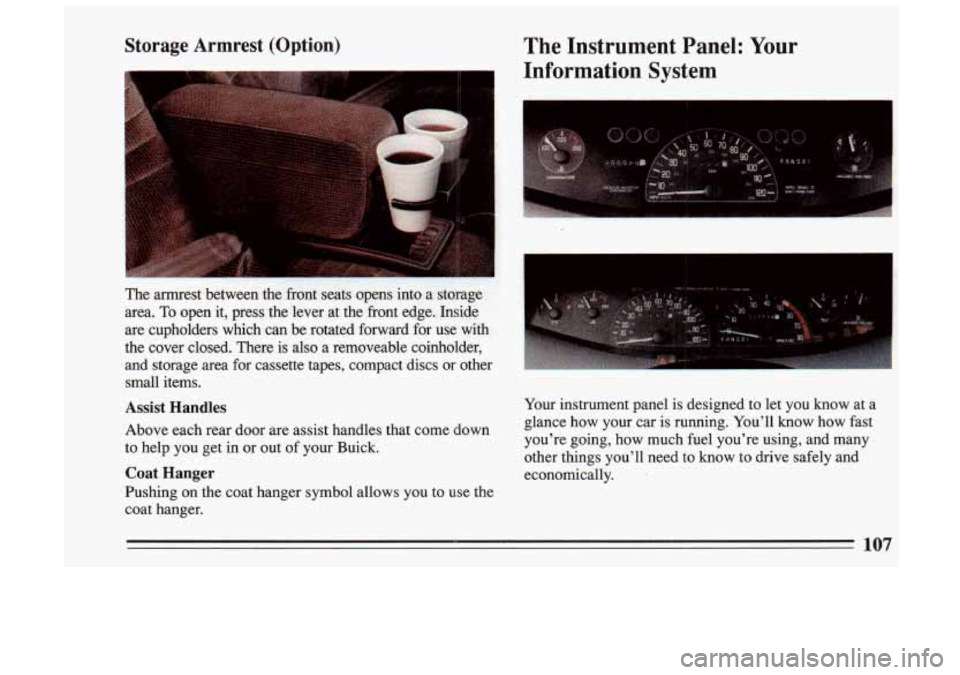
Storage Armrest (Option) The Instrument Panel: Your
Information System
The armrest between the front seats opens' into a storage.
area.
To open it, press the lever at the front edge. Inside
are cupholders which can. be rotated forward for
use with
the cover closed. There is also a removeable coinholder,
and storage area for cassette tapes, compact discs or other small items.
Assist Handles
Above each rear door are as-sist handles that come down
to help you get in or out of your Buick.
Coat Hanger
Pushing on the coat hanger symbol allows you to use the
coat hanger. Your
instrument panel
is designed to let you know at a
glance how your car is running. You'll know
how fast
you're going, how much fuel you're using, and many
other things you'll need to know to drive safely and
economically.
.
Page 122 of 306
BIL (Bi-level) Windshield Defrost
This
setting allows the outside air to flow through your
Buick in two ways. Cooler air is directed to the upper
portion of your body through the vent outlets. Slightly
warmer air
is directed through the heater ducts and
defroster outlets.
Vent
Using vent will allow outside air to flow through the
instrument panel outlets. Set the temperature knob as
desired.
Heater
On days when it’s cold outside, this setting sends heated
air through the heater ducts and
the windshield defroster
outlets. If you have the engine block heater, you can use
it in cold weather (+2OoF/-8 OC or lower) to heat your
vehicle’s passenger area quicker. The engine block
heater warms the engine coolant which
will ultimately
warm the passenger area more efficiently.
( See “Engine
Block Heater” in the Index.)
Blend
This setting divides the air flow equally between the
heater and the defroster outlets. This setting operates the defroster. Most
of the air comes
out near the windshield. Use defrost when you get fog or
ice on the windshield.
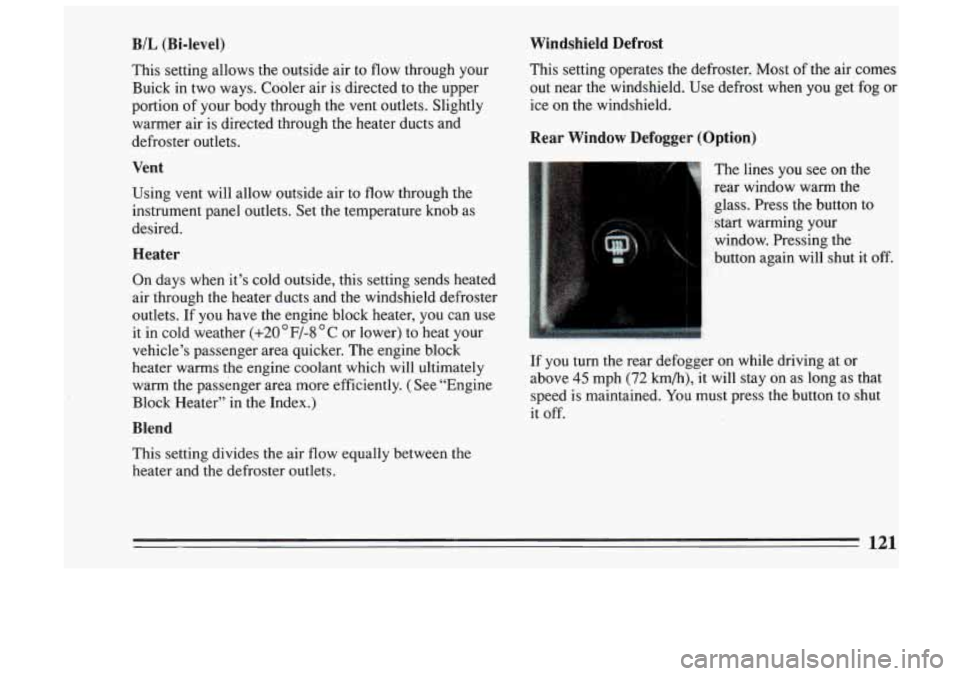
Rear Window Defogger (Option)
The lines you see on the
rear window warm
the
glass. Press the button to
start warming your
.window. Pressing the
button again will shut it off.
If you
turn the rear defogger on while driving at or
above
45 mph (72 km/h), it will stay on as long as that
speed is maintained.
You must press the button to shut
it
off.
121
Page 151 of 306
I A CAUTION.:
“Riding” your brakes can cause them to overhe;
to the point that they won’t work well. You mighl
not be able to stop your vehicle
in time to avoid
an accident. If you “ride” your brakes, they will
get
so hot they will require a lot of pedal fol- -
slow you. down. Avoid “riding” the brakes.
If you keep pace with the traffic and IW realistic
following distances, you will eliminate a lot
of
unnecessary braking. That means better braking and
longer brake life.
If your I- -dine ever stops while you’re driving, brake
normally but don’t pump your brakes.
If you do, the
pedal may get harder to push down.
If your engine
stops, you will still have some power brake assist.
But you will use it when you brake. Once the power
assist
is used up, it may take longer to stop and the
brake pedal will be harder to push.
Anti-Lock Brakes (ABS)
Your Buick has an advanced electronic braking system
that will help prevent skidding.
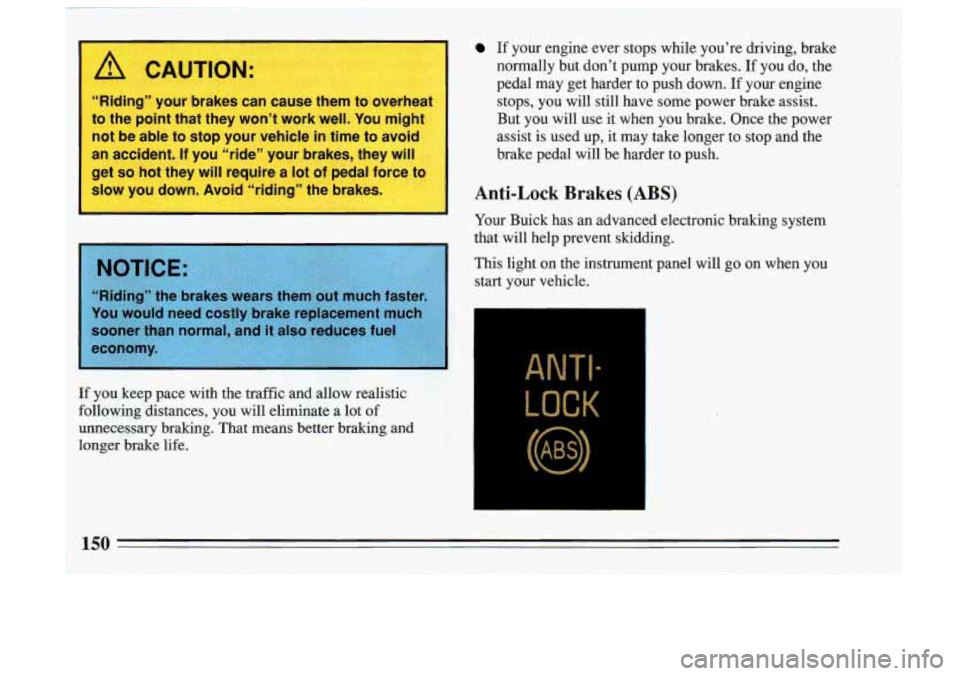
This light on the instrument panel will go on when you
start your vehicle.
TI-
LOCK
150