seats BUICK TERRAZA 2005 User Guide
[x] Cancel search | Manufacturer: BUICK, Model Year: 2005, Model line: TERRAZA, Model: BUICK TERRAZA 2005Pages: 428, PDF Size: 2.6 MB
Page 27 of 428
Q:If I am a good driver, and I never drive far from
home, why should I wear safety belts?
A:You may be an excellent driver, but if you are in an
accident — even one that is not your fault — you
and your passengers can be hurt. Being a good
driver does not protect you from things beyond
your control, such as bad drivers.
Most accidents occur within 25 miles (40 km)
of home. And the greatest number of serious
injuries and deaths occur at speeds of less than
40 mph (65 km/h).
Safety belts are for everyone.
How to Wear Safety Belts Properly
This part is only for people of adult size.
Be aware that there are special things to know about
safety belts and children. And there are different
rules for smaller children and babies. If a child will be
riding in your vehicle, seeOlder Children on page 1-34
orInfants and Young Children on page 1-37. Follow
those rules for everyone’s protection.
First, you will want to know which restraint systems your
vehicle has.
We will start with the driver position.
Driver Position
Lap-Shoulder Belt
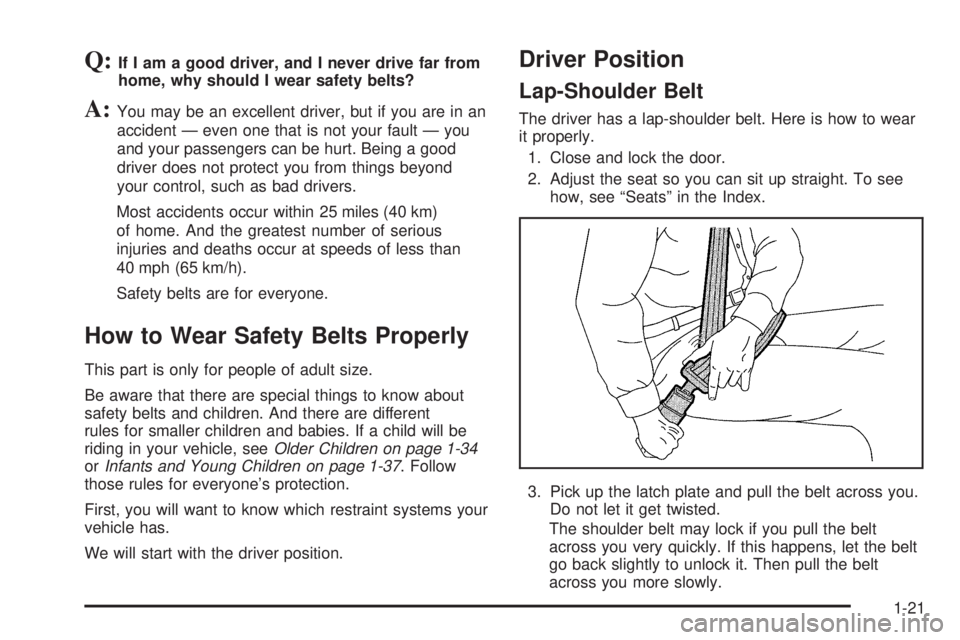
The driver has a lap-shoulder belt. Here is how to wear
it properly.
1. Close and lock the door.
2. Adjust the seat so you can sit up straight. To see
how, see “Seats” in the Index.
3. Pick up the latch plate and pull the belt across you.
Do not let it get twisted.
The shoulder belt may lock if you pull the belt
across you very quickly. If this happens, let the belt
go back slightly to unlock it. Then pull the belt
across you more slowly.
1-21
Page 37 of 428
The safety belt locks if there is a sudden stop or a
crash, or if you pull the belt very quickly out of
the retractor.
{CAUTION:
You can be seriously hurt if your shoulder
belt is too loose. In a crash, you would move
forward too much, which could increase injury.
The shoulder belt should t against your body.
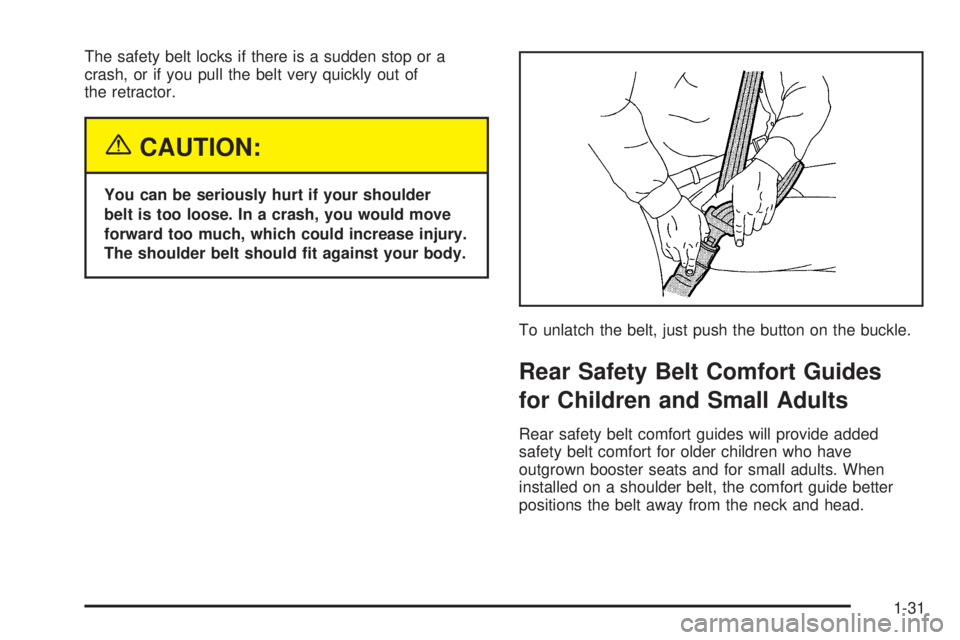
To unlatch the belt, just push the button on the buckle.
Rear Safety Belt Comfort Guides
for Children and Small Adults
Rear safety belt comfort guides will provide added
safety belt comfort for older children who have
outgrown booster seats and for small adults. When
installed on a shoulder belt, the comfort guide better
positions the belt away from the neck and head.
1-31
Page 38 of 428
The third row (if equipped) has one guide for each
outboard position. To provide added safety belt comfort
for children who have outgrown child restraints and
booster seats and for smaller adults, the comfort guides
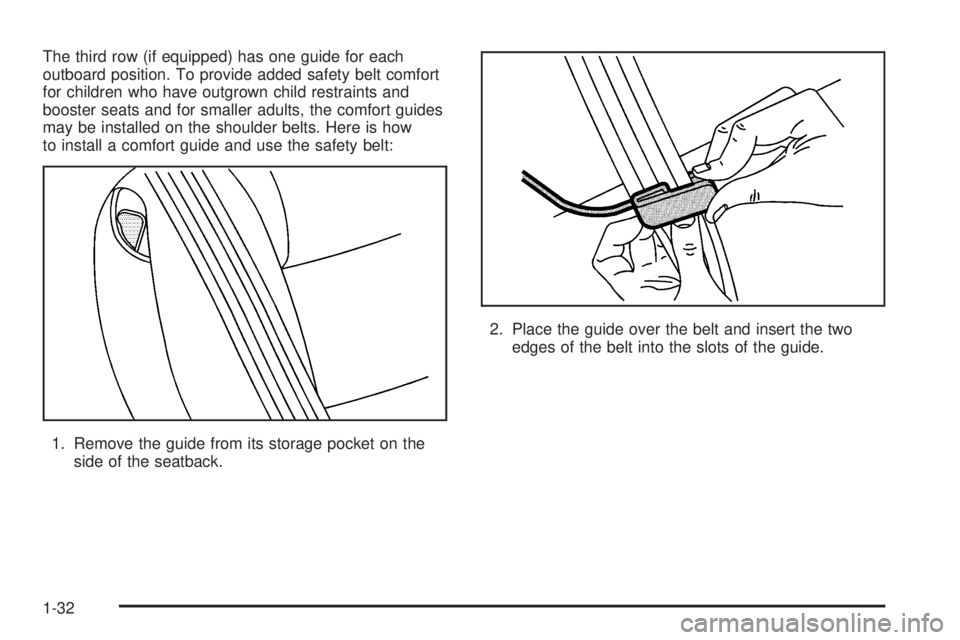
may be installed on the shoulder belts. Here is how
to install a comfort guide and use the safety belt:
1. Remove the guide from its storage pocket on the
side of the seatback.2. Place the guide over the belt and insert the two
edges of the belt into the slots of the guide.
1-32
Page 40 of 428
Safety Belt Pretensioners
Your vehicle has safety belt pretensioners. Although
you cannot see them, they are located on the retractor
part of the safety belts for the driver and right front
passenger. They help the safety belts reduce a person’s
forward movement in a moderate to severe frontal or
near frontal crash.
Pretensioners work only once. If they activate in a
crash, you will need to get new ones, and probably other
new parts for your safety belt system. SeeReplacing
Restraint System Parts After a Crash on page 1-68.
Safety Belt Extender
If the vehicle’s safety belt will fasten around you, you
should use it.
But if a safety belt is not long enough, your dealer will
order you an extender. It is free. When you go in to
order it, take the heaviest coat you will wear, so
the extender will be long enough for you. To help avoid
personal injury, do not let someone else use it, and
use it only for the seat it is made to t. The extender
has been designed for adults. Never use it for securing
child seats. To wear it, just attach it to the regular
safety belt. For more information, see the instruction
sheet that comes with the extender.
Child Restraints
Older Children
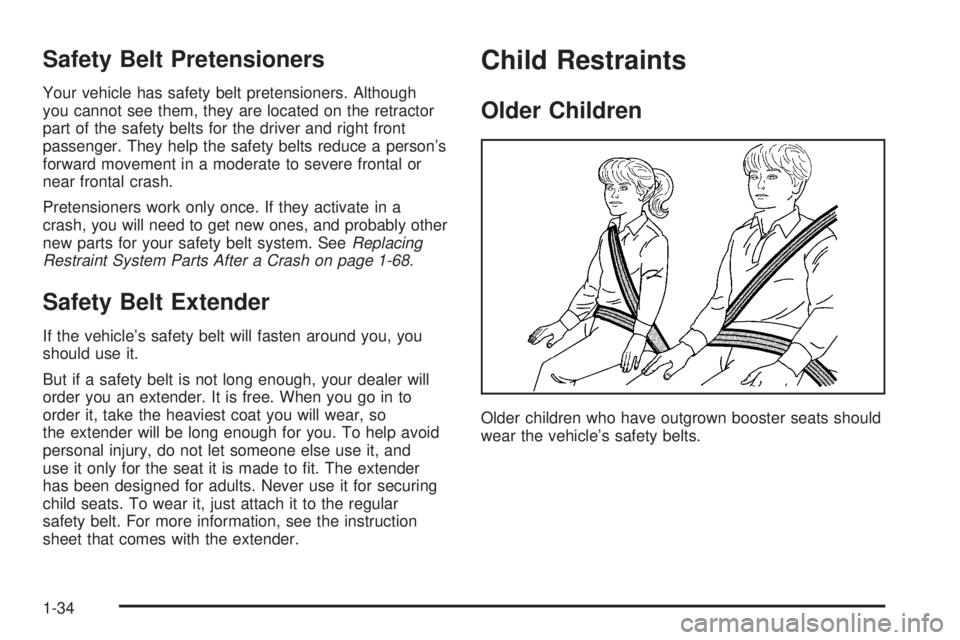
Older children who have outgrown booster seats should
wear the vehicle’s safety belts.
1-34
Page 47 of 428
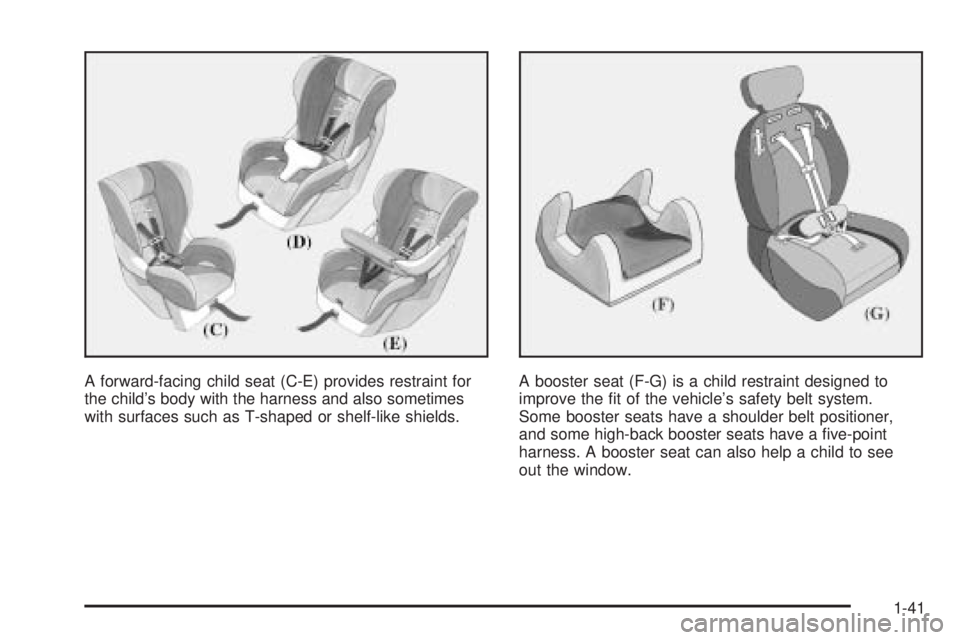
A forward-facing child seat (C-E) provides restraint for
the child’s body with the harness and also sometimes
with surfaces such as T-shaped or shelf-like shields.A booster seat (F-G) is a child restraint designed to
improve the t of the vehicle’s safety belt system.
Some booster seats have a shoulder belt positioner,
and some high-back booster seats have a ve-point
harness. A booster seat can also help a child to see
out the window.
1-41
Page 48 of 428
Q:How do child restraints work?
A:A child restraint system is any device designed for
use in a motor vehicle to restrain, seat, or position
children. A built-in child restraint system is a
permanent part of the motor vehicle. An add-on
child restraint system is a portable one, which
is purchased by the vehicle’s owner.
For many years, add-on child restraints have
used the adult belt system in the vehicle. To help
reduce the chance of injury, the child also has to be
secured within the restraint. The vehicle’s belt
system secures the add-on child restraint in the
vehicle, and the add-on child restraint’s harness
system holds the child in place within the restraint.
One system, the three-point harness, has straps that
come down over each of the infant’s shoulders and
buckle together at the crotch. The ve-point harness
system has two shoulder straps, two hip straps and
a crotch strap. A shield may take the place of hip
straps. A T-shaped shield has shoulder straps that
are attached to a at pad which rests low against the
child’s body. A shelf- or armrest-type shield has
straps that are attached to a wide, shelf-like shield
that swings up or to the side.When choosing a child restraint, be sure the child
restraint is designed to be used in a vehicle. If it is,
it will have a label saying that it meets federal
motor vehicle safety standards.
Then follow the instructions for the restraint. You
may nd these instructions on the restraint itself or
in a booklet, or both. These restraints use the
belt system in your vehicle, but the child also has to
be secured within the restraint to help reduce the
chance of personal injury. When securing an add-on
child restraint, refer to the instructions that come
with the restraint which may be on the restraint itself
or in a booklet, or both, and to this manual. The
child restraint instructions are important, so if they
are not available, obtain a replacement copy
from the manufacturer.
Q:When securing an aftermarket child seat in
a bucket seat, I am unable to get the seat
fastened in snugly enough. What should I do?
A:With some child seats, it may be difficult to tighten
the vehicle belts so that there is less side-to-side
or front-to-back movement of the child seat.
A replacement buckle, which makes it easier to
secure your child seat, is available from your
dealer at no charge to you.
1-42
Page 57 of 428
{CAUTION:
A child in a rear-facing child restraint can be
seriously injured or killed if the right front
passenger’s airbag inates. This is because
the back of the rear-facing child restraint
would be very close to the inating airbag.
Even though the passenger sensing system
is designed to turn off the passenger’s frontal
airbag and seat-mounted side impact airbag
(if equipped) under certain conditions, no
system is fail-safe, and no one can guarantee
that an airbag will not deploy under some
unusual circumstance, even though it is
turned off. General Motors recommends that
rear-facing child restraints be secured in
the rear seat, even if the airbag is off.
If you need to secure a forward-facing child restraint in
the right front seat position, move the seat as far
back as it will go before securing the forward-facing
child restraint. SeeManual Passenger Seat on
page 1-3,Six-Way Power Seats on page 1-3or
Eight-Way Power Seats on page 1-4.If your child restraint is equipped with the LATCH
system, seeLower Anchorages and Top Tethers for
Children (LATCH System) on page 1-46.
There is no top strap anchor at the right front seating
position. Do not secure a child seat in this position if a
national or local law requires that the top strap be
anchored or if the instructions that come with the child
restraint say that the top strap must be anchored. See
Top Strap on page 1-44if your child restraint has one.
You will be using the lap-shoulder belt to secure the child
restraint in this position. Be sure to follow the instructions
that came with the child restraint. Secure the child in the
child restraint when and as the instructions say.
1. Your vehicle has airbags. SeePassenger Sensing
System on page 1-62. General Motors recommends
that rear-facing child restraints be secured in a rear
seat, even if the airbag or airbags are off. If your child
restraint is forward-facing, move the seat as far back
as it will go before securing the child restraint in this
seat. SeeManual Passenger Seat on page 1-3,
Six-Way Power Seats on page 1-3orEight-Way
Power Seats on page 1-4.
When the passenger sensing system has turned off
the right front passenger’s airbag or airbags, the off
indicator in the passenger airbag status indicator
should light and stay lit when you turn the ignition to
RUN or START. SeePassenger Airbag Status
Indicator on page 3-35.
1-51
Page 73 of 428
Adding Equipment to Your
Airbag-Equipped Vehicle
Q:Because I have a disability, I have to get my
vehicle modied. How can I nd out whether
this will affect my airbag system?
A:Changing or moving any parts of the front seats,
safety belts, the airbag sensing and diagnostic
module (located under the driver’s seat), or
the instrument panel can affect the operation of
the airbag system. If you have questions, call
Customer Assistance. The phone numbers and
addresses for Customer Assistance are in Step Two
of the Customer Satisfaction Procedure in this
manual. SeeCustomer Satisfaction Procedure
on page 7-2.
Restraint System Check
Checking the Restraint Systems
Now and then, make sure the safety belt reminder light
and all your belts, buckles, latch plates, retractors
and anchorages are working properly. If your vehicle
has a built-in child restraint, also periodically make sure
the harness straps, latch plates, buckle, clip, child
head restraint and anchorages are working properly.
Look for any other loose or damaged safety belt system
parts. If you see anything that might keep a safety
belt system from doing its job, have it repaired.
Torn or frayed safety belts may not protect you in a
crash. They can rip apart under impact forces. If a belt
is torn or frayed, get a new one right away.
If your vehicle has the built-in child restraint, torn or
frayed harness straps can rip apart under impact forces
just like torn or frayed safety belts can. They may not
protect a child in a crash. If a harness strap is torn
or frayed, get a new harness right away.
Also look for any opened or broken airbag covers, and
have them repaired or replaced. (The airbag system
does not need regular maintenance.)
1-67
Page 122 of 428

Reprogramming a Single HomeLink®
Button
To program a device to HomeLink®using a HomeLink®
button previously trained, follow these steps:
1. Press and hold the desired HomeLink
®button.
Do not release the button.
2. The indicator light will begin to ash after
20 seconds. While still holding the HomeLink
®
button, proceed with Step 2 under “Programming
HomeLink®” shown earlier in this section.
Resetting Defaults
To reset HomeLink®to default settings do the following:
1. Hold down the two outside buttons for about
20 seconds until the indicator light begins to ash.
2. Continue to hold both buttons until the HomeLink
®
indicator light turns off.
3. Release both buttons.
For questions or comments, contact HomeLink
®
at 1-800-355-3515, or on the Internet at
www.homelink.com.
Storage Areas
Your vehicle’s large carrying capacity can store many
items. If the vehicle has an extended wheelbase,
it can carry even larger items. The oor pins that are
used to attach the seats, can be used to secure larger
loads. There may be additional storage areas behind
the seats.
Glove Box
If the glove box has a lock, put your key into the
lock and turn the key counterclockwise. To open the
glove box, pull the latch release.
The glove box door has a detent to prevent the door
from lowering too far. Open the glove box until the door
is partway open, then pull the door down if you need
it fully opened.
To close the glove box, the door must be pushed up
past the detent. To lock the glove box, put your key
into the lock and turn the key clockwise.
2-48
Page 125 of 428
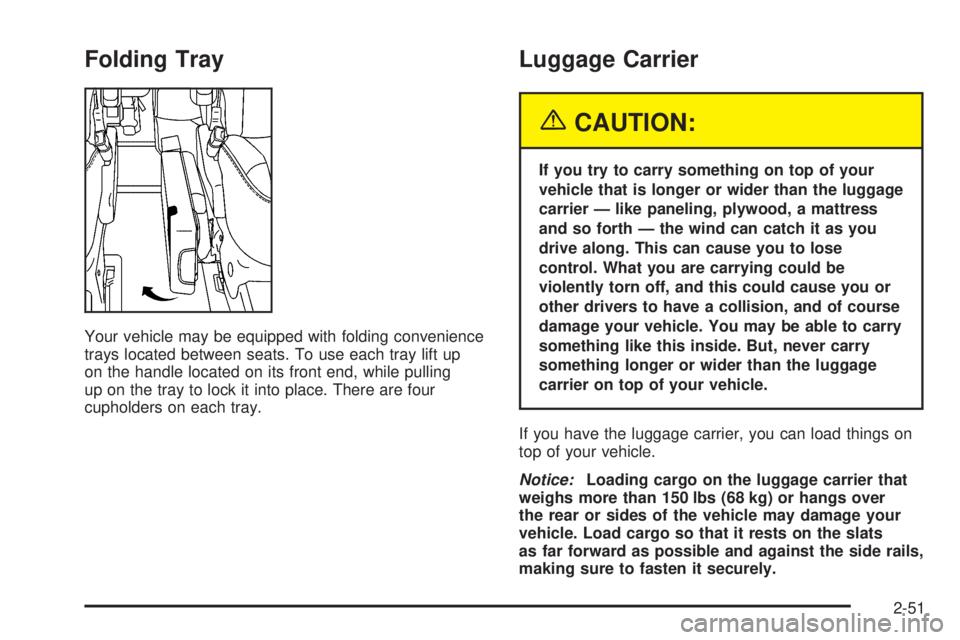
Folding Tray
Your vehicle may be equipped with folding convenience
trays located between seats. To use each tray lift up
on the handle located on its front end, while pulling
up on the tray to lock it into place. There are four
cupholders on each tray.
Luggage Carrier
{CAUTION:
If you try to carry something on top of your
vehicle that is longer or wider than the luggage
carrier — like paneling, plywood, a mattress
and so forth — the wind can catch it as you
drive along. This can cause you to lose
control. What you are carrying could be
violently torn off, and this could cause you or
other drivers to have a collision, and of course
damage your vehicle. You may be able to carry
something like this inside. But, never carry
something longer or wider than the luggage
carrier on top of your vehicle.
If you have the luggage carrier, you can load things on
top of your vehicle.
Notice:Loading cargo on the luggage carrier that
weighs more than 150 lbs (68 kg) or hangs over
the rear or sides of the vehicle may damage your
vehicle. Load cargo so that it rests on the slats
as far forward as possible and against the side rails,
making sure to fasten it securely.
2-51