climate control BUICK TERRAZA 2006 User Guide
[x] Cancel search | Manufacturer: BUICK, Model Year: 2006, Model line: TERRAZA, Model: BUICK TERRAZA 2006Pages: 454, PDF Size: 2.7 MB
Page 164 of 454
Cigarette Lighter
Your vehicle may have a cigarette lighter. To use the
lighter, located on the instrument panel below the
climate controls, push it in all the way and let go. When
it is ready, it will pop back out by itself.
Notice:Holding a cigarette lighter in while it is
heating will not allow the lighter to back away from
the heating element when it is hot. Damage from
overheating may occur to the lighter or heating
element, or a fuse could be blown. Do not hold a
cigarette lighter in while it is heating.
Notice:If you put papers, pins, or other ammable
items in the ashtray, hot cigarettes or other
smoking materials could ignite them and possibly
damage your vehicle. Never put ammable items in
the ashtray.
Climate Controls
Dual Climate Control System
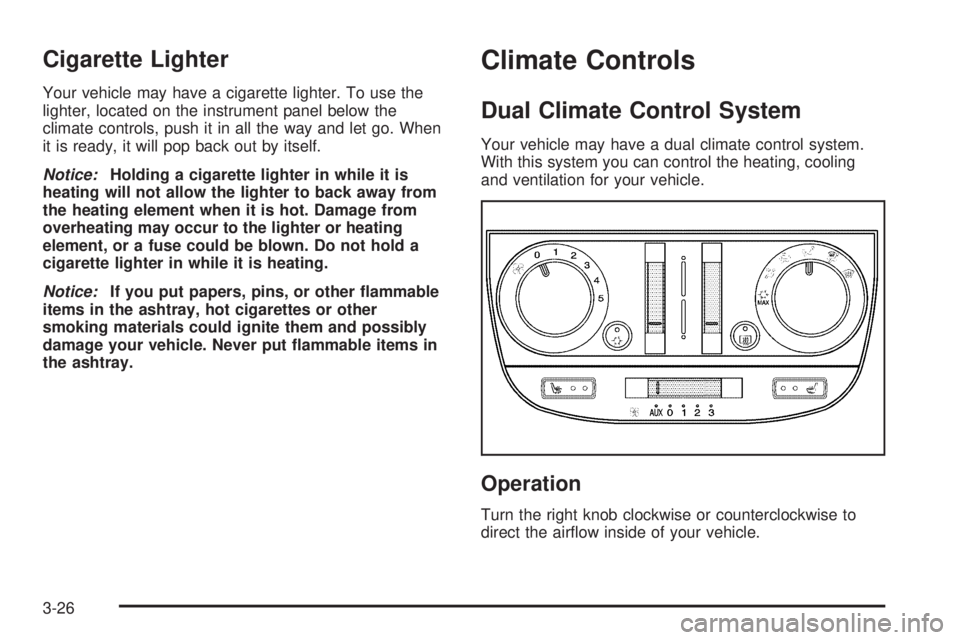
Your vehicle may have a dual climate control system.
With this system you can control the heating, cooling
and ventilation for your vehicle.
Operation
Turn the right knob clockwise or counterclockwise to
direct the airow inside of your vehicle.
3-26
Page 166 of 454
On hot days, open the windows to let hot inside air
escape; then close them. This helps to reduce the time
it takes for your vehicle to cool down. It also helps
the system to operate more efficiently.
The air conditioning system removes moisture from the
air, so you may sometimes notice a small amount of
water dripping underneath your vehicle while idling
or after turning off the engine. This is normal.
#MAX (Maximum Air Conditioning):Turn the right
knob to this position for maximum air conditioning.
This will select air conditioning and recirculation
for maximum cooling of your vehicle.
Recirculation:This mode keeps outside air from
coming in the vehicle. It can be used to prevent outside
air and odors from entering your vehicle or help heat
or cool the air inside your vehicle more quickly.
This mode will automatically be selected when you
select maximum air conditioning.
((Heated Seats):Press this button to turn on the
heated seats. The button on the left controls the driver’s
seat and the button on the right controls the passenger’s
seat. SeeHeated Seats on page 1-3for additional
information.
Defogging and Defrosting
Fog on the inside of windows is a result of high humidity,
or moisture, condensing on the cool window glass.
This can be minimized if the climate control system is
used properly. There are two modes to clear fog or frost
from your windshield. Use the defog mode to clear
the windows of fog or moisture and warm the
passengers. Use the defrost mode to remove fog or
frost from the windshield more quickly.
Turn the right knob to select the defog or defrost mode.
-(Defog):This mode directs air to the windshield
and the oor outlets. When you select this mode,
the system runs the air conditioning compressor unless
the outside temperature is at or below freezing. The
recirculation mode cannot be selected while in the
defog mode.
0(Defrost):This mode directs most of the air to the
windshield and the side window outlets, with some air
directed to the oor outlets. In this mode, the system will
automatically run the air conditioning compressor,
unless the outside temperature is at or below freezing.
Recirculation cannot be selected while in the
defrost mode.
Do not drive the vehicle until all the windows are clear.
3-28
Page 168 of 454
Rear Climate Control System
Your vehicle may have a rear climate control system
that allows the driver to adjust the fan speed for the rear
seating area. This system works with the main climate
control system in your vehicle.
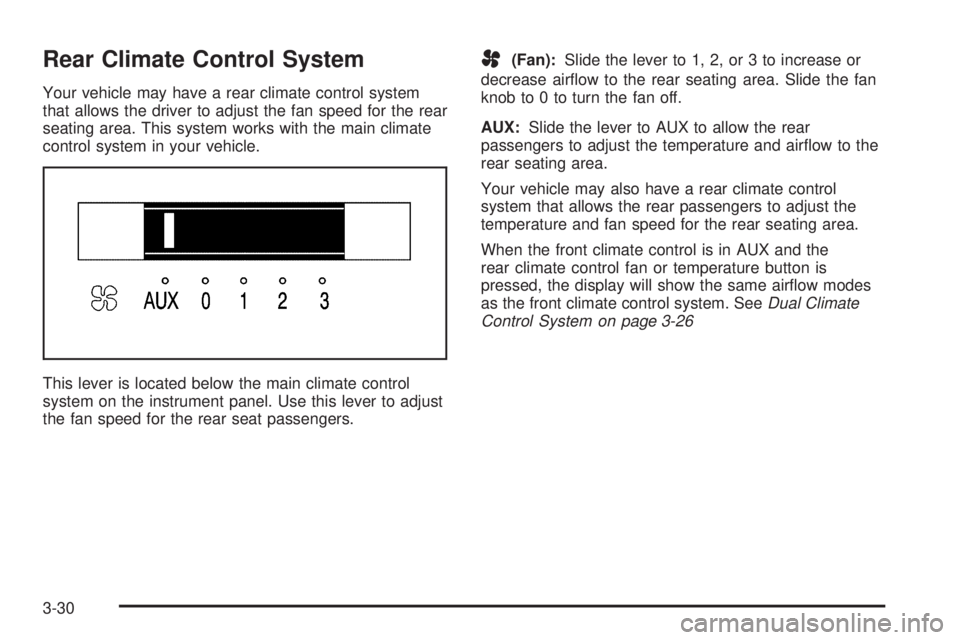
This lever is located below the main climate control
system on the instrument panel. Use this lever to adjust
the fan speed for the rear seat passengers.
A(Fan):Slide the lever to 1, 2, or 3 to increase or
decrease airow to the rear seating area. Slide the fan
knob to 0 to turn the fan off.
AUX:Slide the lever to AUX to allow the rear
passengers to adjust the temperature and airow to the
rear seating area.
Your vehicle may also have a rear climate control
system that allows the rear passengers to adjust the
temperature and fan speed for the rear seating area.
When the front climate control is in AUX and the
rear climate control fan or temperature button is
pressed, the display will show the same airow modes
as the front climate control system. SeeDual Climate
Control System on page 3-26
3-30
Page 169 of 454
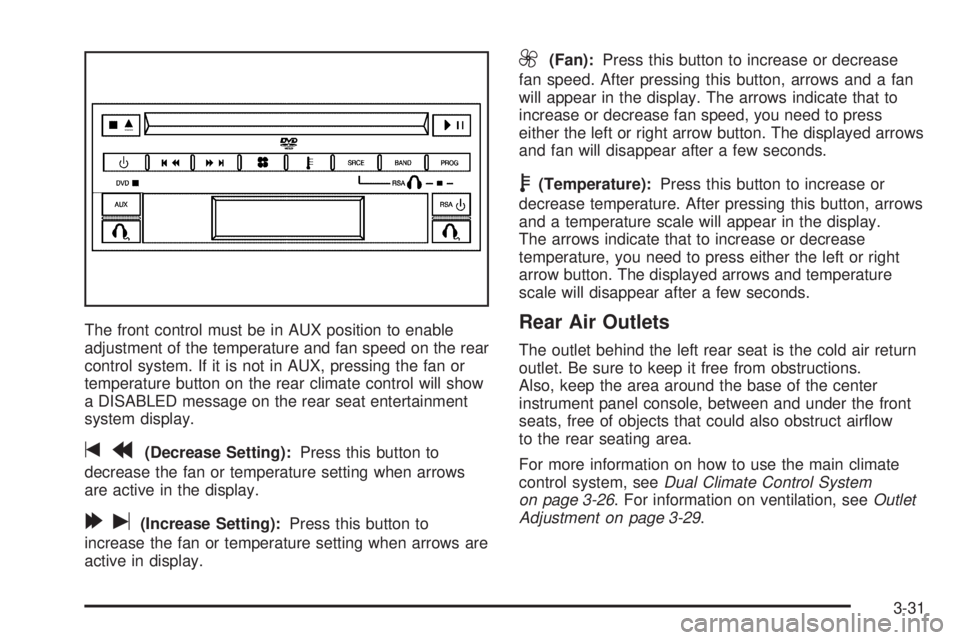
The front control must be in AUX position to enable
adjustment of the temperature and fan speed on the rear
control system. If it is not in AUX, pressing the fan or
temperature button on the rear climate control will show
a DISABLED message on the rear seat entertainment
system display.
tr(Decrease Setting):Press this button to
decrease the fan or temperature setting when arrows
are active in the display.
[u(Increase Setting):Press this button to
increase the fan or temperature setting when arrows are
active in display.
9(Fan):Press this button to increase or decrease
fan speed. After pressing this button, arrows and a fan
will appear in the display. The arrows indicate that to
increase or decrease fan speed, you need to press
either the left or right arrow button. The displayed arrows
and fan will disappear after a few seconds.
b(Temperature):Press this button to increase or
decrease temperature. After pressing this button, arrows
and a temperature scale will appear in the display.
The arrows indicate that to increase or decrease
temperature, you need to press either the left or right
arrow button. The displayed arrows and temperature
scale will disappear after a few seconds.
Rear Air Outlets
The outlet behind the left rear seat is the cold air return
outlet. Be sure to keep it free from obstructions.
Also, keep the area around the base of the center
instrument panel console, between and under the front
seats, free of objects that could also obstruct airow
to the rear seating area.
For more information on how to use the main climate
control system, seeDual Climate Control System
on page 3-26. For information on ventilation, seeOutlet
Adjustment on page 3-29.
3-31
Page 244 of 454

DVD Player Buttons
cY(Stop/Eject):Press and release this button to
stop playing, rewinding, or fast forwarding.
Press this button twice to eject a disc. If the player is
already stopped, then only press this button once.
O(Power):Press this button to turn the DVD player
on and off.
AUX (Auxiliary):Press this button to switch the system
between the DVD player and an auxiliary device.
s(Play/Pause):Press this button to start play of a
disc. Press this button while a disc is playing to
pause it. Press it again to continue play of a disc.
tr/[u(Previous and Fast Reverse/Next
and Fast Forward):These controls can be used
to move forward or backward through a disc.
These buttons can also be used to modify RSA, rear
temperature, rear fan speed, and wired headphone
volume adjustment. See “Headphones” earlier in this
section,Rear Seat Audio (RSA) on page 3-115,
andRear Climate Control System on page 3-30for
more information.
When a DVD is playing in the DVD player and the RSA
system is on, the stop/eject and play/pause buttons
are the only buttons that will work.
3-106
Page 303 of 454
Trailer Brakes
If your trailer weighs more than 1,000 lbs (450 kg)
loaded, then it needs its own brakes – and they must be
adequate. Be sure to read and follow the instructions
for the trailer brakes so you will be able to install, adjust,
and maintain them properly.
Because your vehicle has anti-lock brakes, do not try to
tap into your vehicle’s brake system. If you do, both
brake systems will not work well, or at all.
Driving with a Trailer
{CAUTION:
If you have a rear-most window open and you
pull a trailer with your vehicle, carbon
monoxide (CO) could come into your vehicle.
You cannot see or smell CO. It can cause
unconsciousness or death. SeeEngine
CAUTION: (Continued)
CAUTION: (Continued)
Exhaust on page 2-42. To maximize your safety
when towing a trailer:
Have your exhaust system inspected for
leaks, and make necessary repairs before
starting on your trip.
Keep the rear-most windows closed.
If exhaust does come into your vehicle
through a window in the rear or another
opening, drive with your front, main
heating or cooling system on and with the
fan on any speed. This will bring fresh,
outside air into your vehicle. Do not use
the climate control setting for maximum air
because it only recirculates the air inside
your vehicle. SeeDual Climate Control
System on page 3-26.
Towing a trailer requires a certain amount of experience.
Before setting out for the open road, you will want to
get to know your rig. Acquaint yourself with the feel of
handling and braking with the added weight of the trailer.
And always keep in mind that the vehicle you are
driving is now a good deal longer and not nearly as
responsive as your vehicle is by itself.
4-45
Page 371 of 454

Uniform Tire Quality Grading
Quality grades can be found where applicable on the
tire sidewall between tread shoulder and maximum
section width. For example:
Treadwear 200 Traction AA Temperature A
The following information relates to the system
developed by the United States National Highway
Traffic Safety Administration, which grades tires by
treadwear, traction and temperature performance.
(This applies only to vehicles sold in the United States.)
The grades are molded on the sidewalls of most
passenger car tires. The Uniform Tire Quality Grading
system does not apply to deep tread, winter-type
snow tires, space-saver or temporary use spare tires,
tires with nominal rim diameters of 10 to 12 inches
(25 to 30 cm), or to some limited-production tires.
While the tires available on General Motors passenger
cars and light trucks may vary with respect to these
grades, they must also conform to federal safety
requirements and additional General Motors Tire
Performance Criteria (TPC) standards.
Treadwear
The treadwear grade is a comparative rating based on
the wear rate of the tire when tested under controlled
conditions on a specied government test course.
For example, a tire graded 150 would wear one and
a half (1.5) times as well on the government course as
a tire graded 100. The relative performance of tires
depends upon the actual conditions of their use,
however, and may depart signicantly from the norm
due to variations in driving habits, service practices and
differences in road characteristics and climate.
Traction – AA, A, B, C
The traction grades, from highest to lowest, are AA, A,
B, and C. Those grades represent the tire’s ability
to stop on wet pavement as measured under controlled
conditions on specied government test surfaces of
asphalt and concrete. A tire marked C may have poor
traction performance. Warning: The traction grade
assigned to this tire is based on straight-ahead braking
traction tests, and does not include acceleration,
cornering, hydroplaning, or peak traction characteristics.
5-65
Page 406 of 454

Fuses Usage
SPARE Spare
5 Not Used
6 Air Conditioning Clutch
7 Horn
8 Left Low Beam
9Powertrain Control Module,
Electronic Throttle Control
10 Not Used
11 Transmission Solenoid
12 Right Low Beam
13 Anti-lock Brake System
14 Powertrain Control Module Ignition
15 Electronic IgnitionFuses Usage
16 Fuel Injector
17Climate Control, RPA, Cruise
Control
18 Electronic Throttle Control
19 Engine Sensor, Evaporator
20 Airbag
21 Not Used
22 Emission, All-Wheel Drive
23 Auxiliary Power
24 Front Windshield Washer
25 AC/DC Inverter
26 Rear Blower
27 Front Blower
28 Front Windshield Wiper
5-100
Page 443 of 454

Check
Engine Light...............................................3-44
Checking Things Under the Hood......................5-10
Chemical Paint Spotting...................................5-93
Child Restraints
Child Restraint Systems...............................1-40
Infants and Young Children...........................1-37
Lower Anchors and Tethers for Children..........1-45
Older Children.............................................1-34
Securing a Child Restraint in a Rear Seat
Position..................................................1-51
Securing a Child Restraint in the Right
Front Seat Position...................................1-53
Where to Put the Restraint...........................1-44
Chime Level Adjustment.................................3-119
Cigarette Lighter.............................................3-26
Cleaning
Aluminum or Chrome-Plated Wheels..............5-92
Exterior Lamps/Lenses.................................5-90
Fabric/Carpet..............................................5-88
Finish Care.................................................5-91
Inside of Your Vehicle..................................5-87
Instrument Panel, Vinyl, and Other Plastic
Surfaces.................................................5-89
Leather......................................................5-89
Tires..........................................................5-92
Underbody Maintenance...............................5-93Cleaning (cont.)
Washing Your Vehicle...................................5-90
Weatherstrips..............................................5-90
Windshield, Backglass, and Wiper Blades.......5-91
Climate Control System
Air Filter, Passenger Compartment.................3-32
Dual..........................................................3-26
Outlet Adjustment........................................3-29
Rear..........................................................3-30
Collision Damage Repair..................................7-11
Comfort Guides, Rear Safety Belt.....................1-31
Compact Spare Tire........................................5-86
Content Theft-Deterrent....................................2-28
Control of a Vehicle.......................................... 4-6
Convenience Center........................................2-56
Convenience Net............................................2-55
Coolant
Engine Temperature Gage............................3-43
Heater, Engine............................................2-34
Cooling System..............................................5-29
Cruise Control................................................3-11
Cruise Control Light........................................3-47
Cupholder(s)..................................................2-51
Customer Assistance Information
Courtesy Transportation.................................. 7-8
Customer Assistance for Text Telephone (TTY)
Users....................................................... 7-4
3
Page 444 of 454
Customer Assistance Information (cont.)
Customer Assistance Offices........................... 7-4
Customer Satisfaction Procedure..................... 7-2
GM Mobility Reimbursement Program............... 7-6
Reporting Safety Defects to General Motors....7-15
Reporting Safety Defects to the Canadian
Government............................................7-15
Reporting Safety Defects to the United
States Government...................................7-14
Roadside Assistance Program......................... 7-6
Service Publications Ordering Information........7-15
D
Daytime Running Lamps/Automatic Headlamp
System......................................................3-16
Defensive Driving............................................. 4-2
Delayed Lighting.............................................3-19
Delayed Locking.............................................2-13
Doing Your Own Service Work........................... 5-4
Dome Lamp...................................................3-18
Door
Automatic Door Lock....................................2-14
Delayed Locking..........................................2-13
Dual Sliding Doors.......................................2-14Door (cont.)
Locks........................................................2-11
Power Door Locks.......................................2-12
Power Sliding Door......................................2-17
Programmable Automatic Door Unlock............2-14
Driver
Position, Safety Belt.....................................1-19
Driver Information Center (DIC).........................3-49
DIC Operation and Displays..........................3-50
DIC Vehicle Personalization..........................3-72
DIC Warnings and Messages........................3-56
Driving
At Night.....................................................4-18
City...........................................................4-21
Defensive..................................................... 4-2
Drunken....................................................... 4-3
Freeway.....................................................4-22
Hill and Mountain Roads..............................4-25
In Rain and on Wet Roads...........................4-19
Rocking Your Vehicle to Get it Out.................4-32
Winter........................................................4-27
Dual Climate Control System............................3-26
DVD
Rear Seat Entertainment System..................3-101
4