over drive BUICK TERRAZA 2007 User Guide
[x] Cancel search | Manufacturer: BUICK, Model Year: 2007, Model line: TERRAZA, Model: BUICK TERRAZA 2007Pages: 562, PDF Size: 2.96 MB
Page 113 of 562
Power Sliding Door (PSD) Switches
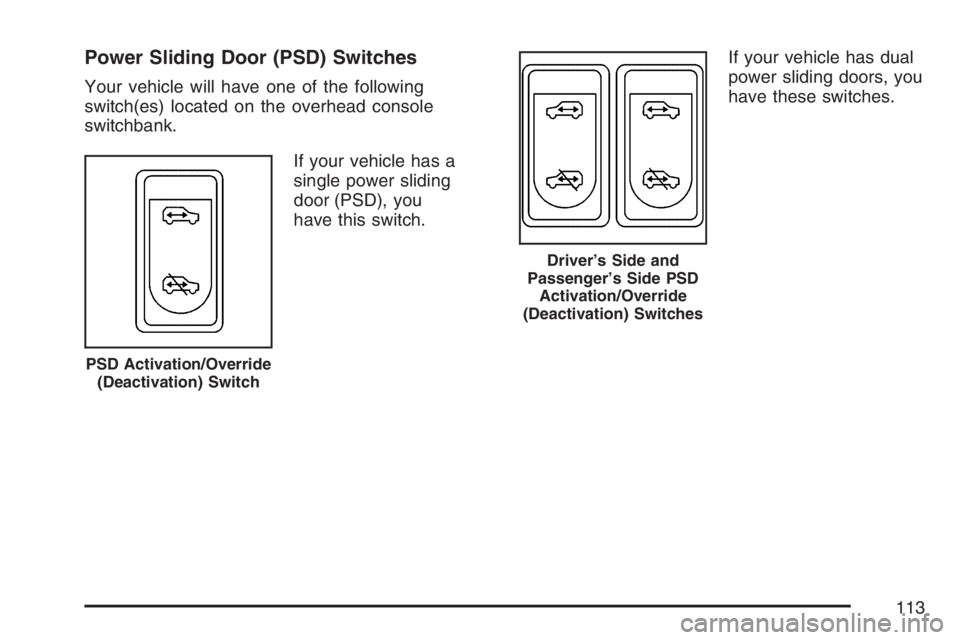
Your vehicle will have one of the following
switch(es) located on the overhead console
switchbank.
If your vehicle has a
single power sliding
door (PSD), you
have this switch.If your vehicle has dual
power sliding doors, you
have these switches.
PSD Activation/Override
(Deactivation) Switch
Driver’s Side and
Passenger’s Side PSD
Activation/Override
(Deactivation) Switches
113
Page 114 of 562
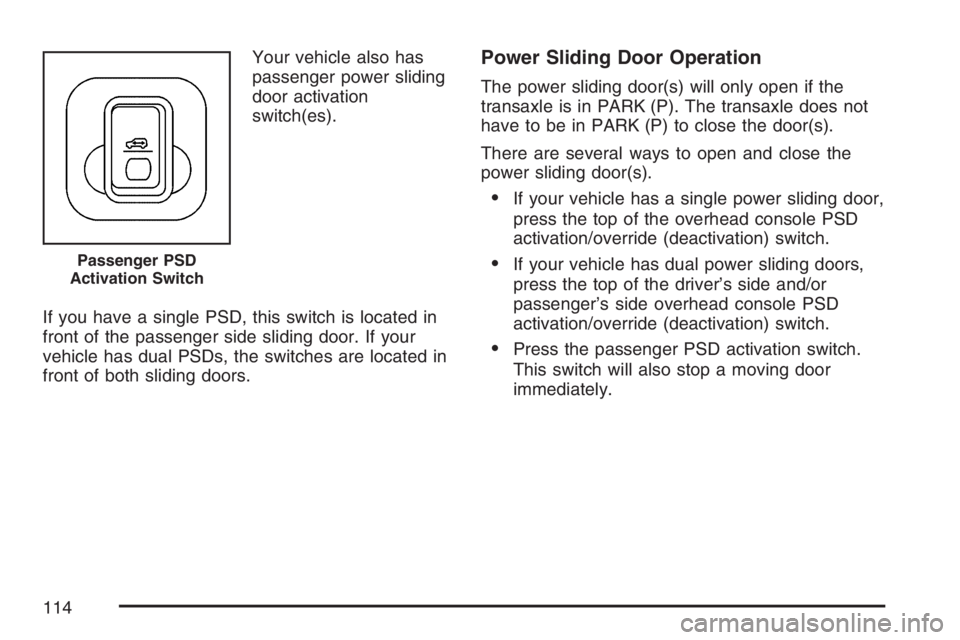
Your vehicle also has
passenger power sliding
door activation
switch(es).
If you have a single PSD, this switch is located in
front of the passenger side sliding door. If your
vehicle has dual PSDs, the switches are located in
front of both sliding doors.Power Sliding Door Operation
The power sliding door(s) will only open if the
transaxle is in PARK (P). The transaxle does not
have to be in PARK (P) to close the door(s).
There are several ways to open and close the
power sliding door(s).
If your vehicle has a single power sliding door,
press the top of the overhead console PSD
activation/override (deactivation) switch.
If your vehicle has dual power sliding doors,
press the top of the driver’s side and/or
passenger’s side overhead console PSD
activation/override (deactivation) switch.
Press the passenger PSD activation switch.
This switch will also stop a moving door
immediately.
Passenger PSD
Activation Switch
114
Page 115 of 562
Press the power sliding door button on the
remote keyless entry transmitter.
To manually open the power sliding door(s)
while the switch(es) are in the activation
position, pull and release the inside or outside
door handle to release the door latch. The
door will fully open.
To manually close the power sliding door(s)
while the switches are in the activation
position, pull the inside or outside door handle
or the edge of the door. Move the door
about 4 inches (10 cm) toward the closed
position and release it. The door will close
completely and latch.
If a power sliding door is locked, it cannot be
unlocked and opened using the overhead console
PSD switch(es) or the passenger PSD activation
switch(es). The power sliding door must either be
manually unlocked or unlocked using the power
door unlock switch located on the driver’s or front
passenger’s armrest, and then opened using the
overhead or passenger PSD activation switch(es).The remote keyless entry transmitter can also be
used to open the power sliding door(s). If the
vehicle is locked, press the power sliding
door button(s) and all doors will unlock and the
sliding door(s) will open. SeeRemote Keyless
Entry System Operation on page 99.
If the power sliding door has been manually locked,
you must unlock the PSD before it can be opened.
Notice:If you leave the power sliding door on
when you go through an automatic car
wash, the door may accidentally open. Be sure
the power sliding door is turned off when
going through a car wash.
115
Page 132 of 562
Engine Coolant Heater
Your vehicle may have an engine coolant heater.
In very cold weather, 0°F (−18°C) or colder,
the engine coolant heater can help. You will get
easier starting and better fuel economy during
engine warm-up. Usually, the coolant heater
should be plugged in a minimum of four hours
prior to starting your vehicle. At temperatures
above 32°F (0°C), use of the coolant heater is not
required. Your vehicle may also have an internal
thermostat in the plug end of the cord. This
will prevent operation of the engine coolant heater
when the temperature is at or above 0°F (−18°C)
as noted on the cord.
To Use the Engine Coolant Heater
1. Turn off the engine.
2. Open the hood and unwrap the electrical
cord. The electrical cord is located on the
driver’s side of the engine compartment.
3. Plug it into a normal, grounded 110-volt AC
outlet.
{CAUTION:
Plugging the cord into an ungrounded
outlet could cause an electrical shock.
Also, the wrong kind of extension cord
could overheat and cause a re. You
could be seriously injured. Plug the cord
into a properly grounded three-prong
110-volt AC outlet. If the cord will not
reach, use a heavy-duty three-prong
extension cord rated for at least 15 amps.
4. Before starting the engine, be sure to unplug
and store the cord as it was before to keep it
away from moving engine parts. If you do
not, it could be damaged.
How long should you keep the coolant heater
plugged in? The answer depends on the outside
temperature, the kind of oil you have, and
some other things. Instead of trying to list
everything here, we ask that you contact your
dealer in the area where you will be parking your
vehicle. The dealer can give you the best
advice for that particular area.
132
Page 134 of 562
REVERSE (R):Use this gear to back up.
Notice:Shifting to REVERSE (R) while your
vehicle is moving forward could damage
the transaxle. The repairs would not be
covered by your warranty. Shift to
REVERSE (R) only after your vehicle is
stopped.
To rock your vehicle back and forth to get out of
snow, ice or sand without damaging your
transaxle, seeIf Your Vehicle is Stuck in Sand,
Mud, Ice, or Snow on page 377.
NEUTRAL (N):In this position, your engine does
not connect with the wheels. To restart when
you are already moving, use NEUTRAL (N) only.
Also, use NEUTRAL (N) when your vehicle is
being towed.
{CAUTION:
Shifting into a drive gear while your
engine is running at high speed is
dangerous. Unless your foot is rmly on
the brake pedal, your vehicle could move
very rapidly. You could lose control and
hit people or objects. Do not shift into a
drive gear while your engine is running at
high speed.
Notice:Shifting out of PARK (P) or
NEUTRAL (N) while the engine is running at
high speed may damage the transaxle.
The repairs would not be covered by your
warranty. Be sure the engine is not running at
high speeds when shifting your vehicle.
134
Page 136 of 562
SECOND (2):This position reduces vehicle speed
more than DRIVE (D) without using your brakes.
You can use SECOND (2) on hills. It can help
control your speed as you go down steep mountain
roads, but then you would also want to use your
brakes off and on.
Notice:Driving in SECOND (2) for more than
25 miles (40 km) or at speeds over 55 mph
(90 km/h) may damage the transaxle. Also,
shifting into SECOND (2) at speeds above
65 mph (105 km/h) can cause damage. Drive in
THIRD (3) or DRIVE (D) instead of SECOND (2).
Notice:If your vehicle seems to start up rather
slowly, or if it seems not to shift gears as you
go faster, something may be wrong with a
transaxle system sensor. If you drive very far
that way, your vehicle can be damaged. So, if
this happens, have your vehicle serviced right
away. Until then, you can use SECOND (2) when
you are driving less than 35 mph (55 km/h) and
THIRD (3) for higher speeds.FIRST (1):This position reduces vehicle speed
even more than SECOND (2) without using your
brakes. You can use it on very steep hills, or in
deep snow or mud. If the shift lever is put in
FIRST (1) while the vehicle is moving forward, the
transaxle will not shift into rst gear until the vehicle
is going slowly enough.
Notice:Spinning the tires or holding the
vehicle in one place on a hill using only the
accelerator pedal may damage the transaxle. If
you are stuck, do not spin the tires. When
stopping on a hill, use the brakes, or parking
brake to hold the vehicle in place.
136
Page 137 of 562
Parking Brake
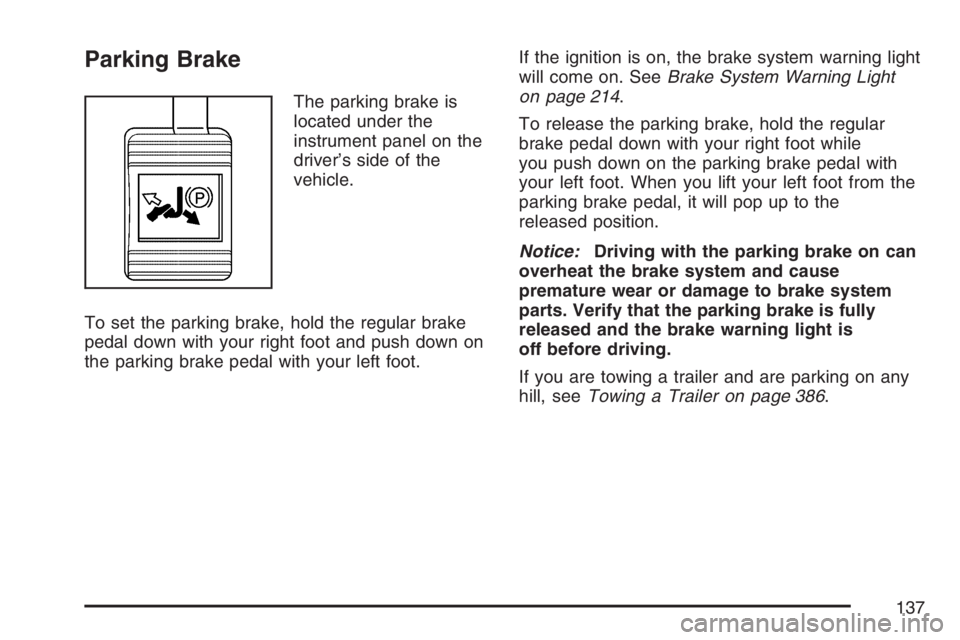
The parking brake is
located under the
instrument panel on the
driver’s side of the
vehicle.
To set the parking brake, hold the regular brake
pedal down with your right foot and push down on
the parking brake pedal with your left foot.If the ignition is on, the brake system warning light
will come on. SeeBrake System Warning Light
on page 214.
To release the parking brake, hold the regular
brake pedal down with your right foot while
you push down on the parking brake pedal with
your left foot. When you lift your left foot from the
parking brake pedal, it will pop up to the
released position.
Notice:Driving with the parking brake on can
overheat the brake system and cause
premature wear or damage to brake system
parts. Verify that the parking brake is fully
released and the brake warning light is
off before driving.
If you are towing a trailer and are parking on any
hill, seeTowing a Trailer on page 386.
137
Page 141 of 562
Engine Exhaust
{CAUTION:
Engine exhaust can kill. It contains the
gas carbon monoxide (CO), which you
cannot see or smell. It can cause
unconsciousness and death.
You might have exhaust coming in if:
Your exhaust system sounds strange
or different.
Your vehicle gets rusty underneath.
Your vehicle was damaged in a
collision.
CAUTION: (Continued)
CAUTION: (Continued)
Your vehicle was damaged when
driving over high points on the road
or over road debris.
Repairs were not done correctly.
Your vehicle or exhaust system has
been modied improperly.
If you ever suspect exhaust is coming into
your vehicle:
Drive it only with all the windows
down to blow out any CO; and
Have your vehicle xed immediately.
141
Page 144 of 562
Outside Convex Mirror
{CAUTION:
A convex mirror can make things (like
other vehicles) look farther away than
they really are. If you cut too sharply into
the right lane, you could hit a vehicle on
your right. Check your inside mirror or
glance over your shoulder before
changing lanes.The passenger’s side mirror is convex. A convex
mirror’s surface is curved so more can be
seen from the driver’s seat. It also makes things
appear farther away than they really are.Outside Heated Mirrors
The outside rearview mirrors will heat to help clear
them of ice, snow, and condensation when the rear
window defogger is turned on. See “Rear Window
Defogger” inClimate Control System on page 193
orDual Climate Control System on page 197.
144
Page 162 of 562
Luggage Carrier
{CAUTION:
If you try to carry something on top of
your vehicle that is longer or wider than
the luggage carrier — like paneling,
plywood, a mattress and so forth — the
wind can catch it as you drive along. This
can cause you to lose control. What you
are carrying could be violently torn off,
and this could cause you or other drivers
to have a collision, and of course damage
your vehicle. You may be able to carry
something like this inside. But, never
carry something longer or wider than the
luggage carrier on top of your vehicle.If you have the luggage carrier, you can load
things on top of your vehicle. Crossrails are not
standard on this vehicle and must be purchased at
your dealer.
Notice:Loading cargo on the luggage carrier
that weighs more than 150 lbs (68 kg) or
hangs over the rear or sides of the vehicle
may damage your vehicle. Load cargo so that
it rests on the slats as far forward as
possible and against the side rails, making
sure to fasten it securely.
Do not exceed the maximum vehicle capacity
when loading your vehicle. For more information
on vehicle capacity and loading, seeLoading Your
Vehicle on page 378.
To prevent damage or loss of cargo as you are
driving, check now and then to make sure
the cargo is still securely fastened.
162