turn signal BUICK TERRAZA 2007 Owner's Guide
[x] Cancel search | Manufacturer: BUICK, Model Year: 2007, Model line: TERRAZA, Model: BUICK TERRAZA 2007Pages: 562, PDF Size: 2.96 MB
Page 365 of 562
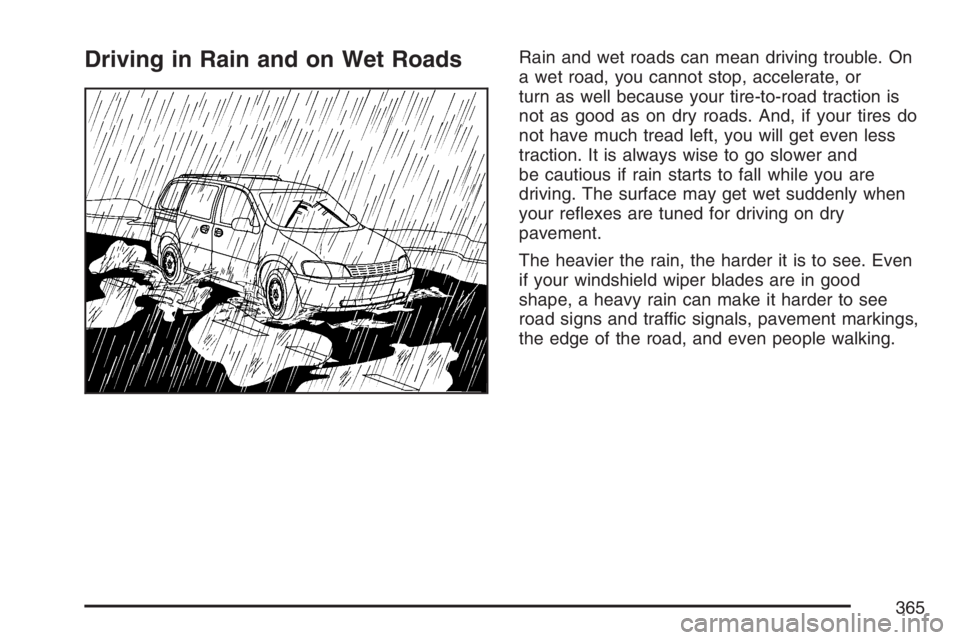
Driving in Rain and on Wet RoadsRain and wet roads can mean driving trouble. On
a wet road, you cannot stop, accelerate, or
turn as well because your tire-to-road traction is
not as good as on dry roads. And, if your tires do
not have much tread left, you will get even less
traction. It is always wise to go slower and
be cautious if rain starts to fall while you are
driving. The surface may get wet suddenly when
your reexes are tuned for driving on dry
pavement.
The heavier the rain, the harder it is to see. Even
if your windshield wiper blades are in good
shape, a heavy rain can make it harder to see
road signs and traffic signals, pavement markings,
the edge of the road, and even people walking.
365
Page 368 of 562
City Driving
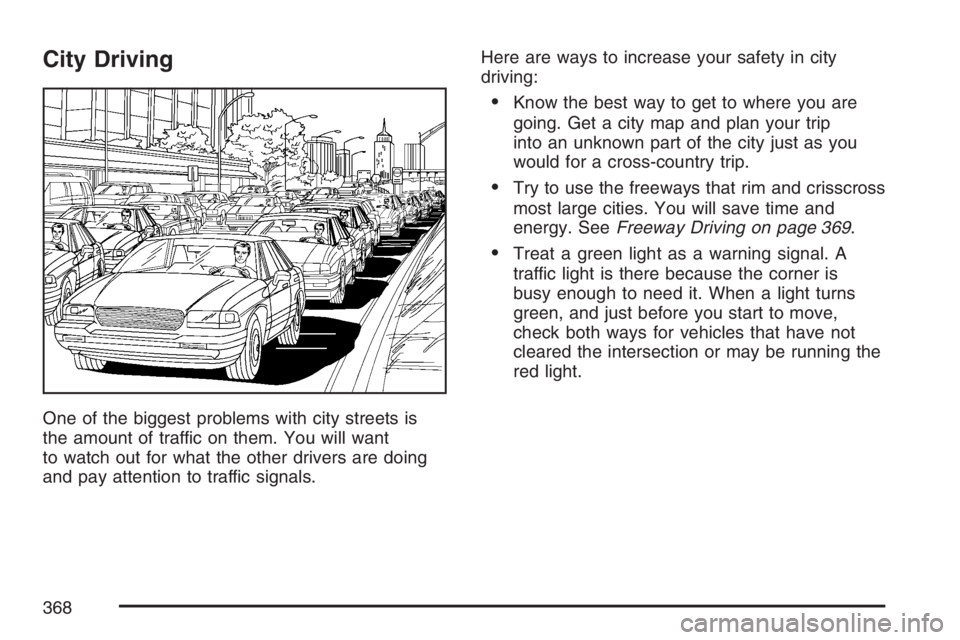
One of the biggest problems with city streets is
the amount of traffic on them. You will want
to watch out for what the other drivers are doing
and pay attention to traffic signals.Here are ways to increase your safety in city
driving:
Know the best way to get to where you are
going. Get a city map and plan your trip
into an unknown part of the city just as you
would for a cross-country trip.
Try to use the freeways that rim and crisscross
most large cities. You will save time and
energy. SeeFreeway Driving on page 369.
Treat a green light as a warning signal. A
traffic light is there because the corner is
busy enough to need it. When a light turns
green, and just before you start to move,
check both ways for vehicles that have not
cleared the intersection or may be running the
red light.
368
Page 369 of 562
Freeway Driving
Mile for mile, freeways — also called thruways,
parkways, expressways, turnpikes, or
superhighways — are the safest of all roads.
But they have their own special rules.
The most important advice on freeway driving is:
Keep up with traffic and keep to the right.
Drive at the same speed most of the other drivers
are driving.Too-fast or too-slow driving breaks a smooth traffic
ow. Treat the left lane on a freeway as a
passing lane.
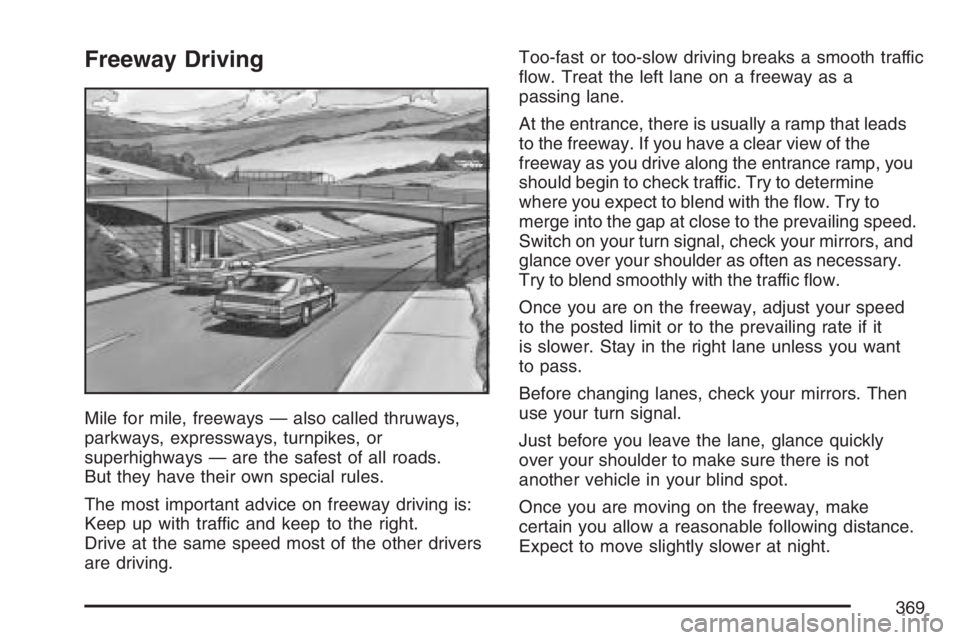
At the entrance, there is usually a ramp that leads
to the freeway. If you have a clear view of the
freeway as you drive along the entrance ramp, you
should begin to check traffic. Try to determine
where you expect to blend with the ow. Try to
merge into the gap at close to the prevailing speed.
Switch on your turn signal, check your mirrors, and
glance over your shoulder as often as necessary.
Try to blend smoothly with the traffic ow.
Once you are on the freeway, adjust your speed
to the posted limit or to the prevailing rate if it
is slower. Stay in the right lane unless you want
to pass.
Before changing lanes, check your mirrors. Then
use your turn signal.
Just before you leave the lane, glance quickly
over your shoulder to make sure there is not
another vehicle in your blind spot.
Once you are moving on the freeway, make
certain you allow a reasonable following distance.
Expect to move slightly slower at night.
369
Page 394 of 562
Making Turns
Notice:Making very sharp turns while
trailering could cause the trailer to come in
contact with the vehicle. Your vehicle could be
damaged. Avoid making very sharp turns
while trailering.
When you are turning with a trailer, make wider
turns than normal. Do this so your trailer will
not strike soft shoulders, curbs, road signs, trees,
or other objects. Avoid jerky or sudden
maneuvers. Signal well in advance.
Turn Signals When Towing a Trailer
When you tow a trailer, your vehicle has to have
extra wiring.
The arrows on your instrument panel will ash
whenever you signal a turn or lane change.
Properly hooked up, the trailer lamps will also
ash, telling other drivers you are about to turn,
change lanes, or stop.When towing a trailer, the arrows on your
instrument panel will ash for turns even if the
bulbs on the trailer are burned out. Thus, you may
think drivers behind you are seeing your signal
when they are not. It is important to check
occasionally to be sure the trailer bulbs are still
working.
Driving on Grades
Reduce speed and shift to a lower gear before
you start down a long or steep downgrade. If you
do not shift down, you might have to use your
brakes so much that they would get hot and
no longer work well.
If you are towing a trailer that weighs more than
1,000 lbs (450 kg), you may prefer to drive in
THIRD (3) instead of DRIVE (D) or, as you need
to, a lower gear. This will minimize heat build-up
and extend the life of your transaxle.
394
Page 397 of 562
Service........................................................ 400
Accessories and Modications................... 400
California Proposition 65 Warning.............. 401
Doing Your Own Service Work.................. 401
Adding Equipment to the Outside of Your
Vehicle................................................... 402
Fuel............................................................. 402
Gasoline Octane........................................ 402
Gasoline Specications.............................. 402
California Fuel........................................... 403
Additives................................................... 403
Fuels in Foreign Countries........................ 404
Filling the Tank......................................... 405
Filling a Portable Fuel Container............... 407
Checking Things Under
the Hood.................................................. 408
Hood Release........................................... 409
Engine Compartment Overview.................. 410
Engine Oil................................................. 411
Engine Oil Life System.............................. 414
Engine Air Cleaner/Filter............................ 416Automatic Transaxle Fluid......................... 417
Engine Coolant.......................................... 420
Radiator Pressure Cap.............................. 423
Engine Overheating................................... 423
Overheated Engine Protection
Operating Mode..................................... 425
Cooling System......................................... 426
Power Steering Fluid ................................. 432
Windshield Washer Fluid........................... 433
Brakes...................................................... 434
Battery...................................................... 437
Jump Starting............................................ 438
Bulb Replacement....................................... 443
Halogen Bulbs........................................... 443
Headlamps and Sidemarker Lamps........... 443
Front Turn Signal, Parking and Daytime
Running Lamps (DRL)........................... 445
Taillamps, Turn Signal, Stoplamps and
Back-up Lamps...................................... 445
License Plate Lamp................................... 447
Replacement Bulbs................................... 447
Section 5 Service and Appearance Care
397
Page 445 of 562
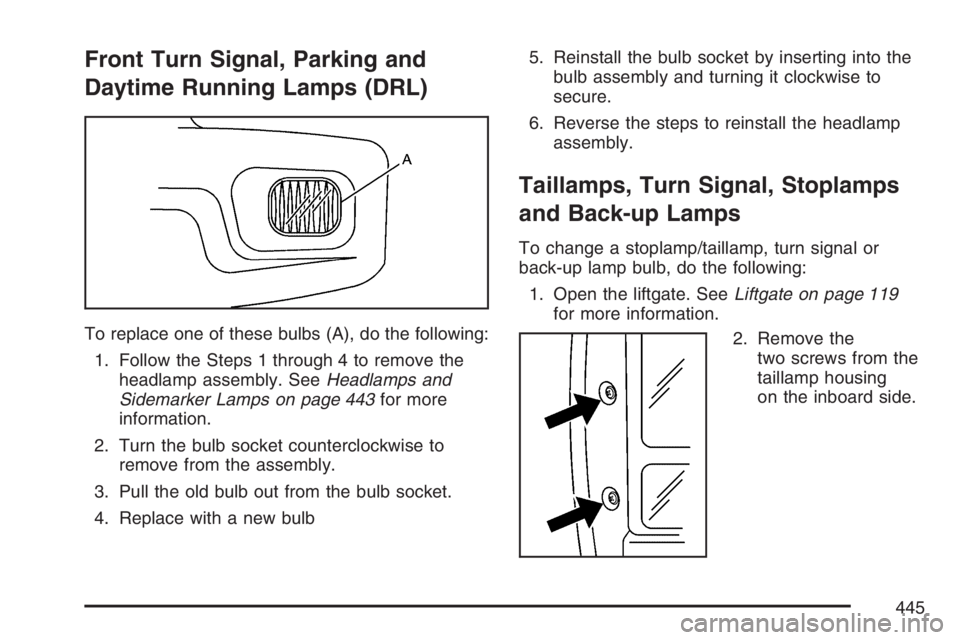
Front Turn Signal, Parking and
Daytime Running Lamps (DRL)
To replace one of these bulbs (A), do the following:
1. Follow the Steps 1 through 4 to remove the
headlamp assembly. SeeHeadlamps and
Sidemarker Lamps on page 443for more
information.
2. Turn the bulb socket counterclockwise to
remove from the assembly.
3. Pull the old bulb out from the bulb socket.
4. Replace with a new bulb5. Reinstall the bulb socket by inserting into the
bulb assembly and turning it clockwise to
secure.
6. Reverse the steps to reinstall the headlamp
assembly.
Taillamps, Turn Signal, Stoplamps
and Back-up Lamps
To change a stoplamp/taillamp, turn signal or
back-up lamp bulb, do the following:
1. Open the liftgate. SeeLiftgate on page 119
for more information.
2. Remove the
two screws from the
taillamp housing
on the inboard side.
445
Page 446 of 562
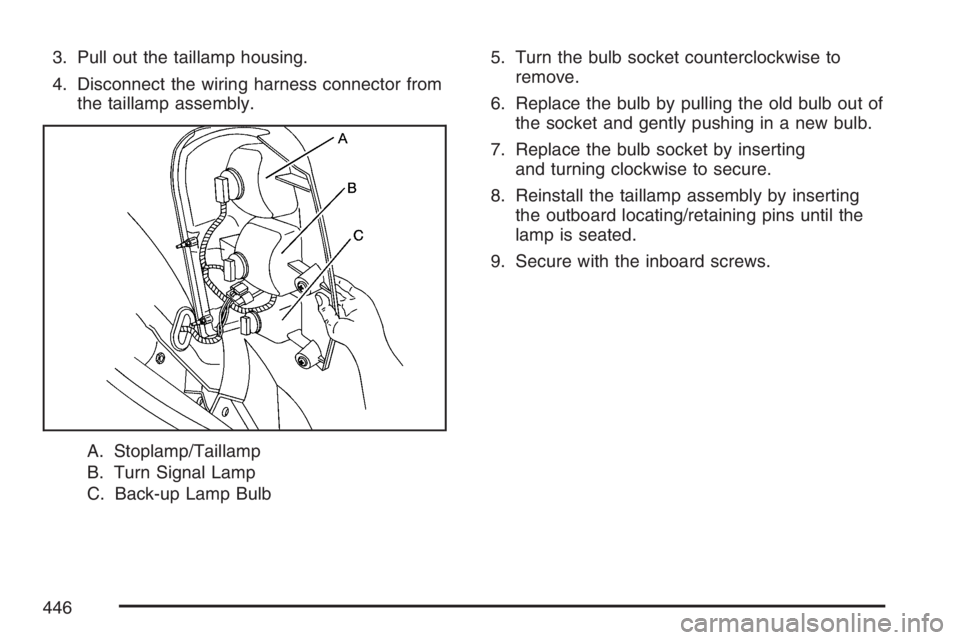
3. Pull out the taillamp housing.
4. Disconnect the wiring harness connector from
the taillamp assembly.
A. Stoplamp/Taillamp
B. Turn Signal Lamp
C. Back-up Lamp Bulb5. Turn the bulb socket counterclockwise to
remove.
6. Replace the bulb by pulling the old bulb out of
the socket and gently pushing in a new bulb.
7. Replace the bulb socket by inserting
and turning clockwise to secure.
8. Reinstall the taillamp assembly by inserting
the outboard locating/retaining pins until the
lamp is seated.
9. Secure with the inboard screws.
446
Page 447 of 562
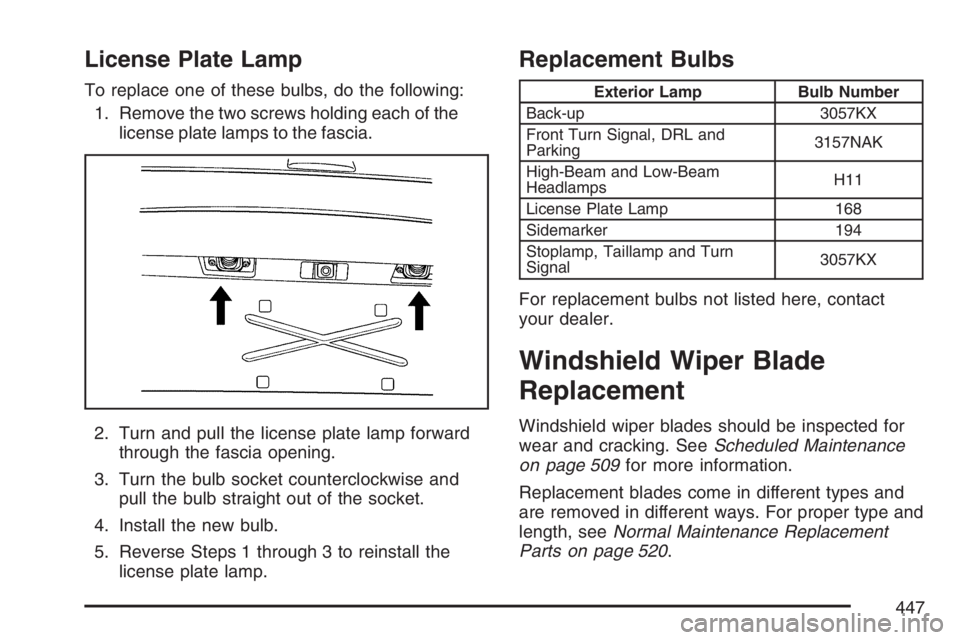
License Plate Lamp
To replace one of these bulbs, do the following:
1. Remove the two screws holding each of the
license plate lamps to the fascia.
2. Turn and pull the license plate lamp forward
through the fascia opening.
3. Turn the bulb socket counterclockwise and
pull the bulb straight out of the socket.
4. Install the new bulb.
5. Reverse Steps 1 through 3 to reinstall the
license plate lamp.
Replacement Bulbs
Exterior Lamp Bulb Number
Back-up 3057KX
Front Turn Signal, DRL and
Parking3157NAK
High-Beam and Low-Beam
HeadlampsH11
License Plate Lamp 168
Sidemarker 194
Stoplamp, Taillamp and Turn
Signal3057KX
For replacement bulbs not listed here, contact
your dealer.
Windshield Wiper Blade
Replacement
Windshield wiper blades should be inspected for
wear and cracking. SeeScheduled Maintenance
on page 509for more information.
Replacement blades come in different types and
are removed in different ways. For proper type and
length, seeNormal Maintenance Replacement
Parts on page 520.
447
Page 548 of 562
Appearance Care (cont.)
Washing Your Vehicle.............................. 491
Weatherstrips........................................... 490
Windshield, Backglass, and
Wiper Blades........................................ 492
Audio System(s).......................................... 258
Audio Steering Wheel Controls................. 341
Care of Your CD and DVD Player............ 343
Care of Your CDs and DVDs................... 343
Chime Level Adjustment........................... 344
Fixed Mast Antenna................................. 344
Mobile Digital Media System.................... 319
Navigation/Radio System,
see Navigation Manual......................... 282
Radio with CD......................................... 260
Rear Seat Audio (RSA)...................314, 316
Setting the Time...................................... 259
Theft-Deterrent Feature............................ 340
Understanding Radio Reception............... 342
XM™ Satellite Radio Antenna System...... 344
Automatic Door Lock................................... 109
Automatic Transaxle
Fluid........................................................ 417
Operation................................................. 133B
Battery........................................................ 437
Electric Power Management..................... 186
Run-Down Protection............................... 187
Before Leaving on a Long Trip.................... 370
Brake
Anti-Lock Brake System (ABS)................. 351
Emergencies............................................ 353
Parking.................................................... 137
System Warning Light.............................. 214
Brakes........................................................ 434
Braking....................................................... 350
Braking in Emergencies............................... 353
Break-In, New Vehicle................................. 128
Bulb Replacement....................................... 443
Front Turn Signal, Parking and
Daytime Running Lamps....................... 445
Halogen Bulbs......................................... 443
License Plate Lamps................................ 447
Replacement Bulbs.................................. 447
Taillamps, Turn Signal, Stoplamps and
Back-up Lamps..................................... 445
Buying New Tires........................................ 461
548
Page 552 of 562
Engine (cont.)
Drive Belt Routing.................................... 521
Engine Compartment Overview................ 410
Exhaust................................................... 141
Oil ........................................................... 411
Oil Life System........................................ 414
Overheated Protection Operating Mode...... 425
Overheating............................................. 423
Starting.................................................... 130
Entry Lighting.............................................. 184
Event Data Recorders (EDR)...................... 537
Exit Lighting................................................ 185
Extender, Safety Belt..................................... 48
Exterior Lamps............................................ 181
F
Filter
Engine Air Cleaner................................... 416
Finish Damage............................................ 494
Fixed Mast Antenna.................................... 344
Flashers, Hazard Warning........................... 172
Flash-to-Pass.............................................. 174
Flat Tire...................................................... 470
Flat Tire, Changing...................................... 470Flat Tire, Storing......................................... 483
Fluid
Automatic Transaxle................................. 417
Power Steering........................................ 432
Windshield Washer.................................. 433
Folding Tray................................................ 161
Front Console Storage Area........................ 161
Front Reading Lamps.................................. 186
Front Turn Signal, Parking and
Daytime Running Lamps.......................... 445
Fuel............................................................ 402
Additives.................................................. 403
California Fuel.......................................... 403
Filling a Portable Fuel Container.............. 407
Filling Your Tank...................................... 405
Fuels in Foreign Countries....................... 404
Gage....................................................... 222
Gasoline Octane...................................... 402
Gasoline Specications............................ 402
Low Warning Light................................... 222
Fuses
Fuses and Circuit Breakers...................... 497
Instrument Panel Fuse Block................... 498
Underhood Fuse Block............................. 500
Windshield Wiper..................................... 497
552