ac control module BUICK VERANO 2012 Owner's Manual
[x] Cancel search | Manufacturer: BUICK, Model Year: 2012, Model line: VERANO, Model: BUICK VERANO 2012Pages: 388, PDF Size: 5.26 MB
Page 121 of 388

Black plate (11,1)Buick Verano Owner Manual - 2012 - CRC - 1/10/12
Instruments and Controls 5-11
Passenger Safety Belt
Reminder Light
When the vehicle is started, this
light flashes and a chime may come
on to remind front passengers to
fasten their safety belt. Then the
light stays on solid until the belt is
buckled.
SeePassenger Airbag Status
Indicator on page 5‑12.
This cycle continues several times
if the front passenger remains or
becomes unbuckled while the
vehicle is moving.
If the front passenger safety belt is
buckled, neither the chime nor the
light comes on. The front passenger safety belt
reminder light and chime may turn
on if an object is put on the seat
such as a briefcase, handbag,
grocery bag, laptop, or other
electronic device. To turn off the
reminder light and/or chime, remove
the object from the seat or buckle
the safety belt.Airbag Readiness Light
This light shows if there is an
electrical problem with the airbag
system. The system check includes
the airbag sensor(s), passenger
sensing system, the pretensioners,
the airbag modules, the wiring, and
the crash sensing and diagnostic
module. For more information on the
airbag system, see
Airbag System
on page 3‑19.
The airbag readiness light comes
on for several seconds when the
vehicle is started. If the light does
not come on then, have the vehicle
fixed immediately.
{WARNING
If the airbag readiness light stays
on after the vehicle is started or
comes on while driving, it means
the airbag system might not be
working properly. The airbags in
the vehicle might not inflate in a
crash, or they could even inflate
without a crash. To help avoid
injury, have the vehicle serviced
right away.
Page 235 of 388

Black plate (33,1)Buick Verano Owner Manual - 2012 - CRC - 1/10/12
Driving and Operating 9-33
Brake Assist
This vehicle has a brake assist
feature designed to assist the driver
in stopping or decreasing vehicle
speed in emergency driving
conditions. This feature uses the
stability system hydraulic brake
control module to supplement
the power brake system under
conditions where the driver has
quickly and forcefully applied the
brake pedal in an attempt to quickly
stop or slow down the vehicle. The
stability system hydraulic brake
control module increases brake
pressure at each corner of the
vehicle until the ABS activates.
Minor brake pedal pulsation or
pedal movement during this time
is normal and the driver should
continue to apply the brake pedal
as the driving situation dictates.
The brake assist feature will
automatically disengage when the
brake pedal is released or brake
pedal pressure is quickly
decreased.
Hill Start Assist (HSA)
Some vehicles have a Hill Start
Assist (HSA) feature, which may be
useful when the vehicle is stopped
on a grade. This feature is designed
to prevent the vehicle from rolling,
either forward or rearward, during
vehicle drive off. After the driver
completely stops and holds the
vehicle in a complete standstill on a
grade, HSA will be automatically
activated. During the transition
period between when the driver
releases the brake pedal and starts
to accelerate to drive off on a grade,
HSA holds the braking pressure to
ensure that there is no rolling. The
brakes will automatically release
when the accelerator pedal is
applied within the two‐second
window. It will not activate if the
vehicle is in a drive gear and facing
downhill or if the vehicle is facing
uphill and in R (Reverse).
Ride Control Systems
Traction Control
System (TCS)
The vehicle has a Traction Control
System (TCS) that limits wheel spin.
On a front-wheel-drive vehicle, the
system operates if it senses that
one or both of the front wheels are
spinning or beginning to lose
traction. When this happens, the
system brakes the spinning
wheel(s), and/or reduces engine
power to limit wheel spin.
The system may be heard or felt
while it is working, but this is
normal.
TCS is on whenever the vehicle
is started. To limit wheel spin,
especially in slippery road
conditions, the system should
always be left on. But, TCS can be
turned off if needed.
Page 257 of 388

Black plate (3,1)Buick Verano Owner Manual - 2012 - CRC - 1/10/12
Vehicle Care 10-3
Accessories and
Modifications
Adding non‐dealer accessories or
making modifications to the vehicle
can affect vehicle performance and
safety, including such things as
airbags, braking, stability, ride and
handling, emissions systems,
aerodynamics, durability, and
electronic systems like antilock
brakes, traction control, and stability
control. These accessories or
modifications could even cause
malfunction or damage not covered
by the vehicle warranty.Damage to vehicle components
resulting from modifications or the
installation or use of non‐GM
certified parts, including control
module or software modifications, is
not covered under the terms of the
vehicle warranty and may affect
remaining warranty coverage for
affected parts.
GM Accessories are designed to
complement and function with other
systems on the vehicle. See your
dealer to accessorize the vehicle
using genuine GM Accessories
installed by a dealer technician.
Also, see
Adding Equipment to the
Airbag-Equipped Vehicle on
page 3‑30.
Vehicle Checks
Doing Your Own
Service Work
{WARNING
It can be dangerous to work on
your vehicle if you do not have
the proper knowledge, service
manual, tools, or parts. Always
follow owner manual procedures
and consult the service manual
for your vehicle before doing any
service work.
If doing some of your own service
work, use the proper service
manual. It tells you much more
about how to service the vehicle
than this manual can. To order the
proper service manual, see Service
Publications Ordering Information
on page 13‑11.
Page 281 of 388

Black plate (27,1)Buick Verano Owner Manual - 2012 - CRC - 1/10/12
Vehicle Care 10-27
Engine Compartment
Fuse Block
To open the fuse block cover, press
the clips at the front and back and
rotate the cover up to the side.
Notice:Spilling liquid on any
electrical component on the
vehicle may damage it. Always
keep the covers on any electrical
component.
Engine Compartment Fuse Block
A fuse puller is located in the engine
compartment fuse block.
The vehicle may not be equipped
with all of the fuses, relays, and
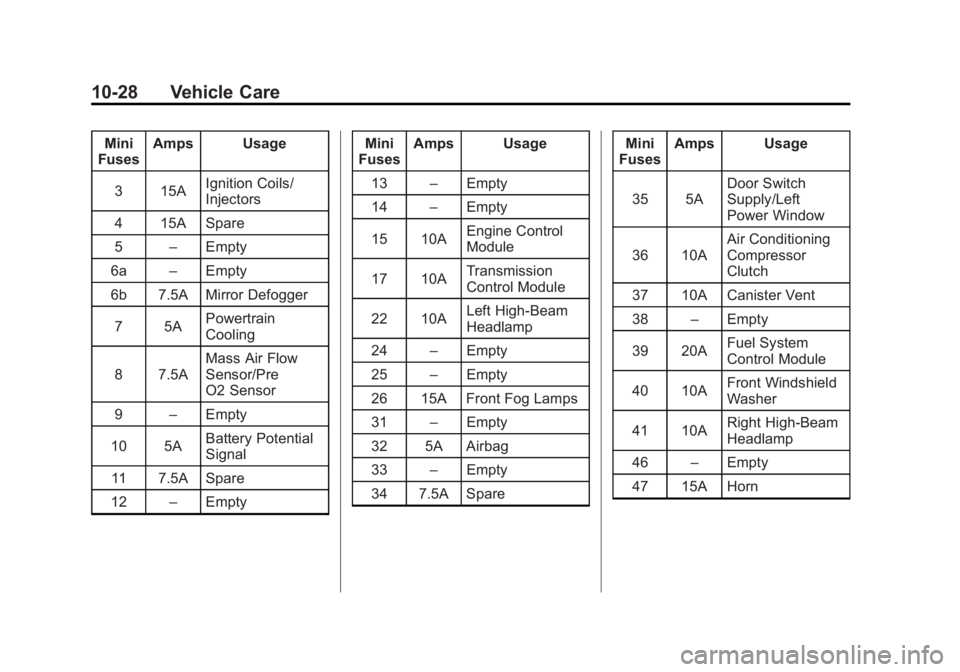
features shown. Mini
Fuses Amps Usage
1 20A Engine Control
Module
2 10A Oxygen Sensor/
Purge Solenoid
Page 282 of 388
Black plate (28,1)Buick Verano Owner Manual - 2012 - CRC - 1/10/12
10-28 Vehicle Care
Mini
Fuses Amps Usage
3 15A Ignition Coils/
Injectors
4 15A Spare
5 –Empty
6a –Empty
6b 7.5A Mirror Defogger
7 5A Powertrain
Cooling
8 7.5A Mass Air Flow
Sensor/Pre
O2 Sensor
9 –Empty
10 5A Battery Potential
Signal
11 7.5A Spare
12 –Empty Mini
Fuses Amps Usage
13 –Empty
14 –Empty
15 10A Engine Control
Module
17 10A Transmission
Control Module
22 10A Left High-Beam
Headlamp
24 –Empty
25 –Empty
26 15A Front Fog Lamps
31 –Empty
32 5A Airbag
33 –Empty
34 7.5A Spare Mini
Fuses Amps Usage
35 5A Door Switch
Supply/Left
Power Window
36 10A Air Conditioning
Compressor
Clutch
37 10A Canister Vent
38 –Empty
39 20A Fuel System
Control Module
40 10A Front Windshield
Washer
41 10A Right High-Beam
Headlamp
46 –Empty
47 15A Horn
Page 283 of 388

Black plate (29,1)Buick Verano Owner Manual - 2012 - CRC - 1/10/12
Vehicle Care 10-29
Mini
Fuses Amps Usage
49 20A Fuel Pump
50 –Empty
51 5A Inside Rear View
Mirror
52 –Empty
53 10A Ignition Engine
Control Module/
Transmission
Control Module
54 7.5A Instrument Panel
Cluster/Fuel
System Control
Module/Heater,
Ventilation, and
Air Conditioning
Run/Crank J-Case
Fuses Amps Usage
16 30A Starter Control
18 30A Rear Window
Defogger
19 30A Front Power
Window
20 30A Rear Power
Window
21 30A Antilock Brake
System Valves
23 –Empty
27 50A Spare
28 –Empty J-Case
Fuses Amps Usage
29 30A Electric Parking
Brake
30 60A Antilock Brake
System Pump
42 40A Engine
Cooling Fan
43 30A Front Wipers
44 –Empty
45 30A Engine
Cooling Fan
48 60A Engine
Cooling Fan
Page 285 of 388

Black plate (31,1)Buick Verano Owner Manual - 2012 - CRC - 1/10/12
Vehicle Care 10-31
Fuses Amps Usage1 2A Body Control
Module
2 20A Body Control
Module
3 20A Body Control
Module
4 20A Infotainment
System
5 10A Information
Display/
Parking
Assist
6 20A Ignition/
Electronic
Key System
7 20A Power Outlet
8 30A Body Control
Module
9 30A Body Control
Module
10 30A Body Control
Module Fuses Amps Usage
11 40A Interior Fan
12 25A Driver
Power Seat
13 –Not Used
14 7.5A Diagnostic
Connector
15 10A Airbag
16 10A Central
Locking
System/
Tailgate
17 10A Air
Conditioning
System
18 30A Infotainment
System
19 30A Body Control
Module
20 5A Passenger
Power Seat Fuses Amps Usage
21 7.5A Instrument
Cluster
22 2A/5A Ignition/
Electronic
Key System
23 20A Body Control
Module
24 20A Body Control
Module
25 –Not Used
26 –Not Used
Relays Usage 1 Trunk Open
2 Door Security
3 Power Outlet
Page 366 of 388
Black plate (14,1)Buick Verano Owner Manual - 2012 - CRC - 1/10/12
13-14 Customer Information
Vehicle Data
Recording and
Privacy
This GM vehicle has a number of
sophisticated computers that record
information about the vehicle’s
performance and how it is driven.
For example, the vehicle uses
computer modules to monitor and
control engine and transmission
performance, to monitor the
conditions for airbag deployment
and deploy airbags in a crash, and,
if so equipped, to provide antilock
braking to help the driver control the
vehicle. These modules may store
data to help your dealer technician
service the vehicle. Some modules
may also store data about how you
operate the vehicle, such as rate of
fuel consumption or average speed.
These modules may also retain the
owner’s personal preferences, such
as radio presets, seat positions, and
temperature settings.
Event Data Recorders
This vehicle has an Event Data
Recorder (EDR). The main purpose
of an EDR is to record, in certain
crash or near crash-like situations,
such as an airbag deployment or
hitting a road obstacle, data that
will assist in understanding how a
vehicle's systems performed. The
EDR is designed to record data
related to vehicle dynamics and
safety systems for a short period of
time, typically 30 seconds or less.
The EDR in this vehicle is designed
to record such data as:
.How various systems in the
vehicle were operating.
.Whether or not the driver and
passenger safety belts were
buckled/fastened.
.How far, if at all, the driver was
pressing the accelerator and/or
brake pedal.
.How fast the vehicle was
traveling. This data can help provide a better
understanding of the circumstances
in which crashes and injuries occur.
Important:
EDR data is recorded
by the vehicle only if a non-trivial
crash situation occurs; no data is
recorded by the EDR under normal
driving conditions and no personal
data (e.g., name, gender, age,
and crash location) is recorded.
However, other parties, such
as law enforcement, could
combine the EDR data with the
type of personally identifying data
routinely acquired during a crash
investigation.
To read data recorded by an EDR,
special equipment is required, and
access to the vehicle or the EDR is
needed. In addition to the vehicle
manufacturer, other parties, such
as law enforcement, that have the
special equipment, can read the
information if they have access to
the vehicle or the EDR.