warning light CADILLAC CATERA 1998 1.G Owner's Manual
[x] Cancel search | Manufacturer: CADILLAC, Model Year: 1998, Model line: CATERA, Model: CADILLAC CATERA 1998 1.GPages: 346, PDF Size: 19.13 MB
Page 203 of 346
Downloaded from www.Manualslib.com manuals search engine Winter Driving
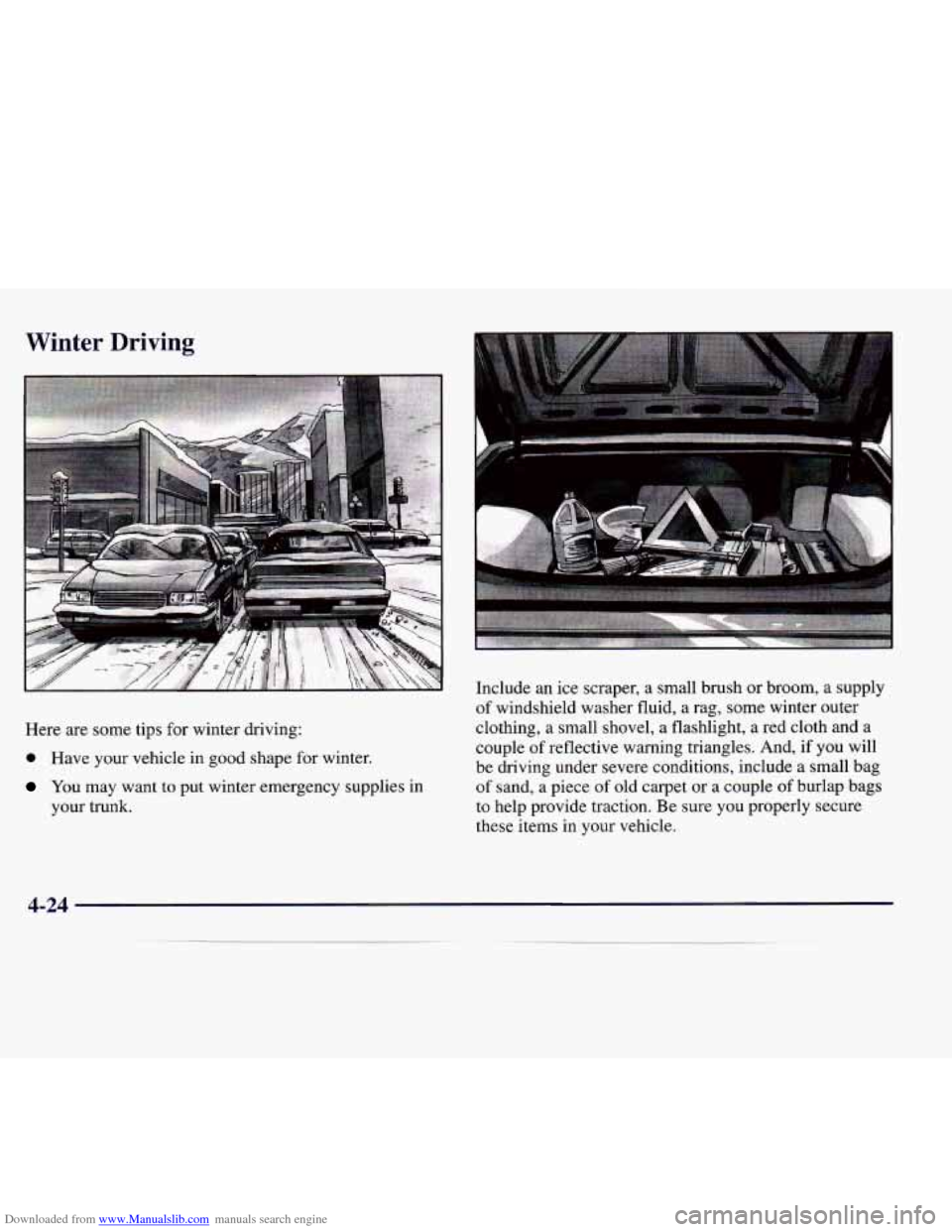
Here are some tips for winter driving:
0 Have your vehicle in good shape for winter.
You may want to put winter emergency supplies in
your
truok
Include an ice scraper, a small brush or broom, a supply
of windshield washer fluid, a rag, some winter outer
clothing, a small shovel,
a flashlight, a red cloth and a
couple of reflective warning triangles. And, if you will
be driving under severe conditions, include a small bag
of sand, a piece
of old carpet or a couple of burlap bags
to help provide traction. Be sure
you properly secure
these items in your vehicle.
4-24
Page 217 of 346
Downloaded from www.Manualslib.com manuals search engine Hazard Warning Flashers
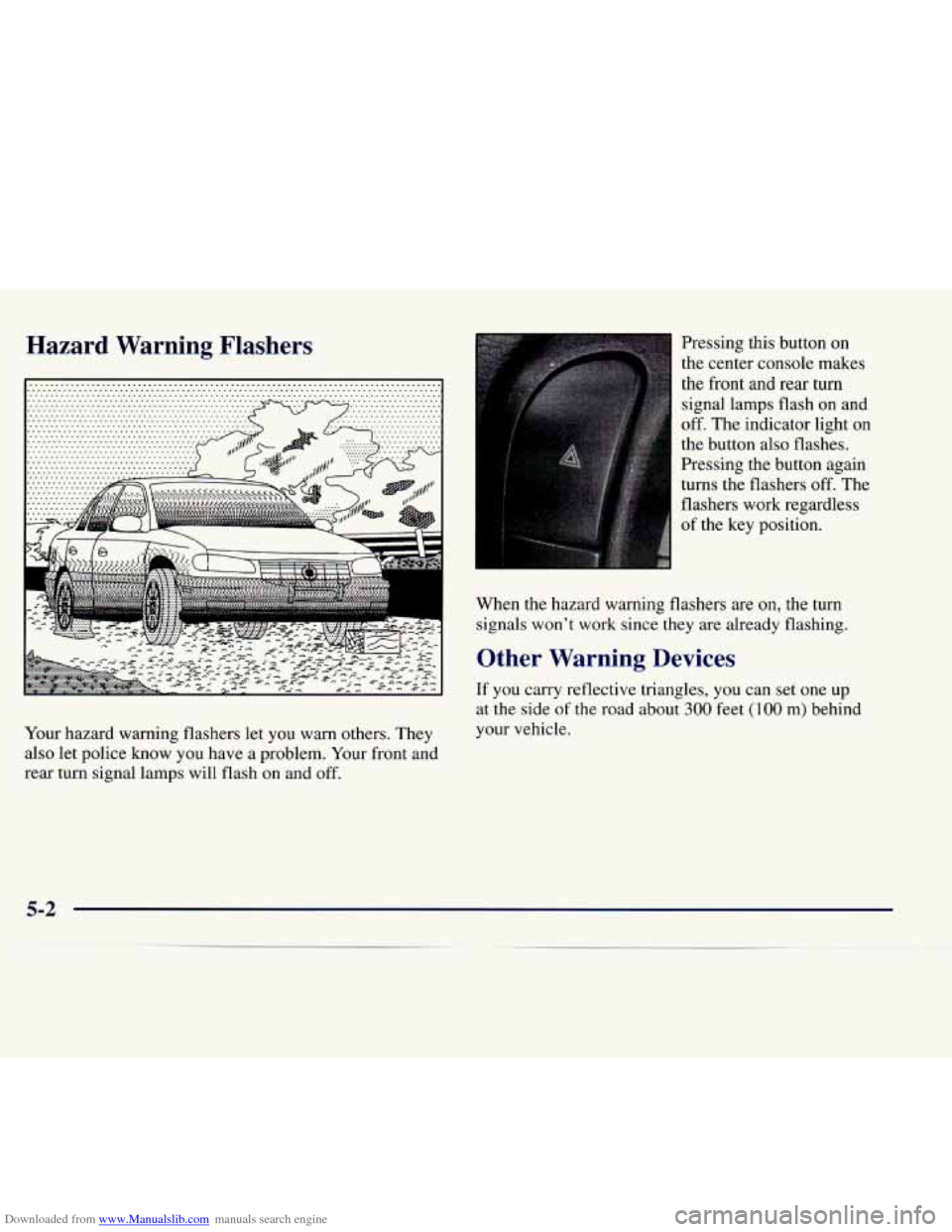
Your hazard warning flashers let you warn others. They
also let police know you have a problem. Your front and
rear turn signal lamps will flash
on and off.
Pressing this button on
the center console makes
the front and rear turn signal lamps flash
on and
off. The indicator light on
the button also flashes.
Pressing the button again
turns the flashers off.
The
flashers work regardless
of the key position.
When the hazard warning flashers are on, the turn signals
won’t work since they are already flashing.
Other Warning Devices
If you carry reflective triangles, you can set one up
at the side
of the road about 300 feet (100 m) behind
your vehicle.
5-2
Page 227 of 346
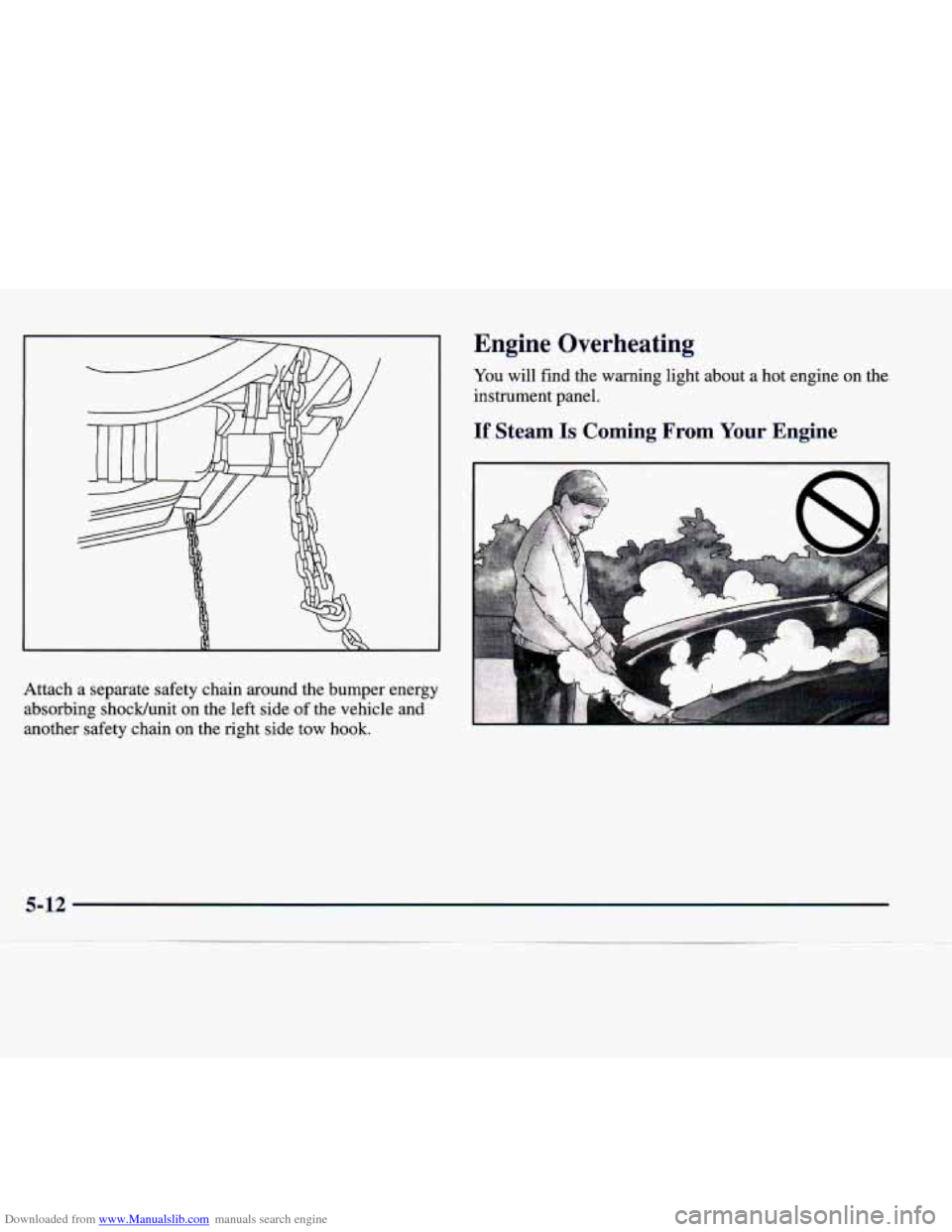
Downloaded from www.Manualslib.com manuals search engine Attach a separate safety chain around the bumper energy
absorbing shockhnit on the left side of the vehicle and
another safety chain on the right side tow hook.
Engine Overheating
You will find the warning light about a hot engine on the
instrument panel.
If Steam Is Coming From Your Engine
5-12
Page 269 of 346
Downloaded from www.Manualslib.com manuals search engine What to Use
Refer to the Maintenance Schedule to determine what
kind of lubricant to use. See “Recommended Fluids and
Lubricants” in the Maintenance Schedule booklet.
Engine Coolant
The cooling s stem in your vehicle is filled with
DEX-COOL engine coolant.
This coolant is designed
to remain in your vehicle for
5 years or 150,000 miles
(240 000 krnb whichever occurs first, if you add only
DEX-COOL extended life coolant.
J
The following explains your cooling system and how to
add coolant when it is low. If you have
a problem with
engine overheating, see “Engine Overheating” in
the Index.
A 50/50 mixture of water and DEX-COOL’
coolant will:
a Give freezing protection down to -34°F (-37°C).
Give boiling protection up to 265 OF (129°C).
Protect against rust and corrosion.
Help keep the proper engine temperature.
Let the warning lights and gages work as
they should.
NOTICE:
When adding coolant, it is important that you use
only
DEX-COOL@ (silicate-free) coolant.
If coolant other than DEX-COOL is added to the
system, premature engine, heater core or
radiator corrosion may result. In addition, the
engine coolant
will require change sooner -- at
30,000 miles (50 000 km) or 24 months,
whichever occurs
first. Damage caused by the use
of coolant other than DEX-COOL@
is not
covered
by your new vehicle warranty.
6-20
-
Page 271 of 346
Downloaded from www.Manualslib.com manuals search engine Checking Coolant
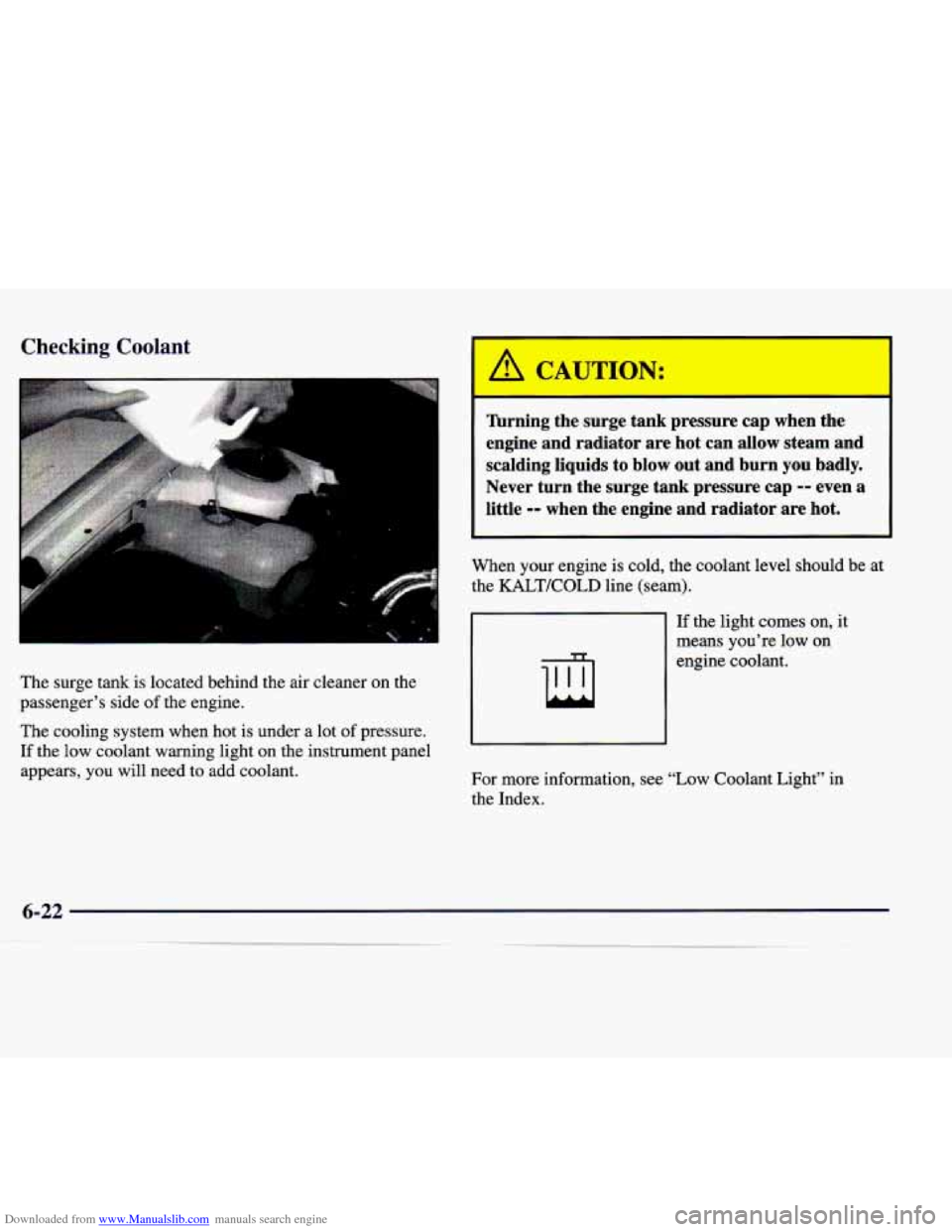
The surge tank is located behind the air cleaner on the
passenger’s side
of the engine.
The cooling system when hot is under a lot
of pressure.
If the low coolant warning light on the instrument panel
appears, you will need to add coolant.
= I
Turning the surge tank pressure cap when the
engine and radiator are hot can allow steam and
scalding liquids to blow out and burn you badly.
Never turn the surge tank pressure cap
-- even a
little
-- when the engine and radiator are hot.
When your engine is cold, the coolant level should be at
the KALTKOLD line (seam).
1
If the light comes on, it
means you’re low on
engine coolant.
]I I I
For more information, see “Low Coolant Light” in
the Index.
6-22
.- - ------
Page 275 of 346
Downloaded from www.Manualslib.com manuals search engine Brakes
Brake Fluid
s
i“
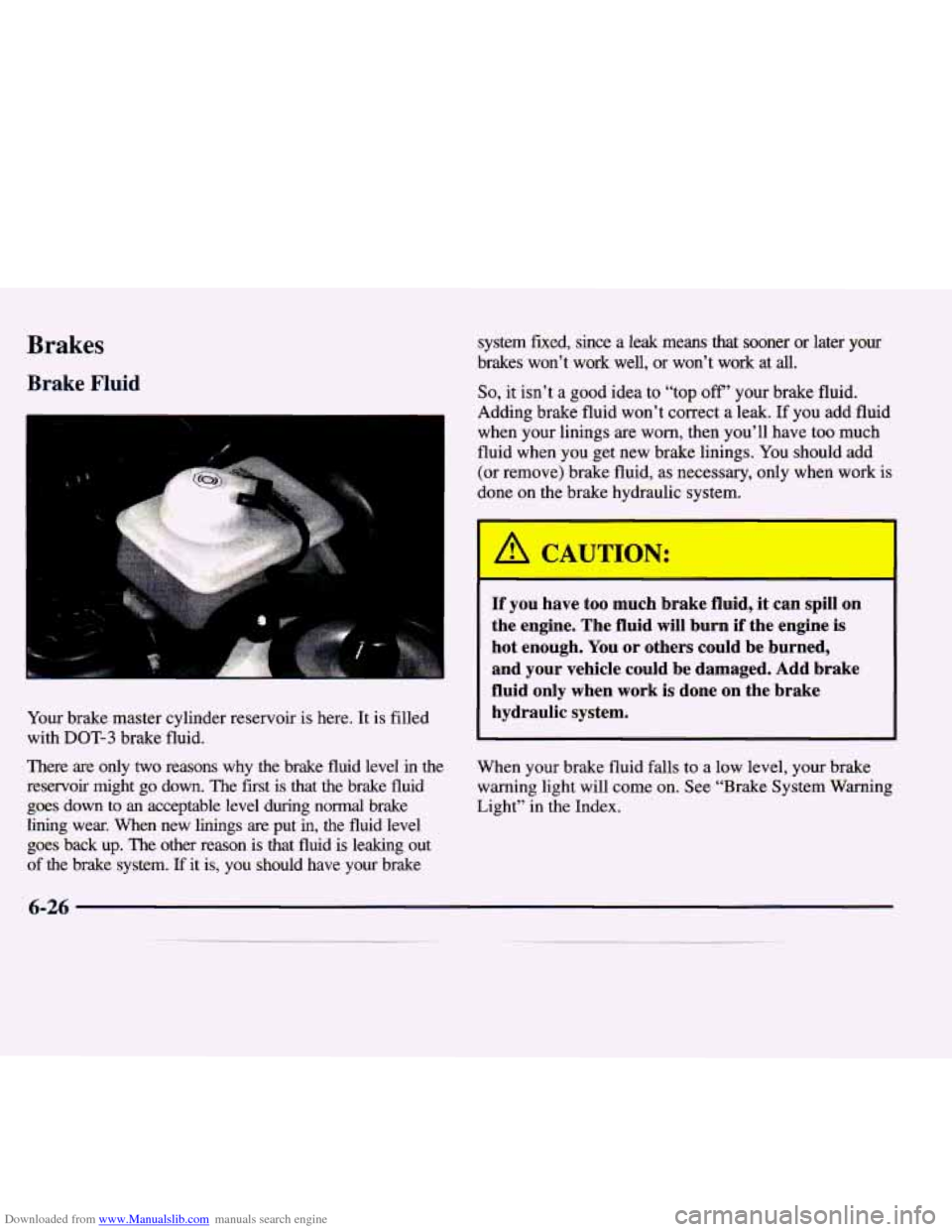
Your brake master cylinder reservoir is here. It is filled
with
DOT-3 brake fluid.
There
are only two reasons why the brake fluid level in the
reservoir might go down. The first
is that the brake fluid
goes down to an acceptable level during normal brake
lining wear. When new linings are put in, the fluid level
goes back up. The other reason is that fluid is leaking out
of the brake system. If it is, you should have your brake system fured, since a leak means that sooner
or later your
brakes won’t work well, or won’t work
at all.
So, it isn’t a good idea to “top off’ your brake fluid.
Adding brake fluid won’t correct
a leak. If you add fluid
when your linings
are worn, then you’ll have too much
fluid when you get new brake linings. You should add
(or remove) brake fluid, as necessary,
only when work is
done on the brake hydraulic system.
A CAV-ION:
If you have too much brake fluid, it can spill on
the engine. The fluid will burn if the engine
is
hot enough. You or others could be burned,
and your vehicle could be damaged. Add brake
fluid only when work is done on the brake
hydraulic system.
When your brake fluid falls to a low level, your brake
warning light will come on. See “Brake System Warning
Light” in the
Index.
Page 291 of 346
Downloaded from www.Manualslib.com manuals search engine Uniform Tire Quality Grading
The following information relates to the system
developed by the United States National Highway
Traffic Safety Administration, which grades tires by
treadwear, traction and temperature performance. (This
applies only to vehicles sold in the United States.) The
grades
are molded on the sidewalls of most passenger
car tires. The Uniform Tire Quality Grading system does
not apply to deep tread, winter-type snow tires,
space-saver or temporary use spare tires, tires with
nominal rim diameters of
10 to 12 inches (25 to 30 cm),
or to some limited-production tires.
While the tires available on General Motors passenger
cars and light trucks
may vary with respect to these
grades, they must also conform to Federal safety
requirements and additional General Motors Tire
Performance Criteria (TPC) standards.
Treadwear
The treadwear grade is a comparative rating based on
the wear rate
of the tire when tested under controlled
conditions on a specified government test course. For
example, a tire graded 150 would wear one and a half
(1
1/2) times as well on the government course as a tire
graded 100. The relative performance
of tires depends
upon the actual conditions of their use, however, and
may depart significantly from the norm due to variations
in driving habits, service practices and differences in
road characteristics and climate.
Traction -- A, B, C
The traction grades, fiom highest to lowest, are A, B, and
C, and they represent the tire’s ability
to stop on wet
pavement
as measured under controlled conditions on
specified government test surfaces of asphalt and concrete.
A tire marked C may have poor traction performance.
Warning: The traction grade assigned to this tire is based
on braking (straight ahead) traction tests and does not
include cornering (turning) traction.
Page 330 of 346
Downloaded from www.Manualslib.com manuals search engine #-A* ‘JL
Section 8 Index
ABS ......................................... 4-7
Adding Equipment to the Outside
of Your Vehicle ...... 6-3
Add-on Electrical Equipment
..................... 6-55
Aiming. Headlamps
............................. 6-33
AirBag ....................................... 1-27
How Does it Restrain
.......................... 1-33
How the Systems Work
........................ 1-30
Location
.................................... 1-30
Readiness Light ......................... 1.30. 2.65
Servicing
................................... 1-35
What Makes it Inflate
.......................... 1-33
What Will You See After it Inflates
............... 1-34
When Should it Inflate
......................... 1-32
Aircleaner
.................................... 6-15
Air Conditioning
................................ 3-6
Air Conditioning Refrigerants ..................... 6-63
Alarm. Theft-Deterrent .......................... 2- 13
Alignment
and Balance. Tire ...................... 6-43
Aluminum Wheels. Cleaning
...................... 6-50
Antenna. Heated Backlite
........................ 3-30
Antifreeze
..................................... 6-20
Anti-Lock Brake System Warning Light
................ 2.68. 4.7
Brakes (ABS)
................................. 4-7 Anti-Lockout Feature
............................ 2-7
Anti-Pinch Feature
......................... 2.32. 2.53
Appearance Care
............................... 6-45
Appearance Care Materials Chart
.................. 6-53
Arbitration Program
............................. 7-11
Ashtrays and Cigarette Lighter
.................... 2-49
Assist Handles
................................. 2-51
Audio Equipment. Adding ........................ 3-28
Audio Steering Wheel Controls
.................... 3-26
Audio Systems
.................................. 3-9
Automatic Door Locks
............................ 2-5
Automatic Operation (Climate Controls)
.............. 3-3
Automatic Transmission Operation
................................... 2-20
Shifting
..................................... 2-20
Warning Light
............................... 2-76
Fluid
....................................... 6-18
Starting Your Engine
.......................... 2-17
Axle. Rear
.................................... 6-19
Battery
...................................... 6-29
Jump Starting
................................. 5-3
Replacement. Remote Keyless Entry
............... 2-9
Warnings ............................ 5.3.5.4. 5.5
Page 331 of 346
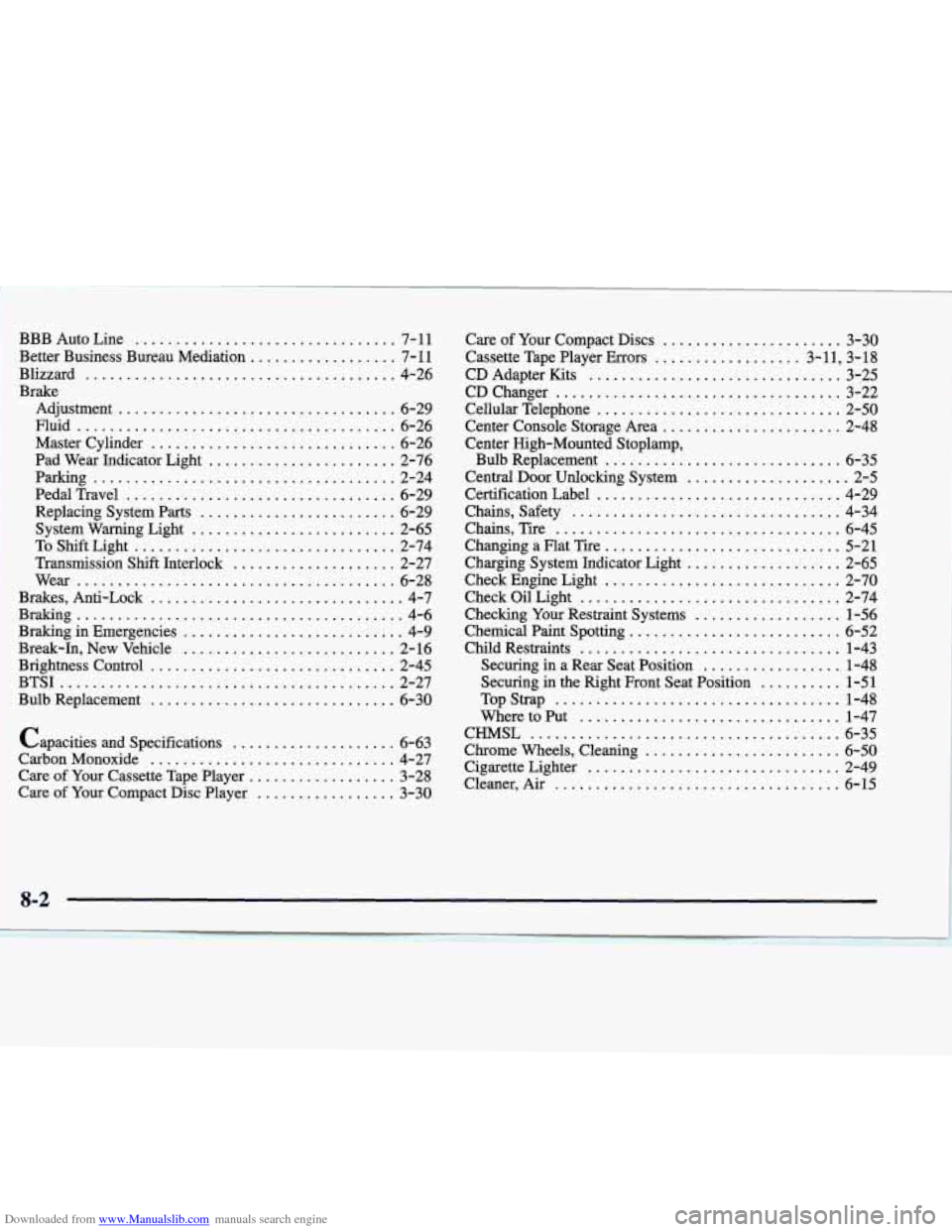
Downloaded from www.Manualslib.com manuals search engine BBB Auto Line ................................ 7-1 1
Better Business Bureau Mediation
.................. 7-11
Blizzard
...................................... 4-26
Brake
Adjustment
.................................. 6-29
Fluid
....................................... 6-26
Master Cylinder
.............................. 6-26
Pad Wear Indicator Light
....................... 2-76
Parking
..................................... 2-24
Pedal Travel
................................. 6-29
Replacing System Parts
........................ 6-29
System Warning Light
......................... 2-65
To Shift Light
................................ 2-74
Transmission Shift Interlock
.................... 2-27
Wear
....................................... 6-28
Brakes,Anti -Lock
............................... 4-7
Braking
........................................ 4-6
Braking in Emergencies
........................... 4-9
Break-In, New Vehicle
.......................... 2-16
Brightness Control
.............................. 2-45
BTSI
......................................... 2-27
Bulb Replacement
.............................. 6-30
Capacities and Specifications
.................... 6-63
CarbonMonoxide
.............................. 4-27
Care
of Your Cassette Tape Player .................. 3-28
Care
of Your Compact Disc Player ................. 3-30 Care
of
Your Compact Discs ...................... 3-30
Cassette Tape Player
Errors .................. 3.11. 3. 18
CD Adapter Kits ............................... 3-25
CD Changer
................................... 3-22
Center Console Storage Area
...................... 2-48
Bulb Replacement
............................. 6-35
Central Door Unlocking System
.................... 2-5
CertificationLabel
.............................. 4-29
Chains, Safety
................................. 4-34
Changing a Flat Tire
............................. 5-21
Charging System Indicator Light
................... 2-65
Check Engine Light
............................. 2-70
Check Oil Light
................................ 2-74
Checking Your Restraint Systems
.................. 1-56
Chemical Paint Spotting
.......................... 6-52
Child Restraints
................................ 1-43
Securing in a Rear Seat Position
................. 1-48
Securing in the Right Front Seat Position
.......... 1-51
Top Strap ................................... 1-48
Chrome Wheels, Cleaning
........................ 6-50
Cigarette Lighter
............................... 2-49
CellularTelephone
.............................. 2-50
Center High-Mounted Stoplamp,
Chains, Tire
................................... 6-45
Wheretoht
.........,...................... l-47
CHMSL ...................................... 6-35
Cleaner, Air
................................... 6-15
Page 333 of 346
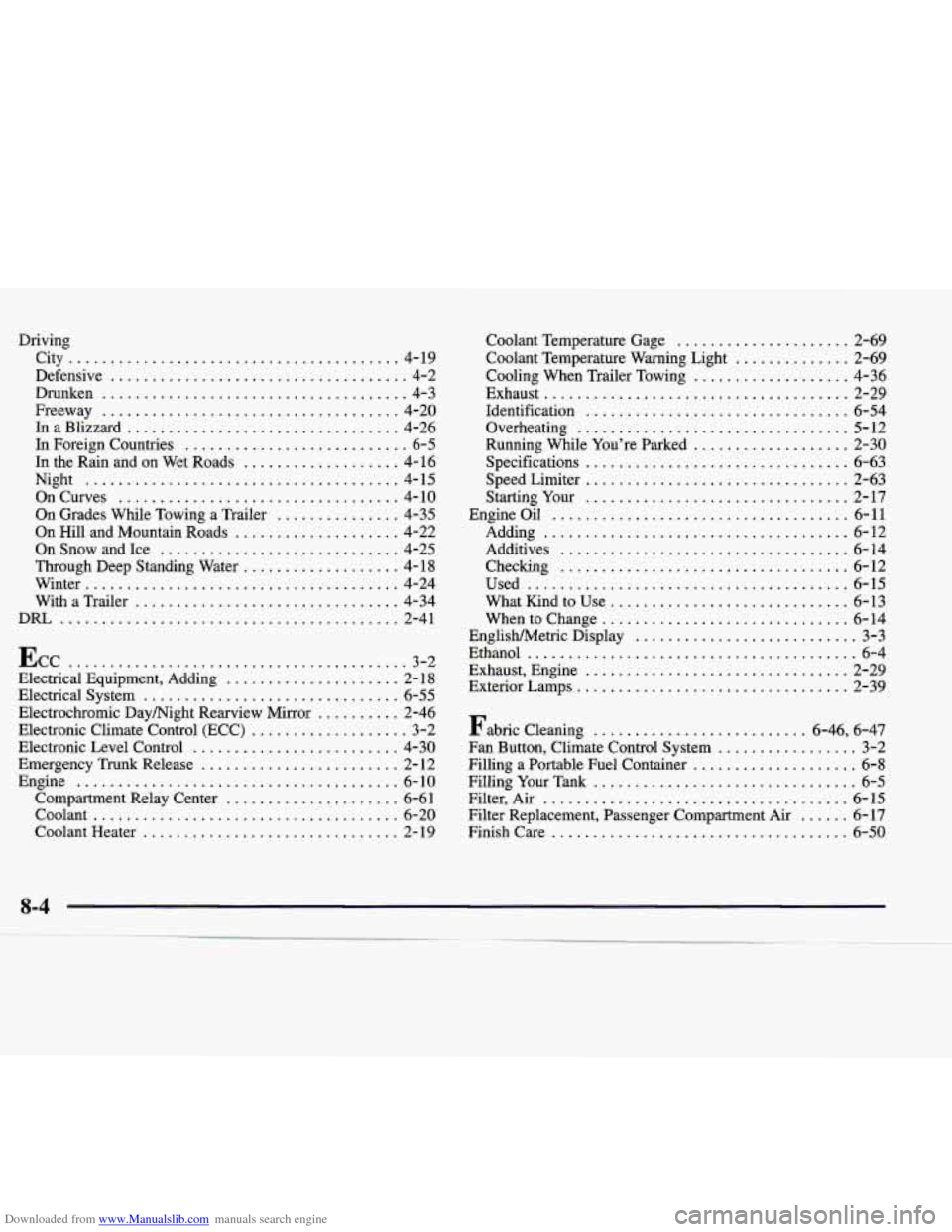
Downloaded from www.Manualslib.com manuals search engine Driving City
........................................ 4-19
Defensive
.................................... 4-2
Drunken
..................................... 4-3
Freeway
.................................... 4-20
In a Blizzard ................................. 4-26
In Foreign Countries
........................... 6-5
In the Rain and on Wet Roads ................... 4-16
Night
...................................... 4-15
OnCurves
.................................. 4-10
On Grades While Towing a Trailer
............... 4-35
On Hill and Mountain Roads
.................... 4-22
OnSnowandIce
............................. 4-25
Through Deep Standing Water
................... 4- 18
Winter
...................................... 4-24
With a Trailer
................................ 4-34
DRL ......................................... 2-41
ECC ......................................... 3-2
Electrical Equipment. Adding
..................... 2- 18
Electrochromic Daymight Rearview Mirror
.......... 2-46
Electronic Climate Control (ECC)
................... 3-2
Electronic Level Control
......................... 4-30
Engine
....................................... 6-10
Coolant
..................................... 6-20
Coolant Heater
............................... 2- 19
Electrical System
............................... 6-55
Emergency Trunk Release
........................ 2- 12
Compartment Relay Center
..................... 6-61 Coolant Temperature Gage
..................... 2-69
Cooling When Trailer Towing
................... 4-36
Overheating
................................. 5-12
Running While You’re Parked
................... 2-30
Specifications
................................ 6-63
Speed Limiter
................................ 2-63
StartingYour
................................ 2-17
Engine Oil
.................................... 6-11
Adding ..................................... 6-12
Additives
................................... 6-14
Checking
................................... 6-12
Used
....................................... 6-15
What Kind to Use
............................. 6-13
Whentochange
.............................. 6-14
EnglishMetric Display
........................... 3-3
Ethanol ........................................ 6-4
Exhaust. Engine
................................ 2-29
Coolant Temperature Warning Light
.............. 2-69
Exhaust
..................................... 2-29
Identification
................................ 6-54
Exterior Lamps
................................. 2-39
Fabric Cleaning
.......................... 6.46. 6.47
Fan Button. Climate Control System
................. 3-2
Filling a Portable Fuel Container
.................... 6-8
Filter. Air
..................................... 6-15
Filter Replacement. Passenger Compartment Air
...... 6-17
Finish Care
.................................... 6-50
Filling
Your Tank
................................ 6-5