warning light CADILLAC CATERA 1998 1.G User Guide
[x] Cancel search | Manufacturer: CADILLAC, Model Year: 1998, Model line: CATERA, Model: CADILLAC CATERA 1998 1.GPages: 346, PDF Size: 19.13 MB
Page 137 of 346
Downloaded from www.Manualslib.com manuals search engine BRAKE
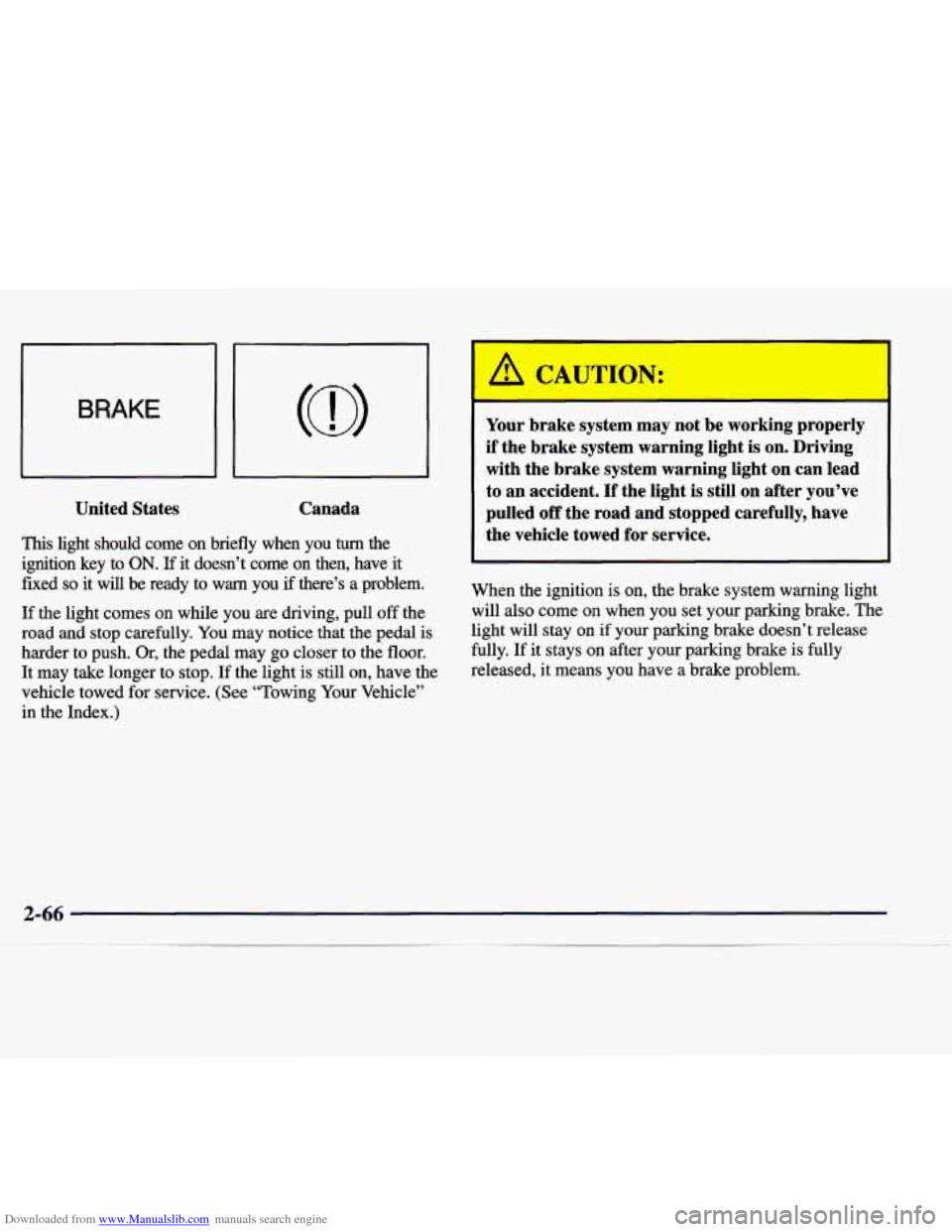
United States
Canada
This light should come on briefly when you turn the
ignition key to
ON. If it doesn’t come on then, have it
fixed so it will be ready to warn you if there’s a problem.
If the light comes on while you are driving, pull off the
road and stop carefully.
You may notice that the pedal is
harder to push. Or, the pedal may go closer to the floor.
It may take longer to stop.
If the light is still on, have the
vehicle towed for service. (See “Towing Your Vehicle”
in the Index.)
A CAUTIC-J:
Your brake system may not be working properly
if the brake system warning light is on. Driving
with the brake system warning light on can lead
to an accident. If the light is still on after you’ve
pulled
off the road and stopped carefully, have
the vehicle towed for service.
When the ignition
is on, the brake system warning light
will also come on when you set your parking brake. The
light will stay on if your parking brake doesn’t release
fully. If it stays on after your parking brake is fully
released, it means you have a brake problem.
Page 138 of 346
Downloaded from www.Manualslib.com manuals search engine Voltmeter
I6h
VOLTS
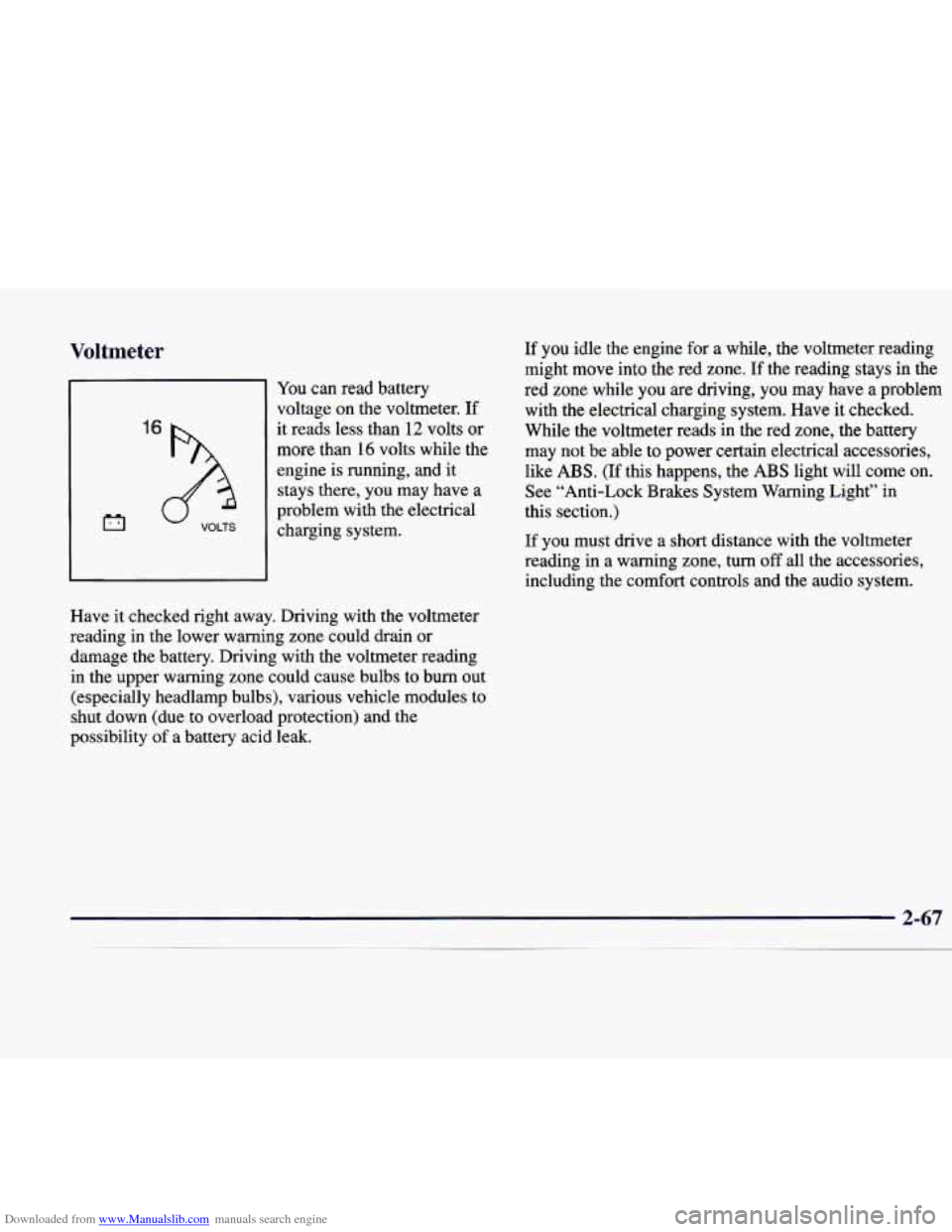
You can read battery
voltage on the voltmeter. If
it reads less than
12 volts or
more than 16 volts while the
engine
is running, and it
stays there, you may have a
problem with the electrical
charging system.
Have it checked right away. Driving with
the voltmeter
reading in the lower warning zone could drain
or
damage the battery. Driving with the voltmeter reading
in the upper warning zone could cause bulbs to burn out
(especially headlamp bulbs), various vehicle modules to
shut down (due to overload protection) and the
possibility
of a battery acid leak.
If you idle the engine for a while, the voltmeter reading
might move into the red zone. If the reading
stays in the
red zone while
you are driving, you may have a problem
with the electrical charging system. Have it checked.
While the voltmeter reads in the red zone, the battery
may not be able to power certain electrical accessories,
like ABS. (If this happens, the ABS light will come on.
See “Anti-Lock Brakes System Warning Light” in
this section.)
If you must drive a short distance with the voltmeter
reading in a warning zone, turn off all the accessories,
including the comfort controls and the audio system.
Page 139 of 346
Downloaded from www.Manualslib.com manuals search engine Anti-Lock Brake System Warning Light
ABS
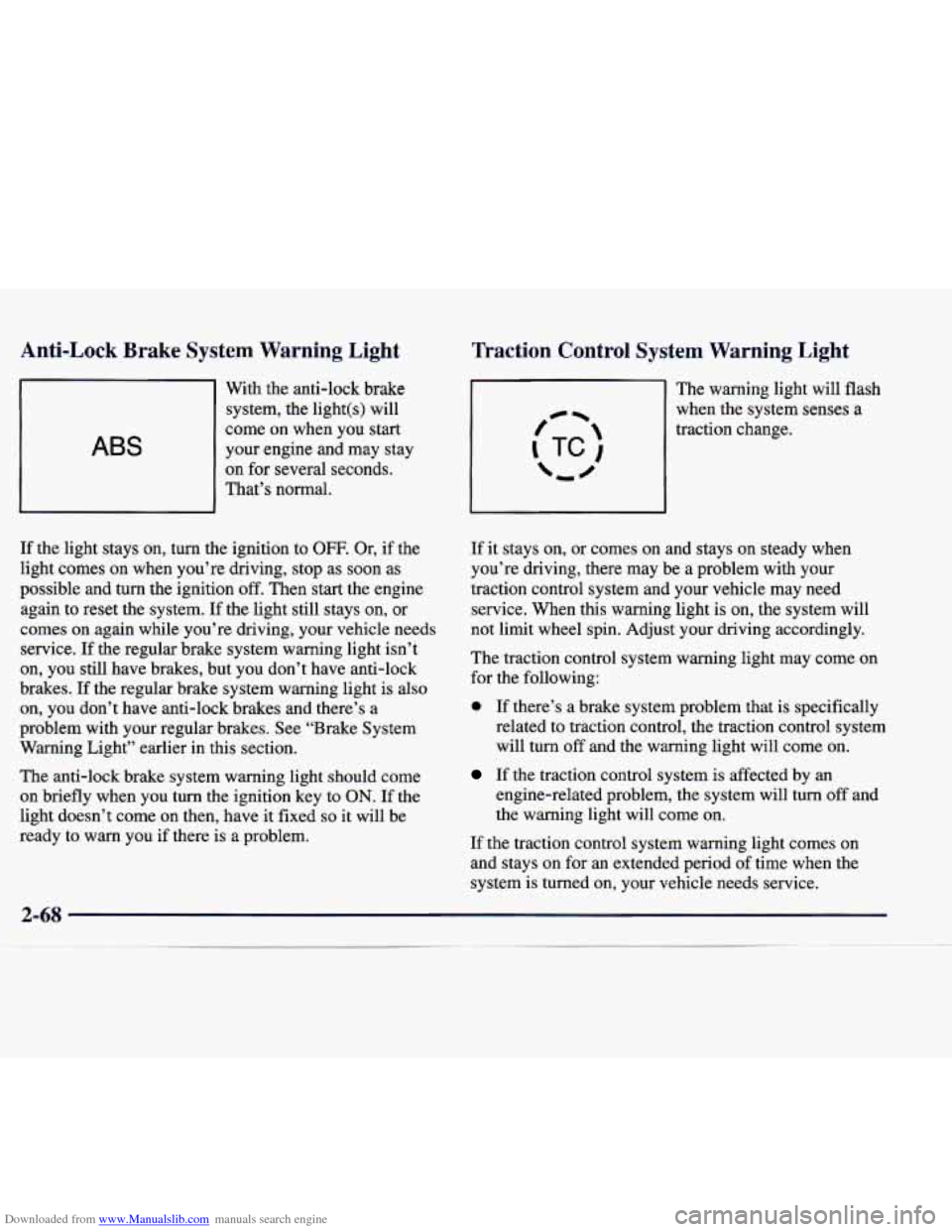
With the anti-lock brake system, the light(s) will
come on when you start
your engine and may stay
on for several seconds.
That’s normal.
Traction Control System Warning Light
The warning light will flash
when the system senses
a
traction change.
If the light stays on, turn the ignition to
OFF. Or, if the
light comes on when you’re driving, stop as soon as
possible and turn the ignition
off. Then start the engine
again to reset the system. If the light still stays on, or
comes on again while you’re driving, your vehicle needs
service.
If the regular brake system warning light isn’t
on, you still have brakes, but you don’t have anti-lock
brakes. If the regular brake system warning light is also
on, you don’t have anti-lock brakes and there’s a
problem with your regular brakes.
See “Brake System
Warning Light” earlier in this section.
The anti-lock brake system warning light should come
on briefly when you turn the ignition key to
ON. If the
light doesn’t come on then, have it fixed
so it will be
ready to warn you if there is a problem. If
it stays on,
or comes on and stays on steady when
you’re driving, there may be a problem with your
traction control system and your vehicle may need
service. When this warning light
is on, the system will
not limit wheel spin. Adjust your driving accordingly.
The traction control system warning light may come on
for the following:
0 If there’s a brake system problem that is specifically
related to traction control, the traction control system will turn off and the warning light will come on.
engine-related problem, the system will turn off and
the warning light will come on.
If the traction control system is affected by an
If the traction control system warning light comes on
and stays on for an extended period of time when the
system is turned on, your vehicle needs service.
Page 140 of 346
Downloaded from www.Manualslib.com manuals search engine Engine Coolant Temperature
Warning Light
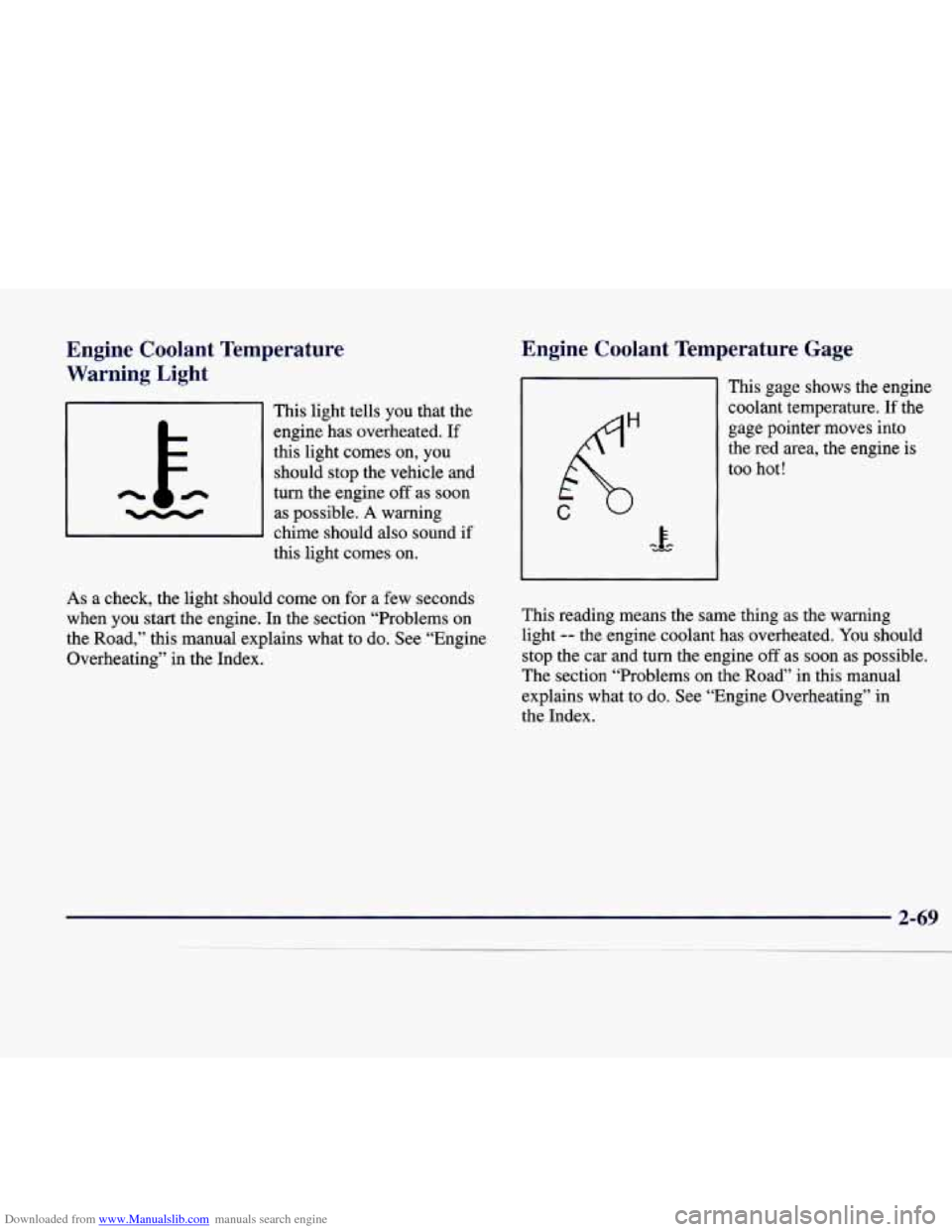
This light tells you that the
engine has overheated. If
this light comes on, you
should stop the vehicle and
turn the engine
off as soon
as possible.
A warning
chime should
also sound if
this light comes on.
Engine Coolant Temperature Gage
C gH
This gage shows the engine
coolant temperature.
If the
gage pointer moves into
the red area, the engine is
too hot!
As a check, the light should come on for a few seconds
when
you start the engine. In the section “Problems on
the Road,” this manual explains what to do. See “Engine
Overheating”
in the Index. This
reading means the same thing as the warning
light
-- the engine coolant has overheated. You should
stop the car and turn the engine off as soon as possible.
The section “Problems on the
Road” in this manual
explains what
to do. See “Engine Overheating” in
the Index.
Page 141 of 346
Downloaded from www.Manualslib.com manuals search engine Low Coolant Warning Light
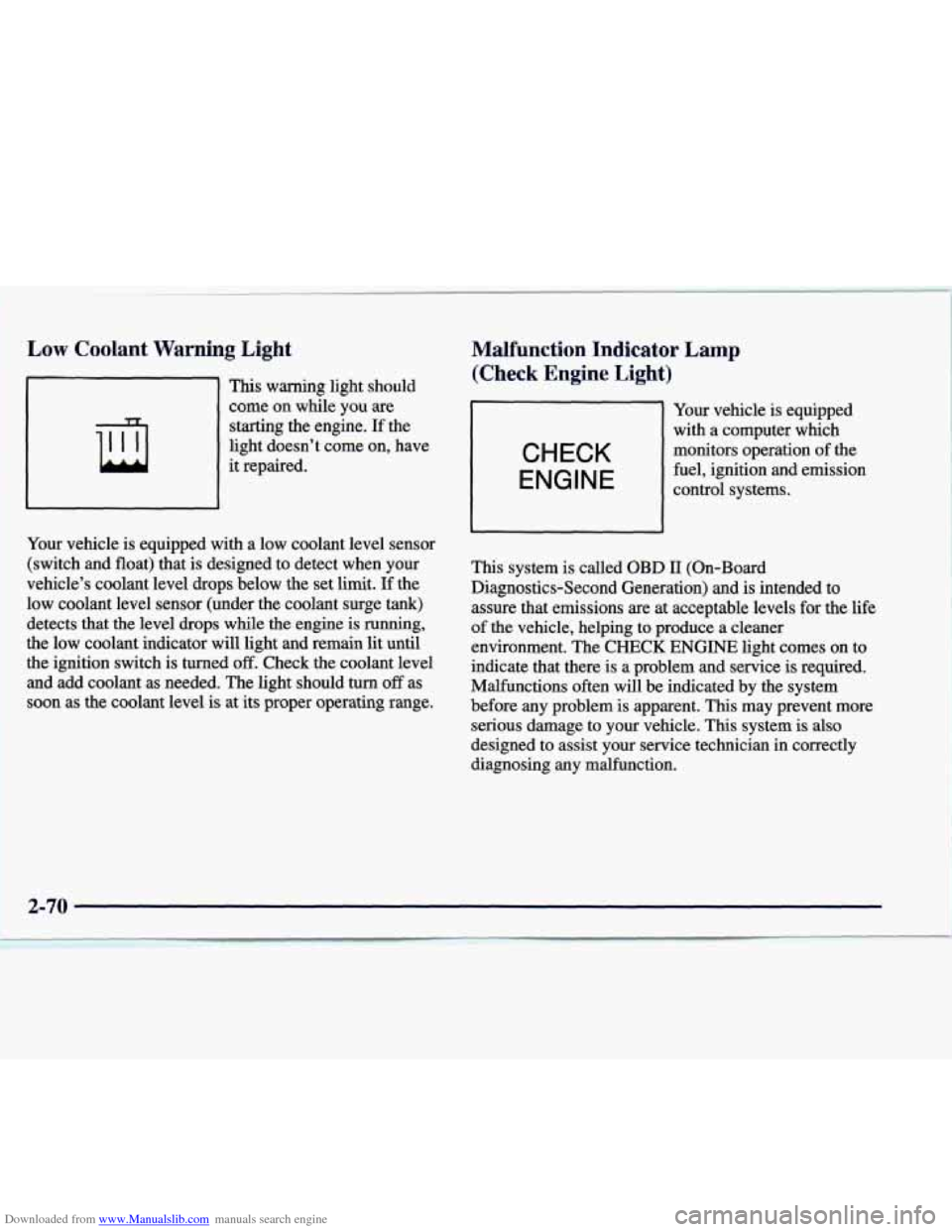
This warning light should
come on while
you are
starting the engine. If the
light doesn’t come on, have
it repaired.
I I
Your vehicle is equipped with a low coolant level sensor
(switch and float) that is designed to detect when your
vehicle’s coolant level drops below the set
limit. If the
low coolant level sensor (under the coolant surge tank)
detects that the level drops while the engine is running,
the low coolant indicator will light and remain lit until
the ignition switch
is turned off. Check the coolant level
and add coolant as needed.
The light should turn off as
soon as the coolant level
is at its proper operating range.
Malfunction Indicator Lamp
(Check Engine Light)
CHECK
ENGINE
Your vehicle is equipped
with a computer which
monitors operation
of the
fuel, ignition and emission
control systems.
This system is called OBD
11 (On-Board
Diagnostics-Second Generation) and is intended to assure that emissions are
at acceptable levels for the life
of the vehicle, helping to produce a cleaner
environment. The CHECK
ENGINE light comes on to
indicate that there is a problem and service
is required.
Malfunctions often will be indicated by the system
before any problem
is apparent. This may prevent more
serious damage to your vehicle. This system
is also
designed to assist your service technician in correctly
diagnosing
any malfunction.
2-70
I
Page 146 of 346
Downloaded from www.Manualslib.com manuals search engine Low Washer Fluid Warning Light
,- # -,
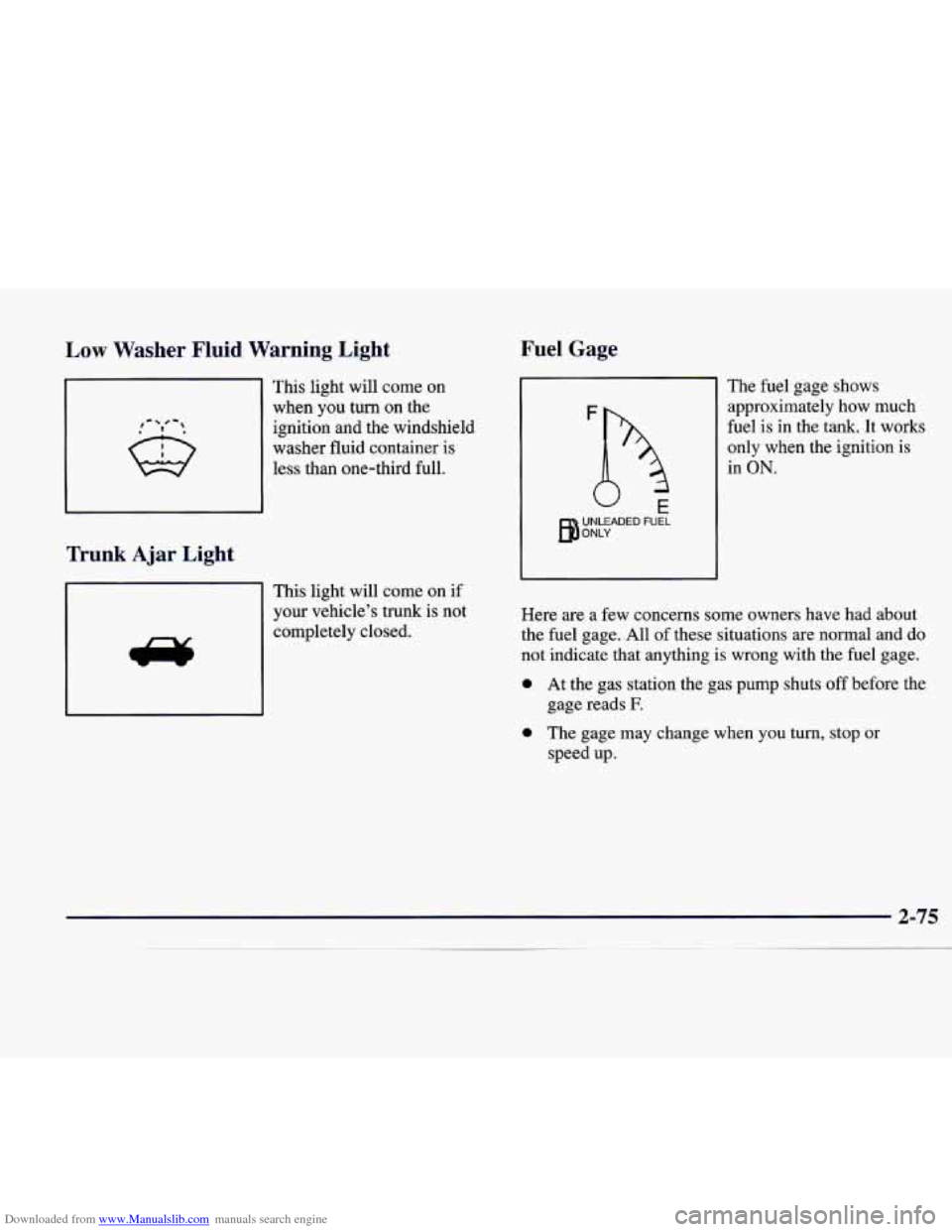
This light will come on
when you turn on the
ignition and the windshield
washer fluid container is
less than one-third full.
Trunk Ajar Light
This light will come on if
your vehicle’s trunk is not
completely closed.
Fuel Gage
The fuel gage shows
approximately how much
fuel is in the tank.
It works
only when the ignition
is
in ON.
Here are a few concerns some owners have had about
the fuel gage. All of these situations are normal and do
not indicate that anything
is wrong with the fuel gage.
0 At the gas station the gas pump shuts off before the
0 The gage may change when you turn, stop or
gage
reads
E
speed up.
2-75
Page 147 of 346
Downloaded from www.Manualslib.com manuals search engine Low Fuel Light
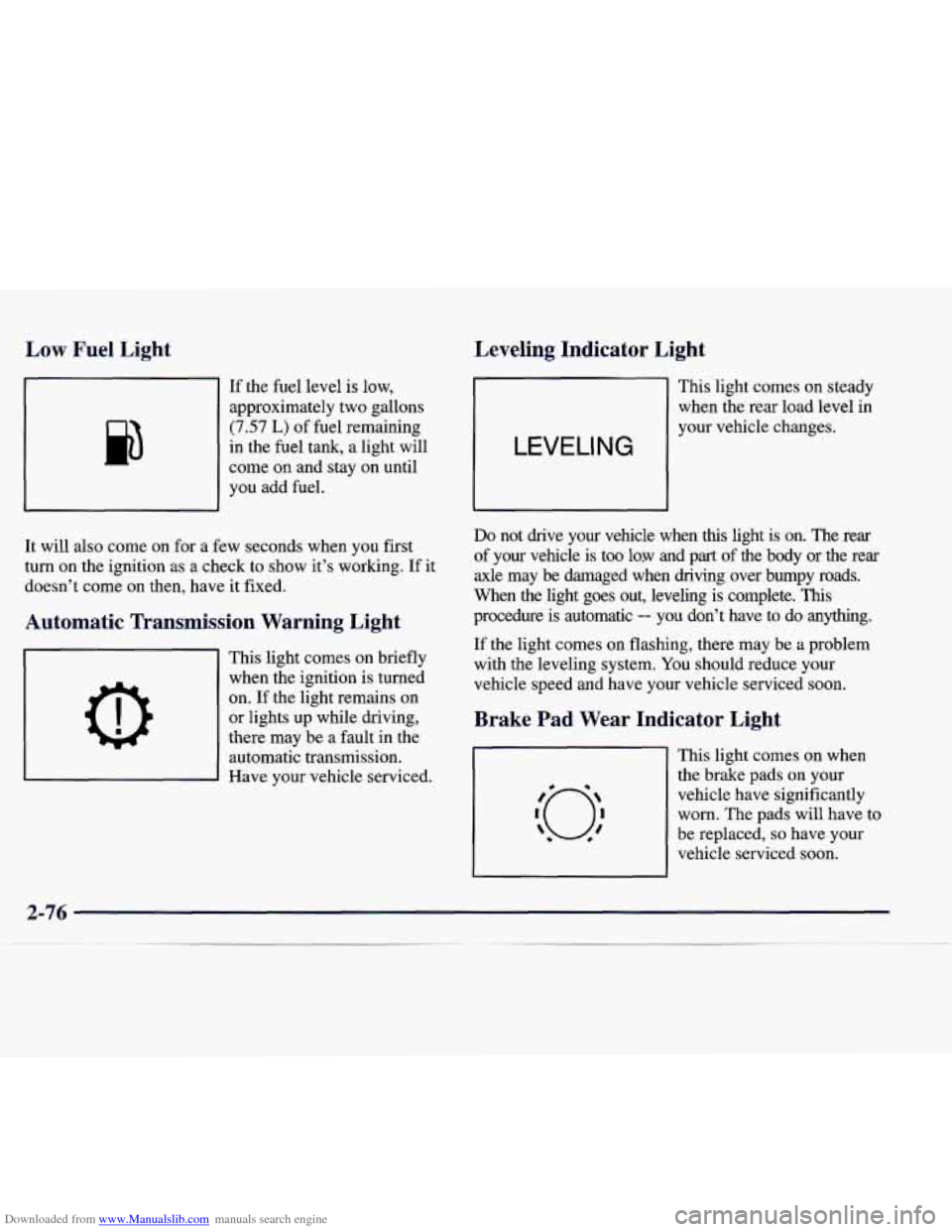
If the fuel level is low,
approximately two gallons
(7.57 L) of fuel remaining
in the fuel tank, a light will
come
on and stay on until
you add fuel.
It will also come on for a few seconds when
you first
turn on the ignition as a check to show it’s working. If
it
doesn’t come on then, have it fixed.
Automatic Transmission Warning Light
0
This light comes on briefly
when the ignition
is turned
on. If the light remains on
or lights up while driving,
there may be a fault in the
automatic transmission.
Have your vehicle serviced.
Leveling Indicator Light
LEVELING
This light comes on steady
when the rear load level in
your vehicle changes.
Do not drive your vehicle when this light is on. The rear
of your vehicle is too low and part of the body or the rear
axle may be damaged when driving over bumpy roads.
When the light goes out, leveling is complete.
This
procedure is automatic -- you don’t have to do anytlmng.
If the light comes on flashing, there may be a problem
with the leveling system. You should reduce your
vehicle speed and have your vehicle serviced soon.
Brake Pad Wear Indicator Light
This light comes on when
the brake pads
on your
vehicle have significantly
worn. The pads will have to
be replaced,
so have your
vehicle serviced soon.
Page 186 of 346
Downloaded from www.Manualslib.com manuals search engine Avoid needless heavy braking. Some people drive
in spurts
-- heavy acceleration followed by heavy
braking
-- rather than keeping pace with traffic. This
is a mistake. Your brakes may not have time to cool
between hard stops. Your brakes will wear out much
faster if you do
a lot of heavy braking. If you keep pace
with the traffic and allow realistic following distances,
you will eliminate a lot of unnecessary braking. That
means better braking and longer brake life.
If your engine ever stops while you’re driving, brake
normally but don’t pump your brakes. If you do, the
pedal may get harder to push down. If your engine
stops, you will still have some power brake assist. But
you will use it when you brake. Once the power assist
is used up, it may take longer to stop and the brake
pedal will be harder to push.
Anti-Lock Brakes (ABS)
Your vehicle has anti-lock brakes (ABS). ABS is an
advanced electronic braking system that will help
prevent a braking skid.
When you start your engine and begin
to drive away,
your anti-lock brake system will check itself. You may
hear a momentary motor or clicking noise while this test
is going on, and you may even notice that your brake
pedal moves a little. This is normal.
ABS
If there’s a problem with
the anti-lock brake system,
this warning light will stay on. See “Anti-Lock Brake
System Warning Light” in
the Index.
Page 188 of 346
Downloaded from www.Manualslib.com manuals search engine Using Anti-Lock
Don’t pump the brakes. Just hold the brake pedal down
firmly and let anti-lock work for you. You may hear the
anti-lock pump or motor operate, and feel the brake
pedal pulsate, but this
is normal.
Traction Control System
Your vehicle has a traction control system that limits
wheel spin. This is especially useful in slippery road
conditions. The system operates only
if it senses that
one or both
of the rear wheels are spinning or beginning
to lose traction. When this happens, the system brakes
the spinning wheel and/or reduces engine power to
limit wheel spin.
You may feel or hear the system working, but this is normal.
This warning light will
come on to let you know if
there’s a problem with your traction control system.
See “Traction Control System Warning Light” in the
Index. When this warning light is on, the system will
not
limit wheel spin. Adjust your driving accordingly. The
traction control system automatically comes
on
whenever you start your vehicle. To limit wheel spin,
especially in slippery road conditions, you should
always leave the system on. But you can turn the
traction control system off if you ever need to.
(You
should turn the system off if your vehicle ever gets
stuck in sand, mud, ice or snow. See “Rocking Your
Vehicle” in the Index.)
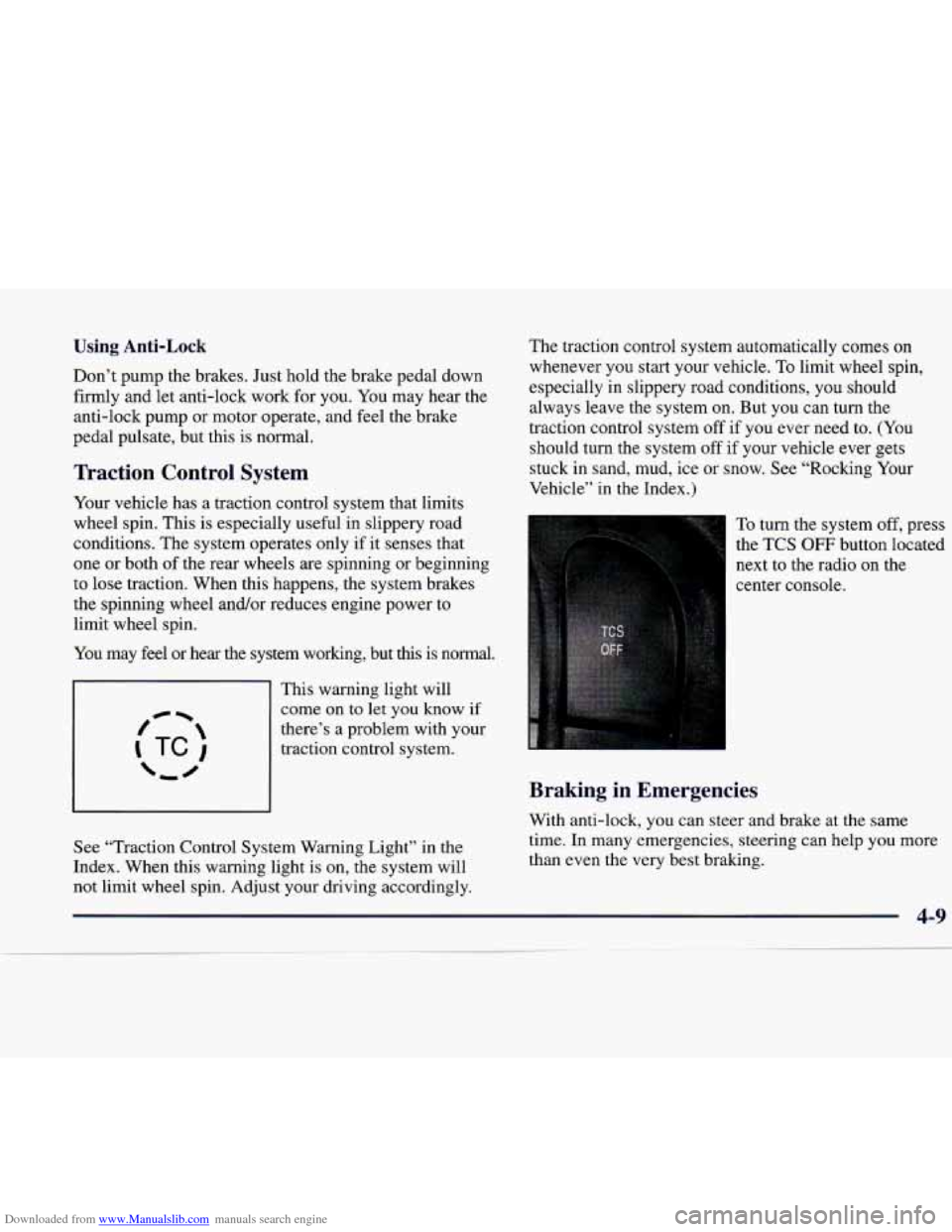
To turn the system off, press the TCS
OFF button located
next to the radio on the
center console.
Braking in Emergencies
With anti-lock, you can steer and brake at the same
time. In many emergencies, steering can help you more
than even the very best braking.
4-9
Page 198 of 346
Downloaded from www.Manualslib.com manuals search engine City Driving
1
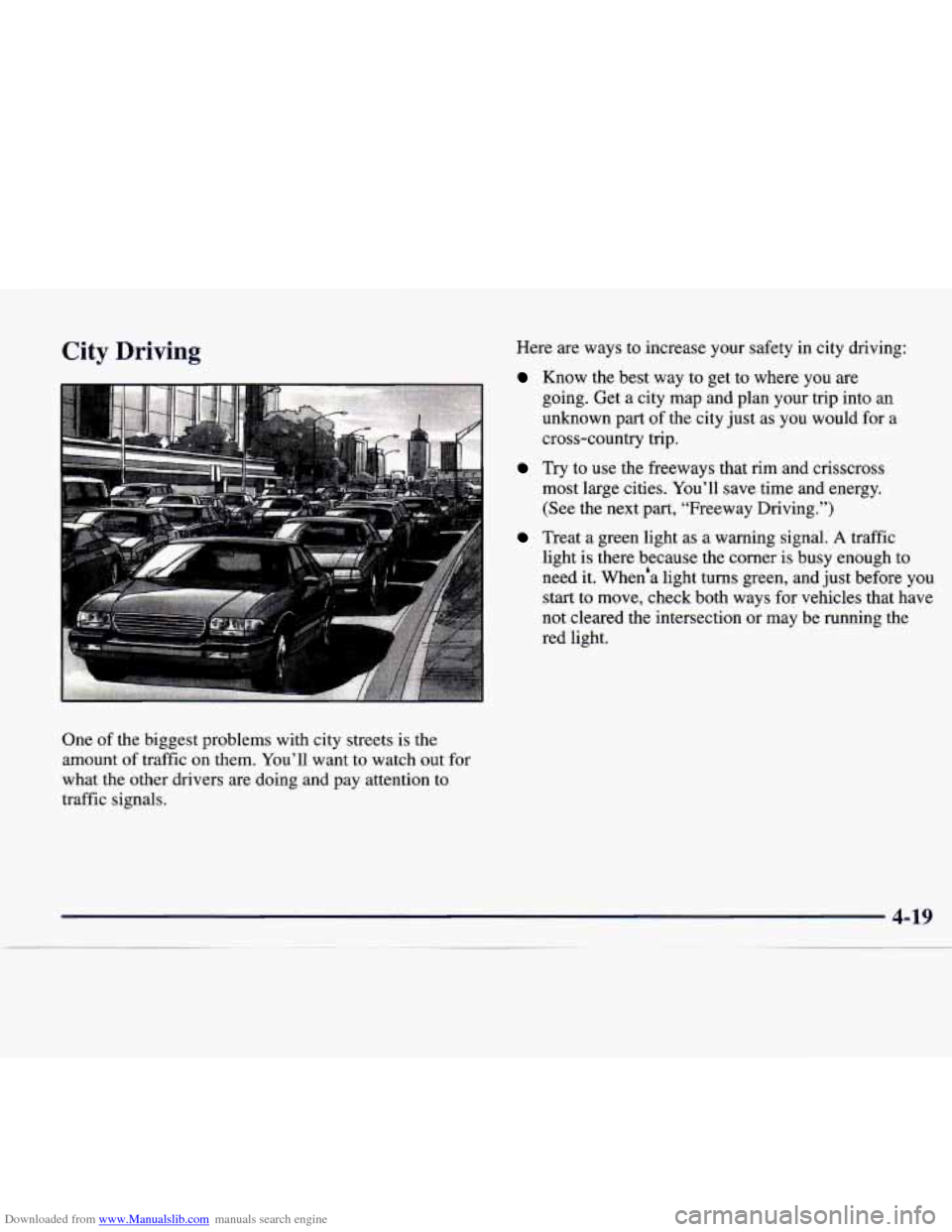
One of the biggest problems with city streets is the
amount of traffic on them. You’ll want to watch out for
what the other drivers are doing and pay attention to
traffic signals. Here
are ways to increase your safety in city driving:
Know
the best way to get to where you are
going. Get
a city map and plan your trip into an
unknown part of the city just as you would for a
cross-country trip.
Try to use the freeways that rim and crisscross most large cities. You’ll save time and energy.
(See the next part, “Freeway Driving.”)
Treat a green light as a warning signal. A traffic
light is there because the corner is busy enough to
need it. When’a light turns green, and just before you
start to move, check both ways for vehicles that have
not cleared the intersection or may be running the
red light.