battery CADILLAC CT4 2022 Owner's Guide
[x] Cancel search | Manufacturer: CADILLAC, Model Year: 2022, Model line: CT4, Model: CADILLAC CT4 2022Pages: 464, PDF Size: 7.82 MB
Page 322 of 464

Cadillac CT4 Owner Manual (GMNA-Localizing-U.S./Canada-15283641) -
2022 - CRC - 10/12/21
DRIVING AND OPERATING 321
Turn Signals When Towing a
Trailer
When properly connected, the trailer
turn signals will illuminate to indicate
the vehicle is turning, changing lanes,
or stopping. When towing a trailer,
the arrows on the instrument cluster
will illuminate even if the trailer is not
properly connected or the bulbs are
burned out.
Conversions and
Add-Ons
Add-On Electrical
Equipment
{Warning
The Data Link Connector (DLC) is
used for vehicle service and
Emission Inspection/Maintenance
testing. SeeMalfunction Indicator
Lamp (Check Engine Light) 099.
A device connected to the DLC —
such as an aftermarket fleet or
driver-behavior tracking device —
(Continued)
Warning (Continued)
may interfere with vehicle systems.
This could affect vehicle operation
and cause a crash. Such devices
may also access information stored
in the vehicle’s systems.
Caution
Some electrical equipment can
damage the vehicle or cause
components to not work and would
not be covered by the vehicle
warranty. Always check with your
dealer before adding electrical
equipment.
Add-on equipment can drain the
vehicle's 12-volt battery, even if the
vehicle is not operating.
The vehicle has an airbag system.
Before attempting to add anything
electrical to the vehicle, see Servicing
the Airbag-Equipped Vehicle 058 and
Adding Equipment to the
Airbag-Equipped Vehicle 058.
Page 323 of 464

Cadillac CT4 Owner Manual (GMNA-Localizing-U.S./Canada-15283641) -
2022 - CRC - 10/12/21
322 VEHICLE CARE
Vehicle Care
General Information
General Information . . . . . . . . . . . . . 323
California Perchlorate MaterialsRequirements . . . . . . . . . . . . . . . . . . . 323
Accessories and Modifications . . . . . . . . . . . . . . . . . . . 323
Vehicle Checks
Doing Your OwnService Work . . . . . . . . . . . . . . . . . . . . 324
Hood . . . . . . . . . . . . . . . . . . . . . . . . . . . . . . 324
Engine Compartment Overview . . . . . . . . . . . . . . . . . . . . . . . . . 326
Engine Oil . . . . . . . . . . . . . . . . . . . . . . . . . 331
Engine Oil Life System . . . . . . . . . . . 333
Automatic Transmission Fluid . . . . . . . . . . . . . . . . . . . . . . . . . . . . . 334
Manual Transmission Fluid . . . . . 335
Hydraulic Clutch . . . . . . . . . . . . . . . . . 335
Engine Air Filter Life System . . . . 335
Engine Air Cleaner/Filter . . . . . . . . . 336
Cooling System . . . . . . . . . . . . . . . . . . . 338
Engine Overheating . . . . . . . . . . . . . . 342
Washer Fluid . . . . . . . . . . . . . . . . . . . . . 343
Brakes . . . . . . . . . . . . . . . . . . . . . . . . . . . . . 344 Brake Pad Life System (If
Equipped) . . . . . . . . . . . . . . . . . . . . . . . 346
Brake Fluid . . . . . . . . . . . . . . . . . . . . . . . 348
Battery - North America . . . . . . . . . 349
All-Wheel Drive . . . . . . . . . . . . . . . . . . 349
Park Brake and P (Park) Mechanism Check . . . . . . . . . . . . . . 350
Wiper Blade Replacement . . . . . . . 350
Windshield Replacement . . . . . . . . 351
Gas Strut(s) . . . . . . . . . . . . . . . . . . . . . . . 351Headlamp Aiming
Front Headlamp Aiming . . . . . . . . . 352
Bulb Replacement
Bulb Replacement . . . . . . . . . . . . . . . . 352
Halogen Bulbs . . . . . . . . . . . . . . . . . . . . 352
High Intensity Discharge (HID) Lighting . . . . . . . . . . . . . . . . . . . . . . . . . 352
LED Lighting . . . . . . . . . . . . . . . . . . . . . 353
Front Turn Signal Lamps . . . . . . . . 353
Electrical System
Electrical System Overload . . . . . . 353
Fuses and Circuit Breakers . . . . . . 355
Engine Compartment Fuse Block . . . . . . . . . . . . . . . . . . . . . . . . . . . . 356
Instrument Panel Fuse Block . . . . 358
Rear Compartment Fuse Block . . . . . . . . . . . . . . . . . . . . . . . . . . . . 361
Wheels and Tires
Tires . . . . . . . . . . . . . . . . . . . . . . . . . . . . . . . 363
All-Season Tires . . . . . . . . . . . . . . . . . . 363
Winter Tires . . . . . . . . . . . . . . . . . . . . . . 364
Run-Flat Tires . . . . . . . . . . . . . . . . . . . . 364
Self-Sealing Tires . . . . . . . . . . . . . . . . . 365
Low-Profile Tires . . . . . . . . . . . . . . . . . 365
Summer Tires . . . . . . . . . . . . . . . . . . . . 365
Tire Sidewall Labeling . . . . . . . . . . . 366
Tire Designations . . . . . . . . . . . . . . . . . 367
Tire Terminology andDefinitions . . . . . . . . . . . . . . . . . . . . . . 368
Tire Pressure . . . . . . . . . . . . . . . . . . . . . . 370
Tire Pressure for High-Speed Operation . . . . . . . . . . . . . . . . . . . . . . . . 371
Tire Pressure Monitor System . . . 372
Tire Pressure Monitor Operation . . . . . . . . . . . . . . . . . . . . . . . . 373
Tire Inspection . . . . . . . . . . . . . . . . . . . 376
Tire Rotation . . . . . . . . . . . . . . . . . . . . . 376
When It Is Time for New Tires . . . . . . . . . . . . . . . . . . . . . . . . . . . . . 378
Buying New Tires . . . . . . . . . . . . . . . . 379
Different Size Tires and Wheels . . . . . . . . . . . . . . . . . . . . . . . . . . 380
Uniform Tire Quality Grading . . . 380
Wheel Alignment and Tire Balance . . . . . . . . . . . . . . . . . . . . . . . . . . 382
Wheel Replacement . . . . . . . . . . . . . . 382
Tire Chains . . . . . . . . . . . . . . . . . . . . . . . 383
Page 328 of 464

Cadillac CT4 Owner Manual (GMNA-Localizing-U.S./Canada-15283641) -
2022 - CRC - 10/12/21
VEHICLE CARE 327
1. Windshield Washer Fluid Reservoir.See Washer Fluid 0343.
2. Engine Coolant Surge Tank and Pressure Cap. See Cooling System
0 338.
3. Engine Air Cleaner/Filter 0336.
4. Engine Cooling Fan (Out of View). See Cooling System 0338.
5. Engine Oil Fill Cap. See Engine Oil
0 331.
6. Engine Oil Dipstick. See Engine Oil
0 331.
7. Remote Positive (+) Battery Terminal. See Jump Starting - North
America 0390.
8. Brake Fluid Reservoir. See Brake
Fluid 0348.
9. Remote Negative (-) Battery Terminal. See Jump Starting - North
America 0390.
10. Engine Compartment Fuse Block
0356.
Page 330 of 464

Cadillac CT4 Owner Manual (GMNA-Localizing-U.S./Canada-15283641) -
2022 - CRC - 10/12/21
VEHICLE CARE 329
1. Windshield Washer Fluid Reservoir.See Washer Fluid 0343.
2. Engine Coolant Surge Tank and Pressure Cap. See Cooling System
0 338.
3. Engine Air Cleaner/Filter 0336.
4. Engine Cooling Fan (Out of View). See Cooling System 0338.
5. Engine Oil Fill Cap. See Engine Oil
0 331.
6. Cooling System Air Bleeder Cap. See Cooling System 0338.
7. Engine Oil Dipstick. See Engine Oil
0 331.
8. Remote Positive (+) Battery Terminal. See Jump Starting - North
America 0390.
9. Brake Fluid Reservoir. See Brake
Fluid 0348.
10. Remote Negative (-) Battery Terminal. See Jump Starting - North
America 0390.
11. Engine Compartment Fuse Block. SeeEngine Compartment Fuse Block
0356.
Page 332 of 464
Cadillac CT4 Owner Manual (GMNA-Localizing-U.S./Canada-15283641) -
2022 - CRC - 10/12/21
VEHICLE CARE 331
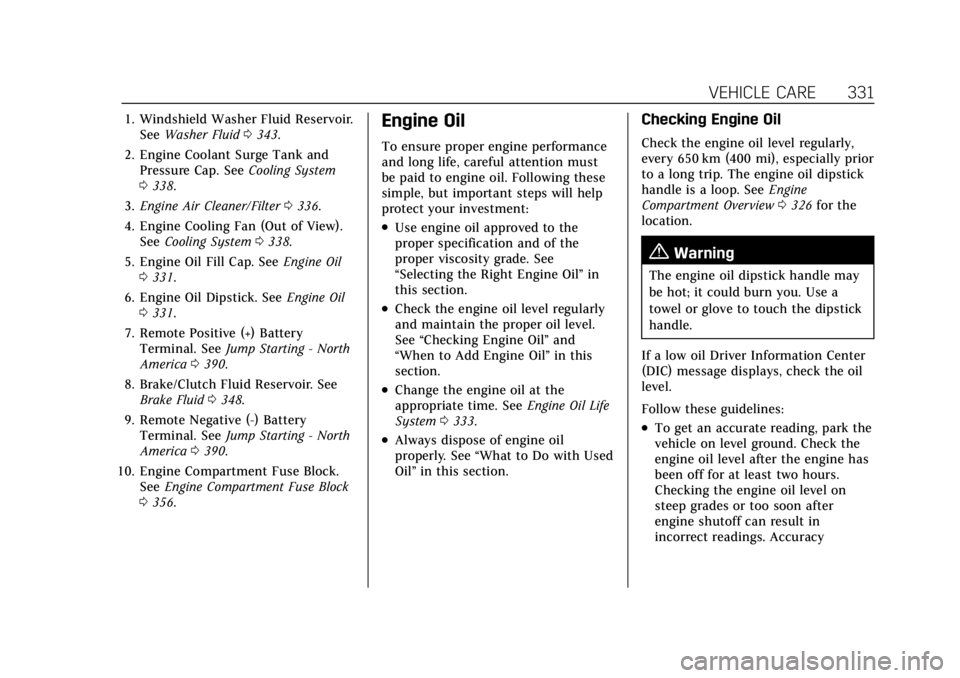
1. Windshield Washer Fluid Reservoir.See Washer Fluid 0343.
2. Engine Coolant Surge Tank and Pressure Cap. See Cooling System
0 338.
3. Engine Air Cleaner/Filter 0336.
4. Engine Cooling Fan (Out of View). See Cooling System 0338.
5. Engine Oil Fill Cap. See Engine Oil
0 331.
6. Engine Oil Dipstick. See Engine Oil
0 331.
7. Remote Positive (+) Battery Terminal. See Jump Starting - North
America 0390.
8. Brake/Clutch Fluid Reservoir. See Brake Fluid 0348.
9. Remote Negative (-) Battery Terminal. See Jump Starting - North
America 0390.
10. Engine Compartment Fuse Block. See Engine Compartment Fuse Block
0 356.Engine Oil
To ensure proper engine performance
and long life, careful attention must
be paid to engine oil. Following these
simple, but important steps will help
protect your investment:
.Use engine oil approved to the
proper specification and of the
proper viscosity grade. See
“Selecting the Right Engine Oil” in
this section.
.Check the engine oil level regularly
and maintain the proper oil level.
See “Checking Engine Oil” and
“When to Add Engine Oil” in this
section.
.Change the engine oil at the
appropriate time. See Engine Oil Life
System 0333.
.Always dispose of engine oil
properly. See “What to Do with Used
Oil” in this section.
Checking Engine Oil
Check the engine oil level regularly,
every 650 km (400 mi), especially prior
to a long trip. The engine oil dipstick
handle is a loop. See Engine
Compartment Overview 0326 for the
location.
{Warning
The engine oil dipstick handle may
be hot; it could burn you. Use a
towel or glove to touch the dipstick
handle.
If a low oil Driver Information Center
(DIC) message displays, check the oil
level.
Follow these guidelines:
.To get an accurate reading, park the
vehicle on level ground. Check the
engine oil level after the engine has
been off for at least two hours.
Checking the engine oil level on
steep grades or too soon after
engine shutoff can result in
incorrect readings. Accuracy
Page 342 of 464

Cadillac CT4 Owner Manual (GMNA-Localizing-U.S./Canada-15283641) -
2022 - CRC - 10/12/21
VEHICLE CARE 341
surge tank, but be sure the cooling
system, including the coolant surge
tank pressure cap, is cool before you
do it.
2.0L L4 Engine and 3.6L
V6 Engine
Automatic Coolant Service Fill
Instructions
The vehicle is equipped with a service
feature that assists with filling and
removing air from the cooling system
after service of components or when
coolant is added after being to low.To use this feature:1. With a cold system, add coolant to
the indicated line on the
surge tank.
2. Replace the pressure cap on the surge tank.
3. Activate the service feature: 3.1. Connect the vehicle to a battery charger.
3.2. Turn the ignition to Service Mode. See Ignition Positions
0 232.
3.3. Turn off the air conditioning.
3.4. Set the parking brake. 3.5. At the same time, press the
accelerator and the brake
pedal for two seconds, then
release.
3.6. At the end of the cycle, check the coolant level in the surge
tank and add coolant if it is
below the indicated line. Turn
the ignition off, allow the
Electronic Control Module
(ECM) to go to sleep, about
two minutes, and repeat
Steps 3.2 –3.6.
Listen for pump activation and
movement of the control valves while
watching the level of the coolant in
the surge tank. If the tank empties,
turn the ignition off, carefully remove
the pressure cap, refill to the indicated
line, replace the pressure cap, and
repeat steps 3.2 –3.6.
The fill and air removal process will
run for approximately 15 minutes.
Page 343 of 464
Cadillac CT4 Owner Manual (GMNA-Localizing-U.S./Canada-15283641) -
2022 - CRC - 10/12/21
342 VEHICLE CARE
Caution
If the pressure cap is not tightly
installed, coolant loss and engine
damage may occur. Be sure the cap
is properly and tightly secured.
2.7L L4 Engine
Automatic Coolant Service Fill
Instructions
The vehicle is equipped with a service
feature that assists with filling and
removing air from the cooling system
after service of components or when
coolant is added after being to low.
To use this feature:1. With a cold system unscrew the cooling system air bleeder cap.
If coolant can be seen through the
bleeder move to Step 3.
2. Add coolant through the surge tank until it is visible through the air
bleeder.
3. Replace the cooling system air bleeder cap.
4. Add coolant to the indicated line on the surge tank. 5. Replace the pressure cap on the
surge tank.
6. Activate the service feature: 6.1. Connect the vehicle to a battery charger.
6.2. Turn the ignition to Service Mode. See Ignition Positions
0 232.
6.3. Turn off the air conditioning.
6.4. Set the parking brake.
6.5. At the same time, press the accelerator and the brake
pedal for two seconds, then
release.
6.6. At the end of the cycle, check the coolant level in the surge
tank and add coolant if it is
below the indicated line. Turn
the ignition off, carefully
remove the pressure cap, refill
to the indicated line, replace
the pressure cap, and repeat
steps 6.2 –6.6.
Listen for pump activation and
movement of the control valves while
watching the level of the coolant in
the surge tank. If the tank empties,
turn the ignition off, carefully remove the pressure cap, refill to the indicated
line, replace the pressure cap, and
repeat steps 6.2
–6.6.
The fill and air removal process will
run for approximately 15 minutes.
Caution
If the pressure cap is not tightly
installed, coolant loss and engine
damage may occur. Be sure the cap
is properly and tightly secured.
Engine Overheating
The vehicle has an indicator to warn
of the engine overheating.
If the decision is made not to lift the
hood when this warning appears, get
service help right away. See Roadside
Service 0432.
If the decision is made to lift the
hood, make sure the vehicle is parked
on a level surface.
Then check to see if the engine
cooling fan is running. If the engine is
overheating, the fan should be
Page 350 of 464

Cadillac CT4 Owner Manual (GMNA-Localizing-U.S./Canada-15283641) -
2022 - CRC - 10/12/21
VEHICLE CARE 349
Caution
If brake fluid is spilled on the
vehicle's painted surfaces, the paint
finish can be damaged. Immediately
wash off any painted surface.
Battery - North America
The original equipment battery is
maintenance free. Do not remove the
cap and do not add fluid.
Refer to the replacement number
shown on the original battery label
when a new battery is needed.
The vehicle has an Absorbed Glass
Mat (AGM) 12-volt battery.
Installation of a standard 12-volt
battery will result in reduced 12-volt
battery life.
When using a 12-volt battery charger
on the 12-volt AGM battery, some
chargers have an AGM battery setting
on the charger. If available, use the
AGM setting on the charger, to limit
charge voltage to 14.8 volts. Follow
the charger manufacturer's
instructions.Stop/Start System
This vehicle has a Stop/Start system
to shut off the engine to help
conserve fuel. See
Stop/Start System
0 235.
{Warning
WARNING: Battery posts,
terminals and related accessories
can expose you to chemicals
including lead and lead compounds,
which are known to the State of
California to cause cancer and birth
defects or other reproductive harm.
Wash hands after handling. For
more information go to
www.P65Warnings.ca.gov.
See the warning on the back cover.
Vehicle Storage
{Warning
Batteries have acid that can burn
you and gas that can explode. You
can be badly hurt if you are not (Continued)
Warning (Continued)
careful. SeeJump Starting - North
America 0390 for tips on working
around a battery without
getting hurt.
Infrequent Usage: Remove the black,
negative (−) cable from the battery to
keep the battery from running down.
Extended Storage: Remove the black,
negative (−) cable from the battery or
use a battery trickle charger.
All-Wheel Drive
If the vehicle is equipped with
All-Wheel-Drive (AWD), this is an
additional system that needs
lubrication.
Transfer Case
Under normal driving conditions,
transfer case fluid does not require
maintenance unless there is a fluid
leak or unusual noise. If required,
have the transfer case serviced by
your dealer.
Page 358 of 464

Cadillac CT4 Owner Manual (GMNA-Localizing-U.S./Canada-15283641) -
2022 - CRC - 10/12/21
VEHICLE CARE 357
FusesUsage
13 Front Wiper
14 Exterior Lighting Module 6
15 Exterior Lighting Module 1
16 Exterior Lighting Module 5
17 Exterior Lighting Module 3
18 Aero Shutter
19 –
20 –
21 Virtual Key System/ Power Sounder
Module
22 Engine Control Module Battery
23 Transmission Control Module
24 Active Engine Mount
25 –
26 Engine Control Module Fuses
Usage
27 Injectors/Ignition 2
28 Charged Air Cooler
29 Transmission Aux Oil Pump/Transmission
Reverse Lock Out
30 Injectors/Ignition 1
31 Emissions 1
32 Emissions 2
33 Starter Solenoid
34 –
35 –
36 Starter Pinion
37 AC Clutch
38 –
39 –
40 –
41 –
42 Water Pump
43 –
44 – Relays
Usage
47 –
48 Front Wiper Speed
49 Front Wiper Control
51 –
52 Engine Control Module
53 Starter Solenoid
54 Starter Pinion
55 –
57 AC Clutch
58 –
Page 377 of 464

Cadillac CT4 Owner Manual (GMNA-Localizing-U.S./Canada-15283641) -
2022 - CRC - 10/12/21
376 VEHICLE CARE
If the hazard warning flashers are on,
the tire fill alert visual feedback will
not work properly.
The TPMS will not activate the tire fill
alert properly under the following
conditions:
.There is interference from an
external device or transmitter.
.The air pressure from the inflation
device is not sufficient to inflate
the tire.
.There is a malfunction in the TPMS.
.There is a malfunction in the horn
or turn signal lamps.
.The identification code of the TPMS
sensor is not registered to the
system.
.The battery of the TPMS sensor
is low.
If the tire fill alert does not operate
due to TPMS interference, move the
vehicle about 1 m (3 ft) back or
forward and try again. If the tire fill
alert feature is not working, use a tire
pressure gauge.
TPMS Sensor Matching Process
— Auto Learn Function
Each TPMS sensor has a unique
identification code. The identification
code needs to be matched to a new
tire/wheel position after rotating the
tires or replacing one or more of the
TPMS sensors. When a tire is
installed, the vehicle must be
stationary for about 20 minutes before
the system recalculates. The following
relearn process takes up to
10 minutes, driving at a minimum
speed of 20 km/h (12 mph). A dash (-)
or pressure value will display in the
DIC. See Driver Information Center
(DIC) (Base Level) 0109 or
Driver Information Center (DIC)
(Uplevel) 0112. A warning message
displays in the DIC if a problem
occurs during the relearn process.
Tire Inspection
We recommend that the tires,
including the spare tire, if the
vehicle has one, be inspected for
signs of wear or damage at least
once a month. Replace the tire if:
.The indicators at three or more
places around the tire can
be seen.
.There is cord or fabric showing
through the tire's rubber.
.The tread or sidewall is cracked,
cut, or snagged deep enough to
show cord or fabric.
.The tire has a bump, bulge,
or split.
.The tire has a puncture, cut,
or other damage that cannot be
repaired well because of the size
or location of the damage.
Tire Rotation
Tires should be rotated every
12 000 km (7,500 mi). See
Maintenance Schedule
0408.
Tires are rotated to achieve a
more uniform wear for all tires.
The first rotation is the most
important.