brake CADILLAC CT4 2023 Owners Manual
[x] Cancel search | Manufacturer: CADILLAC, Model Year: 2023, Model line: CT4, Model: CADILLAC CT4 2023Pages: 524, PDF Size: 6.98 MB
Page 438 of 524

Cadillac CT4 Owner Manual (GMNA-Localizing-U.S./Canada-16500442) -
2023 - CRC - 5/4/22
Vehicle Care 437
Tire Chains
{Warning
If the vehicle has
235/40R18, 235/35R19,
255/35ZR18, or
275/35ZR18 size tires, do
not use tire chains. There is
not enough clearance. Tire
chains used on a vehicle
without the proper amount
of clearance can cause
damage to the brakes,
suspension, or other vehicle
parts. The area damaged by
the tire chains could cause
loss of control and a crash.
Use another type of traction
device only if its
manufacturer recommends
it for the vehicle's tire size
combination and road
conditions. Follow that
manufacturer's instructions.
To avoid vehicle damage,
drive slow and readjust or
remove the traction device if(Continued)
Warning (Continued)
it contacts the vehicle. Do
not spin the wheels.
If traction devices are used,
install them on the rear tires.
Caution
If the vehicle is equipped
with a tire size other than
235/40R18, 235/35R19,
255/35ZR18, or
275/35ZR18, use tire chains
only where legal and only
when necessary. Use low
profile chains that add no
more than 12 mm thickness
to the tire tread and inner
sidewall. Use chains that are
the proper size for the tires.
Install them on the tires of
the rear axle. Don't use
chains on the tires of the
front axle. Tighten them as
tightly as possible with the
ends securely fastened.
Drive slowly and follow the(Continued)
Caution (Continued)
chain manufacturer's
instructions. If the chains
contact the vehicle, stop and
retighten them. If the
contact continues, slow
down until it stops. Driving
too fast or spinning the
wheels with chains on will
damage the vehicle.
If a Tire Goes Flat
It is unusual for a tire to blow
out while driving, especially if
the tires are maintained
properly. If air goes out of a
tire, it is much more likely to
leak out slowly. See Tires
0413 for additional
information. But if there ever
is a blowout, here are a few
tips about what to expect and
what to do:
If a front tire fails, the flat tire
creates a drag that pulls the
vehicle toward that side. Take
your foot off the accelerator
pedal and grip the steering
Page 439 of 524

Cadillac CT4 Owner Manual (GMNA-Localizing-U.S./Canada-16500442) -
2023 - CRC - 5/4/22
438 Vehicle Care
wheel firmly. Steer to maintain
lane position, and then gently
brake to a stop, well off the
road, if possible.
A rear blowout, particularly on
a curve, acts much like a skid
and may require the same
correction as used in a skid.
Stop pressing the accelerator
pedal and steer to straighten
the vehicle. It may be very
bumpy and noisy. Gently brake
to a stop, well off the road,
if possible.
The vehicle has no spare tire,
no tire changing equipment,
and no place to store a tire.
If the vehicle has run-flat tires,
there is no need to stop on
the side of the road to change
a flat tire. See Run-Flat Tires
0415.
If the vehicle has self-sealing
tires, see Self-Sealing Tires
0 415. Tread punctures
typically will not cause tires to
lose air. However, if the vehicle
does get a flat tire, there is no
spare tire, tire changing equipment, or place to store a
tire. Contact Roadside
Assistance for help.
{Warning
Driving on a flat tire will
cause permanent damage to
the tire. Re-inflating a tire
after it has been driven on
while severely underinflated
or flat may cause a blowout
and a serious crash. Never
attempt to re-inflate a tire
that has been driven on
while severely underinflated
or flat. Have your dealer or
an authorized tire service
center repair or replace the
flat tire as soon as possible.
{Warning
Special tools and
procedures are required to
service a run-flat tire.
If these special tools and
procedures are not used,
(Continued)
Warning (Continued)
injury or vehicle damage may
occur. Always be sure the
proper tools and
procedures, as described in
the service manual,
are used.
If a tire goes flat, avoid further
tire and wheel damage by
driving slowly to a level place,
well off the road, if possible.
Turn on the hazard warning
flashers. See Hazard Warning
Flashers 0149.
This vehicle may come with a
tire sealant and compressor
kit. To use the tire sealant and
compressor kit, see Tire
Sealant and Compressor Kit
0 439.
Page 449 of 524

Cadillac CT4 Owner Manual (GMNA-Localizing-U.S./Canada-16500442) -
2023 - CRC - 5/4/22
448 Vehicle Care
2.0L L4 Engine Shown, 3.6LV6 Engine and 2.7L L4 Engine Similar
Connection Points and
Sequence
1. Discharged Battery Positive (+) Terminal
2. Good Battery Positive (+) Terminal
3. Good Battery Negative (−) Terminal
4. Discharged Battery Negative Grounding (−)
Terminal
The jump start positive
terminal (+) and negative post
(−) are on the battery of the
vehicle providing the jump
start.
The jump start remote positive
terminal (+) and the remote
negative grounding terminal (−)
for the discharged battery are
on the passenger side of the
vehicle.
The positive jump start
connection for the discharged
battery is under a cover. Lift
the cover to expose the
terminal.
1. Check the other vehicle. It must have a 12-volt
battery with a negative
ground system.
Caution
If the other vehicle does not
have a 12-volt system with a
negative ground, both
vehicles can be damaged.
Only use a vehicle that has a
(Continued)
Caution (Continued)
12-volt system with a
negative ground for jump
starting.
2. Position the two vehicles so that they are not
touching.
3. Set the parking brake firmly and put the shift
lever in P (Park) with an
automatic transmission,
or Neutral with a manual
transmission.
Caution
If any accessories are left on
or plugged in during the
jump starting procedure,
they could be damaged. The
repairs would not be
covered by the vehicle
warranty. Whenever
possible, turn off or unplug
all accessories on either
vehicle when jump starting.
Page 451 of 524

Cadillac CT4 Owner Manual (GMNA-Localizing-U.S./Canada-16500442) -
2023 - CRC - 5/4/22
450 Vehicle Care
After starting the disabled
vehicle and removing the
jumper cables, allow it to idle
for several minutes.
Towing the
Vehicle
Transporting a
Disabled Vehicle
(Electronic Shifter)
Caution
Incorrectly transporting a
disabled vehicle may cause
damage to the vehicle. Use
proper tire straps to secure
the vehicle to the flatbed
tow truck. Do not strap or
hook to any frame,
underbody, or suspension
component not specified
below. Do not move vehicles
with drive axle tires on the
ground. Damage is not
covered by the vehicle
warranty.
Caution
The vehicle may be equipped
with an electric parking
brake and/or an electronic
shifter. In the event of a loss
of 12-volt battery power, the
electric parking brake
cannot be released, and the
vehicle cannot be shifted to
N (Neutral). Tire skates or
dollies must be used under
the non-rolling tires to
prevent damage while
loading/unloading the
vehicle. Dragging the vehicle
will cause damage not
covered by the vehicle
warranty.
Caution
The vehicle may be equipped
with a tow eye. Improper use
of the tow eye may cause
damage to the vehicle and is
not covered by the vehicle
warranty. If equipped, use(Continued)
Caution (Continued)
the tow eye to load the
vehicle onto a flatbed tow
truck from a flat road
surface, or to move the
vehicle a very short distance
at a walking pace. The tow
eye is not designed for
off-road recovery. The
vehicle must be in
N (Neutral) with the electric
parking brake released when
using the tow eye.
Contact a professional towing
service if the disabled vehicle
must be transported. GM
recommends a flatbed tow
truck to transport a disabled
vehicle. Use ramps to help
reduce approach angles,
if necessary.
If equipped, a tow eye may be
located near the spare tire or
emergency jack. Do not use
the tow eye to pull the vehicle
from the snow, mud, sand,
or ditch. Tow eye threads may
Page 452 of 524
Cadillac CT4 Owner Manual (GMNA-Localizing-U.S./Canada-16500442) -
2023 - CRC - 5/4/22
Vehicle Care 451
have right or left-hand
threads. Use caution when
installing or removing the
tow eye.
The vehicle must be in
N (Neutral) and the electric
parking brake must be
released when loading the
vehicle onto a flatbed tow
truck.
.If the vehicle is equipped
with car wash mode and has
12-volt battery power, refer
to“Car Wash Mode” under
Automatic Transmission
(Mechanical Shifter) 0272 or
Automatic Transmission
(Electronic Shifter) 0275 to
place the vehicle in
N (Neutral).
.If the 12-volt battery is dead
and/or the engine will not
start, the vehicle will not
move. Try to jump start the
vehicle. Refer to Jump
Starting - North America
0 447 and if the jump start is
successful, retry the “Car
Wash Mode” procedure.
.If jump starting is
unsuccessful, the vehicle will
not move. Tire skates or
dollies must be used under
the non-rolling tires to
prevent vehicle damage.
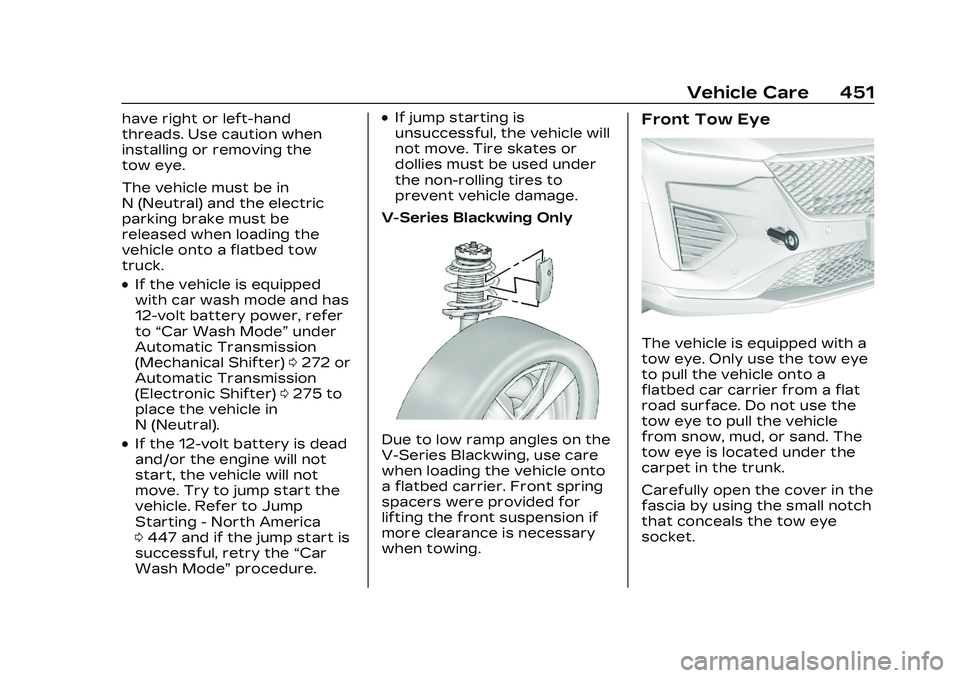
V-Series Blackwing Only
Due to low ramp angles on the
V-Series Blackwing, use care
when loading the vehicle onto
a flatbed carrier. Front spring
spacers were provided for
lifting the front suspension if
more clearance is necessary
when towing.
Front Tow Eye
The vehicle is equipped with a
tow eye. Only use the tow eye
to pull the vehicle onto a
flatbed car carrier from a flat
road surface. Do not use the
tow eye to pull the vehicle
from snow, mud, or sand. The
tow eye is located under the
carpet in the trunk.
Carefully open the cover in the
fascia by using the small notch
that conceals the tow eye
socket.
Page 453 of 524

Cadillac CT4 Owner Manual (GMNA-Localizing-U.S./Canada-16500442) -
2023 - CRC - 5/4/22
452 Vehicle Care
Install the tow eye into the
socket and turn it until it is
fully tightened. When the tow
eye is removed, reinstall the
cover with the notch in the
original position.
Rear Tow Eye
If equipped, carefully open the
cover by using the small notch
that conceals the rear tow eye
socket. Install the tow eye into
the socket and turn it until it is
fully tightened. When the tow
eye is removed, reinstall the
cover with the notch in the
original position.
Transporting a
Disabled Vehicle
(Mechanical Shifter)
Caution
Incorrectly transporting a
disabled vehicle may cause
damage to the vehicle. Use
proper tire straps to secure
the vehicle to the flatbed
tow truck. Do not strap or
hook to any frame,
underbody, or suspension
component not specified
below. Do not move vehicles
with drive axle tires on the
ground. Damage is not
covered by the vehicle
warranty.
Caution
The vehicle may be equipped
with an electric parking
brake and/or a mechanical
transmission range select
shifter. In the event of a loss(Continued)
Caution (Continued)
of 12-volt battery power, the
electric parking brake
cannot be released, and the
vehicle cannot be shifted to
N (Neutral). Tire skates or
dollies must be used under
the non-rolling tires to
prevent damage while
loading/unloading the
vehicle. Dragging the vehicle
will cause damage not
covered by the vehicle
warranty.
Caution
The vehicle may be equipped
with a tow eye. Improper use
of the tow eye may cause
damage to the vehicle and is
not covered by the vehicle
warranty. If equipped, use
the tow eye to load the
vehicle onto a flatbed tow
truck from a flat road
surface, or to move the(Continued)
Page 454 of 524

Cadillac CT4 Owner Manual (GMNA-Localizing-U.S./Canada-16500442) -
2023 - CRC - 5/4/22
Vehicle Care 453
Caution (Continued)
vehicle a very short distance
at a walking pace. The tow
eye is not designed for
off-road recovery. The
vehicle must be in
N (Neutral) with the electric
parking brake released when
using the tow eye.
Contact a professional towing
service if the disabled vehicle
must be transported. GM
recommends a flatbed tow
truck to transport a disabled
vehicle. Use ramps to help
reduce approach angles,
if necessary.
If equipped, a tow eye may be
located near the spare tire or
emergency jack. Do not use
the tow eye to pull the vehicle
from the snow, mud, sand,
or ditch. Tow eye threads may
have right or left-hand
threads. Use caution when
installing or removing the
tow eye. The vehicle must be in
N (Neutral) and the electric
parking brake must be
released when loading the
vehicle onto a flatbed tow
truck.
.If the 12-volt battery is dead
and/or electric parking brake
is not released, the vehicle
will not move. Try to jump
start the vehicle with a
known good 12-volt battery,
shift the car into N (Neutral),
and release the electric
parking brake. Refer to Jump
Starting - North America
0
447.
.If unsuccessful, the vehicle
will not move. Tire skates or
dollies must be used under
the non-rolling tires to
prevent vehicle damage.
Front Tow Eye
Caution
Improper use of the tow eye
can damage the vehicle.
If equipped, use the tow eye
to load a disabled vehicle
onto a flatbed tow truck
from a flat road surface,
or to move the vehicle a
short distance. Use caution
and low speeds. The
transmission must be
in (N) Neutral when moving
the vehicle.
Page 460 of 524

Cadillac CT4 Owner Manual (GMNA-Localizing-U.S./Canada-16500442) -
2023 - CRC - 5/4/22
Vehicle Care 459
extreme dusty conditions,
sand, salt, heat, sun, snow,
and ice.
Weatherstrips
Apply weatherstrip lubricant
on weatherstrips to make
them last longer, seal better,
and not stick or squeak.
Lubricate weatherstrips at
least once a year. Hot, dry
climates may require more
frequent application. Black
marks from rubber material on
painted surfaces can be
removed by rubbing with a
clean cloth. See
Recommended Fluids and
Lubricants0474.
Tires
Use a stiff brush with tire
cleaner to clean the tires.
Caution
Using petroleum-based tire
dressing products on the
vehicle may damage the
paint finish and/or tires.
(Continued)
Caution (Continued)
When applying a tire
dressing, always wipe off
any overspray from all
painted surfaces on the
vehicle.
Wheels and Wheel Trim
Use a soft, clean cloth with
mild soap and water to clean
the wheels. After rinsing
thoroughly with clean water,
dry with a soft, clean towel.
A wax may then be applied.
Caution
Chrome wheels and chrome
wheel trim may be damaged
if the vehicle is not washed
after driving on roads that
have been sprayed with
magnesium chloride or
calcium chloride. These are
used on roads for conditions
such as dust control. Always
wash the chrome with soap
and water after exposure.
Caution
To avoid surface damage on
wheels and wheel trim, do
not use strong soaps,
chemicals, abrasive polishes,
cleaners, or brushes. Use
only GM approved cleaners.
Do not drive the vehicle
through an automatic car
wash that uses silicon
carbide tire/wheel cleaning
brushes. Damage could
occur and the repairs would
not be covered by the
vehicle warranty.
Brake System
Visually inspect brake lines
and hoses for proper hook-up,
binding, leaks, cracks, chafing,
etc. Inspect disc brake pads
for wear and rotors for
surface condition. Inspect
brake linings/shoes for wear
or cracks. Inspect all other
brake parts.
Page 468 of 524

Cadillac CT4 Owner Manual (GMNA-Localizing-U.S./Canada-16500442) -
2023 - CRC - 5/4/22
Service and Maintenance 467
Service and
Maintenance
General Information
General Information . . . . . . 467
Maintenance Schedule
MaintenanceSchedule . . . . . . . . . . . . . . . . . . . 469
Multi-Point Vehicle
Inspection (MPVI)
Multi-Point VehicleInspection (MPVI) . . . . . . . . 472
Special Application
Services
Special ApplicationServices . . . . . . . . . . . . . . . . . . . . 473
Recommended Fluids,
Lubricants, and Parts
Recommended Fluids andLubricants . . . . . . . . . . . . . . . . . 474
Maintenance Replacement Parts . . . . . . 475
Maintenance Records
Maintenance Records . . . . 477
General
Information
Your vehicle is an important
investment. This section
describes the required
maintenance for the vehicle.
Follow this schedule to help
protect against major repair
expenses resulting from
neglect or inadequate
maintenance. It may also help
to maintain the value of the
vehicle if it is sold. It is the
responsibility of the owner to
have all required maintenance
performed.
Your dealer has trained
technicians who can perform
required maintenance using
genuine replacement parts.
They have up-to-date tools
and equipment for fast and
accurate diagnostics. Many
dealers have extended
evening and Saturday hours,
courtesy transportation, and
online scheduling to assist
with service needs. Your dealer recognizes the
importance of providing
competitively priced
maintenance and repair
services. With trained
technicians, the dealer is the
place for routine maintenance
such as oil changes and tire
rotations and additional
maintenance items like tires,
brakes, batteries, and wiper
blades.
Caution
Damage caused by improper
maintenance can lead to
costly repairs and may not
be covered by the vehicle
warranty. Maintenance
intervals, checks,
inspections, recommended
fluids, and lubricants are
important to keep the
vehicle in good working
condition.
Do not have chemical
flushes that are not
approved by GM performed
(Continued)
Page 473 of 524

Cadillac CT4 Owner Manual (GMNA-Localizing-U.S./Canada-16500442) -
2023 - CRC - 5/4/22
472 Service and Maintenance
pressure water can
overcome the seals and
contaminate the transfer
case fluid. Contaminated
fluid will decrease the life of
the transfer case and/or
axles and should be
replaced.
.Change front axle fluid,
if equipped with AWD. Do
not directly power wash the
transfer case and/or front/
rear axle output seals. High
pressure water can
overcome the seals and
contaminate the transfer
case fluid. Contaminated
fluid will decrease the life of
the transfer case and/or
axles and should be
replaced.
Every 120 000 km
(75,000 mi)
.Change rear axle fluid,
without limited slip
differential. Do not directly
power wash the transfer
case and/or front/rear axle
output seals. High pressure water can overcome the
seals and contaminate the
transfer case fluid.
Contaminated fluid will
decrease the life of the
transfer case and/or axles
and should be replaced.
Owner Checks and
Services
Every Five Years
.Replace brake fluid every
five years. See Brake Fluid
0
398.
Every Seven Years
.Replace Air Conditioning
Desiccant every seven years.
The air conditioning system
requires maintenance every
seven years. This service
requires replacement of the
desiccant to help the
longevity and efficient
operation of the air
conditioning system. This
service can be complex. See
your dealer.
Multi-Point Vehicle
Inspection (MPVI)
A Multi Point Vehicle
Inspection (MPVI) completed
by a GM dealer technician is a
maintenance assessment of
your vehicle. The benefit of
the MPVI is to identify and
inform the customer of service
items that require immediate
attention and those that may
require attention in the future.
The technician will perform the
following checks on your
vehicle. For a complete list of
checks, inspections, and
services, see your dealer.
Some items may not apply to
your vehicle and/or region.
Diagnostics
.OnStar active, if equipped
.Service history/recall check
Engine Oil and Filter
.Engine oil
.Oil life monitor
‐ Reset oil life monitor