oil CADILLAC CT4 2023 User Guide
[x] Cancel search | Manufacturer: CADILLAC, Model Year: 2023, Model line: CT4, Model: CADILLAC CT4 2023Pages: 524, PDF Size: 6.98 MB
Page 240 of 524

Cadillac CT4 Owner Manual (GMNA-Localizing-U.S./Canada-16500442) -
2023 - CRC - 5/10/22
Driving and Operating 239
Warning (Continued)
perform these procedures
properly could cause
malfunction, potentially
resulting in death, personal
injury, or damage to the
vehicle or property. Do not
attempt to perform these
adjustments or procedures
unless properly qualified.
{Warning
Prior to each track event
and again before returning
to public roads, tighten the
wheel nuts with a torque
wrench to the proper torque
specification. Wheel nuts
that are improperly or
incorrectly tightened can
cause the wheels to become
loose or come off, resulting
in a crash. See Capacities
and Specifications0480 for
wheel nut torque
specifications.
Caution
Low oil levels can damage
the engine. If using the
vehicle for competitive
driving, the engine may use
more oil than it would with
normal use. Check the oil
level often during
competitive driving.
Competitive Driving Mode can
be selected. See Driver Mode
Control 0292.
Seat Belts
Lap-Shoulder Belt
If equipped, the driver seat
belt has an Automatic Locking
Retractor (ALR). This feature
is useful in performance
driving scenarios where the
driver wants to be held in the
seat more tightly to take
advantage of the aggressive
bolstering of the seat.
1. Move the seat 8-10 cm (3-4 in) rearward from the
normal driving position. 2. Pull the driver shoulder
belt out as far as it will go,
until it stops, to set the
lock. While holding the
shoulder belt in this
position, buckle the belt.
When the shoulder belt is
released, the retractor will
make a ratchet sound
when it retracts. When the
retractor lock is set, the
belt can be tightened but
not pulled out of the
retractor.
3. Adjust the belt, and then move the seat forward
8-10 cm (3-4 in) to the
desired driving position.
This will secure the belt.
The belt fit should be tight,
but not uncomfortable.
To unlatch the belt, press
the button on the buckle.
The belt should return to
its stowed position.
Page 241 of 524

Cadillac CT4 Owner Manual (GMNA-Localizing-U.S./Canada-16500442) -
2023 - CRC - 5/10/22
240 Driving and Operating
Axle Fluid
Axles must have 2 400 km
(1,500 mi) before being used in
track driving.
The rear axle fluid
temperatures may be higher
than when driving in severe
conditions. Drain and refill with
new fluid after the first racing
or competitive driving event,
and then after every 24 hours
of racing or competitive
driving. See your dealer for
the correct fluid.
Caution
During a first time track or
racing event, high axle
temperatures can occur.
Damage could be caused to
the axle and would not be
covered by the vehicle
warranty. Do not drive as
long or as fast the first time
the vehicle is driven on the
track or raced.
.The axle lubricant should be
replaced with new lubricant.
.On vehicles without a
differential cooler, additional
cooling capacity is required
for continuous competitive
driving. The V-Series
Blackwing has a differential
cooler, so no additional
cooling capacity is
necessary.
Engine OilCaution
If the vehicle is used for
track events and
competitive driving, the
engine may use more oil
than it would with normal
use. Low oil levels can
damage the engine. Check
the oil level often and
maintain the proper level.
See Engine Oil 0378.
Check the oil level often during
track events and competitive
driving, and keep the oil level
at or near the upper mark. See
“Checking the Engine Oil" in
Engine Oil 0378.
Fuel
Use premium unleaded
gasoline with a posted octane
rating of 93 at a track event.
Unleaded gasoline with a
posted octane rating of
91 may be used, but
performance will be degraded.
See Prohibited Fuels 0355.
Automatic or Manual
Transmission Fluid
Have the transmission fluid
set to the track specific oil
level prior to track usage.
Transmission fluid should be
changed after every 15 hours
of track usage. Any
transmission level set or
change should be performed
at the dealer.
Brakes
Battery Disconnect
Disconnect the battery before
servicing the hydraulic brake
system. It is critical to
disconnect the battery before
bleeding the system, replacing
Page 243 of 524

Cadillac CT4 Owner Manual (GMNA-Localizing-U.S./Canada-16500442) -
2023 - CRC - 5/10/22
242 Driving and Operating
2. Front Brake Cooling Duct
Brake Pad Wear Sensors
If equipped, the brake pad
wear sensors need to be
removed from the brake
calipers prior to any track or
racing event. The original
sensors can be reinstalled if
significant brake pad wear is
not observed. Refer to Brake
Pad Life System (If Equipped)
0 396. If the sensors are not
reinstalled after the track
event, install brake pad wear
sensor plugs. See your dealer.
The V-Series Blackwing is
equipped with brake pad wear
sensors which are track
capable and should not be
disabled for track and racing.
A message will display in the
Driver Information Center
(DIC) when the brake pads
show excessive wear.
Brake Fluid
Replace existing brake fluid
with a qualified DOT 4 high
performance brake fluid from a sealed container. Brake fluid
with a dry boiling point >310 °C
(590 °F) is qualified. If high
performance brake fluid is
used, replace it with GM
approved brake fluid before
driving on public roads. If high
performance brake fluid is in
the vehicle and the age of the
brake fluid is over a month old
or unknown, replace the brake
fluid before track events and
competitive driving. Do not use
silicone or DOT 5 brake fluids.
Disconnect the battery before
bleeding the system, replacing
the pads, or any other work.
The battery must be
disconnected to prevent the
brake master cylinder from
pressurizing the hydraulic
system during its automated
self diagnostic tests that may
occur when a door is opened
or the remote key is present.
Check the fluid level before
each competitive driving
event.
Brake System Flushing &
Bleeding
The J55 brake system
requires specific processes
for bleeding and fluid flushing.
These can be found in the
service manual.
Properly bleeding the brake
system is required for proper
operation of the hydraulic
brake system.
Brake Leak Detection
The hydraulic braking system
has advanced diagnostic
capability to help detect
hydraulic leaks, trapped air,
and other performance issues.
These diagnostics are active
when the hydraulic system is
powered. In order to avoid
inadvertently setting a leak
Diagnostic Trouble Code
(DTC), disconnect the battery
before servicing the brake
system.
If the vehicle sets a DTC
related to a brake system leak,
the Brake System Warning
Page 244 of 524

Cadillac CT4 Owner Manual (GMNA-Localizing-U.S./Canada-16500442) -
2023 - CRC - 5/10/22
Driving and Operating 243
Light will come on and vehicle
speed may be limited to
100 kph (62 mph). Any time a
leak DTC is set, the vehicle
should be inspected carefully
for evidence of a leak and
should be repaired
immediately. See your dealer.
Brake Fade Warning Assist
The Brake Fade Warning
Assist system monitors the
performance of the brake
system. If the system detects
brake fade, or if the brake fluid
is near the boiling point, the
driver will be alerted.
The Brake Fade Warning
Assist system is designed for
use with the factory-installed
brake pads or GM approved
replacement pads. If the brake
pads on the vehicle need to be
replaced, use GM approved
brake pads. If this is not done,
the brake fade warning
system may not function
properly.Stage 1 :
The DIC displays a
“Reduce Braking to Avoid
Overheating” message, a
chime sounds and brake pedal
effort and travel is increased.
When the message displays,
the driver should back up
braking points and reduce
brake usage in order to reduce
brake temperature. This will
allow for continued lapping
with no speed limitations.
Stage 2 : The DIC displays a
Brakes Overheated Service
Now message, a chime
sounds, and brake pedal effort
and travel is further increased.
This code indicates that the
brake fluid temperature is
excessive and is about to boil.
The system limits vehicle
speed to 100 km/h (62 mph).
The driver should immediately
start a cool down lap if on the
track. If this message displays,
the vehicle needs to be
serviced. The brake system
needs to cool down, and
the brake fluid must be
immediately flushed with DOT 4 for street use, or to a
qualified DOT 4 race fluid for
track use. Boiled brake fluid is
compromised and must be
replaced.
Brake Burnishing
For vehicles equipped with
front Brembo brake systems:
Performance/racing brake
pads are required prior to
racing or closed track driving.
Vehicles with option code JE2
have performance brake pads.
This procedure should not be
performed on other models as
damage may result.
New brake pads must be
burnished before racing or
other competitive driving.
Caution
Performing the brake
burnish procedure on a base
brake system can result in
brake damage.
Page 261 of 524

Cadillac CT4 Owner Manual (GMNA-Localizing-U.S./Canada-16500442) -
2023 - CRC - 5/10/22
260 Driving and Operating
Caution (Continued)
.Check engine oil with
every refueling and add if
necessary. Oil and fuel
consumption may be
higher than normal during
the first
2 414 km (1,500 mi).
.To break in new tires,
drive at moderate speeds
and avoid hard cornering
for the first
322 km (200 mi). New tires
do not have maximum
traction and may tend
to slip.
.New brake linings also
need a break-in period.
Avoid making hard stops
during the first
322 km (200 mi). This is
recommended every time
brake linings are replaced.
.Should the vehicle be used
for racing or competitive
driving (after break-in), the
rear axle lubricant must be
replaced beforehand.See Track Events and
Competitive Driving (V-Series
and V-Series Blackwing)
0238.
On new vehicles, the various
mechanical and electrical
systems experience a
“break-in” period during the
first 6,400 km (4,000 miles) of
routine driving. As the vehicle
is driven, the mechanical
systems adjust to provide
optimal fuel economy and
transmission shift
performance.
Electrical systems will adapt
and calibrate during the
break-in period. A one-time
occurrence of clicks and
similar vehicle noises is normal
during this process.
Normal driving charges the
vehicle’s battery to achieve
the best operation of the
vehicle, including fuel
economy.
Composite Materials
This vehicle may be equipped
with parts containing carbon
fiber, sheet-molding
compound, or other composite
materials. Dealer-installed
accessories may also contain
composite materials.
{Warning
Exposed edges of parts
containing carbon fiber and
other composite materials
can be sharp. Contact with
these parts could result in
injury. Use caution to avoid
contacting these parts,
including when washing the
vehicle. If the parts are
damaged, replace the parts
promptly with replacements
from your dealer.
Page 262 of 524

Cadillac CT4 Owner Manual (GMNA-Localizing-U.S./Canada-16500442) -
2023 - CRC - 5/10/22
Driving and Operating 261
{Warning
Rocker extensions may
break under pressure,
resulting in property damage
or injury. Do not stand on
the rocker extension or use
it as a step.
{Warning
Rear end spoilers may break
under pressure, resulting in
property damage or injury.
Do not push the vehicle by
the spoiler or use the spoiler
as a handle.
Ignition Positions
The vehicle has an electronic
keyless ignition with
pushbutton start.
The Remote Key must be in
the vehicle for the system to
operate. If the pushbutton
start is not working, the
vehicle may be near a strong
radio antenna signal causing
interference to the Keyless
Access system. See Remote
Key Operation09.
To shift out of P (Park), the
vehicle must be on and the
brake pedal must be applied. Stopping the Engine/OFF (No
Indicator Lights) :
When the
vehicle is stopped, press
ENGINE START/STOP once to
turn the engine off.
If the vehicle is in P (Park), the
ignition will turn off, and
Retained Accessory
Power (RAP) will remain active.
See Retained Accessory
Power (RAP) 0267.
If the vehicle has an automatic
transmission, and is not in
P (Park), the ignition will return
to accessory mode and display
a message in the Driver
Information Center (DIC).
When the vehicle is shifted
into P (Park), the ignition
system will turn OFF.
If the vehicle has a manual
transmission and is stationary,
the ignition will turn off, and
Retained Accessory
Power (RAP) will remain active.
See Retained Accessory
Power (RAP) 0267.
Page 265 of 524

Cadillac CT4 Owner Manual (GMNA-Localizing-U.S./Canada-16500442) -
2023 - CRC - 5/10/22
264 Driving and Operating
If the remote key is not in
the vehicle, if there is
interference, or if the
remote key battery is low,
a Driver Information
Center (DIC) message will
display. See Remote Key
Operation09.
Caution
Cranking the engine for long
periods of time, by pressing
ENGINE START/STOP
immediately after cranking
has ended, can overheat and
damage the cranking motor,
and drain the battery. Wait
at least 15 seconds between
each try, to let the cranking
motor cool down.
2. If the engine does not start after five to 10 seconds,
especially in very cold
weather (below −18 °C or
0 °F), it could be flooded
with too much gasoline.
Try pushing the
accelerator pedal all the
way to the floor and hold it there, then press ENGINE
START/STOP for up to a
maximum of 15 seconds.
Wait at least 15 seconds
between each try, to allow
the cranking motor to cool
down. When the engine
starts, let go of the button
and the accelerator. If the
vehicle starts briefly but
then stops again, do the
same thing. This clears the
extra gasoline from the
engine. Do not race the
engine immediately after
starting it. Operate the
engine and transmission
gently until the oil warms
up and lubricates all
moving parts.
Stopping the Engine
If the vehicle has an automatic
transmission, move the shift
lever to P (Park) and press and
hold ENGINE START/STOP on
the instrument panel, until the
engine shuts off. If the shift
lever is not in P (Park), the
engine shuts off and the
ignition goes to accessory
mode. The DIC displays SHIFT
TO PARK. Once the shift lever
is moved to P (Park), the
vehicle turns off.
If the vehicle has a manual
transmission, before getting
out of the vehicle, shift to
1 (First) or R (Reverse) and
apply the parking brake. Then
turn off the ignition off by
pressing ENGINE START/
STOP and release the clutch
pedal when the engine has
stopped.
If the remote key is not
detected inside the vehicle
when it is turned off the DIC
displays a message.
Stop/Start System
If equipped, the Stop/Start
system will shut off the engine
to help conserve fuel. It has
components designed for the
increased number of starts.
Page 357 of 524
Cadillac CT4 Owner Manual (GMNA-Localizing-U.S./Canada-16500442) -
2023 - CRC - 5/10/22
356 Driving and Operating
Treatment Plus−Gasoline to
the vehicle’s gasoline fuel tank
at every oil change or
15 000 km (9,000 mi),
whichever occurs first. TOP
TIER Detergent Gasoline and
ACDelco Fuel System
Treatment Plus−Gasoline will
help keep your vehicle’s
engine fuel deposit free and
performing optimally.
Filling the Tank
An arrow on the fuel gauge
indicates which side of the
vehicle the fuel door is on. See
Fuel Gauge0113.
{Warning
Fuel vapors and fuel fires
burn violently and can cause
injury or death.
Follow these guidelines to
help avoid injuries to you
and others:
(Continued)
Warning (Continued)
.Read and follow all the
instructions on the fuel
pump island.
.Turn off the engine when
refueling.
.Keep sparks, flames, and
smoking materials away
from fuel.
.Do not leave the fuel
pump unattended.
.Avoid using electronic
devices while refueling.
.Do not re-enter the
vehicle while pumping fuel.
.Keep children away from
the fuel pump and never
let children pump fuel.
.Before touching the fill
nozzle, touch a metallic
object to discharge static
electricity from your body.
.Fuel can spray out if the
fill nozzle is inserted too
quickly. This spray can(Continued)
Warning (Continued)
happen if the tank is
nearly full, and is more
likely in hot weather. Insert
the fill nozzle slowly and
wait for any hiss noise to
stop before beginning to
flow fuel.
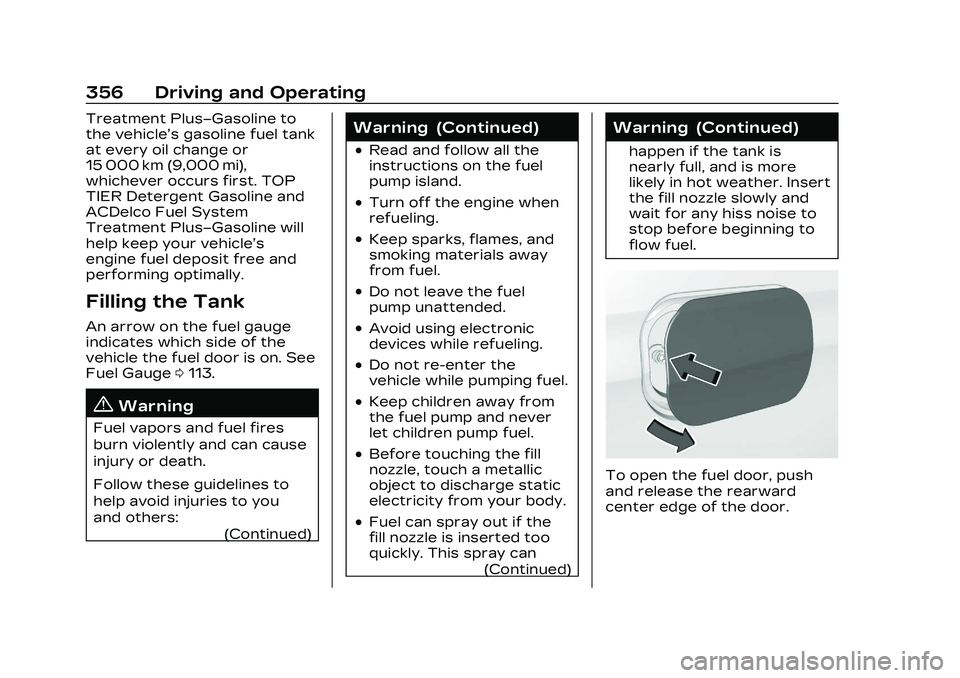
To open the fuel door, push
and release the rearward
center edge of the door.
Page 360 of 524

Cadillac CT4 Owner Manual (GMNA-Localizing-U.S./Canada-16500442) -
2023 - CRC - 5/10/22
Driving and Operating 359
Warning (Continued)
damaged, and the repairs
would not be covered by the
vehicle warranty. Pull a
trailer only if all the steps in
this section have been
followed. Ask your dealer for
advice and information
about towing a trailer with
the vehicle.
Driving with a Trailer
Trailering is different than just
driving the vehicle by itself.
Trailering means changes in
handling, acceleration, braking,
durability, and fuel economy.
Successful, safe trailering
takes correct equipment, and
it has to be used properly.
The following information has
many time-tested, important
trailering tips and safety rules.
Many of these are important
for your safety and that of
your passengers. Read this
section carefully before pulling
a trailer.When towing a trailer:
.Become familiar with, and
follow all state and local laws
that apply to trailer towing.
These requirements vary
from state to state.
.State laws may require the
use of extended side view
mirrors. If your visibility is
limited or restricted while
towing, install extended side
view mirrors on your vehicle,
even if not required.
.Do not tow a trailer during
the first 800 km (500 mi) of
vehicle use to prevent
damage to the engine, axle,
or other parts.
.Perform the first oil change
before heavy towing.
.Do not drive over 800 km/h
(50 mph) and do not make
starts at full throttle during
the first 800 km (500 mi) of
trailer towing.
.Tow in D (Drive). If the
transmission downshifts too
often, a lower gear may be
selected using Manual Mode.
See Manual Mode
(Electronic Shifter)
0281 or
Manual Mode (Mechanical
Shifter) 0280.
If equipped, the following
driver assistance features
should be turned off when
towing a trailer:
.Adaptive Cruise
Control (ACC)
.Super Cruise Control
.Park Assist
.Automatic Parking
Assist (APA)
.Reverse Automatic
Braking (RAB)
Page 362 of 524

Cadillac CT4 Owner Manual (GMNA-Localizing-U.S./Canada-16500442) -
2023 - CRC - 5/10/22
Driving and Operating 361
Towing with a Stability
Control System
When towing, the stability
control system might be
heard. The system reacts to
vehicle movement caused by
the trailer, which mainly occurs
during cornering. This is
normal when towing heavier
trailers.
Following Distance
Stay at least twice as far
behind the vehicle ahead as
you would when driving
without a trailer. This can help
to avoid heavy braking and
sudden turns.
Passing
More passing distance is
needed when towing a trailer.
The combination of the vehicle
and trailer will not accelerate
as quickly and is much longer
than the vehicle alone. It is
necessary to go much farther
beyond the passed vehiclebefore returning to the lane.
Pass on level roadways. Avoid
passing on hills if possible.
Backing Up
Hold the bottom of the
steering wheel with one hand.
To move the trailer to the left,
move that hand to the left. To
move the trailer to the right,
move that hand to the right.
Always back up slowly and,
if possible, have someone
guide you.
Making Turns
Caution
Turn more slowly and make
wider arcs when towing a
trailer to prevent damage to
your vehicle. Making very
sharp turns could cause the
trailer to contact the vehicle.
Make wider turns than normal
when towing, so trailer will not
go over soft shoulders, over
curbs, or strike road signs,
trees, or other objects. Always signal turns well in advance.
Do not steer or brake
suddenly.
Driving on Grades
Reduce speed and shift to a
lower gear before starting
down a long or steep downhill
grade. If the transmission is
not shifted down, the brakes
may overheat and result in
reduced braking efficiency.
Vehicles can tow in D (Drive).
Shift the transmission to a
lower gear if the transmission
shifts too often under heavy
loads and/or hilly conditions.
When towing at higher
altitudes, engine coolant will
boil at a lower temperature
than at lower altitudes. If the
engine is turned off
immediately after towing at
high altitude on steep uphill
grades, the vehicle could show
signs similar to engine
overheating. To avoid this, let
the engine run, preferably on
level ground, with the